Threat Hunting vs SOC Monitoring in India: What’s the Difference?
Key Takeaways:
- Monitoring is alert-driven. It reacts, around the clock, to what your rules and tools flag.
- Hunting is hypothesis-driven. An analyst assumes an attacker already got past those rules and searches for the evidence.
- Both run on largely the same data and tools. What changes is the question asked of that data.
- The Indian Computer Emergency Response Team (CERT-In) requires certain types of cyber incidents to be reported within 6 hours of noticing them, so your deadline depends on how fast your team confirms that an alert is a real, reportable incident.
- For most Indian businesses, the order is monitoring first, hunting second, and the hunts feed new rules back to the SOC.
Imagine your Security Operations Centre (SOC) dashboard shows zero open alerts this morning. Every alert from last night was triaged, closed, and logged. That’s a good morning, and it still can’t tell you whether someone is already inside your network using a real employee’s login, because nothing they did tripped a rule. Finding that person is the job of threat hunting.
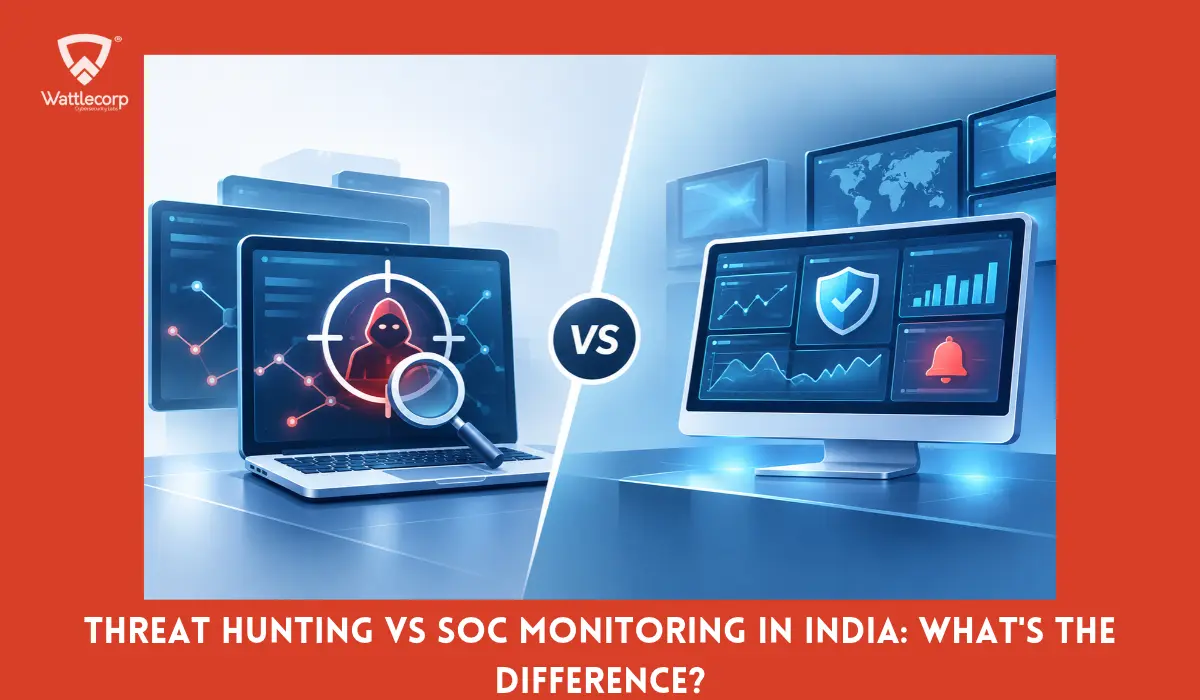
SOC monitoring watches for what your detection rules already know to look for. Hunting goes looking for what they don’t.
If you run security, risk, or IT for an Indian business, especially in BFSI (banking, financial services, and insurance) or fintech, this piece explains how the two differ, where each falls short, and how to decide whether managed threat hunting belongs alongside your monitoring now or after it.
What SOC Monitoring Actually Does All Day
SOC monitoring is the continuous watch over your logs and security tools, where analysts triage alerts as they fire and escalate the real ones. A SOC pulls events from firewalls, servers, endpoints, cloud accounts, and identity systems into a Security Information and Event Management (SIEM) platform, basically a search engine and rule engine for your logs. Rules and correlation logic turn those events into alerts. Analysts work the queue.
Most SOCs split that work into tiers. Level 1 analysts triage, closing false positives and escalating anything that looks real. Level 2 investigates the escalations. Level 3 handles the hardest cases and, in some teams, the hunting.
The strength of monitoring is coverage and speed on known patterns, such as a brute-force login burst, malware your endpoint tool recognises, or a connection to a known-bad IP address. Monitoring catches these well, at 3 a.m. on a Sunday, without anyone having to think of them first. That’s the job a real-time SOC as a service is built to do.
The limit is built in. Monitoring can only alert on what its detection logic is set up to catch, whether that’s your own rules or your tools’ built-in analytics. Take an attacker who logs in with valid credentials, uses tools already installed on your servers, and moves slowly. Every step can look normal to your rules and analytics. Nothing fires, so nothing reaches the queue.
Also read : SOC as a Service in India: How It Works, Pricing, and Why Businesses Need It
What Threat Hunting Does That Monitoring Can’t
Hunting is a proactive search, led by an analyst, for attacker activity that your existing detections missed. It starts from an uncomfortable assumption, that someone may already be in. The hunter then goes through the same telemetry the SOC collects and asks a specific question of it, instead of waiting for an alert.
That’s the honest answer to “why pay for both?” Monitoring tells you what your rules saw. A hunt tells you whether your rules are blind somewhere, which is a different kind of evidence.
A good hunt ends in one of three places: It finds an intrusion, which becomes an incident; it finds nothing, which is a real result if the hunt was well scoped; or it finds a gap, such as a log source nobody was collecting, and that gap gets fixed.
Threat Hunting Techniques Analysts Actually Use
Most threat hunting techniques fall into three families, and a mature team rotates between them.
- Hypothesis-driven hunting. The analyst picks an attacker behaviour, often from MITRE ATT&CK, an open knowledge base of adversary tactics and techniques based on real-world observations, and tests whether it’s happening. Example: “Someone is using valid accounts (ATT&CK technique T1078) to log in from hosts that account never touches.”
- Intelligence-driven hunting. A threat report names indicators or behaviours used against your sector, and the hunter checks your history for them.
- Baseline and anomaly hunting. The analyst profiles what normal looks like, then stacks rare values. A scheduled task (T1053) that exists on exactly one server out of four hundred deserves a look.
Behaviour-based hunts age better than indicator lists, the idea behind David Bianco’s Pyramid of Pain. Attackers change a file hash or an IP address in seconds, but changing how they move between systems with remote services (T1021) costs them real effort.
Threat Hunting vs SOC Monitoring, Side by Side
The clearest way to separate them is to look at what starts the work and what the work produces.
| Items | SOC monitoring | Hunting |
|---|---|---|
| What starts it | An alert from a rule or tool | A hypothesis, a threat report, or an anomaly |
| Question it answers | “Is this alert real?” | “Is an attacker here that we can’t see?” |
| Cadence | Continuous, 24/7 | Planned cycles or targeted hunts |
| Main output | Triaged and escalated incidents | Findings, closed visibility gaps, new detection rules |
| Strongest against | Known malware, known indicators, noisy attacks | Valid-account abuse, built-in tool abuse, slow attacks |
| Depends on | Rule quality and tuning | Log depth, retention, and analyst skill |
How we assess this: The table is Wattlecorp’s own summary of how the two disciplines work in practice, not a split that any standard defines. The attacker behaviours in it map to techniques in MITRE ATT&CK, such as Valid Accounts (T1078), and the placement of detection inside incident response follows the National Institute of Standards and Technology’s NIST SP 800-61 Rev. 3.
Notice the last row. Hunting is only as good as the data underneath it, and if your SOC keeps a few days of logs from half your servers, a hunter has very little to hunt through. Log coverage and retention are worth sorting out with whoever runs your managed security services before any hunting starts.
Also read : MSSP vs In-House Security in India: What Makes Sense for Companies After the 2026 Conflict
Threat Hunting Tools: Mostly the Same Data, a Different Question
Buyers sometimes expect hunting tools to be a separate stack. Mostly they aren’t. Hunters work inside the platforms the SOC already runs, they just use them differently.
- SIEM and log platforms such as Microsoft Sentinel, Splunk, and Elastic Security, where hunters write their own queries instead of reading alerts.
- Endpoint telemetry from Endpoint Detection and Response (EDR) agents, or from Microsoft’s free Sysmon tool, which records process and network activity on Windows hosts.
- Open-source tools like osquery and Velociraptor for querying endpoints at scale, and Zeek for network traffic logs.
- Shared detection formats like Sigma for log-based rules and YARA for file patterns, so a successful hunt becomes a rule the SOC can run every day.
That last point ties the two disciplines together. A hunt should leave behind a new or improved detection rule wherever one is feasible. That way the finding becomes something monitoring catches automatically next time.
Why the CERT-In 6-Hour Rule Changes the Math for Indian Businesses
Under CERT-In’s directions of 28 April 2022, issued under section 70B(6) of the Information Technology Act, 2000, certain types of cyber incidents have to be reported within 6 hours of noticing them or being told about them. CERT-In is India’s national computer emergency response team. The directions apply to service providers, intermediaries, data centres, body corporates (including registered private and public companies), and government organisations.
The clock starts once you’ve noticed the incident. From there, making the deadline depends on how quickly your team can confirm the alert is a real incident of a reportable type. A SOC buried in false positives spends that time sorting noise, which is one reason detection tuning matters, and the baselines hunts build can inform it.
Late detection hurts in a different way. The window doesn’t shrink, but every day a blind spot goes unnoticed is another day an attacker spends inside your systems before anyone starts the clock.
If a hunt turns up an older intrusion, the same 6-hour window applies. The clock starts from the moment the hunt brings it to your notice, so agree with your compliance team before the hunt starts who files the report if one is found.
For help mapping the 6-hour rule to your own setup, start with Wattlecorp’s CERT-In compliance consulting. If you’re regulated by the Reserve Bank of India (RBI), its cybersecurity requirements apply alongside CERT-In’s, and RBI cybersecurity consulting is where to map those.
Also read : AI-Powered Cyberattacks in India 2026: What CISOs Need to Know Now
How an Indian Business Should Decide Between Threat Hunting and SOC Monitoring
For most Indian businesses, the real decision is the order you add them in. Hunting depends on good telemetry and a working triage process, which is what monitoring builds. Without them, a hunter spends the engagement asking for logs.
A rough way to decide where you stand:
- No 24/7 monitoring yet. Start there. A managed or outsourced SOC gives you the alert coverage and log collection everything else depends on.
- Monitoring is running, but you’ve never tested what it misses. This is the point where hunting earns its cost. Periodic hunts check the blind spots and feed rules back.
- You’re a bank, non-banking financial company (NBFC), payments company, or fintech handling customer money. Rules struggle most with valid-account abuse and with slow, quiet movement, and anyone after customer money has every reason to stay quiet. Monitoring with hunting layered on suits this profile best. Our guide to SOC as a service for Indian BFSI and fintech firms covers the monitoring side.
One more check before you buy hunting from anyone. Ask how much log history you keep, because a hunt can’t search data you’ve already deleted.
If what you actually suspect is a specific past breach, that’s closer to a compromise assessment. This requires a separate engagement focused on finding signs of past or ongoing compromise.
Delivery model matters too. Wattlecorp runs SOC setups both on-site and off-site, with a dedicated team monitoring client systems 24/7, so the monitoring layer can run from your premises or remotely.
For teams aligning their programme to the NIST Cybersecurity Framework (CSF) 2.0, monitoring and hunting both support its Detect function.
Start With Clean Monitoring, Then Hunt
Alerts flowing into a queue prove your rules fire. They say nothing about what the rules miss, and that untested space is where a patient attacker sits while the dashboard stays green. Finding them sooner cuts how long they stay inside.
Wattlecorp offers both layers in India, SOC as a service and managed hunting. If your monitoring is in place and you want to know what it can’t see, talk to Wattlecorp about managed threat hunting in India.
Threat Hunting FAQs
1. What are threat hunting tools?
They’re the platforms analysts use to search security data for hidden attacker activity, including SIEM and log platforms, endpoint telemetry from EDR or Sysmon, and open-source tools such as osquery, Velociraptor, and Zeek. Most are the same tools a SOC already runs, queried by a hunter instead of read as alerts.
2. What is the difference between a cyber security analyst and a SOC analyst?
“Cybersecurity analyst” is a broad title that can cover risk, vulnerability management, compliance, or architecture work. A SOC analyst is a specific role inside a Security Operations Centre, monitoring and triaging alerts, usually in shifts and in tiers. Exact titles vary between employers.
3. What is the next career step after working as a SOC analyst?
Common next steps are moving up to a Level 2 or Level 3 analyst role, then into incident response, hunting, detection engineering, or threat intelligence. Some analysts move into SOC lead or manager roles instead of going deeper technically.

 Threat Hunting vs SOC Monitoring in India: What’s the Difference?
Key Takeaways: Monitoring is alert-driven. It reacts, around the clock, to what your rules and tools flag. Hunting is hypothesis-driven. An analyst assumes an attacker already got past those rules and searches for the evidence. Both run on largely the same data and tools. What changes is the question asked of that data. The Indian […]
 Security Architecture Review vs VAPT in Saudi Arabia: Which Security Assessment Does Your Business Need?
Key Takeaways: A security architecture review assesses security design; VAPT evaluates, validates, and prioritises weaknesses in implemented systems. Both support risk decisions, but neither replaces the other. Review new designs early and test implementations before launch. Match assessment scope to business exposure and applicable Saudi requirements. Request actionable findings, remediation ownership, and appropriate verification. One […]
 Top 10 Benefits of Penetration Testing for SaaS & Enterprises in India
Key Takeaways: Finds flaws scanners miss: manual testing catches what automated tools don’t recognise. Proves real impact: shows what an attacker could actually reach, not just a list of possible issues. Exposes misconfigurations: finds exposed interfaces and version leaks across networks and cloud. Secures APIs and integrations: tests the connections that carry your customers’ data. […]
 Compromise Assessment vs Incident Response in the UAE: What’s the Difference and When Do You Need Each?
Key Takeaways: A compromise assessment is a proactive check for signs that an attacker is already in your environment. Incident response is the reactive work of handling a known or suspected incident. The trigger is the clearest dividing line: no known incident means an assessment, an active incident means response. The two feed each other. […]
 ISO 27001 Internal Audit vs Gap Assessment in Saudi Arabia: What’s the Difference?
Key Takeaways: A standalone gap assessment is optional; internal audits are required. Gap assessments can review new or existing systems. Internal audits require competent auditors and an objective, impartial process. Annex A controls should reflect your risks and obligations. Internal audits need to be scheduled early enough to address nonconformities and review corrective action effectiveness […]
 Best vCISO Services in the UAE for Large Enterprises
Key Takeaways: Wattlecorp: A governance-first vCISO with UAE regulatory alignment, listed first because this is our blog. CPX: On-demand executive cyber leadership with an Abu Dhabi address and board-ready direction. Crowe UAE: A vCISO service, pitched as an extension of your internal team. Intello: A vCISO covering strategy, risk governance, and board reporting, from Dubai. […]