Security Architecture Review vs VAPT in Saudi Arabia: Which Security Assessment Does Your Business Need?
Key Takeaways:
- A security architecture review assesses security design; VAPT evaluates, validates, and prioritises weaknesses in implemented systems.
- Both support risk decisions, but neither replaces the other.
- Review new designs early and test implementations before launch.
- Match assessment scope to business exposure and applicable Saudi requirements.
- Request actionable findings, remediation ownership, and appropriate verification.
One Checks the Design, the Other Attacks the Build
A launch deadline approaches, an enterprise customer requests security evidence, and your team must choose an assessment. Buying the wrong service can leave the underlying risk unresolved.
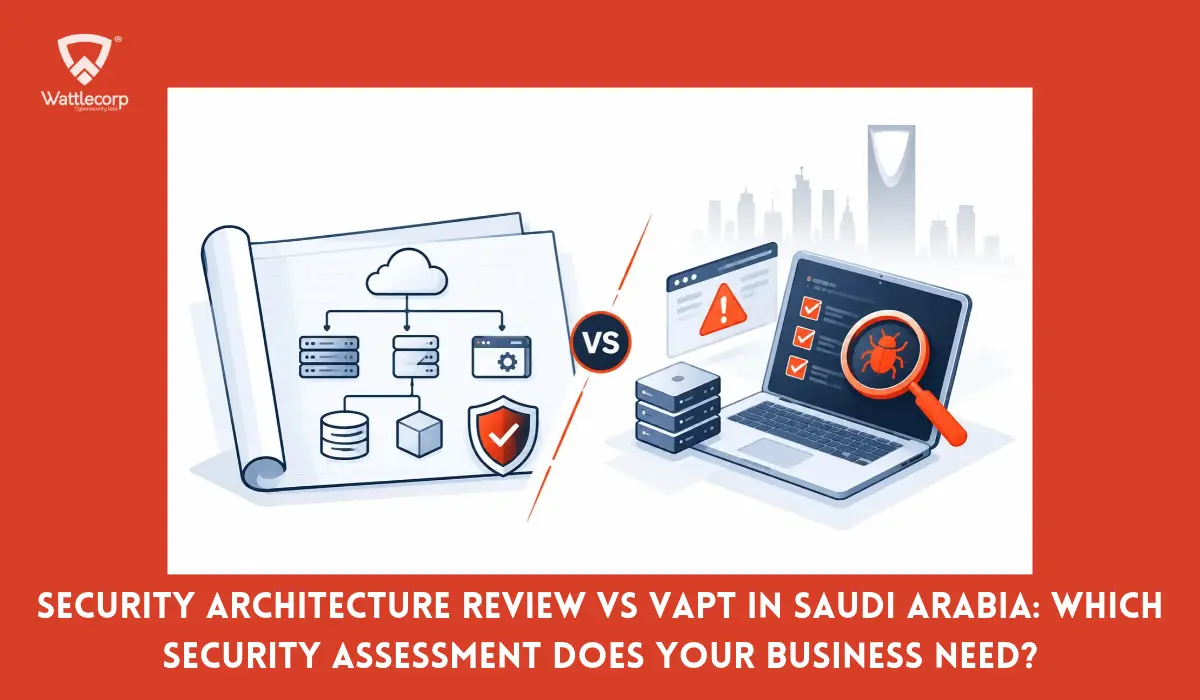
The security architecture review vs VAPT decision starts with your question: “Is our design defensible?” or “Can someone exploit what we have implemented?”
An architecture review examines how protection is designed before or during development. Vulnerability assessment and penetration testing (VAPT) evaluates running systems through discovery and controlled attack simulation. The assessments answer different questions while serving complementary purposes. Choose one that addresses your immediate risk question and use both when design assurance and implementation testing are needed.
What a Security Architecture Review Covers
A review examines network zones, identity, data flows, cloud services, API design, and third-party connections. Reviewers challenge trust assumptions: which components can communicate, who can access sensitive information, and where privileges cross boundaries.
The work relies on diagrams, configuration documentation, threat modelling, and interviews with architects and service owners. A security architecture review primarily examines design and supporting evidence. Live exploitation generally exists outside its scope unless it is explicitly agreed as part of a combined assessment.
Typical findings include excessive trust between environments (treating communication as inherently safe without strict verification), missing isolation (no logical or physical separation between different workloads), inappropriate identity models (poorly designed authentication and authorization architectures), and insecure integration patterns, such as excessive third-party permissions, weak service-to-service authentication, or inadequate protection of exchanged data.
Deliverables should explain design gaps, rank business risk, and recommend changes. Catching issues like these before deployment helps reduce those expensive repairs and operational downtime.
The Saudi Central Bank (SAMA) Cyber Security Framework provides a regulatory reference for defining and reviewing security architecture. This applies well to the Saudi financial organisations.
To gain a better understanding on all these, especially from a sectoral perspective, explore our security architecture review for Saudi FinTech platforms.
What VAPT Covers For Saudi Businesses
Vulnerability assessment identifies weaknesses such as outdated software and insecure configurations. Penetration testing investigates whether weaknesses can be exploited and what access or impact is achievable.
Testing targets authorized production or staging systems under agreed scope and rules of engagement. Assessment targets can include applications, APIs, mobile backends, network services, and cloud assets. The rules of engagement define authorized testers, access arrangements, permitted techniques, and testing restrictions.
Also Read : How Physical Penetration Testing Strengthens VAPT in KSA
Reports should distinguish confirmed vulnerabilities, demonstrated exploitation, and unverified observations. These will help engineers prioritize remediation by using business impact, exposure, exploitability, and existing controls. Moving beyond raw technical data to deliver actionable business intelligence, businesses can clearly get to see affected assets, reproduction steps, severity reasoning, and clear remediation guidance. Retesting, when included, records whether reported weaknesses were resolved.
A clean report applies to the agreed scope and assessment conditions. It does not establish that every design decision is secure.
The National Cybersecurity Authority (NCA) Essential Cybersecurity Controls offers a regulatory reference for vulnerability management and penetration testing for Saudi organisations that come within its scope.
Security Architecture Review vs VAPT: A Side-by-Side Comparison
| Comparison | Security architecture review | VAPT |
| Question answered | Does the design address relevant threats? | What weaknesses exist, and which are exploitable? |
| Timing | Planning, design, major changes, periodic review | Testable implementation, before launch, during operations |
| Effort drivers | Design complexity, integrations, documentation quality | Assets, roles, workflows, access, testing depth |
| Typical findings | Weak trust boundaries, excessive privileges, missing isolation | Missing patches, injection, broken access controls |
| Deliverable | Prioritised design risks and recommended changes | Technical findings, evidence, remediation and agreed retesting |
Consider a proposed connection that lets a supplier reach a sensitive processing zone. A design review can challenge this trust boundary before the connection exists.
Conversely, testing can identify an exploitable missing patch on the deployed gateway that diagrams cannot reveal. These illustrate different strengths; penetration testing can also expose architectural weaknesses, while reviews can identify implementation concerns when supporting evidence is available.
Security Architecture Review vs VAPT: What Comes First, and When Do You Need Both?
For a new system or major change, review architecture first. Address structural weaknesses, then perform VAPT against the implementation before go-live. Allow time to remediate and retest relevant findings.
For an existing system without reliable design records, VAPT can provide an initial view of exposed weaknesses. Use the results alongside discovery workshops to reconstruct architecture and investigate underlying causes. Urgent exposure should not wait for perfect documentation.
Also Read : Cloud-Native Security: Why Saudi Arabia’s AWS, Azure, and GCP Apps Need VAPT
Where both design assurance and testing evidence are expected, maintain connected records: the design decision, implementation, finding, remediation owner, and verification outcome. Efforts on this route help management understand whether fixes address isolated symptoms or recurring weaknesses.
How Security Architecture Review vs VAPT Fits Within NCA and SAMA Expectations in Saudi Arabia
The NCA Essential Cybersecurity Controls address cybersecurity across areas including projects, access management, networks, vulnerability management, and penetration testing. Confirm whether your organisation falls within their scope.
The SAMA Cyber Security Framework addresses security architecture and technical security testing for applicable member organisations.
An architecture review can contribute evidence about design principles and control placement. VAPT supplies evidence about assessed implementation weaknesses and remediation. Neither report alone demonstrates complete compliance.
In essence, understanding security architecture review vs VAPT helps you decide which assessment approach addresses your specific security risks and whether combining both is necessary.
Use our guides to NCA compliance in Saudi Arabia and the SAMA cybersecurity framework for context. Confirm applicable requirements with your compliance team.
How to Choose and Scope Your Assessment
Before commissioning work, ask:
- What changed: architecture, infrastructure, identity, or application functionality?
- Which regulatory, contractual, and customer requirements apply?
- Which services are customer-facing or process sensitive information?
- Are current diagrams, test accounts, and technical owners available?
Define systems, integrations, environments, exclusions, access arrangements, deliverables, and verification responsibilities. In case of VAPT, agree testing windows, escalation contacts, and permitted techniques.
Avoid ordering VAPT and expecting it to redesign an unsuitable trust model. Equally, reviewing diagrams without testing deployment leaves implementation weaknesses unexamined.
Choose the Assessment That Answers Your Risk Question
At Wattlecorp, we help connect assessment findings with practical remediation priorities. Discuss your assessment needs so we can scope testing around your systems, exposure, and business objectives. Meanwhile, go through our network security architecture review services in Saudi Arabia to know how we conduct the process.
Security Architecture Review vs. VAPT FAQs
1. What is a security architecture review?
2. What is VAPT and what does it test?
3. What is the difference between a security architecture review and VAPT?
4. How long does security architecture review vs. VAPT take and what does it produce?

 Security Architecture Review vs VAPT in Saudi Arabia: Which Security Assessment Does Your Business Need?
Key Takeaways: A security architecture review assesses security design; VAPT evaluates, validates, and prioritises weaknesses in implemented systems. Both support risk decisions, but neither replaces the other. Review new designs early and test implementations before launch. Match assessment scope to business exposure and applicable Saudi requirements. Request actionable findings, remediation ownership, and appropriate verification. One […]
 Top 10 Benefits of Penetration Testing for SaaS & Enterprises in India
Key Takeaways: Finds flaws scanners miss: manual testing catches what automated tools don’t recognise. Proves real impact: shows what an attacker could actually reach, not just a list of possible issues. Exposes misconfigurations: finds exposed interfaces and version leaks across networks and cloud. Secures APIs and integrations: tests the connections that carry your customers’ data. […]
 Compromise Assessment vs Incident Response in the UAE: What’s the Difference and When Do You Need Each?
Key Takeaways: A compromise assessment is a proactive check for signs that an attacker is already in your environment. Incident response is the reactive work of handling a known or suspected incident. The trigger is the clearest dividing line: no known incident means an assessment, an active incident means response. The two feed each other. […]
 ISO 27001 Internal Audit vs Gap Assessment in Saudi Arabia: What’s the Difference?
Key Takeaways: A standalone gap assessment is optional; internal audits are required. Gap assessments can review new or existing systems. Internal audits require competent auditors and an objective, impartial process. Annex A controls should reflect your risks and obligations. Internal audits need to be scheduled early enough to address nonconformities and review corrective action effectiveness […]
 Best vCISO Services in the UAE for Large Enterprises
Key Takeaways: Wattlecorp: A governance-first vCISO with UAE regulatory alignment, listed first because this is our blog. CPX: On-demand executive cyber leadership with an Abu Dhabi address and board-ready direction. Crowe UAE: A vCISO service, pitched as an extension of your internal team. Intello: A vCISO covering strategy, risk governance, and board reporting, from Dubai. […]
 Managed Vulnerability Scanning for Indian SaaS Companies: Continuous Security for CERT-In Compliance
Key Takeaways: Recurring vulnerability scanning helps identify weaknesses that new deployments, infrastructure changes, and emerging vulnerabilities introduce. Risk-based prioritisation helps engineering teams focus on exposures with the greatest potential business impact. Remediation tracking and retesting provide evidence that identified vulnerabilities have been appropriately addressed. Recurring vulnerability scanning supports security readiness when combined with timely remediation, […]