


Security Architecture Review for Saudi FinTech Platforms: Identity, API and Cloud Controls
Key Takeaways:
- Security architecture review determines that whether security enables or blocks your FinTech growth in Saudi Arabia. It focuses on the differences between confidently saying yes to new partners versus constantly hitting the security roadblocks.
- Your security tools only work if they’re connected. Identity systems, API gateways, and cloud controls need to feed into your security monitoring team. Otherwise, you have strong controls nobody’s actually watching.
- Traditional VAPT finds individual vulnerabilities; architecture review finds why you keep getting the same types of vulnerabilities. One treats symptoms, the other treats root causes.
- When the regulators or banking partners ask if your platform is secure, you need to be documented the evidence, which showing how your architecture aligns with SAMA and NCA expectations. That is the real defensibility.
- Continuous architecture review can reduce security friction by helping teams identify design risks earlier, support smoother audits, improve partner confidence, and reduce security surprises during product launches.
Digital lending, payment platforms, and digital wallets are completely changing how people access financial services. Rapid growth is creating security blind spots that traditional vulnerability testing may not fully explain or validate at the architectural level.
This is where a structured security architecture review becomes critical. If you’re a FinTech leader, you need to prove that your platform can scale without becoming more vulnerable.
The problem is that most executives don’t realize that a security architecture review isn’t just another compliance checkbox, it is the foundation, which determines whether you can grow confidently or whether security becomes your biggest constraint.
This guide walks you through why your identity systems, APIs, and cloud infrastructure need an architectural-level checkup, not just point-in-time vulnerability scans.
Why Security Architecture Review Matters for Saudi FinTech Companies
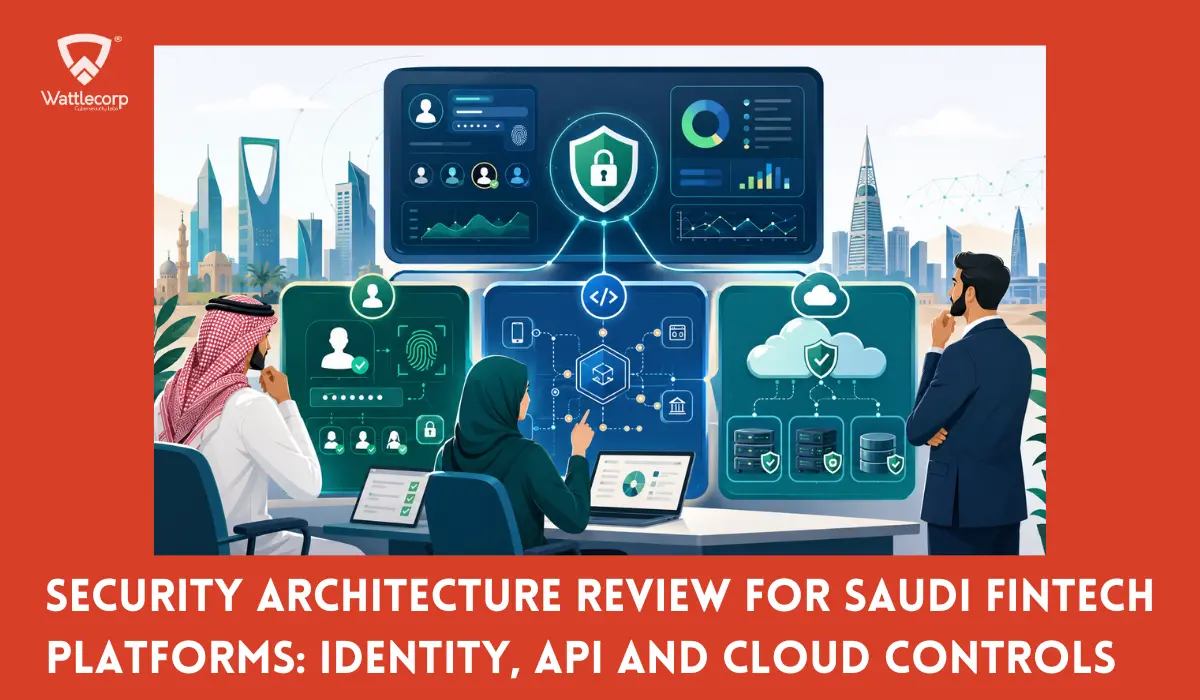
A security architecture review for FinTech platforms goes deeper and it examines the actual design decisions you made around identity management, API access controls, and cloud governance. It explains whether security is helping you move faster or whether it’s becoming a bottleneck to growth.
VAPT services in Saudi Arabia primarily identify exploitable vulnerabilities, while a security architecture review goes deeper by examining the design patterns and control weaknesses that allow similar vulnerabilities to recur. Security architecture review is different because it looks at the root causes behind recurring vulnerabilities, not just the individual findings.
It checks whether your identity models, API security designs, and cloud setups support scaling securely. The architectural weaknesses stay hidden until you do a proper review that looks at how all your controls work together, not in isolation.
Understanding Identity Architecture in Security Architecture Review
Identity represents the primary gateway to FinTech platforms. A comprehensive security architecture review evaluates multiple authentication layers simultaneously.
Saudi FinTech platforms typically manage the customer data and identities, employee identities, partner identities, and service account identities through different systems and without proper architecture-level review, these systems operate in silos.
One identity system might enforce multi-factor authentication while another relies on passwords alone. Some API tokens may have strict expiration policies, while others may persist indefinitely without rotation or revocation controls.
A security architecture review for FinTech platforms ensure adherence to best practices, which examines role-based access control (RBAC) design with privilege boundary enforcement, and session management consistency.
It evaluates whether identity logs feed into security monitoring systems where the SOC can detect suspicious access patterns. When identity architecture lacks integration with detection capabilities, suspicious access activity may remain undetected longer, increasing the risk of account takeover, privilege abuse, and delayed incident response.
API Security Architecture as a Business-Critical Control Layer
APIs function as the transaction nervous system of modern FinTech platforms. Customers interact through mobile application APIs. Banking partners connect through integration APIs. Internal systems communicate through microservice APIs.
A security architecture review analyses whether authentication, authorization, rate limiting, and data validation work together across this distributed API landscape. The challenge intensifies with open banking requirements and third-party integrations common in Saudi FinTech.
- How does the platform distinguish between authorized and unauthorized API access?
- Can one API user view another user’s financial data?
- How are sensitive fields filtered from API responses?
- Do APIs validate that users can only access resources they own?
Also Read : SAMA Open Banking Security: API Security Requirements for Saudi FinTech in 2026
These are the questions form the basis of a strong security architecture review for FinTech platforms services evaluation. Many API-related data exposure incidents result from broken object-level authorization, where APIs allow users to access resources belonging to other users by manipulating request parameters.
This vulnerability is rarely identified through ad hoc testing alone. It requires structured API authorization testing, endpoint mapping, role-based access validation, and review of object ownership enforcement.
Cloud Controls Within Security Architecture Review Framework
Cloud adoption helps accelerate FinTech platform development but also introduces complexity around shared responsibility. Under the cloud shared responsibility model, the provider secures the underlying cloud infrastructure, while the FinTech organization remains responsible for secure configuration, IAM, application security, workload protection, logging, encryption settings, and data governance based on the cloud service model used.
A strong security architecture review for FinTech platforms risk assessment examines this boundary to identifying the gaps.
Also Read : Cloud-Native Security: Why Saudi Arabia’s AWS, Azure, and GCP Apps Need VAPT
What network segmentation exists between customer data, partner data, and operational systems? Are encryption keys managed according to compliance standards? Does backup strategy enable recovery without exposing sensitive data? Are cloud database credentials rotated regularly? Can database activity be audited and monitored? These questions reveal whether cloud architecture aligns with SAMA and NCA expectations.
Saudi FinTech platforms increasingly operate across multiple cloud providers, edge computing resources, and hybrid infrastructure. Without architectural clarity, cloud misconfiguration becomes inevitable. Security architecture review for FinTech platforms conducted at the cloud layer reveals visibility gaps, encryption gaps, and access control gaps that weaken the entire platform.
Alignment with Saudi Regulatory Framework
The SAMA Cyber Security Framework and applicable NCA controls establish cybersecurity expectations for regulated financial organizations operating in Saudi Arabia.
SAMA’s Cyber Security Framework expects regulated financial organizations to demonstrate effective cybersecurity governance, risk management, identity and access controls, monitoring, encryption, technology controls, and third-party cybersecurity management.
NCA Cloud Cybersecurity Controls address both cloud service provider and cloud service tenant responsibilities. A security architecture review creates defensible evidence, which architectural decisions align with regulatory intent.
Instead of responding to regulatory inquiries with generic security assertions, Saudi FinTech leaders can benefit from the reference specific architectural reviews that map controls to regulatory expectations. This evidence can support licensing discussions, reduce audit friction, and demonstrate stronger security maturity to regulators, banking partners, and enterprise customers.
The regulatory advantage compounds when organizations treat security architecture review for FinTech platforms company efforts as continuous improvement cycles rather than one-time initiatives. Quarterly architecture validation sessions ensure that emerging regulations, new business capabilities, and changed threat landscapes receive ongoing attention.
A complete security architecture review for FinTech platforms security controls assessment includes detection architecture evaluation.
Implementation Roadmap for Security Architecture Review
Organizations beginning their security architecture review journey benefit from structured phases. Mapping the current state architecture, assessing the control gaps against the required standards such as SAMA, NCA, and other internal standards, validating the actual attack paths, then map findings to regulatory expectations are the major phases.
And establishing remediation and integrating architecture review outcomes into continuous validation cycles including application testing, cloud reviews, SOC monitoring, and incident response.
This phased approach transforms security architecture review for FinTech platforms from overwhelming the comprehensive exercise into manageable, business-focused improvement program. Each phase delivers a specific value, and it creates momentum toward complete architectural maturity.
Strengthen Saudi FinTech Security with NCA-Aligned Architecture Review
Rapid FinTech growth in Saudi Arabia creates urgency around security maturity, however, the quick fixes and surface-level assessments leave fundamental risks might unaddressed. A comprehensive and structured security architecture review helps to transforms security from a compliance checkbox into a growth accelerator with continuous security.
Wattlecorp’s security architecture review services help Saudi FinTech leaders to prove that identity, API, and cloud controls can withstand regulatory scrutiny, partner due diligence, and real-world attacks.
Strengthen your security architecture with a NCA Network Security Architecture Review designed for Saudi financial and enterprise environments. This SAMA and NCA-aligned approach create defensible architectural evidence, which supports board confidence, regulatory confidence, and partner confidence.
Assess your identity management design, API authorization architecture, and cloud control maturity against Saudi Arabia’s evolving financial ecosystem requirements and ensure to start your security architecture review journey today.
Security Architecture Review FAQs
1. What is a security architecture review for Saudi FinTech platforms?
2. Why do FinTech companies in Saudi Arabia need identity API and cloud control reviews?
3. How does a security architecture review support SAMA and NCA cybersecurity expectations?
4. What should be checked in API security architecture for FinTech applications?
5. How is security architecture review different from VAPT services Saudi?

 Security Architecture Review for Saudi FinTech Platforms: Identity, API and Cloud Controls
Key Takeaways: Security architecture review determines that whether security enables or blocks your FinTech growth in Saudi Arabia. It focuses on the differences between confidently saying yes to new partners versus constantly hitting the security roadblocks. Your security tools only work if they’re connected. Identity systems, API gateways, and cloud controls need to feed into […]
 SOC 2 vs ISO 27001 in India: Which Compliance Framework Does Your SaaS Company Need in 2026
Key Takeaways: Choosing between SOC 2 and ISO 27001 isn’t just about getting a badge. It directly impacts your sales pitch, how customers trust you, and whether you can crack enterprise markets globally. SOC 2 is your quick win if you’re selling to US customers. Most enterprise buyers won’t even look at you without it. […]
 AWS Server Hardening for UAE Enterprises: CIS Benchmark and UAE IA Compliance Guide
Key Takeaways: If you’re running a bank, fintech, healthcare provider, government contractor, or handling sensitive data in the UAE, AWS server hardening is critical for both security and compliance readiness. You’re responsible for your own security. AWS protects their infrastructure, but you must secure everything running on it: your EC2 instances, user permissions, network access, […]
 Compromise Assessment for UAE Enterprises: How to Find Out If You Have Already Been Breached
Key Takeaways: Compromise Assessment for UAE enterprises is an evidence-based investigation that determines whether attackers have already accessed your systems, replacing assumptions with documented proof of what happened in your infrastructure. Hidden compromise costs more to remediate the longer it remains undetected, making early investigation critical for minimizing financial impact, regulatory exposure, and customer trust […]
 Why Indian SaaS Companies Are Losing US Enterprise Deals Without SOC 2 Type II
Key Takeaways: Type I is a starting point. Type II is the deal-maker. US enterprise procurement teams do not settle for a point-in-time audit when vendor risk is on the line. Operational evidence is non-negotiable. Continuous controls, not just documented policies, are what Fortune 500 legal and compliance teams demand before signing contracts. SOC 2 […]
 Continuous Penetration Testing for UAE Enterprises: Moving Beyond Annual VAPT
Key Takeaways: Continuous Penetration Testing helps reduce high-risk testing gaps by providing recurring vulnerability validation after application, cloud, API, and infrastructure changes. Organizations implementing continuous penetration testing services in the UAE can identify and validate vulnerabilities faster, allowing internal teams to prioritize remediation within hours or days instead of waiting months for the next annual […]