

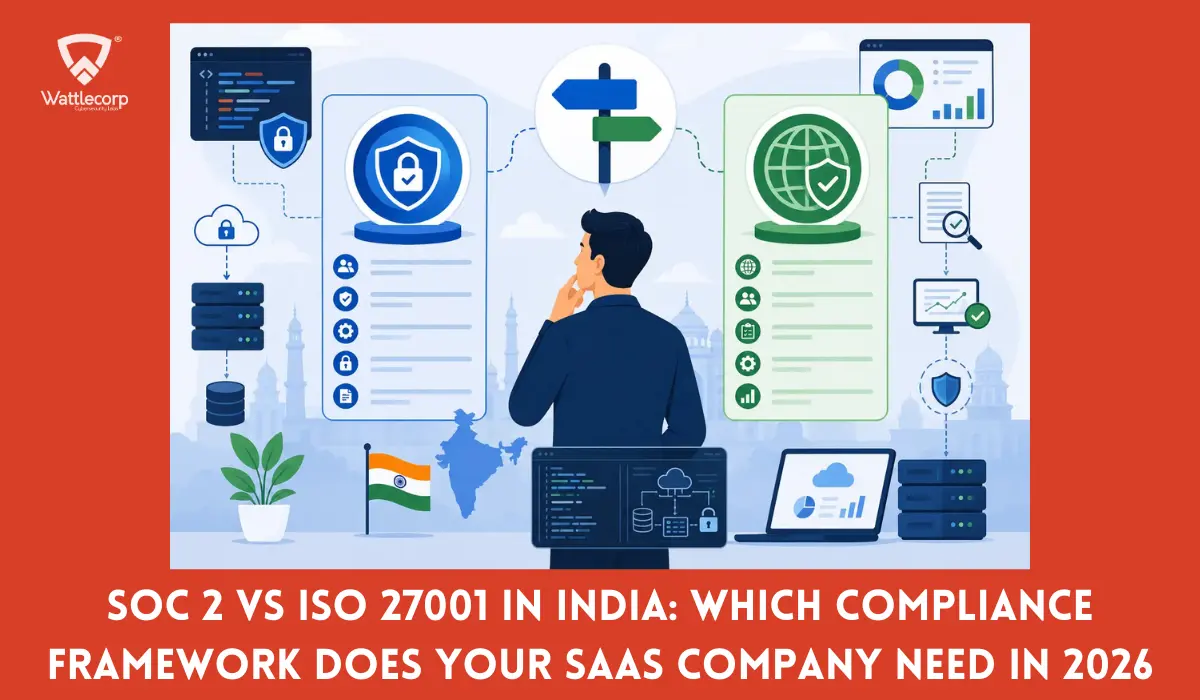
SOC 2 vs ISO 27001 in India: Which Compliance Framework Does Your SaaS Company Need in 2026
Key Takeaways:
- Choosing between SOC 2 and ISO 27001 isn’t just about getting a badge. It directly impacts your sales pitch, how customers trust you, and whether you can crack enterprise markets globally.
- SOC 2 is your quick win if you’re selling to US customers. Most enterprise buyers won’t even look at you without it. It speeds up the sales cycle and opens doors faster.
- ISO 27001 is for companies thinking bigger about security. It helps you build a real information security system across your teams, processes, tools, vendors, and operations, not just for customers, but for yourself.
- You’ll probably need both eventually. Do SOC 2 first to hit your revenue targets, then layer in ISO 27001 when you’re ready to strengthen your credibility and go global.
- The best choice depends on your specific situation. Where are your customers, how urgent are your deals, how sensitive is your data? How mature is your security? Where do you want to expand? Answer these questions, and the path becomes clear.
A global enterprise transaction can be decided by a single compliance request, which can favour or disadvantage an Indian SaaS company. For SaaS companies in India, security compliance is no longer about audits, regulations, or internal governance. It now directly affects the sales cycles, customer trust, investor confidence and worldwide expansion.
Indian SaaS companies are looking for customers in US, Europe, Middle East and other parts of the world. One question that keeps coming up is whether they should choose SOC 2 vs ISO 27001 or both?
The answer will rely on the company’s target market, consumer expectations, data obligations, and security maturity. US enterprise customers frequently request SOC 2 as part of vendor security evaluations. ISO 27001 provides a wider basis for establishing and certifying an information security management system.
Understand that what makes SOC 2 vs ISO 27001 different and why both are important for Indian SaaS companies in 2026, and how to choose which system to use first.
India’s data protection landscape has evolved rapidly following the Digital Personal Data Protection (DPDP) Act and its phased implementation, increasing customer expectations around privacy and security governance. Enterprise buyers worldwide have consolidated around vendor security frameworks.
Let’s examine SOC 2 vs ISO 27001 through a practical lens with which framework gets you revenue, which one builds lasting competitive advantage, and whether you truly need both.
Why SOC 2 Matters for SaaS Companies Selling to Global Enterprises
SOC 2 is what American enterprise procurement teams are mostly looking for. The American Institute of Certified Public Accountants (AICPA) created this framework specifically for service companies and yes, SaaS companies absolutely fall into that category.
It works by assessing your controls across five trust service criteria: security, availability, processing integrity, confidentiality, and privacy. In the SOC 2 vs ISO 27001 comparison, think of SOC 2 as your customer’s security audit tool.
When they’re evaluating you as a vendor, they want independent validation that you do what you claim regarding data protection. SOC 2 compliance provides exactly that through a formal audit process that examines whether your documented controls exist and work the way you say they do.
When comparing SOC 2 vs ISO 27001, SOC Type I is a point-in-time snapshot, a one-time validation that your controls look good on a particular date. Type II is the one that matters for serious enterprise deals. It’s a commitment: you’re being audited over a minimum six-month period to prove your controls work consistently. For Indian SaaS companies chasing US enterprise customers, Type II is becoming table stakes.
Compare that to other frameworks that demand much longer commitments. Once you have it, SOC 2 Type II reports become your primary selling tool in US enterprise RFP responses. Enterprise security teams request them constantly and having that report in your back pocket dramatically accelerates deal velocity.
What Is ISO 27001 and How Does It Build Long-Term Security Governance?
ISO 27001 is essentially the opposite approach. Instead of focusing on what your customers need to see, it focuses on building genuine organizational security maturity from the ground up. The ISO/IEC 27001:2022 standard forces you to establish an Information Security Management System, an ISMS that touches every corner of your organization.
This isn’t just about protecting customer data. This is about treating information security as an organizational discipline. The ISO 27001 vs SOC 2 distinction becomes obvious when you look at scope.
SOC 2 explains that these are the controls relevant to our service delivery. ISO 27001 requires you to examine every information asset in your organization, identify risks, and implement controls accordingly.
Also Read : ISO 27001 Certification Cost in India: What Businesses Should Expect in 2026
A company pursuing ISO 27001 certification India isn’t just getting audited, especially when viewed through the broader SOC 2 vs ISO 27001 decision. it’s fundamentally restructuring how it approaches security governance. You’re not just documenting controls; you’re proving a management system has been running for sufficient time to demonstrate sustainability. After your initial certification, annual surveillance audits ensure you’re maintaining the system.
ISO 27001 credentials carry genuine global weight, especially in the SOC 2 vs ISO 27001 discussion. It’s recognized across Europe, Asia-Pacific, and increasingly everywhere else. For companies planning international expansion, ISO 27001 represents foundational credibility that SOC 2 alone cannot provide.
What Makes SOC 2 Different from ISO 27001 for SaaS Companies
Let’s break down how these frameworks differ when you’re making a real decision. Understand What Makes SOC 2 Different from ISO 27001 for SaaS Companies.
Audit Process & Frequency: SOC 2 attestation India is essentially a time-bound engagement. ISO 27001, by contrast, demands ongoing proof of a functioning management system. After your initial buildup, you face annual surveillance audits indefinitely. This matters when budgeting: ISO 27001 creates recurring audit costs; SOC 2 is more predictable and finite.
Geographic Recognition: If your customer base is concentrated in US enterprise market, SOC 2 is the obvious choice. If you’re selling globally or planning European expansion, ISO 27001 becomes essential.
Also Read : How Indian Startups Can Pass Enterprise Security Reviews: SOC 2, ISO 27001, or VAPT?
Control Scope: SOC 2 lets you narrow the aperture. You can say, “here are the systems relevant to our service delivery,” and audit only those. ISO 27001 forces you to think about your entire information ecosystem. Your development environment, your office network, your employee access management, all of it’s in scope. This is simultaneously the standard’s greatest strength and why it requires such longer implementation timelines.
Business Impact & Revenue: SOC 2 certification India typically accelerates revenue. ISO 27001 vs SOC 2 plays a different role, it builds credibility with sophisticated buyers, investors, and partners who want evidence of genuine security governance maturity. Both support SaaS security frameworks and cloud security compliance, but they’re solving different business problems.
Strategic Implementation Guidance for Indian SaaS Organizations
Knowing that which framework is better for you and which one solves your problem is essential thing.
Choose SOC 2 First If:
- You have specific enterprise deals blocked pending SOC 2 compliance
- Your customer concentration is US enterprise market -heavy
- Your board is pushing for revenue acceleration, and this accelerates deals
- You want to establish credibility with sophisticated US venture investors
- Timeline is compressed
Choose ISO 27001 First If:
- You’re planning genuine international expansion across Europe and Asia
- You want investors and partners to see genuine security governance maturity
- Your organization is distributed and genuinely needs organization-wide security policy framework
- You’re in a regulated industry or handling highly sensitive data
Choose Both – In That Sequence – If:
- You’re scaling aggressively across multiple geographies
- You have both US enterprise and European customer demand
- You’re raising serious venture funding
- You realize you’ll need both within 3-4 years anyway
Most successful Indian SaaS companies we’ve seen take a phased approach to SOC 2 vs ISO 27001. They achieve SOC 2 first because it closes immediate deals. Then they begin ISO 27001 implementation because they’ve realized their global customer base expects it. Starting simultaneously sounds efficient but typically creates chaos and extends both timelines.
The cost-benefit analysis is that SOC 2 generates immediate revenue. If your revenue impact is marginal but your investors expect global credibility signals, ISO 27001 becomes the play.
Strategic Framework Selection for Sustained Organizational Growth
The choice between SOC 2 vs ISO 27001 should be driven by one fundamental question, where are your customers and where will they be in three years? At Wattlecorp, we help Indian SaaS companies answer this question based on customer expectations, sales priorities, compliance gaps, and long-term market expansion.
Most Indian SaaS companies we see navigate this by choosing SOC 2 first. It’s faster, cheaper, and generates immediate revenue impact. Once SOC 2 is operational and generating deal acceleration, they begin ISO 27001 implementation knowing they have financial breathing room to invest properly.
For companies that need structured governance and audit readiness, our ISO 27001 Consulting Services in India for Compliance & Certification can help build a practical roadmap toward certification. This sequential approach works because it aligns compliance investment with revenue generation.
What matters is making the decision deliberately based on your actual business circumstances, not on generic compliance advice. And regardless of which path you choose, remember that soc 2 vs iso 27001 implementation is a multi-year journey, not a checkbox exercise.
SOC 2 vs ISO 27001 FAQs
1. What is the key difference between SOC 2 and ISO 27001?
2. Is SOC 2 required for Indian SaaS companies?
3. Which is more recognized globally, SOC 2 or ISO 27001?
4. What is the cost of SOC 2 vs ISO 27001 in India?
5. Can a company implement both SOC 2 and ISO 27001?

 SOC 2 vs ISO 27001 in India: Which Compliance Framework Does Your SaaS Company Need in 2026
Key Takeaways: Choosing between SOC 2 and ISO 27001 isn’t just about getting a badge. It directly impacts your sales pitch, how customers trust you, and whether you can crack enterprise markets globally. SOC 2 is your quick win if you’re selling to US customers. Most enterprise buyers won’t even look at you without it. […]
 AWS Server Hardening for UAE Enterprises: CIS Benchmark and UAE IA Compliance Guide
Key Takeaways: If you’re running a bank, fintech, healthcare provider, government contractor, or handling sensitive data in the UAE, AWS server hardening is critical for both security and compliance readiness. You’re responsible for your own security. AWS protects their infrastructure, but you must secure everything running on it: your EC2 instances, user permissions, network access, […]
 Compromise Assessment for UAE Enterprises: How to Find Out If You Have Already Been Breached
Key Takeaways: Compromise Assessment for UAE enterprises is an evidence-based investigation that determines whether attackers have already accessed your systems, replacing assumptions with documented proof of what happened in your infrastructure. Hidden compromise costs more to remediate the longer it remains undetected, making early investigation critical for minimizing financial impact, regulatory exposure, and customer trust […]
 Why Indian SaaS Companies Are Losing US Enterprise Deals Without SOC 2 Type II
Key Takeaways: Type I is a starting point. Type II is the deal-maker. US enterprise procurement teams do not settle for a point-in-time audit when vendor risk is on the line. Operational evidence is non-negotiable. Continuous controls, not just documented policies, are what Fortune 500 legal and compliance teams demand before signing contracts. SOC 2 […]
 Continuous Penetration Testing for UAE Enterprises: Moving Beyond Annual VAPT
Key Takeaways: Continuous Penetration Testing helps reduce high-risk testing gaps by providing recurring vulnerability validation after application, cloud, API, and infrastructure changes. Organizations implementing continuous penetration testing services in the UAE can identify and validate vulnerabilities faster, allowing internal teams to prioritize remediation within hours or days instead of waiting months for the next annual […]
 DPDP Act vs GDPR: Key Differences Every CTO in India Must Know
Key Takeaways: GDPR compliance provides a baseline, but DPDP introduces India-specific obligations that require additional operational and technical implementation. Simplified notices, grievance redressal, and children’s data controls are India-specific obligations that most GDPR programs simply do not cover. The DPDP Act and GDPR are built differently and the GDPR gives organizations six legal grounds to […]