

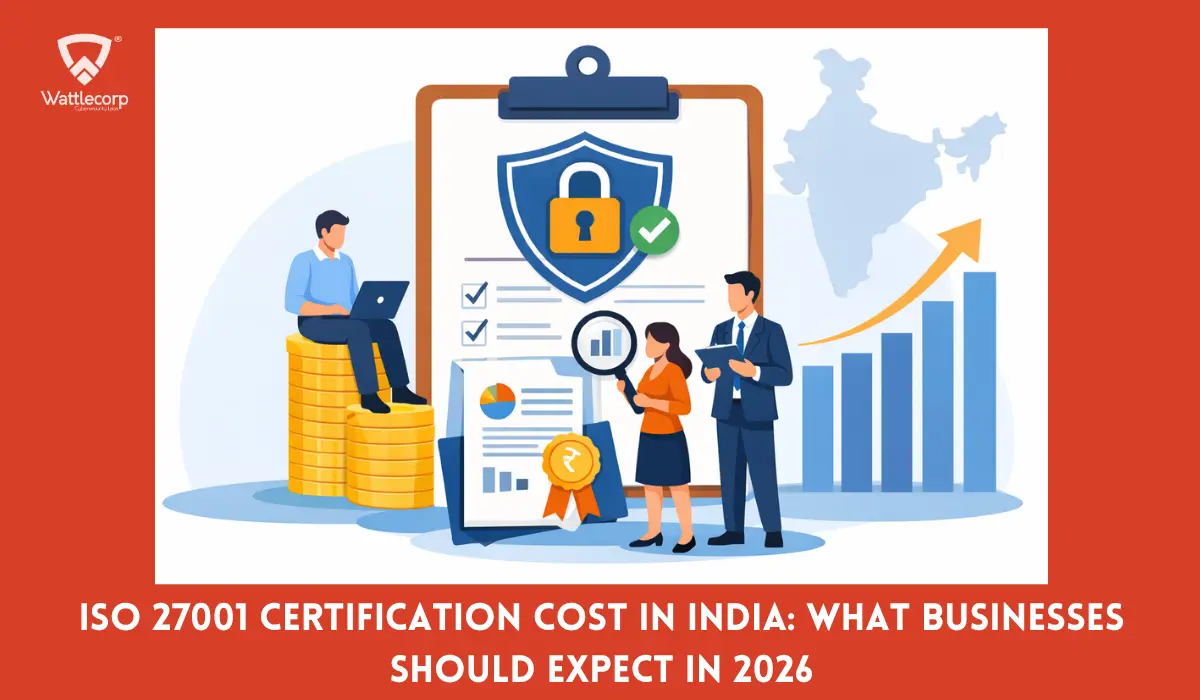
ISO 27001 Certification Cost in India: What Businesses Should Expect in 2026
Key Takeaways:
- Most businesses in India underestimate ISO 27001 certification cost by only planning for the audit fee, not the full implementation journey.
- Your current security maturity is the single biggest hidden variable that shapes total ISO 27001 certification cost.
- Technical control gaps discovered mid-project can silently double your timeline and inflate overall cost beyond expectations.
- Rushing ISO 27001 after a client demand almost always costs more and delivers weaker, audit-fragile results.
- In 2026, ISO 27001 certification India directly impacts enterprise sales velocity, vendor trust scores, and procurement outcomes.
What Businesses Need to Know About ISO 27001 Certification Costs in 2026
For many businesses in India, ISO 27001 certification is no longer just a compliance milestone.
In 2026, it has become a practical trust signal for enterprise buyers, partners, investors, and security-conscious customers.
But one of the most common questions leadership teams still ask is how much does ISO 27001 certification actually cost?
The honest answer depends on far more than the audit fee.
Most organizations underestimate ISO 27001 certification cost because they only budget for the certification body audit.
In reality, the total cost is shaped by your current security maturity, documentation readiness, technical control gaps, internal governance structure, and how well your teams can produce audit-defensible evidence.
If your business is planning ISO 27001 certification India in 2026, this guide breaks down what you should realistically expect and what often gets missed before the first audit conversation even begins.
Why ISO 27001 Cost Matters More in 2026
For Indian SaaS companies, IT service providers, fintech firms, healthcare businesses, and enterprise-focused technology companies, ISO 27001 increasingly influences:
- Enterprise customer trust
- Security due diligence outcomes
- Vendor onboarding approvals
- RFP competitiveness
- Overall governance maturity perception
Most businesses do not start this journey because they want a certificate on the wall.
They start this journey because a major enterprise client asks for it. Because a security questionnaire surfaced uncomfortable maturity gaps.
Because procurement cycles began slowing down. Because leadership finally acknowledged that weak governance carries real and measurable business risk.
That is exactly why ISO 27001 certification cost should never sit as a standalone compliance budget line. It is a business growth and risk-defensibility investment.
For companies in India that also deliver mobile applications or APIs to external clients, broader security assurance work often enters the picture here.
Services like mobile app penetration testing India are frequently integrated into security assurance roadmaps that complement ISO 27001 implementation, especially when client security questionnaires probe application-level controls.
What Actually Makes Up ISO 27001 Certification Cost in India
The most common planning mistake is treating ISO 27001 certification cost as a single invoice. In practice, it breaks into five distinct layers, each capable of expanding your budget if not anticipated early.
1. Gap Assessment and Readiness Review
Before implementation, your team must understand exactly where you currently stand. This phase covers scope definition, existing policy review, risk management maturity mapping, control gap identification, and evidence readiness assessment.
Businesses in India that skip this phase consistently pay more later, through rework, documentation revisions, delayed audits, and technical remediation discovered too close to the audit deadline.
A structured gap assessment is often the most effective cost-control measure available before implementation begins.
2. ISMS Documentation and Governance Buildout
ISO 27001 requires a functioning Information Security Management System, not just policies sitting in a folder that no one reads.
That means building or formalizing information security policies, risk treatment plans, asset inventories, access governance procedures, incident response workflows, vendor security processes, backup governance, internal audit records, and management review mechanisms.
For organizations with immature internal governance, this layer is a major driver of total ISO 27001 certification cost. The real challenge is not just making policies defensible during audits, but ensuring that they are consistently followed across departments, with operational alignment and documented evidence available at the time of audit.
3. Technical Control Improvements
This is where hidden ISO 27001 certification cost most often appears.
Many businesses begin ISO 27001 certification India assuming their existing security posture is sufficient, only to discover gaps like unsecured APIs, misconfigured access controls, and inadequate logging and monitoring systems.
Also Read : What Are the ISO 27001 Requirements in 2025?
These gaps must be closed before any certification audit. That means ISO 27001 certification cost routinely expands into broader cybersecurity remediation work, which, if planned for from the start, becomes manageable rather than disruptive.
4. Internal Audit and Pre-Certification Readiness
Having controls documented is not the same as demonstrating that they function consistently.
Internal audits, corrective action tracking, and formal management reviews should be conducted regularly to prove that the ISMS is consistently operational, not just at the time of certification.
This phase frequently surfaces issues that sharply increase ISO 27001 certification cost when found late: controls without evidence, policies that teams are not following, risk registers missing ownership, and governance reviews that never happened.
Finding and fixing these during implementation, rather than at the Stage 1 audit, directly reduces overall spend.
5. Certification Audit and Ongoing Surveillance Costs
This is the cost most decision-makers ask about first: Stage 1 audit, Stage 2 audit, annual surveillance audits, and eventual recertification.
Actual audit fees depend on company size, employee headcount, operational complexity, scope, and required audit days.
Two technology companies operating in India can receive very different estimates for ISO 27001 certification India because scope complexity and operational depth, not industry category, determine the final cost.
The Bureau of Indian Standards (BIS) is India’s national standards body, the authority that decides what good enough actually means for products and systems operating in the country, and ensures they hold up against both Indian and international benchmarks.
What Influences ISO 27001 Certification Cost the Most in India
If you are building a 2026 budget, these six variables shape ISO 27001 certification cost more than anything else.
- Scope size: Scope size and complexity, including cloud environments and third-party integrations, play a critical role in determining the certification cost. A smaller scope in a multi-cloud environment may still incur higher costs due to increased governance and integration requirements. Scope decisions made on day one protect your budget throughout the project.
- Security maturity: Businesses in India with immature existing controls often see ISO 27001 certification cost grow substantially once the full gap picture becomes clear during assessment.
- Documentation readiness: Missing policies, absent evidence, and fragmented governance records each add hours of remediation effort that translate directly into budget impact.
- Cloud and vendor complexity: Multi-cloud environments, SaaS-dependent stacks, and third-party supply chains require stronger governance frameworks and clearer evidence mapping, all of which add cost.
- Internal ownership alignment: ISO 27001 requires active coordination across IT, engineering, HR, legal, procurement, and leadership. When alignment is fragmented, implementation slows and ISO 27001 certification cost grows with every delay.
- Technical remediation depth: If your implementation surfaces weak log management, poor access governance, or inadequate vulnerability handling, that remediation is not optional. That is not a failure, it means you are closing real security gaps, not simply producing paperwork that satisfies a checklist.
How Businesses in India Cut ISO 27001 Costs Without Cutting Corners
The organizations that manage ISO 27001 certification cost most effectively are not the ones hunting for the cheapest provider. They are the ones that invest time in preparation before spending a single rupee on implementation.
Practical measures that genuinely reduce ISO 27001 certification cost:
- Define certification scope precisely before implementation begins
- Run a structured gap or readiness assessment as the first step
- Identify technical control gaps before the audit phase begins
- Assign clear internal ownership across all relevant departments
- Build evidence continuously throughout the project, not in the final week
- Never treat ISO 27001 as a documentation-only exercise
The costliest pattern businesses in India repeat is attempting to rush certification after a major client suddenly demands proof of compliance.
That approach consistently produces expensive late-stage remediation, weak internal adoption, and fragile audit readiness that surveillance audits later tear apart.
Building an ISO 27001 Budget in 2026 That Leadership Can Confidently Approve
Leadership teams that ask only about the audit fee are building incomplete, unrealistic budgets.
Also Read : VAPT Metrics That Matter: How to Measure and Report Security Testing ROI to Leadership
A defensible ISO 27001 certification cost structure for 2026 should account for every layer:
- Readiness and gap assessment
- ISMS governance and documentation buildout
- Technical control improvements and remediation
- Security validation testing
- Internal audit execution
- Certification audit fees
- Ongoing surveillance, maintenance, and sustainment
Building around this full structure gives finance and leadership a planning model that does not collapse the first time a technical gap or documentation deficiency appears mid-project.
Reframing ISO 27001 Cost as a Security Maturity Investment in 2026
The most accurate way to think about ISO 27001 certification cost in India is this. You are not paying for a certificate.
You are paying to demonstrate that your business operates securely, consistently, and defensibly before customers, auditors, and regulators who increasingly recognize strong security practices.
For some businesses, that journey is efficient because the security foundations already exist.
For others, ISO 27001 certification cost is expensive because the process reveals operational and governance gaps that were always present, just not visible until structured implementation work made them undeniable.
That’s where Wattlecorp comes in, bridging those gaps so the road to certification doesn’t turn into an open-ended project.
By offering tailored gap assessments, documentation buildout, and remediation of technical controls, Wattlecorp helps businesses avoid common pitfalls and manage costs more effectively.
In 2026, organizations across India that extract the most value from ISO 27001 certification India will not be the ones that found the lowest price.
They will be the ones that used certification to build stronger customer trust, cleaner audit readiness, and a security posture that holds up under real scrutiny, not just on paper, but in consistent, defensible, day-to-day operational practice.
ISO 27001 Certification Cost FAQs
1. What is the average ISO 27001 certification cost in India?
The average ISO 27001 certification depends heavily on how big your organization is and how much ground needs to be covered. Smaller businesses tend to spend far less, while larger companies with complex setups will naturally see higher costs. Factor in annual surveillance audits too, as those are recurring expenses that often get overlooked during initial budgeting.
2. What factors influence ISO 27001 implementation cost?
The company’s size, the scope you choose to certify, how mature your existing security practices already are, and whether you bring in an external consultant. The certification body you go with also matters, since fees differ across providers. Gaps in technology and the extent of staff training needed can quietly push costs up as well.
3. How long does ISO 27001 certification take in India?
It really comes down to the size and complexity of your operations. Smaller companies with a clearly defined scope tend to move through the process faster, while larger organizations with multiple departments and systems in scope will need considerably more time to get everything in order before the final audit.
4. Is ISO 27001 mandatory for Indian companies?
Not legally, but that distinction matters less than it used to. Government tenders, BFSI empanelment, and overseas enterprise clients are routinely asking for it now. With India’s DPDP Act (2023) putting data protection front and center, having a recognized framework like ISO 27001 in place is increasingly hard to argue against.
5. Can startups afford ISO 27001 certification in India?
More often than people assume, yes. Keeping the certification scope tight, using automation-driven ISMS platforms, and bringing consultants in only where genuinely needed can make the whole thing quite manageable. For startups chasing enterprise deals, it tends to pay for itself fairly quickly.

 AI-Powered Cyberattacks in India 2026: What CISOs Need to Know Now
Key Takeaways: Generative AI has sharply accelerated the attacker’s advantage by making phishing, reconnaissance, and exploit preparation faster and easier to scale. Being a CISO in 2026 means making real-time threat decisions at board level, that’s a different job from what most security leaders are trained for, and the skill gap is already showing. CERT-In’s […]
 ISO 27001 Internal Audit for Saudi Companies: Preparing Evidence Before Certification
Key Takeaways: An ISO 27001 internal audit helps Saudi companies validate whether their Information Security Management System is implemented, not just documented. Certification auditors do not only review policies. They check risk registers, control ownership, access reviews, incident records, supplier reviews, audit trails, management review minutes, and corrective action evidence. For Saudi companies, ISO 27001 […]
 Proactive Threat Hunting for UAE Enterprises: Finding Attackers Before They Strike
Key Takeaways: Proactive threat hunting is not the same as traditional monitoring. Monitoring waits for the alerts, while threat hunting actively searches for signs of attacker behaviour that may not trigger automated detection. For UAE enterprises, threat hunting is becoming more important because attacks are shifting from simple malware to credential abuse, ransomware preparation, cloud […]
 CERT-IN Empanelled VAPT: Why Indian Companies Should Choose CERT-IN Approved Firms in 2026
Key Takeaways: Running a VAPT with a CERT-In empanelled firm means your security testing is backed by a standard that regulators and enterprise clients in India actually recognize, not just a vendor promise. When sensitive data and critical systems are involved, a CERT-In empanelled VAPT provider gives Indian companies compliance readiness they can demonstrate, not […]
 SOC 2 Type I vs Type II Timeline: How Long UAE Companies Actually Need
Key Takeaways: SOC 2 Type I vs Type II timelines differ and it is mostly based on audit depth. Type I checks if controls are well-designed at a given point in time. Type II goes a step further and it proves those controls worked consistently over a defined period. For UAE SaaS companies, Type I […]
 AI Security Testing for US SaaS Platforms: NIST AI RMF and What 2026 Standards Require
Key Takeaways: AI security testing for SaaS platforms isn’t just a technical upgrade from traditional app security. It’s a completely different job. You’re not running a scan on code, you’re stress-testing a model to see how it breaks when someone is actively trying to make it fail. NIST AI RMF isn’t law yet, but your […]