

SOC 2 Type I vs Type II Timeline: How Long UAE Companies Actually Need
Key Takeaways:
- SOC 2 Type I vs Type II timelines differ and it is mostly based on audit depth. Type I checks if controls are well-designed at a given point in time. Type II goes a step further and it proves those controls worked consistently over a defined period.
- For UAE SaaS companies, Type I is the quicker path. It clears early procurement requirements without waiting through a long observation window, which is exactly what matters when a deal is moving.
- Type II holds more weight with buyers. Larger enterprises, regulated clients, and teams reviewing renewals will almost always ask for it as the engagement grows.
- How long it takes depends on readiness, scope, Trust Service Criteria, team bandwidth, and auditor availability. Companies with documented policies and clear control ownership get through it faster.
Understanding SOC 2 Type I vs Type II Timelines for UAE Companies
Enterprise deals in the UAE do not fall apart because of bad products. They fall apart because of missing paperwork specifically, a SOC 2 report that a procurement team requested somewhere between the second call and the final signature.
SOC 2 is no longer a checkbox for US-market entry and it is the price of admission into serious B2B conversations globally and UAE companies are feeling that pressure harder than ever.
The question is no longer whether to pursue it or not. It is which path to take and how fast you can move.
That is where SOC 2 Type I vs Type II splits the room. Both carry weight. Both demand real investment.
But SOC 2 Type I vs Type II differ in timeline, depth, and what enterprise buyers actually accept at the table.
How SOC 2 Compliance Helps UAE Companies Win Enterprise Clients
SOC 2 rarely enters a UAE company’s roadmap through strategic planning. For most, it surfaces mid-conversation, when a prospective enterprise client requests an audit report as a condition of moving forward, and the absence of one brings everything to a halt.
It is an expensive lesson in the value of preparation.
This is why understanding SOC 2 Type I vs Type II early can help UAE companies avoid delayed deals, procurement friction, and last-minute audit pressure.
SOC 2 is an independent audit conducted against standards established by the American Institute of CPAs. It assesses how an organisation manages client data against the selected Trust Services Criteria, which may include Security, Availability, Processing Integrity, Confidentiality, and Privacy depending on audit scope.
Unlike internal policy documentation or self-assessments, it carries the weight of independent validation, which is precisely what enterprise procurement teams require before approving a new vendor.
In the UAE, that requirement is becoming the norm rather than the exception. As data protection expectations tighten across regulated industries, enterprise buyers are applying significantly more scrutiny to their vendor selection process.
A SOC 2 report focuses on addressing that scrutiny directly, demonstrating that your organisation’s security posture has been independently examined and verified, not simply declared.
For UAE SaaS companies pursuing enterprise growth, SOC 2 compliance is no longer a future consideration. It is a present commercial necessity.
The Real Difference Between SOC 2 Type I vs Type II
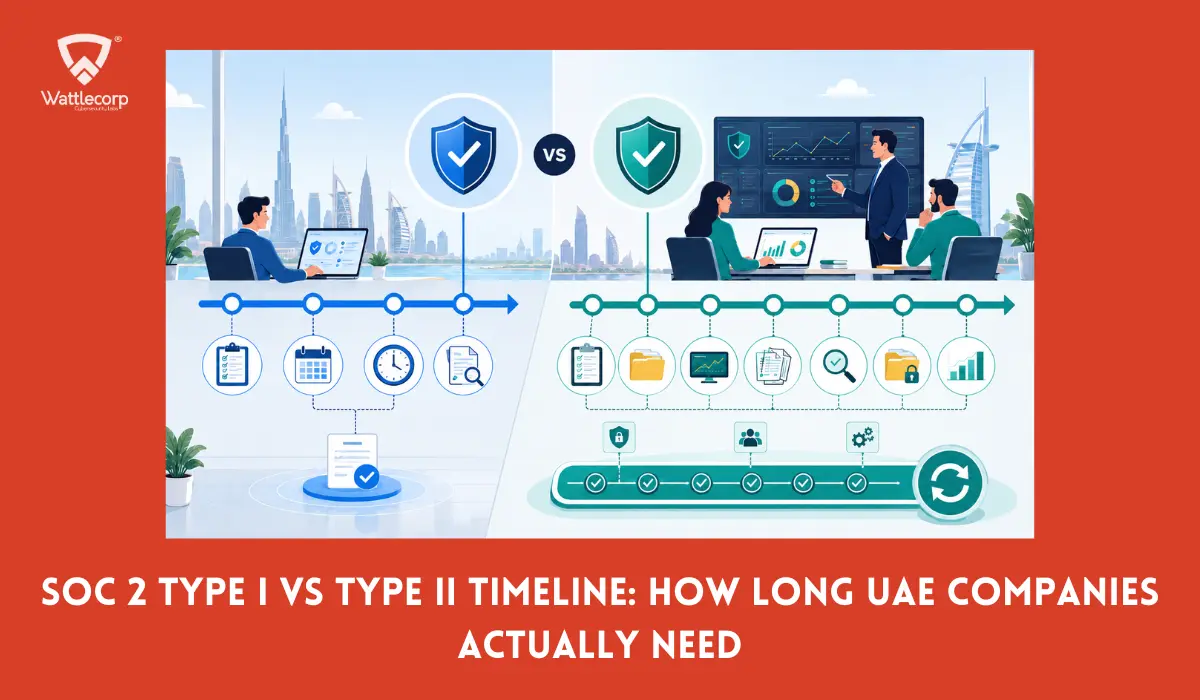
The easiest way to understand the difference between SOC 2 Type I vs Type II is to look at the time factor.
SOC 2 Type I reviews whether your security controls are properly designed and in place at a specific point in time. It is like taking a snapshot of your security program. The auditor checks what exists today and whether those controls are suitable for protecting customer data.
And the SOC 2 Type II goes a step further and it does not only check whether the controls exist; it checks whether they have been working consistently over a defined review period.
Also Read : Achieve SOC 2 Type 2 Assessment in 90 Days: The Fast-Track Guide to Series A Funding in the UAE
In that sense, Type II is more like a recorded track record. It proves that your controls are not just documented for the audit, but actually followed in daily operations.
This is why the timeline differs so much. A SOC 2 Type I audit can often be completed within 3 to 6 weeks, depending on readiness.
A SOC 2 Type II audit needs a longer window than Type I because the company must show operational evidence across the review period before the final report can be issued.
SOC 2 Timeline in UAE: What Type I and Type II Actually Look Like
If you’re a SaaS company in the UAE trying to figure out how long SOC 2 is going to take, here’s what our timeline genuinely looks like, broken down by type, with real numbers. Moreover it is based on the size of the company and project.
SOC 2 Type I: 3 to 6 Weeks
Type I is a point-in-time assessment. An auditor looks at your controls as they exist today and confirms they are suitably designed.
There is no observation window, no waiting around. That is exactly why companies chasing a specific enterprise deal or trying to clear a procurement checklist go this route first.
For most UAE companies, the work breaks down into different phases such as scoping and planning, assessment in 15days, design and alignment in 15 days, practice and test in 5 days and attestation support in 5 days. Usually it takes 3 to 6 weeks for the process, which depends on the company.
The biggest factor that moves this timeline left or right? How prepared you are walking in. Companies that already have documented policies, basic security tooling, and some internal ownership of controls can move through Phase 1 and 2 quickly.
Companies starting from zero, with no documentation or clearly defined ownership, will experience delays primarily during Phase 2.
SOC 2 Type II: Usually 3 to 12 Months Depending on the Review Period
SOC 2 Type II requires evidence that controls operated effectively over a defined observation period. First-time UAE SaaS companies may choose a shorter review period, such as 3 months, to meet urgent buyer expectations, while larger enterprises and annual renewals often use 6 to 12 months.
That is what makes it the report enterprise buyers value most because it demonstrates consistency, not just intent.
The structured engagement for Type II looks like this: The readiness and implementation engagement may run across structured phases over two to three months, depending on infrastructure complexity and internal maturity.
However, the final SOC 2 Type II report depends on the selected observation period, which is commonly 3 to 12 months.
It begins with Scoping and Planning, followed by assessment at six days, and then Design and Align at twenty-two days.
After that Practice and Test runs for eleven days, and Attestation Support wraps up the engagement at five days.
These timelines may vary depending on the complexity of the existing data processing infrastructure, the maturity of current governance frameworks, and the scale of organizational change management required.
Notice that Phase 2 and Phase 3 carry more weight in Type II. That is intentional, design alignment and evidence testing both require more rigour when controls need to hold up over time, not just pass a single review.
Once issued, a SOC 2 Type II report covers a defined historical review period. Most enterprise buyers expect an updated report annually, so UAE companies should plan for yearly renewal to maintain procurement credibility.
For UAE SaaS companies, choosing between SOC 2 Type I vs Type II depends on urgency, buyer expectations, and how mature the company’s internal security controls already are.
What Determines Whether a First-Time SOC 2 Type II Can Use a 3-Month Review Period?
For Type I, comfortably. For Type II, a three-month first-time observation period may be an efficient path if controls are already operating, evidence collection is active, and internal teams respond quickly.
However, many enterprise buyers may still expect a 6- or 12-month review period depending on risk, contract value, and industry expectations.
The companies that stretch beyond 3 months on Type II are usually the ones that underestimated Phase 2.
Getting controls designed and aligned across teams takes coordination, and that is the phase where delays tend to quietly accumulate. Plan for it early, and the timeline holds.
SOC 2 for SaaS Companies in the UAE: Key Considerations and Timeline Factors
SOC 2 is becoming a baseline expectation for UAE SaaS companies selling to global enterprise, regulated, or security-conscious buyers. In these sales cycles, it is less of a differentiator and more of a procurement requirement.
Many US and European enterprise clients now request SOC 2 or equivalent independent assurance during vendor assessments.
This is why understanding SOC 2 Type I vs Type II early is important for SaaS companies planning enterprise sales.
Moreover the benefits are practical: faster sales cycles, less security questionnaire fatigue, and stronger competitive positioning.
Aligning the SOC 2 controls with UAE data residency and privacy requirements is not always straightforward.
Companies serving US federal, regulated, or highly security-conscious clients may also need to map SOC 2 controls to frameworks such as the NIST Cybersecurity Framework or NIST SP 800-53. Where the service is intended for US federal agency use, FedRAMP may become a separate authorization consideration rather than a simple SOC 2 mapping exercise.
Also Read : How Multi-Tenant SaaS Platforms in the UAE Can Truly Protect Tenant Data Through Effective VAPT
The compliance journey is rarely linear, and a few factors consistently affect timelines.
Companies with no formal security policies will need substantial upfront preparation, working through a compliance checklist before the audit is far more efficient than plugging gaps mid-process.
Auditor availability is a real constraint; reputable firms carry waitlists, so early engagement matters. Internally, SOC 2 requires significant involvement from engineering, IT, and compliance teams, and that allocation must be planned carefully, not assumptions.
Scope definition deserves more particular attention. Narrowing the audit to the right systems is one of the most effective ways to keep timelines manageable, and experienced local consultants add clear value here.
The choice of Trust Service Criteria matters too, because the security is the baseline, but adding Availability, Confidentiality, or Privacy broadens the audit considerably.
When comparing SOC 2 Type I vs Type II, understanding these variables at the outset helps companies plan realistically rather than be caught off guard later.
SOC 2 Type I vs Type II: Which Should UAE Startups Choose First?
For most UAE startups, the practical answer is simple: start with SOC 2 Type I first, especially if an enterprise deal is already waiting on compliance proof.
Type I helps you show buyers that your security controls are properly designed and in place, without waiting months for an observation period.
Once Type I is complete, the next step should be moving directly into the SOC 2 Type II observation period.
The policies, controls, and compliance checklist created for Type I do not go to waste. They become the foundation for collecting Type II evidence, making the overall journey faster and more structured.
This is why many SOC 2 compliance companies in the UAE recommend the Type I-first approach. It gives startups a quicker commercial advantage while preparing them for deeper, long-term credibility.
From a buyer’s point of view, the difference is clear. SOC 2 Type I shows that your controls are ready at a specific point in time.
SOC 2 Type II proves those controls actually worked over several months of day-to-day operations. For early-stage procurement discussions, Type I may be enough to move the deal forward.
But for larger enterprises, regulated industries, renewals, or expanded contracts, Type II often becomes the stronger requirement.
Timelines also vary. Startups may take longer than expected because they are often building policies, processes, and security ownership from the ground up.
Enterprises may already have mature controls, but their timelines can stretch because of wider systems, more teams, and broader audit scope.
Cost is another factor. Type I is usually the lighter investment. Type II requires ongoing evidence collection, security tooling, internal coordination, and additional audit effort.
So, the SOC 2 Type I vs Type II decision depends mainly on urgency, buyer expectations, and where the company stands in its enterprise sales journey.
For UAE startups, the smartest route is usually not choosing one forever. It is using Type I to build momentum now, then using Type II to prove lasting trust over time.
Start Your SOC 2 Journey with the Right Partner in UAE
Whether you are weighing SOC 2 Type I vs Type II for the first time or accelerating toward SOC 2 Type II for SaaS, timeline success depends on preparation, expertise, and the right partner.
Wattlecorp specialises in guiding UAE-based SaaS companies and enterprises through the full SOC 2 audit services for SaaS companies journey from gap assessment through report issuance.
As a trusted VAPT company in Dubai and SOC 2 consulting firm, Wattlecorp brings deep technical expertise alongside a practical understanding of the UAE’s regulatory landscape.
If your goal is to close enterprise deals faster, reduce vendor risk questionnaires, and build lasting credibility with global clients, reach out to Wattlecorp UAE today.
The SOC 2 compliance timeline UAE companies face does not have to be daunting with the right roadmap, it becomes a competitive advantage.
SOC 2 Type i vs Type ii FAQs
1. How long does SOC 2 Type I take in UAE?
2. Why does SOC 2 Type II take longer than Type I?
3. Can UAE SaaS startups speed up SOC 2 compliance?
4. What factors affect SOC 2 timelines?
5. Is SOC 2 Type I enough for enterprise deals?

 SOC 2 Type I vs Type II Timeline: How Long UAE Companies Actually Need
Key Takeaways: SOC 2 Type I vs Type II timelines differ and it is mostly based on audit depth. Type I checks if controls are well-designed at a given point in time. Type II goes a step further and it proves those controls worked consistently over a defined period. For UAE SaaS companies, Type I […]
 AI Security Testing for US SaaS Platforms: NIST AI RMF and What 2026 Standards Require
Key Takeaways: AI security testing for SaaS platforms isn’t just a technical upgrade from traditional app security. It’s a completely different job. You’re not running a scan on code, you’re stress-testing a model to see how it breaks when someone is actively trying to make it fail. NIST AI RMF isn’t law yet, but your […]
 SOC 2 Compliance for DIFC and ADGM-Registered Companies: What’s Different?
Key Takeaways: SOC 2 isn’t a regulatory requirement in DIFC or ADGM but if you’re dealing with enterprise clients, investors, or international partners, it is quickly becoming something the market expects anyway. DIFC and ADGM have their own data protection frameworks, but SOC 2 goes further, it asks whether your security, privacy, and operational controls […]
 How Indian SaaS Enterprises Can Defend Against Ransomware in 2026
Key Takeaways: Ransomware defense for Indian enterprises in 2026 is identity-driven, which is not just malware-driven, access control is your first and most critical line of defense. Effective ransomware defense requires detection and response speed, not prevention tools alone. How fast you contain an attack determines the level of damage. Backup validation is as critical […]
 AI Security Risks in Saudi Banking: What SAMA Expects from FinTech and Banks in 2026
Key Takeaways: AI Security Risks in Saudi Banking are expanding faster than most existing cybersecurity programs can handle, and the gap is widening with every new deployment. SAMA regulations do not currently include a standalone AI cybersecurity rulebook; banks and FinTechs should assess AI use cases against applicable SAMA Cyber Security Framework control areas to […]
 DIFC Data Protection Law Amendment Guide for Dubai Financial Firms
Key Takeaways: The DIFC data protection law amendment has raised compliance obligations significantly, firms relying on their pre-amendment posture are already exposed. DIFC Data Protection Law operates independently from UAE federal data protection law; financial firms within the Centre must meet its specific requirements directly. The Commissioner of Data Protection holds real enforcement authority, documentation […]