

Achieve SOC 2 Type 2 Assessment in 90 Days: The Fast-Track Guide to Series A Funding in the UAE
Key Takeaways:
- SOC 2 Type 2 demonstrates that your security is not merely a policy but a way of life. This is often the make-or-break element of due diligence for UAE founders considering SOC 2 compliance.
- The 90-day window will help you align SOC 2 Type 2 with your next funding milestone without pulling your engineering team away from their main objectives.
- Passing a Type II audit tells enterprise clients and VCs that your start-up has outgrown the ‘move fast and break things’ phase. It shows you have the operational discipline to protect their data privacy.
- Security is the only strict requirement, most startups in the region also include Availability and Confidentiality. It’s a proactive way to answer the security questions your customers are already asking.
- Do not skip the VAPT. Finding your own vulnerabilities early means there are no surprises during the actual audit, making the whole evaluation much smoother.
How SOC 2 Type 2 Certification in 90 Days Can Transform the Future of Your UAE Startup
SOC 2 Type 2 has become the non-negotiable proof investors demand, as UAE startups find that Series A due diligence now demands operational proof of security rather than just a statement of intent.
SOC 2 Type 2 is an independent audit, which is conducted by a licensed CPA firm. The audit typically evaluates your security controls over 3-6 months.
This timeframe is what separates Type II from Type I while Type I only captures a single moment. Type II shows sustained performance.
The UAE tech ecosystem is exploding with SaaS platforms, fintech innovators, and healthtech disruptors. But global investors have non-negotiable standards.
They need to see your controls work consistently, therefore SOC 2 Type 2 bridges the gap between local innovation and international credibility.
You can now compress the entire journey into 90 days.
This timeline aligns perfectly with funding deadlines. Understanding the SOC 2 challenges and best practices helps to achieve the certification without disrupting core operations with the right strategy.
SOC 2 Type 2 signals maturity to investors, shows risk awareness and it demonstrates operational discipline. These build confidence, shorten due diligence, and position you as enterprise-ready and directly supports your growth trajectory and valuation.
Understanding SOC 2 Type 2 with Trust Service Principles
SOC 2 Type 2 revolves around the Trust Service Principles. Understanding which matters for your business is essential.
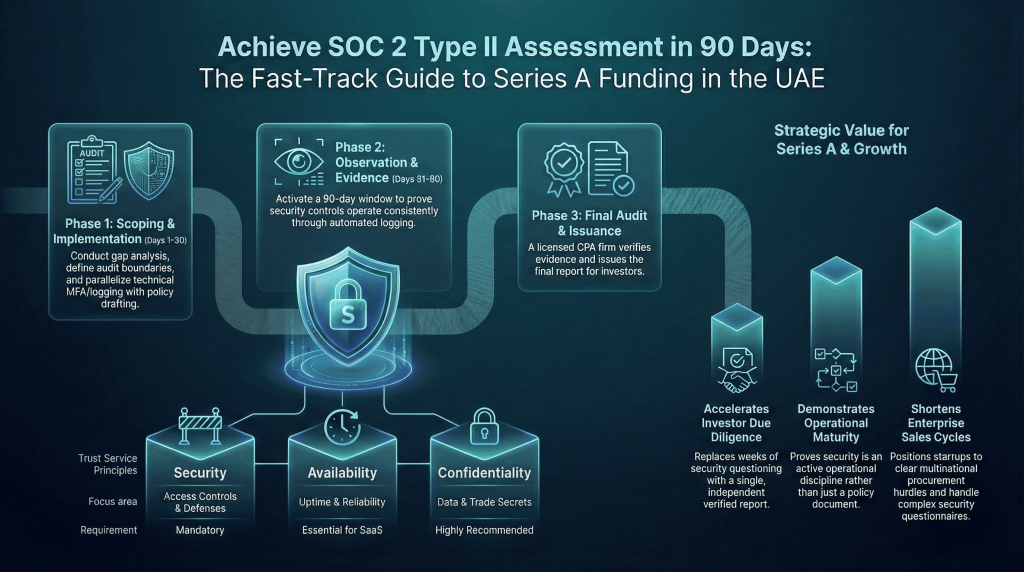
Security is the foundation and it is the only mandatory principle. Security covers protection against unauthorized access, including access controls, network defenses, monitoring systems, and incident response. Every SOC 2 Type 2 audit evaluates Security.
Availability focuses on system uptime and reliability. Availability becomes essential for SaaS platforms with uptime SLAs.
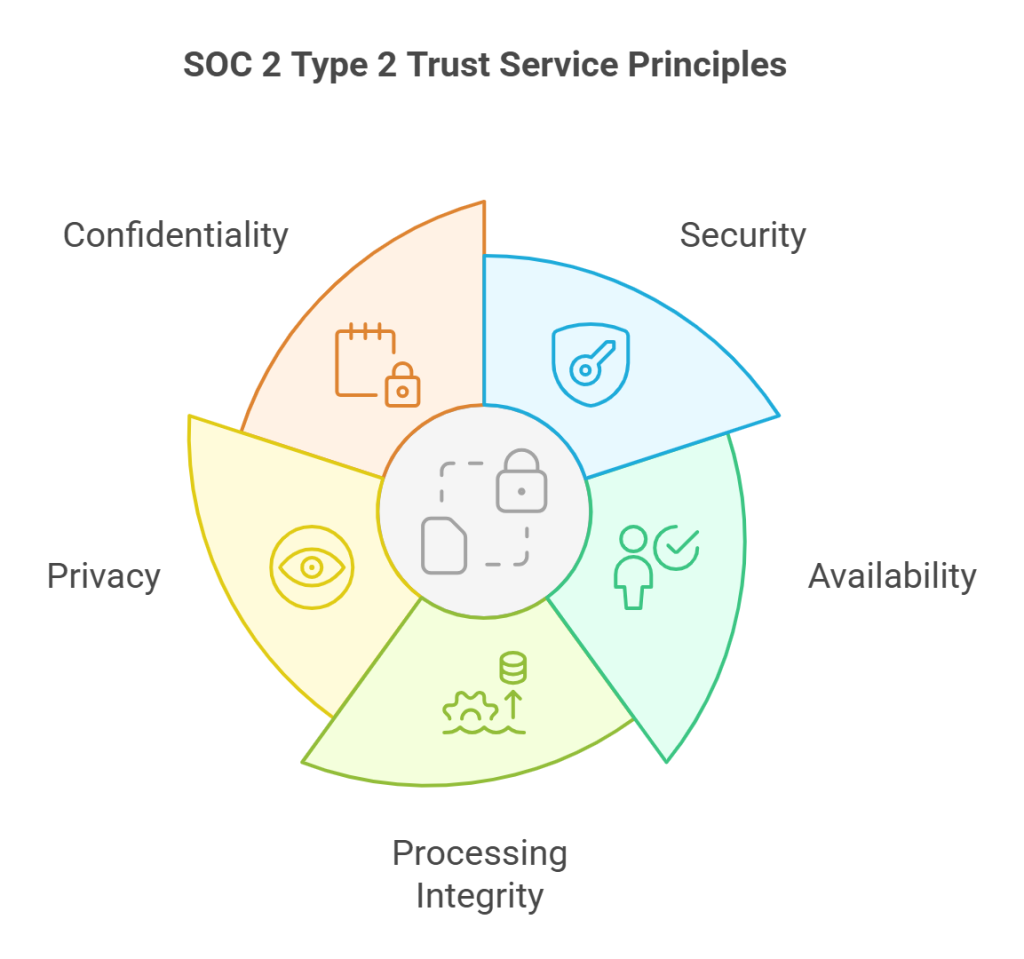
Processing Integrity ensures accurate data processing and it covers transaction integrity and authorization workflows. It includes proprietary algorithms, trade secrets, and confidential contracts.
Privacy addresses personal data handling. It covers consent management and data privacy rights, PDPL. Privacy matters for healthtech, HR tech, and consumer-facing applications.
Most UAE startups target Security with Availability and Confidentiality. This combination addresses investor and customer due diligence without over-scoping. Ensure to choose principles based on your actual business model.
Why Investors Care About Achieving SOC 2 Type 2
Venture capitalists review hundreds of pitches. When deciding between similar startups, the one with SOC 2 Type 2 has already answered their security questions. This advantage is significant.
SOC 2 Type 2 signals you’ve built real processes. These aren’t just documented policies sitting in a drawer. Your team actually follows them. Change management protocols exist and function. Incident response runbooks get tested. Access review cycles happen on schedule.
Investors see operational maturity. Startups that articulate their control environment demonstrate thinking beyond their age. This reduces post-investment surprises. Nobody wants to discover security gaps after the check clears.
Also Read : Security Operations Center Strategy: Building a Resilient SOC for Your Business
The certification proves you’re enterprise-ready. If you can pass a SOC 2 Type 2 audit, you can handle enterprise security questionnaires. Your sales team closes larger deals faster. Enterprise customers move through procurement without endless back-and-forth.
Due diligence accelerates dramatically. Instead of weeks of email exchanges about security practices, you hand over a comprehensive report. An independent auditor verified everything. The conversation moves forward.
Without SOC 2 Type 2, investors start wondering. What else haven’t they thought through? That hesitation creates longer timelines. Terms get tougher. Sometimes opportunities get passed entirely. The certification removes friction from the funding process.
Achieving SOC 2 Type 2; The 90-Day Fast-Track Roadmap
Achieving SOC 2 Type 2 within 90 days is possible. But it requires an efficient SOC strategy with disciplined focus. Here’s the timeline with four stages.
Audit Preparation
Start with an honest gap analysis. Identify where your current controls stand versus where they need to be for finding the highest-impact gaps.
Define your audit boundary clearly with scope. Find which applications and data flows matter.
Engage your CPA firm early. Alignment at the start keeps the timeline on track and gets auditor buy-in on scope to prevent unexpected events.
Security Control Implementation
On the technical side, ensure multi-factor authentication. Turn on centralized logging with real-time alerts. Establish backup and recovery procedures that actually get tested.
On the administrative side, document your information security policies. Create change management workflows with clear approval gates.
The key is parallelization. Your infrastructure team handles MFA and logging. Your compliance leads to draft policies. Don’t sequence everything linearly. You’ll miss the deadline.

Documentation
Your observation period starts once core controls are operational. The 90-day window is when auditors verify controls operated consistently.
During this phase, you’re generating evidence continuously. Access logs accumulate. Change tickets get documented. Vulnerability scans run on schedule. Backup tests produce results. Security training completion gets tracked. Incident response activities get recorded.
Systematic collection matters here. Set up automated exports where possible. Create a shared repository organized by control area. Make it easy for your auditor to navigate.
This is when VAPT fits perfectly. Run vulnerability assessments and penetration tests during observation. You’ll uncover weaknesses in real-time. Remediate them immediately. Document the entire cycle.
Final Audit
Your CPA firm conducts independent testing. They review your evidence packages. They interview key personnel.
Any exceptions or gaps get identified. You remediate them with supplemental evidence. Testing concludes. Findings get addressed. The auditor issues your SOC 2 Type 2 report.
Share this report under NDA with investors and customers. It’s valid proof of your security posture. It demonstrates operational maturity. It opens doors that were previously closed.
Critical Requirements for SOC 2 Type 2 Compliance
Understanding what auditors actually validate helps you prepare effectively. SOC 2 Type 2 is not about documentation alone. It’s about proving your controls function in practice.
Security & Availability Controls
Access management requires evidence. Demonstrate how access gets approved. Document how access gets revoked when the roles change.
Network security needs concrete proof. Firewall rules must be documented. Responses to suspicious activity must be logged.
Continuous monitoring and logging demand centralized systems. Alert configurations for security events require documentation. Proof of investigating those alerts is essential.
Backup and disaster recovery procedures get tested. Uptime SLAs need monitoring evidence.
Processing Integrity Controls
Secure Software Development Lifecycle practices need documentation. Code review procedures must be followed.
Change management shows approval workflows. Audit trails of who changed what and when are mandatory.
Transaction processing requires validation. Input validation gets tested. Output reconciliation happens regularly.
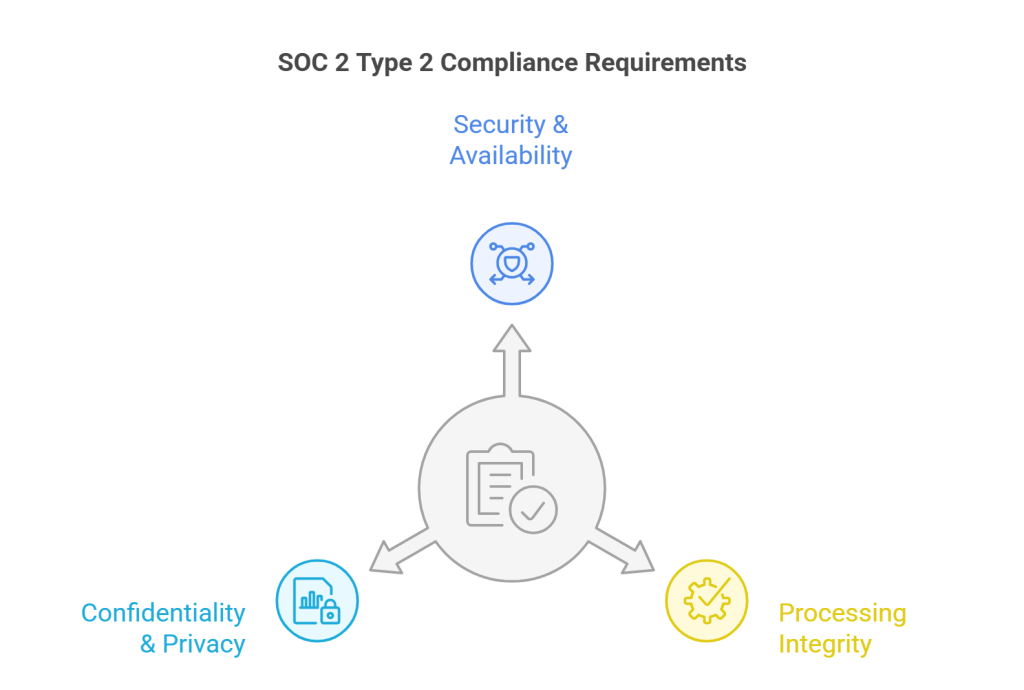
Confidentiality & Privacy Controls
Data classification frameworks must exist. Encryption at rest and in transit needs implementation.
Privacy notices must be clear. Consent management needs systematic handling. Retention and deletion policies must be followed.
Vendor risk assessment happens before onboarding. Contractual security audit requirements get included. Ongoing monitoring of vendors is documented. Access controls for vendor personnel are enforced.
Key Steps to Achieve SOC 2 Type 2
The Step-by-Step guide to achieve SOC 2 Type 2 includes
- Initial assessment and gap analysis
- Policy development and control implementation
- Employee training and security awareness
- Continuous monitoring and control evidence collection
How VAPT Strengthens Your SOC 2 Compliance
VAPT is not technically required for SOC 2 Type 2. But smart UAE startups run it anyway.
Vulnerability Assessment and Penetration Testing (VAPT) identifies exploitable weaknesses that exist in applications, infrastructure, and network architecture.
Finding issues proactively demonstrates mature risk management. This is exactly what SOC 2 Type 2 auditors evaluate.
- Security risk management
- Continuous improvement
- Evidence of proactive security posture
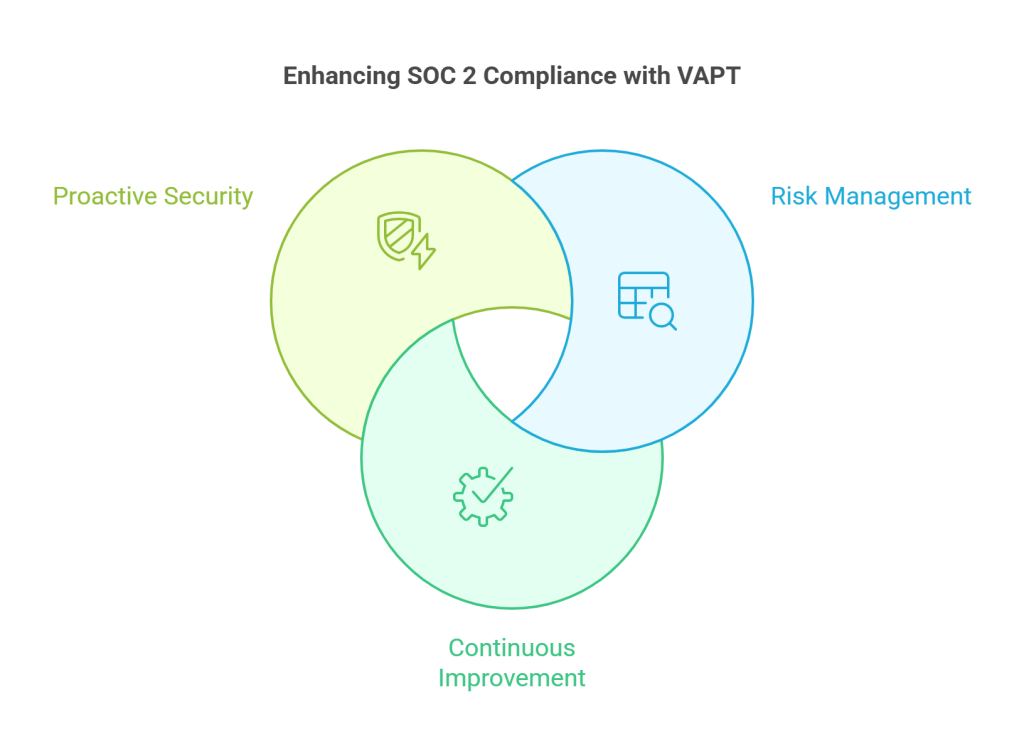
VAPT supports specific requirements around risk identification and validates vulnerability management processes.
For UAE businesses preparing for SOC 2 Type 2, working with the right VAPT company in Dubai ensures testing aligns with regional threats. It addresses compliance expectations specific to the UAE market.
Schedule VAPT 30-60 days before your audit. This gives time to remediate critical findings and retest before auditor review.
Why the UAE Market Makes SOC 2 Type 2 Essential
The UAE has positioned itself as a regional technology hub. This attracts global venture capital and enterprise customers. But that exposure brings international security expectations.
The UAE does not require SOC 2 Type 2 to be regulated. There is a special pressure on startups that are aimed at North American or European markets.
The SOC 2 Type 2 fits the current cybersecurity environment in the UAE. The construction of SOC 2 related control by organizations can tend to be inclusive of additional structures.
Also Read : 6 Effective Team-Building Activities to Strengthen Your SOC and Incident Response Teams
The benefits of certification that are applicable to UAE start-ups include enterprise sales cycles being accelerated.
Customer onboarding with multinationals becomes smoother. Investor due diligence conversations get stronger. These factors directly impact growth velocity and valuation multiples.
UAE-based SaaS and fintech startups with SOC 2 Type 2 reports see consistent patterns. The certification removes friction from revenue and funding pipelines.
How Wattlecorp Accelerates Your Path to Certification
Wattlecorp specializes in accelerated SOC 2 Type 2 programs for UAE startups. We’ve built a methodology that compresses timelines without compromising quality.
We start with providing expert SOC 2 consulting for the smooth process of implementation for both startups and growth stage companies.
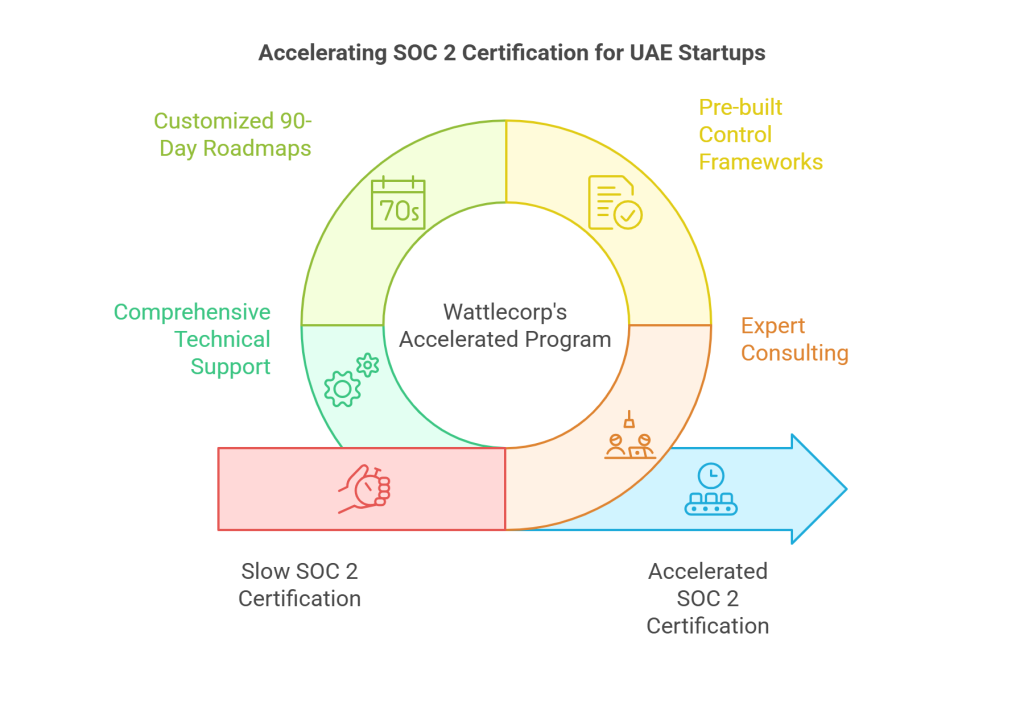
Our pre-built control frameworks are designed for auditor acceptance. Policy templates come ready to customize. You’re not iterating on documentation during observation. This saves weeks of back-and-forth.
Our 90 days customized roadmaps are designed around funding deadlines and audit windows.
Provide comprehensive technical implementation support on ongoing compliance, control optimization, and post certification advisory to maintain audit readiness year-round. Renewal doesn’t create panic.
The Strategic Value of SOC 2 Type 2 to Series A
Security is not the only thing that is verified by investors. They are checking that you have considered operational risk before they invest.
Type II of SOC 2 makes them sure that you will not turn into a liability after the investment. The trust is converted into improved conditions and quicker decisions.
Wattlecorp’s 90-day fast-track makes this achievable. You won’t derail product development. Your team won’t burn out.
With the support and structured execution of SOC 2 Compliance Consulting Services in UAE, the certification becomes a competitive advantage.
If you’re preparing for SOC 2 compliance or expanding into enterprise markets, start support from a qualified VAPT company in Dubai now.
The controls you build today become the trust infrastructure powering tomorrow’s growth. The earlier you start, the stronger your position becomes.
Ready to achieve SOC 2 Type 2 certification in 90 days? Contact Wattlecorp to schedule your readiness assessment. Build your funding-ready compliance roadmap today.
Soc 2 Type 2 FAQs
What is SOC 2 Type 2 attestation?
The SOC 2 Type 2 is an audit report of a licensed CPA firm and it demonstrates through 90-180 days that your security controls are consistently effective for organizations operating in the UAE. In contrast to Type I (point-in-time snapshot), Type II demonstrates long-term effectiveness. It is what enterprise customers and investors really want to see.
How to achieve SOC 2 Type 2 attestation?
Begin with gap assessment in order to recognize control deficiencies in line with UAE enterprise and regulatory expectations. Enforce necessary security measures, by Trust Service Principles. Gather data over a 90 day period of observations. Outsource to a CPA firm to do independent audits. Remediate any findings. Do it with concentration and professional assistance and get it done within 90 days.
What are the requirements for SOC 2 Type 2?
Control over security is compulsory. These are access management, network security, monitoring, incident response, change management, vendor risk and data protection. Availability, Processing integrity, Confidentiality and Privacy are optional. Select according to the needs of the business. You are required to show that the controls that you operated have been performed successfully during at least 90 days.
How long does it take to get SOC 2 Type 2?
Existing baseline security startups take certification of 90 days. For startups it requires 120-180 days. The schedule involves preparation evaluation (2-3 weeks), control execution (4-6 weeks), observation timeframe (90+ days), and the final audit (2-4 weeks). The process is speeded up by expert support.
Why is SOC 2 Type 2 certification important for Series A funding?
The independent security maturity is validated through SOC 2 Type 2, for organizations operating in the UAE. It deals directly with the issue of cybersecurity risk to investors. Allows lowering a perceived risk of investment. It is fast tracked due diligence. It indicates working discipline and preparation. Companies that do not have SOC 2 Type 2 frequently have a longer timeline to go through, less favorable terms, or postponed funding.

 Cyber Security Strategic Consulting for UAE Boards: Aligning Security Investment with the NCSS 2025–2031
Key Takeaways: The Cyber Security Strategic Consulting UAE programmes help organizations align their cybersecurity roadmaps with the five NCSS pillars, namely governance, protection, innovation, establishing and building, and partnership. Boards should connect cybersecurity spending to material business risks, critical services, regulatory duties, and measurable resilience outcomes. Cyber security strategic consulting UAE programmes translate national direction […]
 Mobile Application Penetration Testing for Qatar Government Digital Services: NCSA- Aligned Security Assurance
Key Takeaways: Mobile Application Penetration Testing Qatar must cover the app, device storage, APIs, authentication and third-party components. Qatar’s NCSA assurance environment combines the National Information Assurance (NIA) Standard, the National Information Security Compliance Framework (NISCF) and accredited security assessment services. OWASP MASVS defines mobile security controls, while MASTG supplies practical test methods for Android […]
 Qatar Data Protection Law: Implementing PDPPL Data Subject Rights Processes for Businesses
Key Takeaways: The Qatar Data Protection Law (Law No. 13 of 2016) for Personal Data Privacy Protection, grants individuals specific rights such as right to access, correct, erase, object, withdraw consent, and right to be notified of processing or inaccurate disclosure. Beyond having a privacy policy, businesses or controllers, under Article 11 of Personal Data […]
 AI Governance for Indian Enterprises: Building Internal Controls Before Key DPDP Obligations Take Effect
Key Takeaways: The DPDP Act does not contain AI-specific provisions. Its requirements, however, apply in situations when an AI system processes digital personal data within its territorial and material scope. India is working on building a broader governance framework around safety, accountability, transparency and trust via programs like the IndiaAI Mission. Indian organizations should inventory […]
 Cloud Security Audit for UAE Government Cloud Migration: NCAP and Security Requirements
Key Takeaways: A cloud security audit UAE helps government entities identify security, governance, configuration, access, data-protection and resilience gaps, before and after shifting critical workloads to the cloud. UAE National Cloud Security Policy has defined cloud governance, data security, data sovereignty, IAM, incident management, resilience, portability and cloud operations requirements. The National Cyber Accreditation Program […]
 Data Privacy Consulting UAE – Building a PDPL-Compliant Data Governance Program
Key Takeaways: PDPL compliance requires ongoing operational governance that goes beyond policies to demonstrate how personal data is collected, used, protected, transferred, retained, and deleted. Data mapping helps businesses move from reactive compliance to proactive risk management by establishing a comprehensive inventory of the data ecosystem, helping build a mature data privacy and governance program. […]