

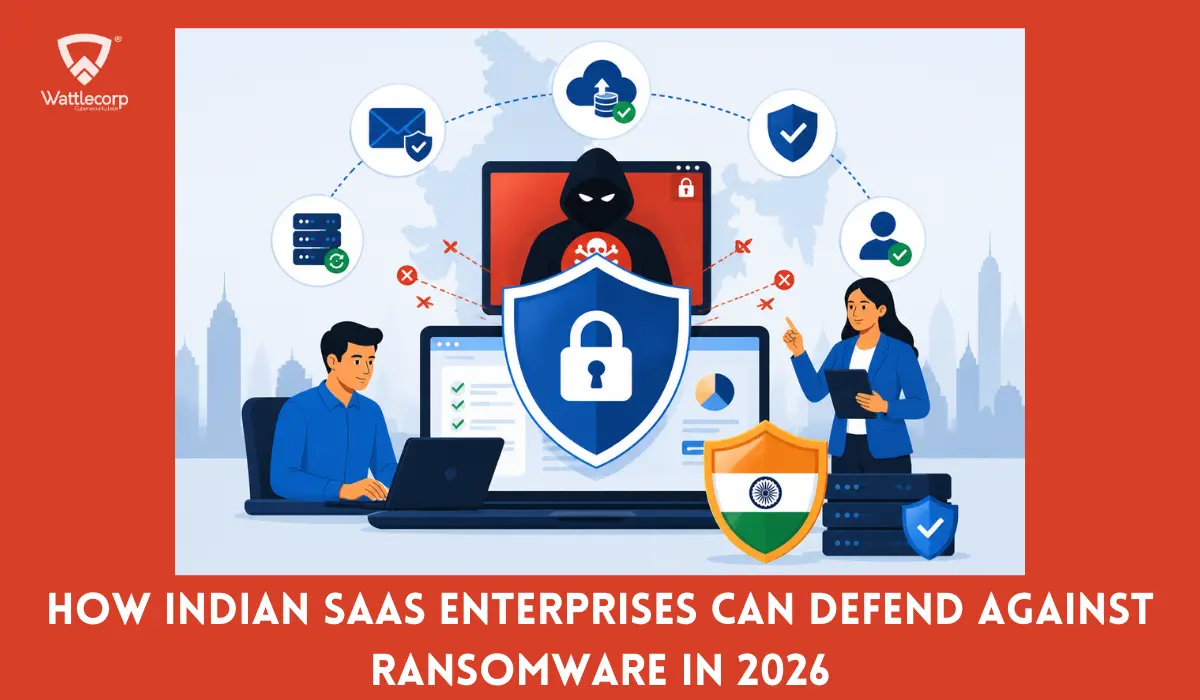
How Indian SaaS Enterprises Can Defend Against Ransomware in 2026
Key Takeaways:
- Ransomware defense for Indian enterprises in 2026 is identity-driven, which is not just malware-driven, access control is your first and most critical line of defense.
- Effective ransomware defense requires detection and response speed, not prevention tools alone. How fast you contain an attack determines the level of damage.
- Backup validation is as critical as prevention in any ransomware defense for Indian enterprises strategy. Test restoration before an incident, not during one.
- Ransomware defense built on compliance checklists alone will not survive a real attack, operational testing is what closes the gap between documentation and readiness.
- Proactive ransomware defense for Indian enterprises directly improves enterprise deal velocity, audit readiness, and long-term customer trust.
Why Ransomware Defense for Indian Enterprises Looks Different in 2026
Ransomware defense for Indian enterprises has moved well past the point of being a purely technical conversation.
Indian SaaS companies operate in a rapidly maturing threat environment.
Ransomware groups are better organized, better funded, and far more selective about who they target. These are not opportunistic attacks.
They are deliberate, researched, and designed to cause maximum disruption at the worst possible moment.
What makes 2026 different is how attacks actually start. Most people still picture ransomware as a malware problem, a malicious file that gets clicked, encryption that kicks in, a ransom note that appears.
That is rarely how it works anymore. Attackers today walk in through stolen credentials, exposed APIs, and cloud environments that were configured quickly and never reviewed.
Once inside, they move quietly, mapping your infrastructure, locating your backups, and identifying your most sensitive data, sometimes for weeks before any signs are detected.
By the time encryption triggers, the real damage is often already done.
The Digital Personal Data Protection Act, 2023 has added another layer of urgency to this picture.
A ransomware incident may trigger CERT-In cyber incident reporting obligations and, where personal data is compromised, DPDP-related breach notification exposure, making it both an operational and regulatory crisis.
If your ransomware defense for Indian enterprises still leans on perimeter firewalls and legacy antivirus tools, it is not just outdated. In 2026, it is a liability.
Why 2026 Is a Turning Point for Ransomware Defense in India
Modern ransomware attacks rarely begin with malware. They begin with stolen credentials, exposed APIs, and misconfigured cloud environments.
Attackers spend days or weeks inside a network before encrypting anything, mapping infrastructure, identifying sensitive data, and disabling backups along the way.
Ransomware defense for Indian enterprises must reflect this reality.
The Digital Personal Data Protection Act, 2023 and DPDP Rules 2025 add regulatory weight where ransomware incidents involve personal data compromise, creating notification and accountability obligations beyond operational recovery.
If your ransomware defense posture still relies primarily on perimeter controls and legacy antivirus tools, it needs a fundamental rethink.
Why Indian SaaS Companies Are Prime Targets
Indian SaaS platforms are attractive targets because they hold sensitive global enterprise data, run interconnected cloud infrastructure, and often scale faster than their security practices can follow.
Weak identity controls, poorly monitored APIs, and overprivileged accounts are the entry points attackers consistently exploit.
Smaller SaaS companies are also regularly used as stepping stones into larger client ecosystems.
Also Read : Top 10 Cybersecurity Companies in India for SaaS Businesses in 2026
Inadequate ransomware defense does not just put your own business at risk, it makes you a liability for your customers.
Effective ransomware defense for Indian enterprises means understanding your position in the broader supply chain, not just your own perimeter, while maintaining continuous security monitoring across interconnected systems and dependencies.
The Business Cost of Ransomware Failures in Indian Enterprises
A ransomware attack typically triggers days of downtime, immediate customer escalations, and contract reviews.
The longer-term damage leads to deal velocity, investor confidence, and brand reputation, which often outlasts the operational recovery itself.
Ransomware defense for Indian enterprises is, at its core, a revenue protection strategy.
Companies that treat ransomware defense as a core business investment close enterprise deals faster, pass security reviews with less friction, and build the customer trust that drives long-term retention.
A Real-World Ransomware Defense Framework for Indian Enterprises
Lock Down Identity First
Most ransomware attacks in 2026 begin with an identity compromise.
Strong ransomware defense starts with enforcing least privilege access, deploying MFA without exceptions, and monitoring for abnormal login behavior and privilege escalation in real time.
Identity-layer anomalies are often among the earliest warning signals and should be correlated with endpoint, network, cloud, and backup activity for reliable ransomware detection.
Build Detection You Can Actually Trust
Prevention will eventually fail.
What separates companies that survive ransomware incidents from those that don’t is how quickly they detect and contain them.
Mature ransomware defense for Indian enterprises demands SIEM and EDR working together, with behavior-based detection tuned for your actual environment, not generic signatures that sophisticated attackers already know how to bypass.
Detection engineering, building precise, context-aware alerting rules is what makes ransomware defense operational rather than theoretical.
Without it, security teams drown in noise and miss the signals that actually matter.
Validate Backups Before You Need Them
Unvalidated backups are one of the most dangerous false comforts in ransomware defense.
Many organizations discover mid-incident that their backups haven’t been tested in months, or that they only cover a fraction of critical data.
Immutable backups, offline copies, and regular restoration testing are non-negotiable in ransomware defense for Indian enterprises.
When encryption hits, there is no time to find out your recovery process does not work.
Run Realistic Attack Simulations
Red team exercises and ransomware simulations reveal gaps that no tabletop discussion can surface.
Periodic simulation is increasingly expected by enterprise buyers and is a practical best practice for SaaS platforms handling sensitive customer data.
Ransomware defense for Indian enterprises that has never been tested under realistic attack conditions is, in practical terms, untested.
Treat simulations like fire drills, scheduled, documented, and acted on.
Build and Practice an Incident Response Playbook
Knowing what to do when an attack unfolds is as important as preventing one.
Your IR playbook should cover containment, escalation, communication, and recovery steps specific to ransomware scenarios.
Ransomware defense without a practiced response capability leaves your team improvising under pressure, which is exactly when costly mistakes happen.
From Compliance to Execution: A 90-Day Ransomware Readiness Framework
ISO 27001, SOC 2, and the DPDP Act all create meaningful obligations. But ransomware defense built purely on compliance checklists will not hold against a real attack.
Compliance frameworks help define and evidence security controls, but they do not automatically prove that detection rules are tuned correctly or that teams can respond effectively during a live ransomware incident.
Use compliance as the foundation of ransomware defense for Indian enterprises, not the ceiling. Enterprise buyers increasingly want operational evidence, not just audit reports.
Also Read : ISO 27001 Certification Cost in India: What Businesses Should Expect in 2026
To translate compliance into real-world resilience, teams must adopt a structured execution roadmap for building or strengthening ransomware defense for Indian enterprises:
Days 0–30: Focus on visibility. Complete your asset inventory, establish logging baselines, and identify the highest-risk identity and access gaps across your environment.
Days 30–60: Shift to detection engineering. Tune your SIEM, deploy EDR, and build ransomware defense-specific alerting rules based on behavioral indicators rather than known signatures.
Days 60–90: Validate everything. Run your incident response playbooks, conduct a ransomware simulation, and test backup restoration end to end before you need it in a real incident.
How Wattlecorp Supports Indian SaaS Companies
Wattlecorp helps Indian SaaS companies build ransomware defense for Indian enterprises programs that are practical, audit-ready, and aligned with how modern attacks actually operate.
From readiness assessments and red team simulations to SIEM implementation, detection engineering, and continuous monitoring, Wattlecorp brings the depth that enterprise security reviews expect.
Ransomware defense is not a one-time exercise. It is a continuous discipline and that is exactly how Wattlecorp structures its work with clients.
Increasingly, regulatory bodies like CERT-In reinforce this shift through mandatory cyber incident reporting requirements, log retention expectations, and guidance that pushes organizations toward operational security maturity rather than checklist-based compliance.
Ransomware in 2026 is identity-driven, multi-stage, and designed to maximize damage before detection. Organizations are increasingly relying on partners like Wattlecorp to strengthen their security posture against such evolving threats.
Ransomware defense for Indian enterprises must match that evolution with stronger access controls, real-time detection, validated recovery, and an incident response capability that has been tested before it is needed to maintain continuous security.
The Indian SaaS companies investing in ransomware defense today are not just protecting themselves from attacks.
By adopting capabilities such as managed security services, Indian SaaS companies can build a competitive advantage that shows up in enterprise deals, audit outcomes, and long-term customer trust.
They are building a competitive advantage that highlights enterprise deals, audit outcomes, and long-term customer trust.
The ones that don’t will eventually face a conversation they are not prepared to have.
Ransomware Defense FAQs
1. What are the most effective ransomware defenses for Indian enterprises in 2026?
2. How does CERT-In recommend Indian organizations prepare for ransomware attacks?
3. Why are offline backups and restoration testing critical against ransomware?
4. Which Indian sectors face higher ransomware risk in 2026?
5. How do continuous security testing and managed security services improve ransomware resilience?

 Mobile Application Penetration Testing for Qatar Government Digital Services: NCSA- Aligned Security Assurance
Key Takeaways: Mobile Application Penetration Testing Qatar must cover the app, device storage, APIs, authentication and third-party components. Qatar’s NCSA assurance environment combines the National Information Assurance (NIA) Standard, the National Information Security Compliance Framework (NISCF) and accredited security assessment services. OWASP MASVS defines mobile security controls, while MASTG supplies practical test methods for Android […]
 Qatar Data Protection Law: Implementing PDPPL Data Subject Rights Processes for Businesses
Key Takeaways: The Qatar Data Protection Law (Law No. 13 of 2016) for Personal Data Privacy Protection, grants individuals specific rights such as right to access, correct, erase, object, withdraw consent, and right to be notified of processing or inaccurate disclosure. Beyond having a privacy policy, businesses or controllers, under Article 11 of Personal Data […]
 AI Governance for Indian Enterprises: Building Internal Controls Before Key DPDP Obligations Take Effect
Key Takeaways: The DPDP Act does not contain AI-specific provisions. Its requirements, however, apply in situations when an AI system processes digital personal data within its territorial and material scope. India is working on building a broader governance framework around safety, accountability, transparency and trust via programs like the IndiaAI Mission. Indian organizations should inventory […]
 Cloud Security Audit for UAE Government Cloud Migration: NCAP and Security Requirements
Key Takeaways: A cloud security audit UAE helps government entities identify security, governance, configuration, access, data-protection and resilience gaps, before and after shifting critical workloads to the cloud. UAE National Cloud Security Policy has defined cloud governance, data security, data sovereignty, IAM, incident management, resilience, portability and cloud operations requirements. The National Cyber Accreditation Program […]
 Data Privacy Consulting UAE – Building a PDPL-Compliant Data Governance Program
Key Takeaways: PDPL compliance requires ongoing operational governance that goes beyond policies to demonstrate how personal data is collected, used, protected, transferred, retained, and deleted. Data mapping helps businesses move from reactive compliance to proactive risk management by establishing a comprehensive inventory of the data ecosystem, helping build a mature data privacy and governance program. […]
 Saudi Arabia’s Critical Systems Controls: What CSP-Linked Enterprises Must Comply With in 2026
Key Takeaways: The Critical Systems Cybersecurity Controls (CSCC) are more applicable to critical systems than to all IT assets owned or operated by an organization. To be in full compliance or to remain in full compliance with CSCC, organizations must maintain continuous adherence to NCA ECC. CSCC has 32 core controls and 73 sub-controls across […]