

Saudi Arabia’s Critical Systems Controls: What CSP-Linked Enterprises Must Comply With in 2026
Key Takeaways:
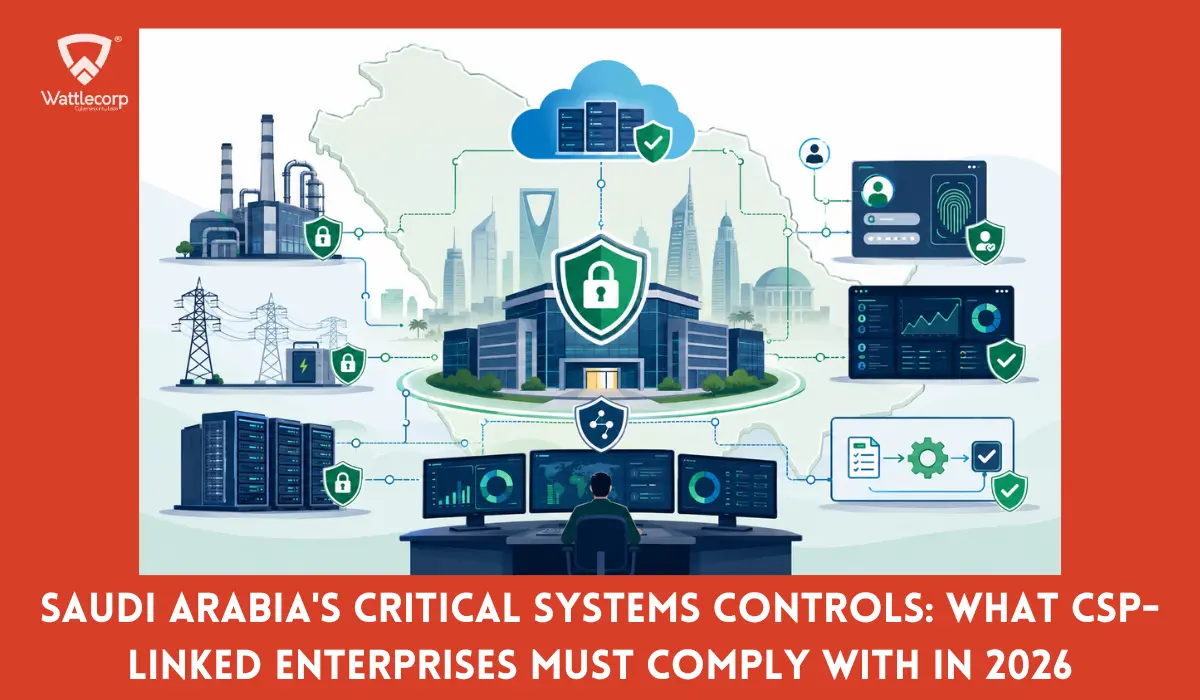
- The Critical Systems Cybersecurity Controls (CSCC) are more applicable to critical systems than to all IT assets owned or operated by an organization.
- To be in full compliance or to remain in full compliance with CSCC, organizations must maintain continuous adherence to NCA ECC.
- CSCC has 32 core controls and 73 sub-controls across four cybersecurity domains.
- Organizations hosting critical systems or technical components in cloud services must ensure that the hosting arrangement meets CSCC subcontrol 4-2-1-1 in accordance with the NCA Cloud Security Controls (NCA CCC) requirements.
- Vulnerability assessment, penetration testing, access control, monitoring, resilience and third party governance require demonstrable implementation, not just policy documents.
What Saudi Arabia Should Know About Critical Systems Cybersecurity Compliance Requirements in 2026
Consider a Saudi enterprise running a business-critical platform across a cloud environment. Its security team may already have MFA, vulnerability scanning, backups, SIEM monitoring, and a reputable cloud service provider in place. Yet, during a compliance readiness review, management discovers that it cannot clearly demonstrate which systems qualify as critical, whether every critical component is covered by testing, or whether its CSP relationship satisfies the cybersecurity requirements applicable to those systems.
Situations like these account for more than documentation gaps for organizations that support government services, critical infrastructure, high-impact digital platforms, or sensitive operations.
Saudi Arabia’s National Cybersecurity Authority (NCA) enforces Critical Systems Cybersecurity Controls as a mandatory framework to introduce specific protection measures for organizational and national infrastructure. Failing to comply with these may lead to high-impact consequences.
In such a context, enterprises, specifically those linked to cloud service providers, need to understand how CSCC, ECC, and Cloud Cybersecurity Controls interact, in 2026 and beyond.
What Makes a System “Critical” Under NCA CSCC?
The NCA defines a critical system as a system or network whose failure, unauthorized modification, unauthorized access, or data compromise could either harm organizational services or trigger significant national-level economic, financial, security, or social consequences.
Also Read : Cybersecurity Risk Assessment for Saudi Supply Chain Vendors Under Aramco and NCA Expectations
NCA identification criteria for critical systems also include:
- Potential impact on the Kingdom’s security and reputation
- Adverse effects on vital sector operations
- Potential risks or even loss of human life
- Unauthorized disclosure of data classified as Secret or Top Secret
- Significant financial loss
- Service disruption to a tremendous degree, affecting a good percentage of population
This means organizations cannot treat critical systems cybersecurity controls as a generic compliance checklist. They first need a defensible process for identifying critical systems and mapping the assets that support them, including networks, databases, servers, operating systems, applications, middleware, storage, encryption devices, privileged personnel, service providers, and associated documentation.
How Critical Systems Cybersecurity Controls Extends Saudi Arabia’s ECC Requirements
Saudi NCA’s Critical Systems Cybersecurity Controls is designed as an extension and complement to the Essential Cybersecurity Controls. The NCA explicitly states that organizations must continuously comply with ECC to achieve full CSCC compliance. CSCC adds stronger requirements where the potential impact of compromise is greater.
The critical systems cybersecurity controls contain four domains:
- Cybersecurity Governance
- Cybersecurity Defense
- Cybersecurity Resilience
- Third-Party and Cloud Computing Cybersecurity
Also Read : The Intersection of NCA ECC and Data Privacy: Ensuring Comprehensive Protection
For security and compliance teams already managing multiple NCA requirements, the practical challenge is avoiding separate compliance silos. Controls should be mapped across ECC, CSCC, and any additional applicable frameworks so that one technical safeguard can provide evidence against multiple requirements.
Critical Security Requirements Enterprises Should Prioritize
Critical Systems Cybersecurity Controls introduce several measurable requirements that directly affect day-to-day security operations.
One of these mentions that cybersecurity risk assessments for critical systems must be conducted at least annually, with the associated risk register reviewed on a monthly basis. Critical-system configurations and hardening must be reviewed at least every six months.
Secondly, the strict identity controls going hand in hand with critical systems cybersecurity controls, enforce multifactor authentication (MFA), privileged administration safeguards, regular access reviews, and limited and secured remote access to prevent breaches.
For many enterprises, the biggest ICP pain point is not knowing whether these controls exist somewhere in the environment, but whether they are consistently implemented across every critical component and whether evidence can demonstrate that implementation.
Vulnerability Assessment and Penetration Testing Under CSCC
The pace at which cyber threats are rising increasingly prompt security leaders to increase their testing frequencies. Since critical systems attack surfaces and vulnerabilities keep changing over time, relying on one-time assessments will only add to the risk. Periodic testing and continuous security assessments should remain a priority to reduce cyber threat exposures.
CSCC requires vulnerability assessments of critical-system technical components at least monthly. It also requires penetration testing to cover all technical components and internal and external services of critical systems, using a qualified team, at least once every six months.
Organizations evaluating VAPT services Saudi need to look beyond a conventional annual perimeter assessment. This is given the dynamic nature of the cloud environments, the complex AI integrations, and the rapid digital growth under Vision 2030. The fact that these create and widen exposure gaps on a continuous plane qualifies them to undergo more regular security assessments.
These do not end here. Testing scope, asset coverage, remediation evidence, retesting, and alignment with the actual critical-system boundary are a must as far as demonstrating readiness with both ECC and Critical Systems Cybersecurity Controls is concerned.
What CSP-Linked Critical Systems Need to Address
Cloud adoption does not transfer the organization’s CSCC accountability to its provider.
CSCC states that its cloud and hosting subdomain (Subdomain 4-2, i.e., Cloud Computing and Hosting Cybersecurity) applies where organizations currently use or plan to use cloud computing or hosting services. Subcontrols 4-2-1-1 of Critical Systems Cybersecurity Controls (CSCC-1:2019) also mention where organizations can host their critical systems and associated technical components.
The current CCC 2:2024 extends ECC requirements specifically for Cloud Service Providers and Cloud Service Tenants to establish clear cloud security baselines.
CSP-linked enterprises should also establish clear allocation of cybersecurity responsibilities between an organization and its cloud service provider. This should accompany validation of applicable CSP and CST-side controls, supported by appropriate evidence.
Building CSCC Readiness in 2026
A practical readiness program should begin with identifying critical systems using NCA criteria and establishing a documented system boundary. This enables organizations to map relevant ECC, CSCC and CCC requirements to existing controls.
The next step is an evidence-driven validation that includes reviewing configurations, privileges, network segmentation, vulnerability management, penetration-testing coverage, logging, backup recovery, third-party arrangements, and cloud responsibilities.
Wattlecorp helps organizations assess and prioritize CSCC compliance gaps based on cybersecurity risk and regulatory significance. Our approach in this regard goes beyond treating compliance as a checklist exercise, having our team support enterprises like you in identifying critical systems, evaluating existing controls against applicable NCA requirements, validating technical and operational safeguards, and developing prioritized remediation plans. Our NCA Cybersecurity Framework Assessment Services in Saudi Arabia help strengthen your ongoing compliance readiness activities that specifically include internal assessments and potential NCA compliance reviews or on-site audits.
Critical Systems Cybersecurity Controls FAQs
1. What are the NCA Critical Systems Cybersecurity Controls (CSCC) in Saudi Arabia?
2. Which organizations and systems are subject to NCA CSCC requirements?
3. How are CSCC, ECC, and Cloud Cybersecurity Controls related?
4. What cybersecurity requirements should CSP-linked critical systems address in Saudi Arabia?
5. How can organizations assess their readiness for NCA CSCC compliance in 2026?

 Saudi Arabia’s Critical Systems Controls: What CSP-Linked Enterprises Must Comply With in 2026
Key Takeaways: The Critical Systems Cybersecurity Controls (CSCC) are more applicable to critical systems than to all IT assets owned or operated by an organization. To be in full compliance or to remain in full compliance with CSCC, organizations must maintain continuous adherence to NCA ECC. CSCC has 32 core controls and 73 sub-controls across […]
 DevSecOps for Saudi Banking and FinTech Applications: Building a SAMA-Aligned Secure Development Lifecycle
Key Takeaways: DevSecOps Saudi Arabia for banks & FinTech enterprises doesn’t make security journey a last stop but embeds it into the software development life cycle. Mapping DevSecOps methods to the SAMA Cybersecurity Framework improves security governance and application resilience while boosting audit readiness. Continuous security testing such as SAST, DAST, SCA, IaC scanning, and […]
 Qatar Cybersecurity Boardroom Accountability: Why QCB and NCSA Now Expect Executive Ownership
Key Takeaways: Cybersecurity in Qatar is increasingly becoming an executive governance responsibility, with national cybersecurity initiatives and sector-specific requirements encouraging organizations to establish stronger leadership oversight. QCB and NCSA play important roles in strengthening cybersecurity governance in Qatar, with QCB focusing on financial sector requirements and NCSA supporting national-level cybersecurity coordination and guidance. Executives can’t […]
 Data Privacy Consulting for Saudi Enterprises: How to Operationalize PDPL Data Subject Rights in 2026
Key Takeaways: The Saudi data protection law may apply to organizations outside the Kingdom when they process personal data related to individuals in Saudi Arabia, meaning geographic location alone does not automatically exclude an organization from PDPL obligations. PDPL data subject rights span access, correction, deletion, and consent withdrawal, and enterprises are on the hook […]
 Third-Party Vendor Security Risk Assessment Under DPDP: A Guide for Indian Enterprises
Key Takeaways: Third-party vendor risk assessment with DPDP practices helps Indian enterprises to verify that external partners handle personal data with adequate safeguards. The Digital Personal Data Protection Act holds data fiduciaries accountable for vendor conduct, which makes due diligence a legal and operational necessity. A structured vendor security questionnaire, covering encryption, access control, and […]
 Virtual CISO Services for UAE Free Zone Startups: Affordable Security Leadership for Growing Companies
Key Takeaways: Most startups already hold sensitive data such as customer info, source code, financials, long before they feel big enough to take security seriously, and that’s exactly when the risk starts. A virtual CISO gets you someone who’s done this before, setting up strategy and guiding compliance, without the cost of putting a full-time […]