


Cybersecurity Risk Assessment for Saudi Supply Chain Vendors Under Aramco and NCA Expectations
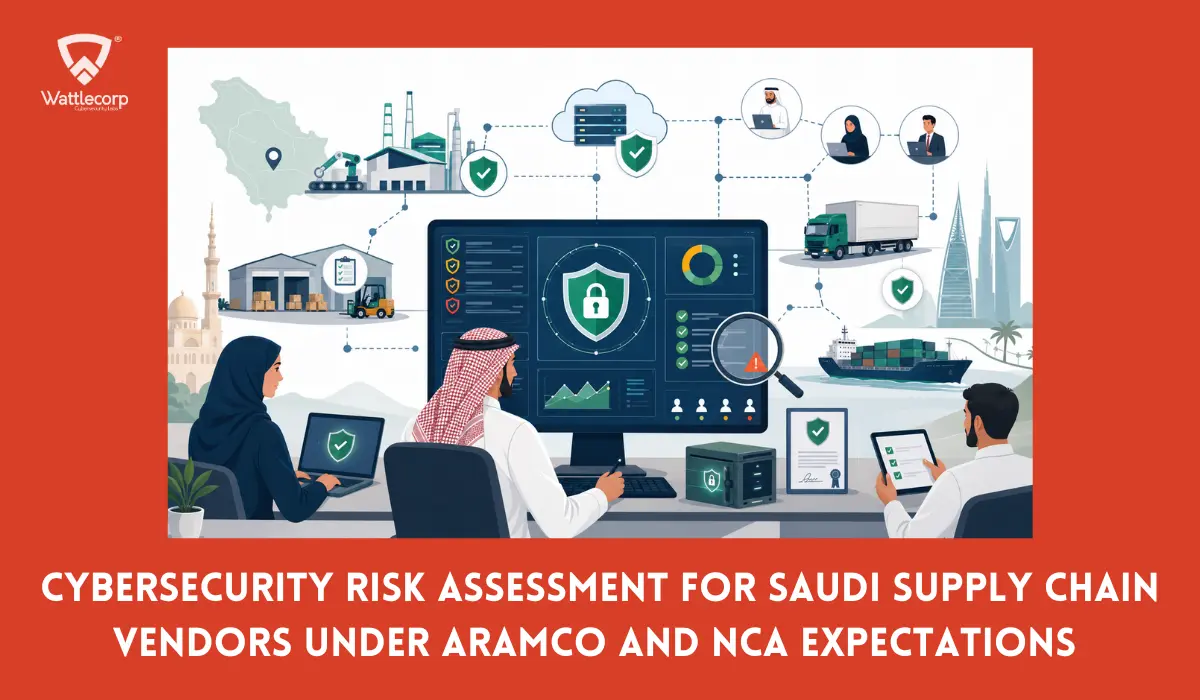
Key Takeaways:
- Cybersecurity risk assessment becomes a practical requirement for proving security maturity, with protecting vendor relationships, and moving forward in procurement processes with Aramco and critical infrastructure clients.
- Vendors will need to provide evidence of access review documentation, patch deployment, monitoring artifacts, technical assessment results and more that demonstrates the controls in place are effective.
- An effective assessment scope is a screening of the systems that allows vendors to concentrate on the things that matter. Customer applications, infrastructure, and data flows are the top priority for Saudi vendors to maintain customer operations, continuity, and essential services delivery.
- VAPT, cloud configuration review, identity and access evaluation, and infrastructure hardening review help validate whether security controls are properly implemented and whether exploitable weaknesses exist in real-world attack paths.
- Vendors that can transform the output of their findings into a realistic 90–120-day improvement plan consolidate the reduction of business risk, evidence of progress, and enterprise buying and regulatory confidence.
Cybersecurity Risk Assessment for Saudi Vendors Under Aramco and NCA Requirements
Aramco’s Cybersecurity Compliance Certificate program changed how vendors get evaluated in Saudi Arabia. Organizations, which maintained vendor relationships through documented security policies and internal control frameworks are now facing stricter requirements.
What Aramco changed was the assurance requirement. Vendors are now expected to provide evidence-based validation that their cybersecurity controls align with SACS-002 expectations. Before, vendors submitted security policies and pointed to their control procedures. Aramco cybersecurity compliance certificate demands independent, objective proof that security controls do what they’re supposed to do.
The certification methodology is straightforward in concept but demanding in execution. Security policies remain important, but they’re just a starting point. When vendors claim they’ve implemented access controls, Aramco wants to see the audit trails.
When they say systems are patched regularly, Aramco wants deployment records showing when patches were applied.
Monitoring data helps demonstrate that detection systems are operating, while alert reviews, use-case validation, incident records, and tuning evidence show whether detection processes are effective. This evidence-based cybersecurity risk assessment approach means vendors need multiple types of documentation.
Access governance requires the audit trails. Patch management needs deployment records. Infrastructure hardening requires technical assessment results. Detection capability demands monitoring artifacts. Lacking any of these creates gaps in the vendor qualification picture.
Why Framework Alignment Matters for Vendor Advancement
National Cybersecurity Authority’s Essential Cybersecurity Controls (ECC) establish baseline cybersecurity expectations for Saudi national entities, especially government and critical infrastructure environments. Vendors may also encounter ECC-aligned expectations through customer procurement and third-party risk assessments.
Direct NCA regulation may vary by organizational classification, major procurement entities increasingly reference to ECC framework principles during the vendor evaluation.
This creates an expectation that cybersecurity risk assessments focus on addressing both Aramco-specific requirements and broader NCA alignment.
Also Read : NCA Compliance and Cybersecurity Excellence: How Saudi Banks Can Achieve Regulatory Success
Vendors attempting to satisfy only one framework often find that their assessment efforts fall short of customer expectations. Aramco-focused cybersecurity risk assessment may address SACS-002 requirements while missing broader NCA principles.
Third-party vendors learn through experience that cybersecurity risk assessment credibility depends on demonstrating the alignment across multiple standards simultaneously.
Organizations that map their evidence and controls across both SACS-002 and relevant NCA ECC expectations can strengthen procurement confidence and reduce vendor qualification friction.
Understanding What Scope Definition Actually Accomplishes
Vendors frequently approach cybersecurity risk assessment by examining their organizational infrastructure comprehensively. This expansive methodology may consume a substantial budget while generating the findings of limited relevance to customer qualification purposes.
Effective scope definition prioritizes assessment effort on systems directly that influencing business continuity and customer relationships. This distinction assists to separates meaningful assessment from compliance, which consuming organizational bandwidth without strategic value.
Vendors should identify that which infrastructure handles customer data and which applications maintain the integration with customer systems and which assets support critical service delivery.
Departmental perspectives ensure to shape appropriate scope.
- Finance prioritizes more on systems processing transactions.
- Operations emphasize on infrastructure supporting customer commitments.
- Security frequently assesses on disconnected from these operational contexts.
Assessment organizations, which align security evaluation scope with business criticality generate findings customers value during vendor qualification.
Wattlecorp’s cybersecurity risk assessment helps organizations to clarify scope definition before the assessment initiation, with preventing resource misallocation across peripheral infrastructure while ensuring critical systems receive adequate evaluation attention.
Building Organized Evidence: The Foundation Gap Most Vendors Face
Vendors typically maintain functional security controls generating relevant operational data daily. Access management teams review user privileges. System administrators deploy the patches. Monitoring systems collect security events. Yet when assessment activities commence, evidence often remains scattered across operational systems without organized documentation framework.
This evidence organization gap represents primary delay factor during cybersecurity risk assessment activities. Organizations may operate solid access governance procedures without maintaining centralized access review records.
Patch deployment occurs on schedule, so that the deployment documentation lacks completeness. It is essential to monitoring systems function properly while alert tuning results aren’t systematically captured.
Building evidence frameworks before the formal cybersecurity risk assessment commencement supports to accelerates the assessment completion substantially.
Usually, organizations that systematically gather access control documentation, compile patch records, and organize monitoring artifacts progress through assessment activities with minimal delays. This preparation helps to demonstrates organizational maturity regarding security governance.
Moreover, most effective approach involves identifying required evidence categories aligned with Aramco SACS-002 and NCA ECC expectations, then systematically collecting existing operational documentation into organized formats. This transform scattered data into a credible assessment foundation that supports vendor qualification.
Moving From Findings to Prioritized Remediation
Assessment activities support to generate findings that requiring disciplined prioritization. Organizations, which discovering numerous vulnerabilities often attempt simultaneous remediation across all findings, resulting in demoralized teams and minimal visible progress.
Strategic prioritization ensures to maintain measurable improvement with maintaining operational stability and an effective cybersecurity risk assessment focuses on to evaluates multiple dimensions simultaneously.
Exploitability assesses whether the identified exposures permit straightforward compromise and cybersecurity regulatory relevance examines whether gaps directly violate Aramco SACS-002 or NCA expectations.
Also Read : How Aramco CCC Shapes Supplier Compliance and Cybersecurity in Saudi Arabia
Remediation feasibility finds that whether these issues require configuration changes or need architectural modifications. This structured approach helps to creates more realistic remediation roadmaps spanning around 90-120 days.
Organizations that handling highest-impact issues first demonstrate measurable security improvement to customers observing remediation progress. This builds confidence during vendor qualification processes.
Understanding Vendor Qualification Through Security Assessment
Cybersecurity risk assessment ultimately helps determine whether vendors advance through procurement or encounter qualification delays. Organizations that managing Aramco data or connecting to infrastructure, which represent material security risk requiring evidence-based confidence.
Vendors that view cybersecurity risk assessment as strategic investment, they need to develop deeper understanding of their actual security posture beyond compliance checkboxes.
Organizations that completing cybersecurity risk assessment activities need to establish foundations supporting long-term vendor relationship stability with Aramco and other critical infrastructure customers.
The most successful vendors approach cybersecurity risk assessment as organizational development activity rather than compliance obligation. This perspective enables teams to use assessment findings for genuine security improvement rather than superficial compliance demonstration.
Wattlecorp’s Approach to Cybersecurity Risk Assessment
Effective assistance for Saudi vendors throughout cybersecurity risk assessment help to make the implementation aligned with Aramco SACS-002 and NCA ECC frameworks. It also helps organizations clarify assessment scope, identify evidence gaps, plan technical validation activities, and structure board-level governance over remediation progress.
Our methodology combines technical assessment expertise with remediation planning experience, enabling vendors to address security gaps strategically rather than reactively. Our NCA Cybersecurity Framework Assessment services integrate scope definition, evidence collection support, technical assessment coordination, and business-aligned remediation planning.
This comprehensive approach ensures cybersecurity risk assessment produces genuine security improvement with VAPT assistance rather than compliance documentation.
Organizations beginning their cybersecurity risk assessment journey benefit from external expertise navigating Aramco and NCA requirement complexity while maintaining focus on legitimate security improvement. Wattlecorp brings experience from multiple vendor assessments, enabling efficient gap identification and realistic remediation planning.
Strengthening Vendor Readiness Through Cybersecurity Risk Assessment
Cybersecurity risk assessment transitions from abstract requirement to organizational reality once implementation commences. Organizations investing in proper cybersecurity risk assessment gain knowledge extending far beyond compliance satisfaction.
Wattlecorp recognizes that cybersecurity risk assessment represents critical vendor qualification requirement in current Saudi supply chain environment. Our team combines both technical assessment expertise with business-focused remediation guidance, which enabling vendors to address security gaps strategically while maintaining operational stability.
If your organization operates within Aramco supply ecosystem or serves critical infrastructure sectors in Saudi Arabia, cybersecurity risk assessment credibility determines competitive positioning and procurement advancement.
Our NCA Cybersecurity Framework Assessment services provide technical expertise, assessment methodology, and remediation guidance ensuring your cybersecurity risk assessment produces genuine security maturity rather than compliance documentation.
Cybersecurity Risk Assessment FAQs
1. What is a cybersecurity risk assessment for Saudi supply chain vendors?
2. Why do Aramco vendors need cybersecurity risk assessment?
3. How does NCA ECC relate to third-party vendor cybersecurity in Saudi Arabia?
4. What is the difference between SACS-002 compliance and NCA cybersecurity assessment?
5. Can VAPT services Saudi support supplier cybersecurity risk assessment?

 Saudi Arabia’s Critical Systems Controls: What CSP-Linked Enterprises Must Comply With in 2026
Key Takeaways: The Critical Systems Cybersecurity Controls (CSCC) are more applicable to critical systems than to all IT assets owned or operated by an organization. To be in full compliance or to remain in full compliance with CSCC, organizations must maintain continuous adherence to NCA ECC. CSCC has 32 core controls and 73 sub-controls across […]
 DevSecOps for Saudi Banking and FinTech Applications: Building a SAMA-Aligned Secure Development Lifecycle
Key Takeaways: DevSecOps Saudi Arabia for banks & FinTech enterprises doesn’t make security journey a last stop but embeds it into the software development life cycle. Mapping DevSecOps methods to the SAMA Cybersecurity Framework improves security governance and application resilience while boosting audit readiness. Continuous security testing such as SAST, DAST, SCA, IaC scanning, and […]
 Qatar Cybersecurity Boardroom Accountability: Why QCB and NCSA Now Expect Executive Ownership
Key Takeaways: Cybersecurity in Qatar is increasingly becoming an executive governance responsibility, with national cybersecurity initiatives and sector-specific requirements encouraging organizations to establish stronger leadership oversight. QCB and NCSA play important roles in strengthening cybersecurity governance in Qatar, with QCB focusing on financial sector requirements and NCSA supporting national-level cybersecurity coordination and guidance. Executives can’t […]
 Data Privacy Consulting for Saudi Enterprises: How to Operationalize PDPL Data Subject Rights in 2026
Key Takeaways: The Saudi data protection law may apply to organizations outside the Kingdom when they process personal data related to individuals in Saudi Arabia, meaning geographic location alone does not automatically exclude an organization from PDPL obligations. PDPL data subject rights span access, correction, deletion, and consent withdrawal, and enterprises are on the hook […]
 Third-Party Vendor Security Risk Assessment Under DPDP: A Guide for Indian Enterprises
Key Takeaways: Third-party vendor risk assessment with DPDP practices helps Indian enterprises to verify that external partners handle personal data with adequate safeguards. The Digital Personal Data Protection Act holds data fiduciaries accountable for vendor conduct, which makes due diligence a legal and operational necessity. A structured vendor security questionnaire, covering encryption, access control, and […]
 Virtual CISO Services for UAE Free Zone Startups: Affordable Security Leadership for Growing Companies
Key Takeaways: Most startups already hold sensitive data such as customer info, source code, financials, long before they feel big enough to take security seriously, and that’s exactly when the risk starts. A virtual CISO gets you someone who’s done this before, setting up strategy and guiding compliance, without the cost of putting a full-time […]