


Third-Party Vendor Security Risk Assessment Under DPDP: A Guide for Indian Enterprises
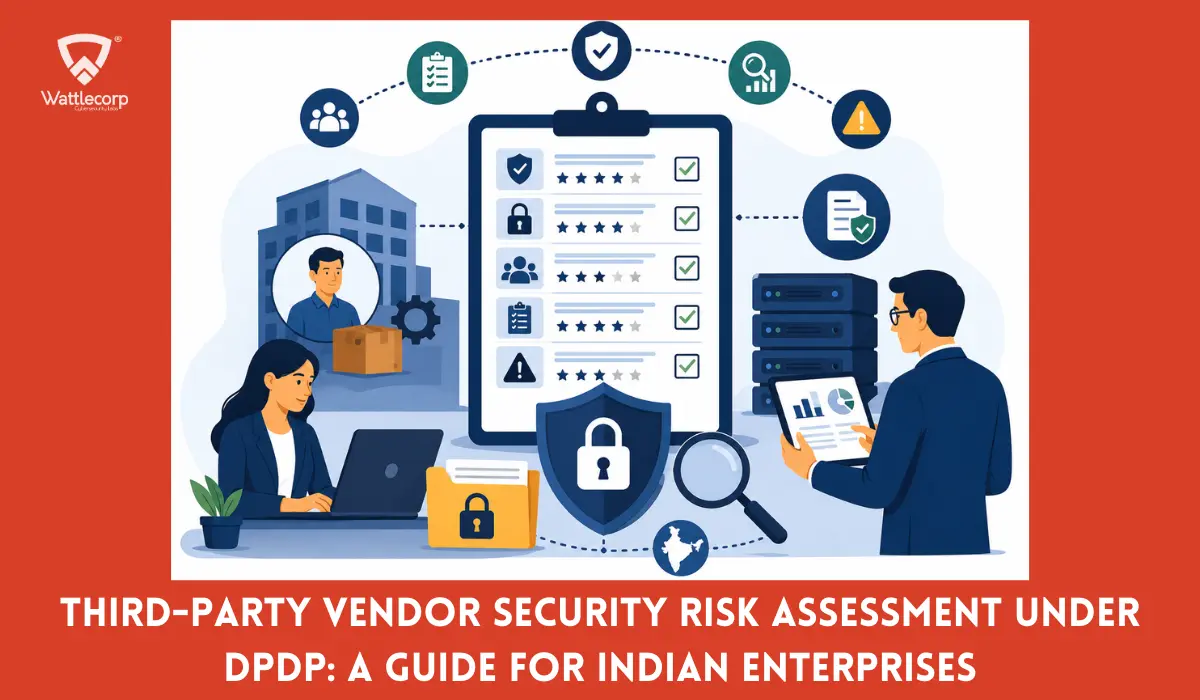
Key Takeaways:
- Third-party vendor risk assessment with DPDP practices helps Indian enterprises to verify that external partners handle personal data with adequate safeguards.
- The Digital Personal Data Protection Act holds data fiduciaries accountable for vendor conduct, which makes due diligence a legal and operational necessity.
- A structured vendor security questionnaire, covering encryption, access control, and incident response, forms the backbone of a reliable assessment process.
- Regular reassessment, contractual clauses, and monitoring help to reduce the likelihood of data breaches originating from third-party ecosystems.
- Specialized testing, including mobile app penetration testing India helps strengthen vendor risk programs for fintech, SaaS, and app-based businesses.
Most Indian enterprises no longer run their operations on a single, self-contained system. Cloud hosting, payment gateways, customer support platforms, HR software, and marketing tools are typically supplied by outside vendors, and each of these vendors touches personal data in some form.
That dependency is exactly why third-party vendor risk assessment DPDP has become a recurring line item in board discussions rather than a topic confined to the legal or IT department.
The Digital Personal Data Protection Act, 2023, significantly changed the compliance landscape for organizations handling personal data in India. Obligations no longer stop at the enterprise’s own servers; they extend to every partner that stores, processes, or transmits information on the organization’s behalf.
A vendor’s careless configuration, an unpatched server, or a poorly trained support team can undo years of internal security investment. For sectors like banking, insurance, healthcare, and e-commerce, where personal data volumes are high and scrutiny is intense, a disciplined third-party vendor risk assessment DPDP framework has effectively become table stakes.
This piece looks at what such an assessment involves, why Indian law makes it unavoidable, and how enterprises can build a third-party vendor risk assessment DPDP process around it that holds up under audit.
What Third-Party Vendor Risk Assessment Under DPDP Actually Involves
At its core, third-party vendor risk assessment DPDP is an exercise in verification. It is the structured process of checking whether a vendor’s data handling practices, technical controls, and compliance posture meet the standard an enterprise is legally required to uphold before, and throughout, a working relationship.
Digital Personal Data Protection draws a distinction between the data fiduciary, the entity that decides why and how personal data is processed, and the data processor, typically the vendor carrying out that processing on the fiduciary’s instructions.
The catch is that liability does not transfer cleanly. Even when a vendor mishandles data, the fiduciary usually remains answerable to regulators and to the individuals whose data was exposed. That single fact drives most of the urgency around third-party vendor risk assessment DPDP work across Indian industries today.
A properly scoped assessment looks past a vendor’s marketing claims. It examines technical safeguards, internal policies, incident history, whether subcontractors are involved, and where data physically resides. It should also confirm the vendor can support data principal rights such as access, correction, and erasure requests, since these are guaranteed under the Act and cannot be outsourced away.
Why DPDP Leaves No Room for Skipping Vendor Due Diligence
The Digital Personal Data Protection Act, 2023 sets a direct expectation. Enterprises must apply reasonable security safeguards, and that requirement does not stop at their own network perimeter. It follows the data wherever it travels, including into vendor environments. Treating third-party vendor risk assessment DPDP as optional, or as a formality completed once during onboarding, misreads what the law asks for.
Organizations designated as Significant Data Fiduciaries under the DPDP Act are expected to appoint a Data Protection Officer, who can oversee vendor governance, audit planning, and data flow management. The role typically oversees vendor contracts, audit schedules, and data flow mapping, keeping the enterprise’s exposure visible rather than buried in procurement paperwork.
Privacy compliance across India has shifted noticeably over the past few years, moving away from a one-time checklist toward something closer to continuous governance, especially as enforcement mechanisms under the Act begin to take shape.
Also Read : Mobile App Security Testing for Indian Digital Lending Apps RBI, DPDP and API Risk Checklist
There is a cost to getting this wrong that goes beyond fines. A vendor running outdated software, granting excessive access, or lacking a workable incident response plan can become the weak link that undermines an otherwise well-secured organization.
Enterprises that build third-party vendor risk assessment DPDP into their operating rhythm, rather than treating it as a one-off exercise, tend to catch these weaknesses before they turn into breaches.
Reputational stakes matter too. Customers, investors, and partners increasingly expect visible proof of responsible data stewardship, not just a privacy policy on a website. Demonstrating a working third-party vendor risk assessment DPDP program signals a level of maturity that is becoming difficult to compete without.
Building a DPDP-Ready Vendor Security Questionnaire
A consistent questionnaire is what turns third-party vendor risk assessment DPDP from a subjective judgment call into something comparable across vendors. Without one, enterprises end up relying on whatever documentation a vendor chooses to hand over, which is rarely enough.
- Data handling and storage: Vendors should clearly disclose where personal data is stored, whether cross-border transfers occur, and how those transfers comply with applicable DPDP requirements.
- Access control: Role-based access, multi-factor authentication, and periodic access reviews matter more than most vendors initially disclose. This section of the assessment often reveals significant security weaknesses, particularly when combined with reviews of logging, monitoring, and privileged access management.
- Incident response: DPDP requires timely breach reporting, so vendors need a documented plan and, more importantly, a track record of notifying clients promptly when something goes wrong.
Also Read : Data Minimization and Purpose Limitation: Core Principles of the DPDPA (INDIA)
- Subcontractor exposure: Few vendors operate in isolation. A thorough third-party vendor risk assessment DPDP process traces the chain of subcontractors a vendor relies on, because personal data can leak through a link the enterprise never directly contracted with.
- Consent and data principal rights: Any vendor collecting or processing customer data on the enterprise’s behalf should support consent management India requirements, including consent withdrawal and data principal requests, without requiring manual intervention every time.
- Retention and deletion: Personal data that outlives its purpose becomes a liability. Vendors should confirm deletion or anonymization timelines that align with data minimization principles under the Act.
Put together, these six areas give enterprises something they can defend in an audit, rather than a stack of self-reported claims.
A Practical Process for Running the Assessment
Enterprises that manage dozens or hundreds of third-party relationships need a repeatable sequence because the ad hoc reviews rarely scale past a handful of vendors.
Start by categorizing vendors according to the sensitivity and volume of personal data they touch. A payroll processor handling salary and bank details clearly warrants more scrutiny than a vendor supplying office furniture and treating both the same wastes effort where it is least needed.
Initial due diligence comes next, gathering certifications, security policies, and prior audit findings before a vendor is allowed anywhere near live personal data. From there, a privacy impact assessment conducted by India teams helps clarify how the relationship affects data subjects and what risk remains once mitigations are applied.
Contracts need to carry their weight too. Clauses covering processing limitations, audit rights, breach notification timelines, and liability allocation give the third-party vendor risk assessment DPDP program legal teeth, not just a paper trail.
Where the vendor’s role is technical, independent security testing adds a layer that policy reviews cannot replicate on their own. And because vendor risk shifts over time, as systems change and staff turnover, periodic reassessment and monitoring of public breach disclosures should continue for as long as the relationship lasts.
Enterprises that follow this sequence consistently tend to close compliance gaps faster and maintain a more accurate picture of risk management across the vendor lifecycle.
Extending the Assessment to Mobile Apps, Fintech, and SaaS Vendors
A single mobile application or SaaS platform often relies on numerous APIs, third-party libraries, cloud services, identity providers, and software supply chain components, each introducing its own security considerations. This is where technical testing becomes a necessary complement to the governance side of third-party vendor risk assessment DPDP.
Mobile app penetration testing India providers conduct is particularly relevant for banking apps, digital wallets, and customer-facing platforms that store or transmit personal data, since these applications are frequent attack targets.
Testing commonly identifies insecure local storage, weak session management, exposed APIs, certificate validation issues, insecure authentication mechanisms, and other weaknesses before attackers can exploit them.
For vendors supplying software components or hosting infrastructure, enterprises should ask for recent penetration test results as standard practice within their third-party vendor risk assessment DPDP process, not as an optional extra. This matters most for fintech and SaaS providers, where a single overlooked vulnerability can affect an entire user base at once.
Combining governance-focused reviews with technical validation, including mobile app penetration testing India engagements, gives enterprises a far more complete view of risk than either approach delivers alone.
Building Vendor Trust Through Continuous DPDP Risk Governance
Third-party vendor risk assessment DPDP has moved well past being a compliance checkbox for Indian enterprises. As organizations lean further into external vendors for cloud infrastructure, payments, and app development, Wattlecorp helps businesses strengthen third-party security and compliance because the obligation to protect personal data does not end where the organization’s own systems stop.
The DPDP Act reflects that reality directly, holding data fiduciaries responsible for how their vendors handle information on their behalf. A program built around third-party vendor risk assessment DPDP works best when it combines structured questionnaires, enforceable contract terms, ongoing monitoring, and technical checks such as mobile app penetration testing India engagements.
Enterprises willing to treat this as continuous governance, rather than a box to tick during onboarding, will be better placed to protect data privacy, prevent breaches, satisfy regulators, and maintain the trust of the customers and partners whose data they are entrusted with.
Third-Party Vendor Risk Assessment DPDP FAQs
1. What is third-party vendor security risk assessment under DPDP in India?
2. Does DPDP make Indian enterprises responsible for vendors that process personal data?
3. What should be included in a DPDP vendor security assessment checklist?
4. How often should Indian enterprises assess vendor security risks?
5. How does mobile app penetration testing India connect with vendor risk assessment for apps, fintech platforms, and SaaS products?

 Mobile Application Penetration Testing for Qatar Government Digital Services: NCSA- Aligned Security Assurance
Key Takeaways: Mobile Application Penetration Testing Qatar must cover the app, device storage, APIs, authentication and third-party components. Qatar’s NCSA assurance environment combines the National Information Assurance (NIA) Standard, the National Information Security Compliance Framework (NISCF) and accredited security assessment services. OWASP MASVS defines mobile security controls, while MASTG supplies practical test methods for Android […]
 Qatar Data Protection Law: Implementing PDPPL Data Subject Rights Processes for Businesses
Key Takeaways: The Qatar Data Protection Law (Law No. 13 of 2016) for Personal Data Privacy Protection, grants individuals specific rights such as right to access, correct, erase, object, withdraw consent, and right to be notified of processing or inaccurate disclosure. Beyond having a privacy policy, businesses or controllers, under Article 11 of Personal Data […]
 AI Governance for Indian Enterprises: Building Internal Controls Before Key DPDP Obligations Take Effect
Key Takeaways: The DPDP Act does not contain AI-specific provisions. Its requirements, however, apply in situations when an AI system processes digital personal data within its territorial and material scope. India is working on building a broader governance framework around safety, accountability, transparency and trust via programs like the IndiaAI Mission. Indian organizations should inventory […]
 Cloud Security Audit for UAE Government Cloud Migration: NCAP and Security Requirements
Key Takeaways: A cloud security audit UAE helps government entities identify security, governance, configuration, access, data-protection and resilience gaps, before and after shifting critical workloads to the cloud. UAE National Cloud Security Policy has defined cloud governance, data security, data sovereignty, IAM, incident management, resilience, portability and cloud operations requirements. The National Cyber Accreditation Program […]
 Data Privacy Consulting UAE – Building a PDPL-Compliant Data Governance Program
Key Takeaways: PDPL compliance requires ongoing operational governance that goes beyond policies to demonstrate how personal data is collected, used, protected, transferred, retained, and deleted. Data mapping helps businesses move from reactive compliance to proactive risk management by establishing a comprehensive inventory of the data ecosystem, helping build a mature data privacy and governance program. […]
 Saudi Arabia’s Critical Systems Controls: What CSP-Linked Enterprises Must Comply With in 2026
Key Takeaways: The Critical Systems Cybersecurity Controls (CSCC) are more applicable to critical systems than to all IT assets owned or operated by an organization. To be in full compliance or to remain in full compliance with CSCC, organizations must maintain continuous adherence to NCA ECC. CSCC has 32 core controls and 73 sub-controls across […]