

Qatar Data Protection Law: Implementing PDPPL Data Subject Rights Processes for Businesses
Key Takeaways:
- The Qatar Data Protection Law (Law No. 13 of 2016) for Personal Data Privacy Protection, grants individuals specific rights such as right to access, correct, erase, object, withdraw consent, and right to be notified of processing or inaccurate disclosure.
- Beyond having a privacy policy, businesses or controllers, under Article 11 of Personal Data Privacy Protection Law (PDPPL), need to have internal mechanisms to handle user complaints and requests in terms of access, correction, and deletion of personal data.
- The NCSA guidance requires controllers to respond to data subject requests within 30 calendar days, avoiding compliance delays and request-handling bottlenecks through reliable and repeatable operational processes.
- Security assessments are complementary to privacy governance in that they help organizations test the adequacy of administrative and technical safeguards for protecting personal information, thus supporting data subject rights.
How One Customer Request Turned into an Enterprise-Wide Privacy Challenge
Imagine a Qatar-based financial services company that received a request from a customer asking what personal information it holds, where it is used, and whether inaccurate records can be corrected. What initially sounded like a straightforward privacy request quickly became complicated when customer information was distributed across CRM platforms, support systems, cloud applications, archived records, and third-party processors.
The privacy team was eventually left with the critical task to identify the individual, locate relevant records, coordinate multiple departments, document the response, prevent another person’s information from being disclosed, with the entire process not given ample time to complete.
A hypothetical case like the above illustrates one of the most practical challenges businesses face under the Qatar Data Protection Law. This also reminds us of the most bitter truths in the realm of security and compliance: Recognizing privacy rights is easier than operationalizing them across fragmented technology and business environments.
Understanding Data Subject Rights Under the Qatar Data Protection Law
The Qatar Data Protection Law (Law No. 13 of 2016) applies to
● Personal data processed electronically
● Data obtained, collected, or extracted in preparation for electronic processing
● Certain combined electronic/traditional processing
Article 2 of PDPPL excludes processing of personal data that comes within private or family scope. Nor does it apply to collecting the same for official statistics that otherwise come within specific state laws.
For banks, FinTech companies, healthcare providers, SaaS businesses, retailers, and other data-intensive organizations, PDPPL compliance requires data subject rights to be processed on a repeatable, structured basis rather than plainly resorting to ad hoc responses.
Also Read : Qatar Cybersecurity Boardroom Accountability: Why QCB and NCSA Now Expect Executive Ownership
The Qatar Personal Data Privacy Protection Law, therefore, gives individuals meaningful control over how organizations should process their personal information.
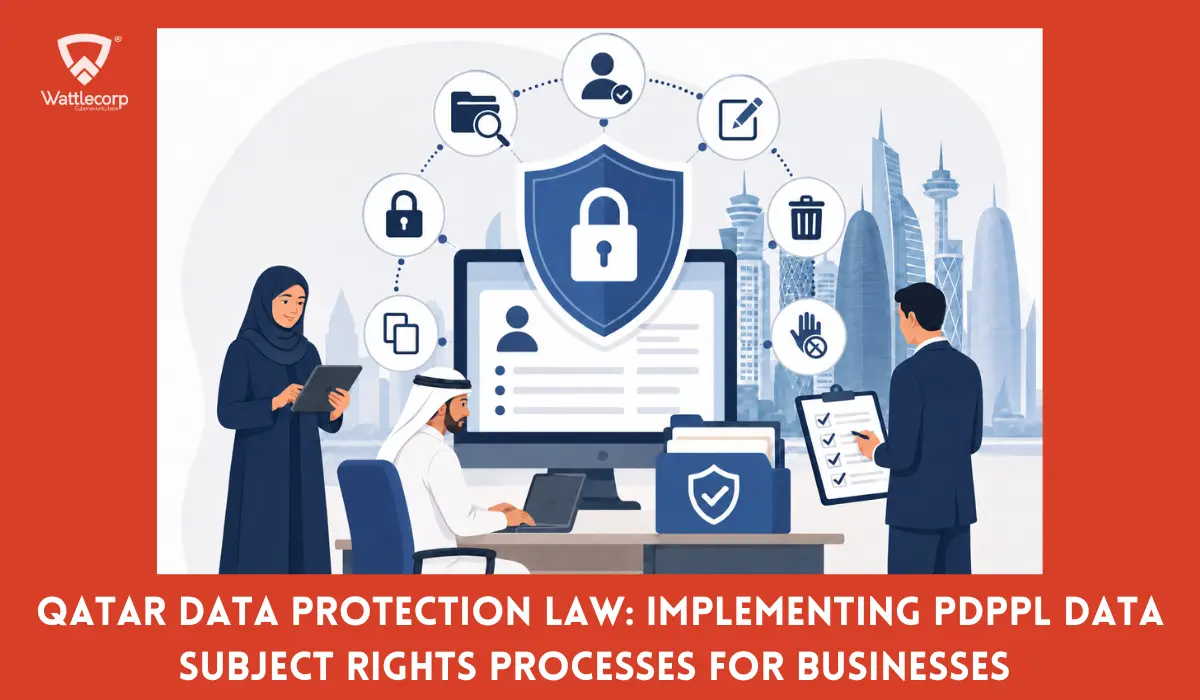
Under Articles 5 and 6 of PDPPL, individuals can:
● Withdraw previous consent
● Object to certain types of processing
● Request correction or deletion in specified circumstances
● Access and review their information
● Receive updates about processing
● Be notified of inaccurate disclosures
● Obtain copies of their personal data
These rights, however, create practical obligations across the data lifecycle.
Take for instance, a correction request requiring changes to be made across multiple connected systems instead of plainly modifying one database. Similarly, an erasure request. Both these scenarios require organizations to trace and update requested personal data in all the distributed platforms/architectures. Exercising data subject rights additionally requires establishing response timelines as per the NCSA guidance. This includes a 30-calendar-day response period for access requests, and corresponding handling expectations for other applicable rights request.
The task is not simple, as organizations need to identify where relevant information exists.
Effective Qatar Personal Data Privacy compliance is built on governance and correct implementation of technical controls (encryption), proper training, and adequate oversight mechanisms.
Building an Effective PDPPL Data Subject Request Process
Article 11 requires controllers to establish internal systems for receiving and investigating complaints, data access requests, and omission or correction requests. Along with these, there should be broader mechanisms for managing and reviewing privacy compliance.
A practical Qatar Data Protection Law data subject rights workflow should include:
1. Request intake and identification: Establish accessible channels through which individuals can submit requests and ensure employees can recognize requests even when they arrive through customer support or other channels.
2. Identity verification: Verify the requester appropriately before releasing or modifying information. Weak verification can turn a privacy process into an unauthorized disclosure risk.
3. Request classification: It analyzes the nature of the user’s request, mapping it to the applicable data subject right. Organizations can meet those obligations in the 30-day response timeline by routing those requests through specific compliance workflows.
4. Data discovery and coordination: This is considered one of the key foundational steps in the PDPPL compliance process and requires organizations to systematically map and discover personal data across systems, departments, archives, cloud platforms and processors.
5. Review and respond: Affirming the legal handling of user data with strict adherence to individual access and correction requests
6. Evidence and audit trail: Maintaining appropriate evidence and audit trails that demonstrate lawful processing, technical security measures, and respect for data subject rights in line with PDPPL requirements and relevant guidance issued by the National Cybersecurity Agency (NCSA).
A structured workflow like the above helps reduce the risk of requests becoming lost between privacy, IT, legal, security, and business teams.
Why Data Mapping Becomes Critical for PDPPL Compliance
Data fragmentation is one of the biggest operational barriers to achieving Qatar Data Protection Law compliance.
An organization cannot retrieve, correct, or erase information if it cannot trace its exact location. Even if data exists within CRM systems, HR platforms, SaaS applications, cloud infrastructure, email, databases, backups, and external processors, this leads to poor visibility and data duplication owing to constant movement.
Businesses should maintain sufficiently detailed data inventories or data maps that identify relevant personal data categories, processing purposes, systems, responsible owners, recipients, processors, and applicable retention requirements. Maintaining such visibility helps support transparency and effective handling of data subject rights under PDPPL.
Article 9 of Qatar PDPPL requires controllers to provide individuals with adequate information regarding controller details, legitimate processing purposes, a description of processing activities, and disclosure levels. Activities like this undoubtedly call for implementing data mapping as far as fulfilling these transparency requirements are concerned, also ensuring effective rights management.
Connecting Privacy Rights with Cybersecurity Controls
Privacy rights processes cannot operate independently from information security.
Article 8 serves to address appropriate administrative, technical, and financial precautions, while Article 13 requires controllers and processors to protect personal data against loss, damage, alteration, disclosure, and unauthorized access.
Security assessments can support Qatar Data Protection Law compliance by evaluating controls such as identity and access management, encryption, privileged access, cloud configurations, database security, application vulnerabilities, logging, and third-party connectivity.
Also Read : How Qatar Companies Can Protect Against Nation-State Cyber Threats in 2026
When individuals make access requests, this should naturally trigger the need to ensure data security and accurate identity verification from the controller’s end. Adjunct to these is the need to build mechanisms that will allow organizations to accurately retrieve the correct individual records without exposing information belonging to another.
Regular vulnerability assessments and penetration testing (VAPT), configuration reviews, and cloud security assessments can therefore provide technical assurance alongside privacy governance.
Handling Personal Data of a Special Nature
Organizations operating in healthcare, BFSI, HR-intensive businesses, and other critically regulated sectors should pay particular attention to Article 16.
The Qatar Data Protection Law identifies data concerning ethnic origin, children, health or physical or psychological condition, religious beliefs, marital relationships, and criminal offences as personal data of a special nature. Processing personal data of a special nature should be subject to additional requirements under Article 16. These include obtaining permission from the Competent Department as per applicable measures and controls.
Businesses handling these categories should clearly identify where such information resides and implement controls proportionate to its sensitivity.
How Data Privacy Consulting Helps Businesses Comply with Qatar Data Protection Law
Implementing the Qatar Data Protection Law can become difficult when privacy responsibilities are divided among legal, compliance, IT, cybersecurity, HR, marketing, and operational teams.
Data privacy consulting for Qatar businesses helps align privacy governance with cybersecurity controls by prompting organizations to engage in privacy gap assessments, build data inventories, define retention practices, develop data subject request procedures, review privacy notices, and evaluate processors.
This simultaneously needs establishing an operational privacy framework that can effectively demonstrate how requirements work in practice.
For organizations managing growing volumes of personal information, this approach also reduces dependence on manual, person-specific processes.
Strengthen PDPPL Readiness with Wattlecorp
Meeting data protection requirements for Qatar implies connecting policies, people, data, applications, infrastructure, and security controls.
Wattlecorp helps Qatar organizations assess privacy governance gaps, improve data subject rights workflows, evaluate technical safeguards, and identify security weaknesses that could otherwise undermine personal data protection. In accordance with the Qatar Personal Data Privacy Protection Law, we help businesses strengthen privacy governance, establish practical process, and identify compliance gaps.
Our coordinated privacy and security approach by integrating VAPT services in Qatar enables organizations to move beyond checkbox compliance and build more sustainable PDPPL governance.
Qatar Data Protection Law FAQs
1. What rights does a person have under the Qatar Data Protection Law?
2. What are the duties of business regarding data subject requests under PDPPL?
3. How does data privacy consulting help PDPPL Compliance in Qatar?
4. Who should comply with the Personal Data Privacy Protection Law in Qatar?
5. How can Security assessments support PDPPL compliance requirements?

 Qatar Data Protection Law: Implementing PDPPL Data Subject Rights Processes for Businesses
Key Takeaways: The Qatar Data Protection Law (Law No. 13 of 2016) for Personal Data Privacy Protection, grants individuals specific rights such as right to access, correct, erase, object, withdraw consent, and right to be notified of processing or inaccurate disclosure. Beyond having a privacy policy, businesses or controllers, under Article 11 of Personal Data […]
 AI Governance for Indian Enterprises: Building Internal Controls Before Key DPDP Obligations Take Effect
Key Takeaways: The DPDP Act does not contain AI-specific provisions. Its requirements, however, apply in situations when an AI system processes digital personal data within its territorial and material scope. India is working on building a broader governance framework around safety, accountability, transparency and trust via programs like the IndiaAI Mission. Indian organizations should inventory […]
 Cloud Security Audit for UAE Government Cloud Migration: NCAP and Security Requirements
Key Takeaways: A cloud security audit UAE helps government entities identify security, governance, configuration, access, data-protection and resilience gaps, before and after shifting critical workloads to the cloud. UAE National Cloud Security Policy has defined cloud governance, data security, data sovereignty, IAM, incident management, resilience, portability and cloud operations requirements. The National Cyber Accreditation Program […]
 Data Privacy Consulting UAE – Building a PDPL-Compliant Data Governance Program
Key Takeaways: PDPL compliance requires ongoing operational governance that goes beyond policies to demonstrate how personal data is collected, used, protected, transferred, retained, and deleted. Data mapping helps businesses move from reactive compliance to proactive risk management by establishing a comprehensive inventory of the data ecosystem, helping build a mature data privacy and governance program. […]
 Saudi Arabia’s Critical Systems Controls: What CSP-Linked Enterprises Must Comply With in 2026
Key Takeaways: The Critical Systems Cybersecurity Controls (CSCC) are more applicable to critical systems than to all IT assets owned or operated by an organization. To be in full compliance or to remain in full compliance with CSCC, organizations must maintain continuous adherence to NCA ECC. CSCC has 32 core controls and 73 sub-controls across […]
 DevSecOps for Saudi Banking and FinTech Applications: Building a SAMA-Aligned Secure Development Lifecycle
Key Takeaways: DevSecOps Saudi Arabia for banks & FinTech enterprises doesn’t make security journey a last stop but embeds it into the software development life cycle. Mapping DevSecOps methods to the SAMA Cybersecurity Framework improves security governance and application resilience while boosting audit readiness. Continuous security testing such as SAST, DAST, SCA, IaC scanning, and […]