


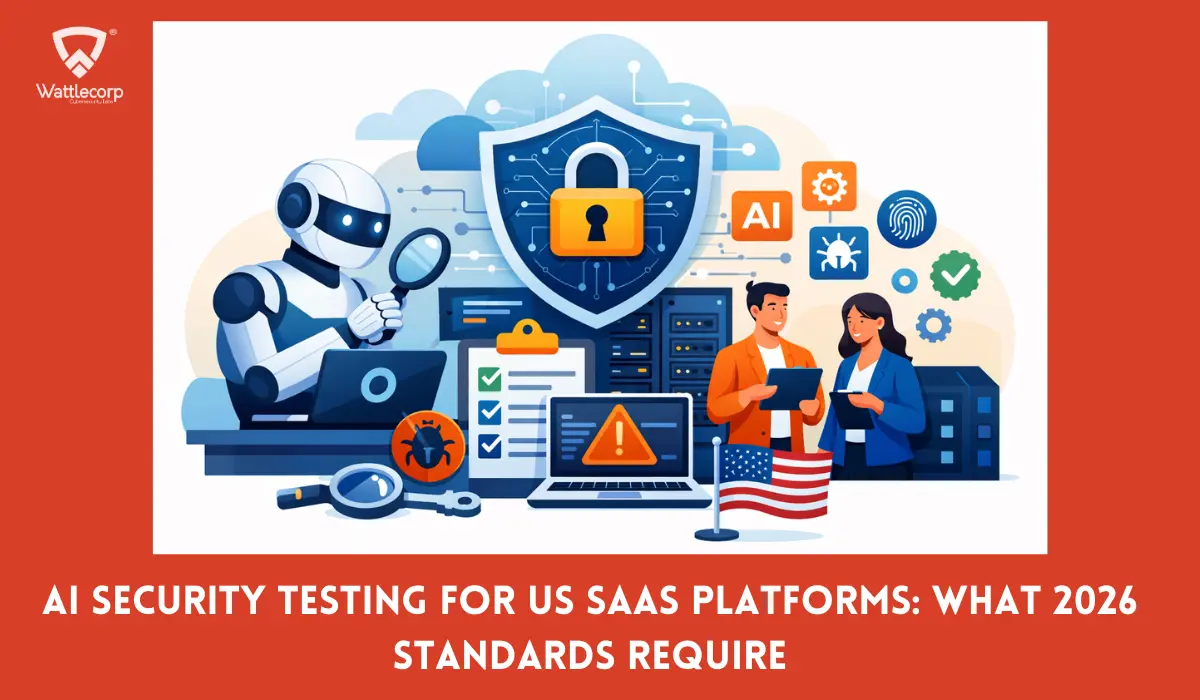
AI Security Testing for US SaaS Platforms: What 2026 Standards Require
Key Takeaways:
- AI security is no longer something you bolt on after a deal is signed. Buyers are asking hard questions about it before contracts ever get written.
- The old VAPT playbook isn’t enough anymore. Testing AI systems helps to understand how they behave, how they can be manipulated, and what happens when they’re pushed to their limits.
- Frameworks like the NIST AI Risk Management Framework are giving enterprise buyers a shared language and SaaS vendors who don’t speak it are getting left behind.
- Of all the risks AI introduces, prompt injection and data leakage are the ones keeping security teams up at night and for good reason.
- You can’t audit your way to AI security once a year and call it done. SOC 2 compliance and real enterprise trust are both built on continuous validation, not point-in-time snapshots.
Security Testing for AI-Powered US SaaS Platforms: What 2026 Standards Require
Artificial intelligence is no longer an experimental feature tucked inside a SaaS product roadmap.
It is the product. From intelligent copilots to fully automated workflows, machine learning is now embedded in the critical paths of how modern SaaS platforms operate and how enterprises decide to buy them.
That shift changes everything about security.
SaaS security has moved from a back-end technical concern to a frontline procurement requirement.
Enterprise buyers across the US are no longer asking whether your platform uses intelligent automation.
They are asking how it is secured, what testing has been performed, and whether you can prove that during an audit.
In 2026, SaaS companies that cannot answer those questions clearly are more likely to face delayed procurement, increased due diligence, and, in some cases, regulatory or legal exposure.
Why Security Testing for Intelligent Systems Is Now a Business Requirement
Traditional application security was built around infrastructure, APIs, and known vulnerability classes.
Those controls still matter. But machine learning introduces an entirely different risk surface: model behavior, which is why SaaS AI security requires a new testing mindset.
A misconfigured API endpoint can be patched. A prompt injection vulnerability, one that allows an attacker to override your system instructions through crafted user input, is harder to detect, harder to reproduce, and potentially far more damaging.
Security testing for US SaaS platforms must now go beyond scanning for CVEs.
It must interrogate how your models respond, what data they expose, and how they behave under adversarial conditions, which is a core requirement in SaaS AI security strategies.
The US regulatory environment is sharpening this requirement.
The Federal Trade Commission has signaled clearly that misleading AI claims, weak data safeguards, and poorly controlled deployment practices can create enforcement risk.
Companies that treat intelligent feature security as optional are building on increasingly unstable ground.
The Threat Landscape SaaS Companies Face in 2026
Understanding what to test begins with understanding what threatens you, especially in the evolving domain of SaaS AI security.
The five highest-impact risk categories for SaaS platforms today are:
- Prompt injection remains the most urgent. Attackers craft inputs designed to override system-level instructions, effectively hijacking your model’s behavior. This is especially dangerous in platforms where the underlying model has access to user data, external APIs, or internal business logic, which makes it a critical concern for SaaS AI security.
Also Read : Multi-Tenant Data Isolation: How a SaaS Platform Protected 50K+ Customer Records
- Sensitive data leakage occurs when language models surface PII, credentials, or confidential business information in their responses — often unintentionally. This can emerge from insufficient output filtering or poorly designed retrieval-augmented generation pipelines.
- Model abuse involves automated, high-volume misuse of intelligent features — scraping, spamming, or extracting competitive intelligence through repeated prompting. Rate limiting alone is rarely sufficient protection.
- Hallucination exploitation is an underappreciated risk. Incorrect or fabricated outputs, when surfaced to users in high-stakes contexts, can be exploited to justify fraudulent actions or mislead internal workflows.
- Third-party model risk is growing as SaaS platforms increasingly rely on external providers and inference APIs. Without visibility into how those providers handle your data, your security posture is only as strong as your weakest dependency.
What 2026 Standards Actually Require
NIST AI Risk Management Framework
The National Institute of Standards and Technology‘s Risk Management Framework for intelligent systems has become the de facto benchmark for enterprise governance in the US.
While not a federal mandate for private companies, it is increasingly expected by large enterprise buyers during vendor assessments.
The framework organizes risk management into four functions: Govern, Map, Measure, and Manage.
For SaaS platforms, practical alignment means documenting your intelligent systems and their risk profiles, establishing testing procedures, and maintaining ongoing monitoring, not a one-time audit, which directly strengthens SaaS AI security posture.
SOC 2 and the Expanding Audit Scope
SOC 2 auditors are adapting to the era of embedded machine learning. Where previously an audit might have examined API access controls and data encryption, examiners now expect evidence of governance specific to intelligent features, including SaaS AI security controls.
This includes visibility into model data flows, logs of system interactions, and documented security testing results.
Companies that lack this evidence are finding themselves in difficult conversations with auditors and with enterprise procurement teams that require SOC 2 reports before contracts are signed.
FTC Enforcement Posture
The FTC’s increasing focus on automated system misuse and deceptive practices creates direct liability for SaaS businesses that overstate their security posture or fail to implement reasonable safeguards, particularly around SaaS AI security.
This is not just a technical hygiene question, it is a legal and commercial risk management issue, which should be solved by proper risk assessment.
How This Testing Differs from Traditional VAPT
Conventional vulnerability assessment and penetration testing is built around a finite universe of known attack patterns such as OWASP Top 10, CVE databases, network misconfigurations.
This works well for traditional application components.
Testing intelligent systems for US SaaS platforms requires a fundamentally different methodology aligned with SaaS AI security principles.
Also Read : VAPT Remediation Verification: How to Ensure Vulnerabilities Are Properly Fixed
The attack surface is behavioral, not structural.
You are not just asking “is this port open?” You are asking “how does this model respond when I give it this carefully crafted input?”
That requires adversarial testing, red teaming approaches borrowed from both cybersecurity and machine learning safety research.
Key practices that traditional VAPT does not cover include: prompt injection testing, jailbreak attempt simulation, output content filtering validation, semantic similarity attacks, and indirect injection through data the model retrieves.
If your testing approach does not include these, it is incomplete from a SaaS AI security standpoint.
A Practical Security Testing Framework for SaaS Platforms
Effective security testing for intelligent systems follows a structured, repeatable process:
Asset discovery is the foundation. Before you can test, you must know that you have every model in use, every model-dependent API, every integration that passes data to an external provider. Map your intelligent system data flows the same way you would map your network topology.
Threat modeling translates that asset map into a prioritized list of attack scenarios. Which features handle sensitive user data? Which has the broadest access to internal systems? Start your testing there.
Adversarial testing is the core of the engagement. This includes structured prompt injection attempts, model manipulation testing, context window abuse scenarios, and multi-turn attack chains. The goal is to find failure modes before attackers do.
Control validation examines whether your defenses actually work, input sanitization, output filtering, rate limiting, and access controls specific to model-powered endpoints. Many platforms implement these controls in theory but have not verified them under realistic attack conditions.
Monitoring integration ensures that security testing does not end at the penetration test report. Model activity logs should feed into your SIEM, with anomaly detection tuned for behavioral patterns specific to intelligent system misuse.
Common Mistakes That Undermine Platform Security
Several patterns appear consistently in platforms that have gaps in their security posture:
Treating model-powered features as just another API is the most prevalent mistake. These endpoints require different testing logic, different logging strategies, and different abuse scenarios than traditional REST APIs.
Ignoring behavioral risk in favor of infrastructure hardening leaves the most distinctive attack vectors untested. Prompt injection does not care whether your servers are patched.
Over-reliance on vendor security is a false comfort. Your provider’s safeguards do not cover how you use their model, what data you send to it, or how you display its outputs to end users.
Skipping model-specific testing before release is increasingly untenable. Enterprise buyers and auditors are asking about testing cadence as part of vendor due diligence, not just whether a test was performed once.
Security as a Revenue and Trust Enabler
Strong platform security is not only a risk mitigation strategy, it is a sales asset.
Enterprise procurement teams now include intelligent system security questionnaires in their vendor review processes.
SaaS platforms that can present documented testing results, clear governance frameworks, and audit-ready evidence of security controls will close deals faster and face fewer friction points in security reviews.
Conversely, platforms without this documentation face delayed procurement cycles, additional due diligence requests, and in some cases, disqualification from regulated industry deals entirely.
Building a Continuous Security Testing Strategy
One-time testing is no longer sufficient. Security for intelligent systems must be treated as an ongoing practice, and organizations often rely on experts like Wattlecorp to operationalize and scale this approach effectively.
That means integrating model-specific testing into CI/CD pipelines, scheduling periodic red team exercises as models and features evolve, maintaining up-to-date asset inventories, and tracking alignment with emerging frameworks as NIST guidance matures.
The SaaS platforms that build this discipline now will be positioned for the next wave of enterprise requirements, not scrambling to catch up when a major customer’s security team asks for evidence they cannot provide.
In 2026, securing intelligent systems is a core requirement for any SaaS platform that takes enterprise sales, regulatory compliance, and customer trust seriously.
Structured security testing has moved from an optional technical exercise to a documented, auditable business practice.
The organizations that invest in SaaS security now will earn faster deal cycles, cleaner audits, and a demonstrable competitive advantage.
The ones that don’t will find themselves explaining gaps to enterprise buyers and regulators at the worst possible time.
SaaS AI Security FAQs
1.What AI security testing should a US SaaS company perform in 2026?
At the very least, test whether someone can manipulate your models through crafted inputs, and whether your platform leaks sensitive data in its responses. Check your access controls and output filters while you are at it. But do not treat it as a one-time task, make it part of how you ship. Buyers will ask for proof.
2.Is NIST AI RMF mandatory for private US SaaS businesses?
No, there is no legal obligation. But ignore it and you will notice the gap the moment you are in an enterprise sales conversation or compliance review. Companies that follow the framework simply move through those situations with far less friction. It is really less about compliance and more about being taken seriously by the people writing the checks.
3.How does AI security testing differ from normal SaaS application security testing?
Regular testing checks whether your doors are locked. Testing model-powered features asks whether someone can talk their way past them. You are not just looking for broken code, you are asking how your system behaves under pressure, what it gives away, and whether it can be steered somewhere it should not go. That takes a completely different approach.
4.How should AI testing evidence be mapped to SOC 2 for enterprise buyers?
Keep a paper trail that tells a clear story, what you tested, what turned up, and what you did about it. Your test reports, model interaction logs, and control validations should be organized and easy to hand over. When an auditor or procurement team asks, you want to pull up a document, not piece together an explanation on the spot.
5.Which AI risks matter most for SaaS platforms using LLMs or embedded AI features?
Prompt injection is the one that catches most teams off guard, it is easier to exploit than people expect. Unintended data leakage through model responses is a close second. Beyond those, keep an eye on large-scale misuse and how much you are trusting third-party providers without visibility. Most real incidents trace back to one of these four.

 Mobile Application Penetration Testing for Qatar Government Digital Services: NCSA- Aligned Security Assurance
Key Takeaways: Mobile Application Penetration Testing Qatar must cover the app, device storage, APIs, authentication and third-party components. Qatar’s NCSA assurance environment combines the National Information Assurance (NIA) Standard, the National Information Security Compliance Framework (NISCF) and accredited security assessment services. OWASP MASVS defines mobile security controls, while MASTG supplies practical test methods for Android […]
 Qatar Data Protection Law: Implementing PDPPL Data Subject Rights Processes for Businesses
Key Takeaways: The Qatar Data Protection Law (Law No. 13 of 2016) for Personal Data Privacy Protection, grants individuals specific rights such as right to access, correct, erase, object, withdraw consent, and right to be notified of processing or inaccurate disclosure. Beyond having a privacy policy, businesses or controllers, under Article 11 of Personal Data […]
 AI Governance for Indian Enterprises: Building Internal Controls Before Key DPDP Obligations Take Effect
Key Takeaways: The DPDP Act does not contain AI-specific provisions. Its requirements, however, apply in situations when an AI system processes digital personal data within its territorial and material scope. India is working on building a broader governance framework around safety, accountability, transparency and trust via programs like the IndiaAI Mission. Indian organizations should inventory […]
 Cloud Security Audit for UAE Government Cloud Migration: NCAP and Security Requirements
Key Takeaways: A cloud security audit UAE helps government entities identify security, governance, configuration, access, data-protection and resilience gaps, before and after shifting critical workloads to the cloud. UAE National Cloud Security Policy has defined cloud governance, data security, data sovereignty, IAM, incident management, resilience, portability and cloud operations requirements. The National Cyber Accreditation Program […]
 Data Privacy Consulting UAE – Building a PDPL-Compliant Data Governance Program
Key Takeaways: PDPL compliance requires ongoing operational governance that goes beyond policies to demonstrate how personal data is collected, used, protected, transferred, retained, and deleted. Data mapping helps businesses move from reactive compliance to proactive risk management by establishing a comprehensive inventory of the data ecosystem, helping build a mature data privacy and governance program. […]
 Saudi Arabia’s Critical Systems Controls: What CSP-Linked Enterprises Must Comply With in 2026
Key Takeaways: The Critical Systems Cybersecurity Controls (CSCC) are more applicable to critical systems than to all IT assets owned or operated by an organization. To be in full compliance or to remain in full compliance with CSCC, organizations must maintain continuous adherence to NCA ECC. CSCC has 32 core controls and 73 sub-controls across […]