


VAPT Remediation Verification: How to Ensure Vulnerabilities Are Properly Fixed
Key Takeaways:
- VAPT remediation checking assists in ensuring that remedies are operating and greatly decreases the chances of re-exploitation by employing specific re-scans, manual exploitation tests and patch analyzes so that residual risk in manufacturing settings is minimized.
- Post-testing is essential to prevent breaches of unfinished patches, particularly in BFSI and healthcare sectors of India where sensitive information such as UPI transactions and patient records is subjected to attacks due to the dynamic nature of cyber attacks.
- Automated-manual retests can be used to pinpoint high-risk areas and can be used in connection with CERT-In that holds critical systems in high regard by providing strong-security audits and post-change testing as components of due diligence in the face of the IT Act.
- Vulnerability management has evolved from reactive, one-time fixes into a continuous lifecycle. Integrating SIEM monitoring with regular manual penetration testing and maintaining 180-day log retention ensures that threats are identified and mitigated in real-time, meeting the mandatory standards set by CERT-In.
What is VAPT Remediation Verification?
VAPT remediation verification is the critical post-testing phase. In this phase organizations re-assess the systems after the application of fixes that were identified during Vulnerability Assessment and Penetration Testing (VAPT).
This is a systematic process that goes beyond simple patch application by including targeted re-scans with automated tools.
It includes extensive validation across all environments, from staging to production, detailed code and configuration inspections, and targeted manual exploitation attempts to simulate an attacker’s pattern.
The primary use of VAPT remediation verification is that it must ensure that the vulnerabilities found are managed.
This will prevent the possibility of re-exploitation and at the same time, fixes will not bring new security holes or performance problems.
In India, the security policies of CERT-In include secure SDLC, approved vulnerability remediation through annual audits, and post-change VAPT. They also mandate a remediation-verification step (re-testing) before a final ‘Safe-to-Host’ or compliance certificate can be issued.
This is consistent with secure SDLC practices, in which verification does not allow superficial compliance, but instead encourages real security to improve.
It can make organizations close down to false positives without providing them with a chance to remain under the protection of systems.
Why Post-VAPT Remediation Verification Matters?
Post-VAPT remediation verification is essential because initial fixes often fall short, leaving systems exposed.
Patches may solve surface problems but overlook root causes or install in an uneven manner or create new problems such as performance drags.
According to industry research, most of the attacks are based on the vulnerabilities that are known and not patented, proving the fact that the poor patching and verification procedures are directly translated into real-life compromises.
The CoWIN incident that took place in India in 2023 happened because of the lack of API authentication controls and thus unauthorized access to the information of citizens did not happen because of an unpatched vulnerability.
In a case of a global nature, in 2017, Equifax breach consisted of an unpatched Apache Struts weakness. In controlled industries, like BFSI and healthcare, these kinds of lapses may result in the violation of compliance and punishment based on the IT Act and industry regulations.
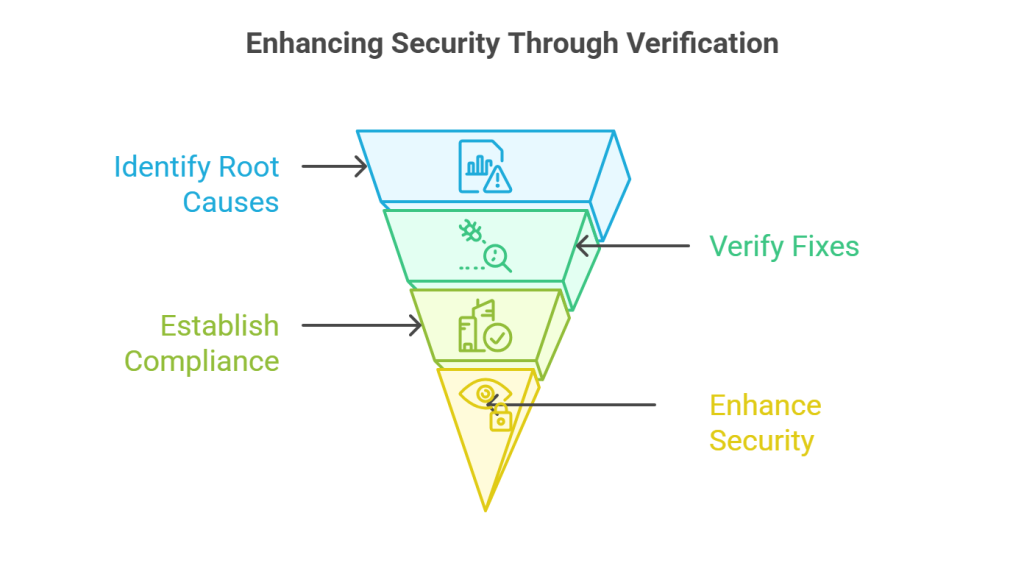
Fixes are verified by re-scans/exploits, and compliance and trust is established, reducing the likelihood of breaches by half in the Indian digital explosion.
In the case of Indian fintechs, regulatory authorities, in particular, RBI, focus on high-security standards, so VAPT is a critical practice to ensure safe and legal business operations.
It enhances overall security of your systems by continuously identifying and mitigating hidden vulnerabilities.
Best Practices for VAPT Remediation Verification
The best approaches to VAPT fixes are retesting the vulnerabilities, auditing patches, and focusing on the most critical threats.
These actions make your security positioning very robust and minimize the chances of successful attacks.
Also Read : The Cost of Ignoring VAPT: What Happens When Businesses Skip Security Testing
An effective VAPT confirmation is a procurement, tactical and uniform process that may be adopted to attain a greater degree of security.
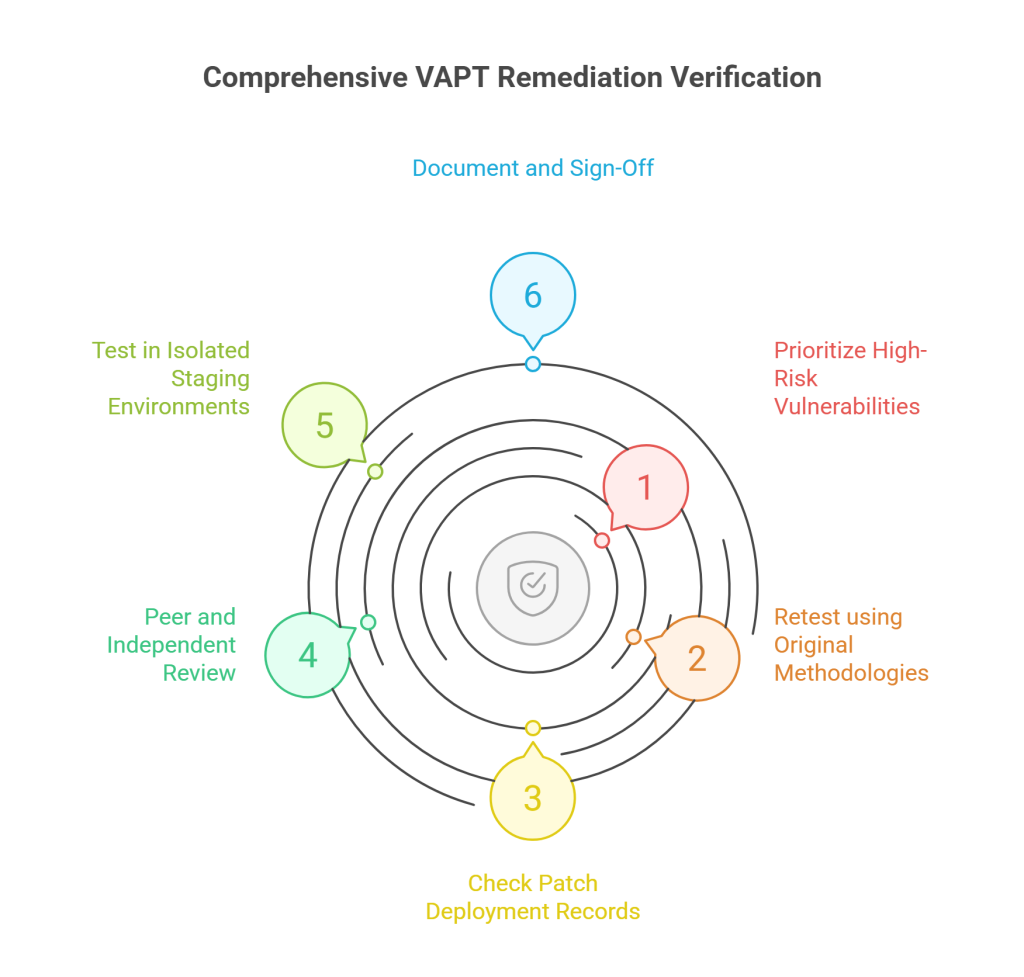
And the best practices includes:
- Prioritize High-Risk Vulnerabilities: First allocate resources efficiently by prioritizing the high risk vulnerabilities and deploying risk-based triage.
- Retest using Original Methodologies: Repeat the precise VAPT methods, automated scans via Nessus and manual exploits, ensure that they have been removed.
- Check Patch Deployment Records: Audit the records of change management, and ensure the roll out in all instances and environments and dependencies.
- Peer and Independent Review: According to the CERT-In empanelment norms, engage developers to fix bugs in the code, and engage third-party auditors to be objective.
- Test in Isolated Staging Environments: Run production loads to identify regressions prior to live operations.
- Document and Sign-Off: Only after independent retesting, formal reports with evidence such as screenshots, logs and executive approval are required.
Essential Tools for Remediation Validation
Automated scanning tools like Nessus and Nmap allow repeated scans to verify whether vulnerabilities have been fully resolved and to compare pre- and post-remediation states.
These tools show detailed reports on the remaining risks and priority issues on high severity are resolved swiftly.
To make use of automation, manual penetration testing is used to emulate real-world attacks to identify logic errors or chained exploits.
Also Read : What is VAPT?
Frameworks like the Metasploit are used by testers to check after patching to ensure exploits are really exploitable.
Critical Tools for Remediation Validation:
- Nessus: Scans repeatedly to check the effectiveness of patches as well as report any persistent vulnerabilities.
- Metasploit: This is the one that carries out exploits after remediation to make sure the defenses stand against the attacks.
- Burp Suite and Wireshark: Track web traffic and requests on residual problems on verification.
A combination of automated and manual penetration testing approaches will guarantee a full remediation validation.
Step-by-Step Verification for Mobile App Remediation
Verifying mobile app remediation ensures that fixes truly address security gaps, protecting user data and maintaining customer trust.
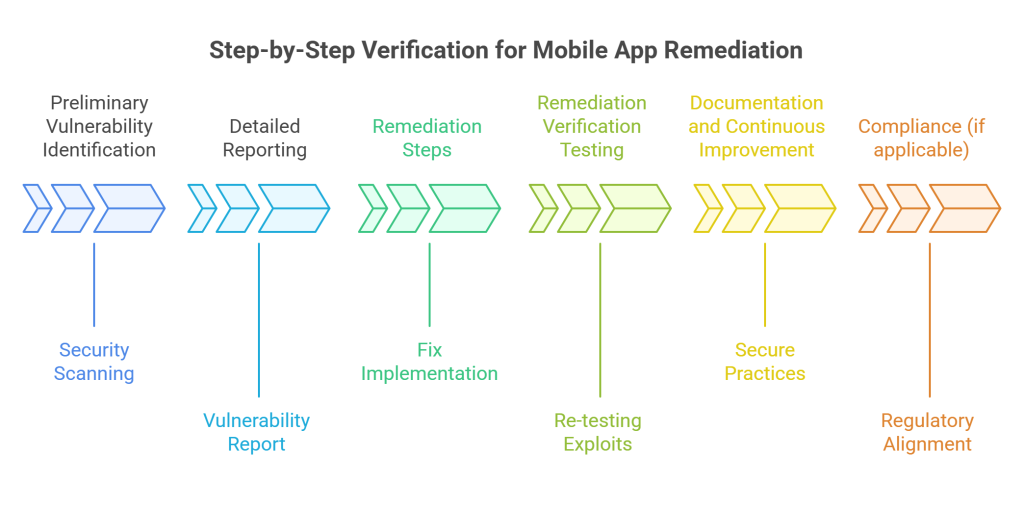
The verification process of mobile app fixes will follow the following systematic process:
- Preliminary Vulnerability Identification: Start with a complete and detailed security scanning with VAPT, SAST and DAST. These identify typical weaknesses such as insecure data storage, weak authentication or open APIs, which may reveal sensitive information.
- Detailed Reporting: Prepare all the findings into a transparent report. Identify and describe every vulnerability’s risk level, provide evidence on how it was discovered. Evidence such as logs or screenshots show clarity and also we provide precise remediation guidelines to direct the staff.
- Remediation Steps: Developers and security experts make fixes in order of priority, depending on the report. This could be followed by the implementation of safe code conventions, implementation of powerful AES-256 encryption and the use of multi-factor authentication (MFA), or more strong input verification. Ensure there is an open communication through teams in order to be fully on track on risks.
- Remediation Verification Testing: When changes are made in the system, ensure to do re-tests. Security testers make an attempt to re-enacting the original exploits to ensure that the vulnerabilities will no longer exist.
- Documentation and Continuous Improvement: Document verification outcomes provide clarity on effectiveness. Set up feedback loops in your development lifecycle to avoid repeat issues, fostering ongoing secure practices.
- Compliance (if applicable): Match the final setup to key standards like GDPR, ISO 27001, HIPAA, or PCI DSS to stay regulation-ready.
In India, mobile app penetration testing is really essential for securing UPI and health apps to prevent vulnerabilities like insecure storage and weak APIs, Wattlecorp’s VAPT services pinpoint and fix these to ensure robust mobile security.
Implementing Continuous VAPT Remediation Cycles
Security is an ongoing cycle in the process of vulnerability management. It is not just a one-time fix process and the ongoing monitoring and remediation are part of the vulnerability management lifecycle.
Implementing effective remediation validation tools such as Nessus to perform regular scans, use SIEM for real-time alerts, and run quarterly penetration testing.
Understanding the importance of post-VAPT remediation and verification is essential for prioritizing long-term security.
Continuous vulnerability management enables early threat detection, accurate risk scoring, and ongoing improvements to your SDLC through better code reviews and team training.
The VAPT remediation verification by Wattlecorp not only ensures long-term protection but also assists in avoiding breaches in India’s BFSI and healthcare sectors.
It also helps organizations reduce the risk of non-compliance and potential penalties under the IT Act and relevant regulatory frameworks.
Let Wattlecorp handle it. Start Securing Your Systems Today with Wattlecorp’s Penetration Testing Services.
VAPT Remediation FAQs
1.What is VAPT remediation verification?
The VAPT verification at Wattlecorp involves a stringent re-examination of the systems after fixation with automated re-scans, manual exploits, config audit and proof validation on environments. This verification process minimizes the risk of unresolved vulnerabilities and false closures while supporting CERT-In aligned security practices.
2.How do you verify if vulnerabilities have been fixed?
Wattlecorp certifies through original VAPT replication in staging/production: Nessus scans, Metasploit exploits, patch log reviews, peer code audits, SIEM checks- logs evidence of positive sign-off in all systems every time.
3.Why is post-remediation testing necessary?
The post remediation testing by Wattlecorp reveals unfinished remedies such as MOVEit incursions, avoidance of penalties under the IT Act. It assists prevention of re-exploitation of BFSI, verification of patches that do not introduce new threats, addressing a significant portion of potential threats by ensuring patches are correctly applied and verified.
4.What tools help with VAPT remediation verification?
Wattlecorp uses Nessus/OpenVAS for infrastructure, Burp/ZAP for web and MobSF for mobile. We combine SonarQube code analysis with Metasploit exploits and Splunk monitoring to deliver scalable, audit-ready validation that meets strict government compliance standards.
5.How does vulnerability management lifecycle impact VAPT remediation?
The lifecycle of Wattlecorp is discover-assess-remediate-verify-monitor transform VAPT into an ongoing process through CI/CD, SIEM alerts, repeat processes to reducing MTTR by half to improve CERT-In SDLC resilience to a more proactive and resilient security posture over the long term.

 Third-Party Vendor Security Risk Assessment Under DPDP: A Guide for Indian Enterprises
Key Takeaways: Third-party vendor risk assessment with DPDP practices helps Indian enterprises to verify that external partners handle personal data with adequate safeguards. The Digital Personal Data Protection Act holds data fiduciaries accountable for vendor conduct, which makes due diligence a legal and operational necessity. A structured vendor security questionnaire, covering encryption, access control, and […]
 Virtual CISO Services for UAE Free Zone Startups: Affordable Security Leadership for Growing Companies
Key Takeaways: Most startups already hold sensitive data such as customer info, source code, financials, long before they feel big enough to take security seriously, and that’s exactly when the risk starts. A virtual CISO gets you someone who’s done this before, setting up strategy and guiding compliance, without the cost of putting a full-time […]
 SOC as a Service for Indian BFSI and FinTech Companies: 24/7 Monitoring for CERT-In Readiness
Key Takeaways: SOC as a Service for BFSI and FinTech India gives banks, NBFCs, insurers and digital lenders continuous security visibility without the cost and hiring effort of building an in-house operations centre. CERT-In directions require regulated entities to report qualifying cyber incidents within six hours of detection, and implementing SOC for BFSI and FinTech […]
 SOC as a Service in India: How It Works, Pricing, and Why Businesses Need It
Key Takeaways: SOC as a Service helps Indian businesses to get 24×7 security monitoring without huge cost and complexity of building a full in-house security operations center. A managed SOC check and analyse beyond basic log monitoring, which combining SIEM, threat intelligence, analyst-led alert triage, incident escalation, reporting, and security response support. SOC as a […]
 Mobile App Security Testing for Indian Digital Lending Apps RBI, DPDP and API Risk Checklist
Key Takeaways: Mobile app security testing forms an important part of meeting RBI cybersecurity expectations, secure application development practices, and periodic security assessment requirements for digital lending platforms. APIs in lending apps are constantly under attack. Broken object-level authorization, data leaking where it shouldn’t, weak token validation, and missing rate limiting, these aren’t edge cases, […]
 Cybersecurity Risk Assessment for Saudi Supply Chain Vendors Under Aramco and NCA Expectations
Key Takeaways: Cybersecurity risk assessment becomes a practical requirement for proving security maturity, with protecting vendor relationships, and moving forward in procurement processes with Aramco and critical infrastructure clients. Vendors will need to provide evidence of access review documentation, patch deployment, monitoring artifacts, technical assessment results and more that demonstrates the controls in place are […]