

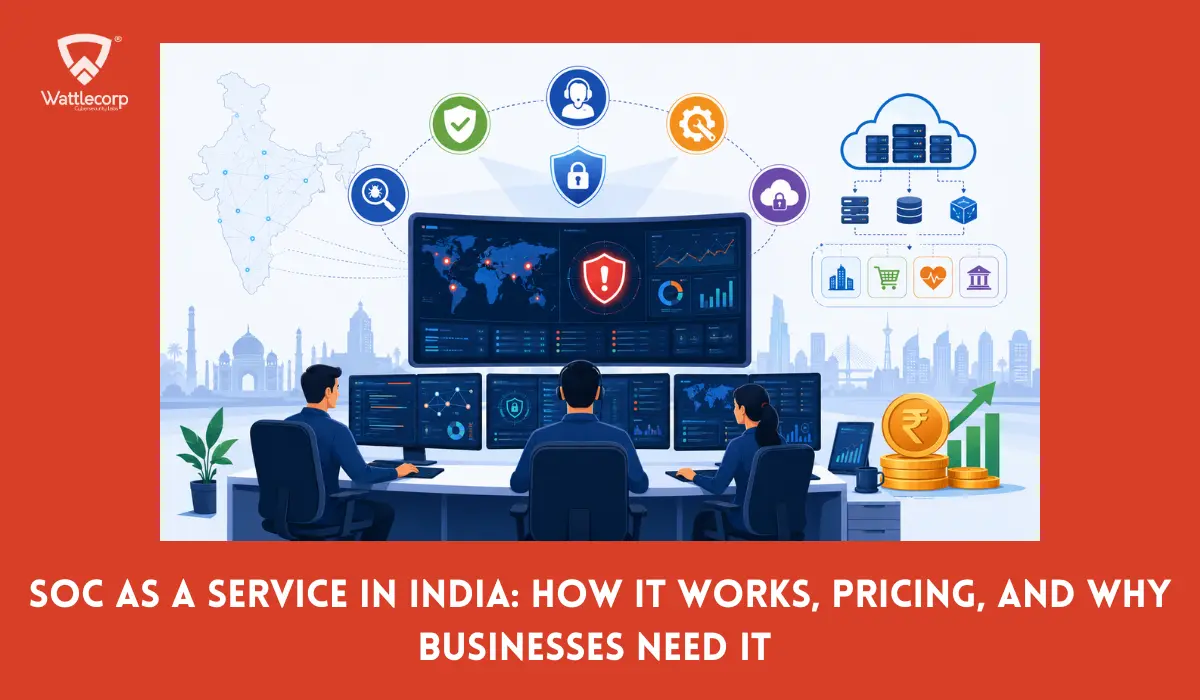
SOC as a Service in India: How It Works, Pricing, and Why Businesses Need It
Key Takeaways:
- SOC as a Service helps Indian businesses to get 24×7 security monitoring without huge cost and complexity of building a full in-house security operations center.
- A managed SOC check and analyse beyond basic log monitoring, which combining SIEM, threat intelligence, analyst-led alert triage, incident escalation, reporting, and security response support.
- SOC as a Service is useful for startups, SaaS companies, BFSI firms, healthcare providers, and digital-first enterprises, which need stronger visibility across the cloud, endpoints, APIs, applications, and identity systems.
- SOC pricing in India, mainly depends on multiple factors, that including log volume, number of devices, cloud assets, SIEM platform, monitoring hours, incident response scope, and compliance reporting needs.
- SOC supports CERT-In readiness by helping with log collection, log retention, incident detection, alert escalation, evidence preservation, and incident reporting workflows.
Indian companies are moving incredibly fast right now. SaaS platforms are scaling globally, finance and healthcare are rushing to digitize, and startups are building in the cloud from day one.
This rapid change opens a massive attack surface. Every API, endpoint, cloud server, and third-party integration expands the attack surface and can create exploitable exposure if it is misconfigured, poorly monitored, or insufficiently secured.
That’s why SOC-as-a-Service (SOCaaS) is becoming a necessity, and a Security Operations Center (SOC) basically watches your back 24/7. It helps detect suspicious activity early, escalate validated threats, and support containment before incidents become more damaging.
It used to be that only large corporations could afford a full, in-house security team. But with managed models and growing companies can tap into the enterprise-grade protection without the massive overhead of hiring an entire team.
For Indian startups, SaaS companies, BFSI firms, and growing enterprises, outsourced SOC has become a practical way to strengthen security posture and support CERT-In readiness through log visibility, incident detection, escalation, evidence preservation, and reporting workflows.
Whether you’re running a startup, a SaaS platform, or managing strict compliance in healthcare and finance. SOC as a Service improves visibility across monitored systems and supports faster incident response without the cost and complexity of building a full in-house SOC.
What Is SOC as a Service and How It Goes Beyond Basic Monitoring
Many businesses confuse SOC with basic log monitoring or network surveillance because SOC as a service is not just outsourced monitoring; it is a managed security operations model, which combines SIEM, threat intelligence, analyst review, incident triage, escalation, and reporting.
A managed SOC as service includes these factors:
- SIEM (Security Information and Event Management): Centralized collection, correlation, and analysis of logs from across your infrastructure
- Threat Detection: Continuous monitoring and alert on suspicious activities using correlation rules, behavioural analysis, and threat intelligence
- Incident Triage: 24×7 analyst review of security alerts to identify false positives and genuine threats
- Incident Response: Escalation procedures, containment guidance, and forensic support were included in the service scope
- Compliance Reporting: Documentation and evidence collection to support CERT-In compliance, ISO 27001, and other regulatory frameworks
- Threat Hunting: Proactive searches for indicators of compromise and advanced threats, usually included in mature or advanced SOC service tiers
- Log Management: Long-term storage, indexing, and searchability of security logs
The key difference between this as a managed SOC doesn’t just collect logs, it investigates incidents and helps you respond.
What Is SOC as a Service?
SOC as a Service is an outsourced security operations model, where a third-party cybersecurity provider monitors your IT environment, analyses the security alerts, investigates the suspicious activities, and supports your team during the incidents.
Instead of building a complete in-house security operations center, businesses can use a managed security operations center to access skilled analysts, SIEM tools, threat intelligence, reporting dashboards, and security incident response support.
A managed SOC usually includes:
- 24×7 security monitoring
- SIEM-based log collection and correlation
- Cyber threat monitoring
- Threat detection and response
- Alert triage by security analysts
- Incident escalation
- Log management
- Compliance reporting
- Threat hunting
- Security incident response support
Also Read : SOC Challenges and Best Practices to Overcome Them
In simple terms, SOC as a Service helps businesses to answer three questions what is happening inside our environment, is anything suspicious or malicious and what should we do next. For Indian businesses, which lack a dedicated internal security team and these answers can make a major difference.
How SOC as a Service Works in India for Startups and Enterprises
Understanding how SOC as a service works helps businesses to know what to expect during the onboarding and day-to-day operations.
1. Asset and Log Source Identification
The first step is identifying what needs to be monitored and this may include Firewalls, Servers, Cloud workloads, Endpoints, VPNs, Identity systems, Databases, APIs, Business applications, Email security tools and Network devices.
For SaaS platforms, this may also include cloud infrastructure, admin panels, API gateways, and authentication logs. And for BFSI companies, payment systems, customer portals, core applications, and privileged access systems may be more important.
2. SIEM Integration
The next step is SIEM integration, the SIEM stands for Security Information and Event Management. It collects logs from the different systems and correlates them to identify suspicious patterns.
The relationship between SIEM and SOC as a service is simple. SIEM is the technology that collects and analyses logs and SOC is the team that reviews alerts, investigates incidents, and guides response actions.
A SIEM generates an alert when it sees repeated failed login attempts and a SOC analyst checks whether it is a false positive, a brute-force attempt, or an early sign of account compromise.
3. Alert Monitoring and Threat Detection
Once log sources are connected, the SOC team starts monitoring for suspicious behaviour. The most common detection uses cases include, Multiple failed login attempts, Login from unusual locations, Privilege escalation, Malware activity, Suspicious PowerShell commands, Data exfiltration signs, Abnormal API usage, Cloud misconfiguration alerts, Endpoint compromise, Insider threat indicators.
This is where threat detection and response become valuable, instead of waiting for a breach to become visible, SOC as a service teams look for early warning signs.
4. Analyst Triage
Not every alert is an incident. Some alerts are false positives. Some are low-risk events. Others may need immediate response.
SOC analysts classify alerts based on severity, context, affected assets, and business impact. For example, a failed login from an employee’s usual location may not be serious. But a successful login from a new country followed by large data access may require urgent investigation.
This human review is one of the biggest advantages of a managed SOC.
5. Incident Escalation and Response
The SOC team escalates when a threat is identified and share it to the client with clear details and possible solutions. A good SOC report should explain what happened, which systems were affected, what evidence was found, and what action should be taken.
The response actions may include Blocking the malicious IP addresses, Disabling the compromised accounts, Revoking exposed credentials, Isolating affected systems, resetting passwords, reviewing access logs, preserving evidence, Supporting forensic investigation.
The SOC may not always directly make changes in the client environment unless this is included in the agreement. But it should provide clear, actionable guidance.
6. Reporting and Continuous Improvement
SOC operations do not stop after alerting. Monthly reports, incident summaries, trend analysis, and tuning recommendations help businesses to improve their security posture over time.
Reports may include, Number of alerts reviewed, Confirmed incidents, False positives, High-risk assets, Repeated attack patterns, Response timelines, Compliance-related log evidence, Recommendations for improvement.
This is especially useful for companies preparing for ISO 27001, SOC 2, PCI DSS, CERT-In readiness, or internal security audits.
Benefits of SOC as a Service for SaaS and BFSI Companies
The major benefits of SOC as a service for SaaS and BFSI companies are significant because these sectors handle sensitive customer data, financial transactions, APIs, and high-availability systems.
- 24×7 Security Monitoring: Attackers do not wait for office hours; therefore, a managed SOC gives businesses to continuous visibility across systems, even during the weekends and holidays.
- Faster Threat Detection: SOC teams assist to identify the suspicious behaviour early, such as unusual logins, abnormal traffic, and suspicious API calls etc.
- Lower Operational Burden: Building a full SOC internally requires people, tools, shifts, training, and management, and SOC as a Service majorly helps to reduces this operational load.
- Better Compliance Readiness: SOC reporting can help to support audit evidence, log retention, incident review, and security governance and this is useful for CERT-In, ISO 27001, SOC 2, and PCI DSS readiness.
- Improved Incident Response: A managed SOC can help identify affected systems, provide evidence, and guide containment actions; this is really matter when an incident occurs.
- Stronger Security Visibility: A SOC can bring visibility across endpoints, cloud platforms, networks, applications, APIs, and identity systems. For customer-facing businesses, this visibility is essential.
Also Read : SOC 2 Compliance for DIFC and ADGM-Registered Companies: What’s Different?
Companies running digital platforms should combine SOC monitoring with periodic security testing, which including mobile app penetration testing India, helps to identify vulnerabilities before attackers exploit them.
SOC as a Service does not automatically make a company compliant, but it supports important parts of CERT-In readiness.
A managed SOC can help with Log collection, Log retention, Incident detection, Timeline reconstruction, Evidence preservation, Alert escalation, Incident reporting support and post-incident analysis.
CERT-In’s directions make it important for organisations to maintain logs and report certain cybersecurity incidents within the required time. Without proper monitoring and log management, businesses may it difficult to understand what happened, when it happened, and what systems were affected.
A SOC gives organisations the visibility needed to investigate incidents more effectively.
Who Needs SOC as a Service in India?
SOC as a Service is useful for many kinds of Indian businesses such as Startups, SaaS Companies, BFSI and FinTech Companies, Healthcare Companies, E-commerce and Digital Platforms etc.
Startups often have small teams but fast-growing infrastructure. SOC as a Service gives them access to professional monitoring without building a full security department.
SaaS companies need to protect customer data, cloud environments, admin panels, APIs, and user accounts. SOC also helps build trust with enterprise customers.
BFSI and FinTech businesses face risks such as fraud, account takeover, credential abuse, and data exposure. SOC monitoring helps improve detection and response maturity.
Healthcare organisations handle sensitive patient data and are frequent targets for ransomware and data theft. SOC can help monitor endpoints, servers, and access activity.
E-commerce platforms need visibility into payment flows, customer accounts, API abuse, bots, and backend systems.
Some providers price SOC services based on devices. Some use log volume. Some offer tier-based plans such as basic, standard, and advanced. Larger enterprises may need custom pricing because their environments are more complex.
Build Stronger Cyber Resilience with Managed SOC Services
SOC as a Service is becoming a practical security model for Indian companies, which required continuous monitoring, but they cannot build a full in-house security operations center. With Wattlecorp, businesses get access to skilled analysts, SIEM-driven visibility, threat detection and response, log management, reporting, and incident support.
For startups, SaaS companies, BFSI firms, healthcare providers, and digital-first enterprises, a managed SOC services can support to reduce detection gaps and improve response readiness. More importantly, it helps security teams to move from the reactive firefighting to the continuous monitoring with a structured response.
Managed SOC services reduce security blind spots by providing 24/7 monitoring, expert alert triage, and better visibility into suspicious activity across monitored environments. Our expert response teams, and real visibility into your network, without the massive headache of building it all in-house. It’s basically having security experts on speed dial so you can sleep at night.
SOC as a Service FAQs
1.What is the SAMA CSF and why is it critical for Saudi financial institutions?
2.What tools can automate SAMA CSF compliance effectively?
Here are some of the key capabilities that you should look for in this regard:
● Simplify and standardize risk assessments
● Automatically collect evidence
● Continuously monitor your security posture and detect control deviations
● Provide centralized dashboards and compliance reporting
There are platforms like CyberArrow, Secusy AI, and EasyAudi that are considered as some of the preferable options to automate the SAMA-aligned compliance process.
Additionally, tools like Splunk SOAR (Phantom), Cortex XSOAR (Demisto), RSA Archer, and AWS Config can further strengthen your cybersecurity framework by enabling:
● Security orchestration and automated incident response
● Cloud infrastructure configuration monitoring and compliance checks
● Continuous cloud security posture management
You should not mistake these tools to make your organization automatically compliant with the SAMA CSF. Rather, these support ongoing compliance by reducing your manual tasks, improving visibility, and ensuring timely control execution. In fact, it is their proper utilization that leads you to achieve and ensure compliance.
3.How does automation reduce the cost of SAMA CSF compliance?
● Reduces manual efforts by streamlining repeated tasks
● Decreases operational cost
● Minimizes human errors
● Improves or optimizes resource efficiency
● Prevents reputational damage
● Everts risks related to costly penalties
4.What are some real-world use cases of SAMA CSF automation in Saudi Arabia?
● Automate SAMA Compliance management and monitoring
● Improve security controls
● Streamline risk management and reporting processes
● Prove compliance to the regulator or auditor
5.How does penetration testing support SAMA CSF compliance in Saudi organizations?
● Mitigate cyber threats by simulating real-world attacks to identify potential security flaws and associate risks, thus preventing cyberattacks in a proactive manner.
● Strengthen an organization’s security posture through regular penetration testing that go in line with the specific criteria set by SAMA. This helps meet regulatory compliance requirements while ensuring sensitive data protection.

 Mobile Application Penetration Testing for Qatar Government Digital Services: NCSA- Aligned Security Assurance
Key Takeaways: Mobile Application Penetration Testing Qatar must cover the app, device storage, APIs, authentication and third-party components. Qatar’s NCSA assurance environment combines the National Information Assurance (NIA) Standard, the National Information Security Compliance Framework (NISCF) and accredited security assessment services. OWASP MASVS defines mobile security controls, while MASTG supplies practical test methods for Android […]
 Qatar Data Protection Law: Implementing PDPPL Data Subject Rights Processes for Businesses
Key Takeaways: The Qatar Data Protection Law (Law No. 13 of 2016) for Personal Data Privacy Protection, grants individuals specific rights such as right to access, correct, erase, object, withdraw consent, and right to be notified of processing or inaccurate disclosure. Beyond having a privacy policy, businesses or controllers, under Article 11 of Personal Data […]
 AI Governance for Indian Enterprises: Building Internal Controls Before Key DPDP Obligations Take Effect
Key Takeaways: The DPDP Act does not contain AI-specific provisions. Its requirements, however, apply in situations when an AI system processes digital personal data within its territorial and material scope. India is working on building a broader governance framework around safety, accountability, transparency and trust via programs like the IndiaAI Mission. Indian organizations should inventory […]
 Cloud Security Audit for UAE Government Cloud Migration: NCAP and Security Requirements
Key Takeaways: A cloud security audit UAE helps government entities identify security, governance, configuration, access, data-protection and resilience gaps, before and after shifting critical workloads to the cloud. UAE National Cloud Security Policy has defined cloud governance, data security, data sovereignty, IAM, incident management, resilience, portability and cloud operations requirements. The National Cyber Accreditation Program […]
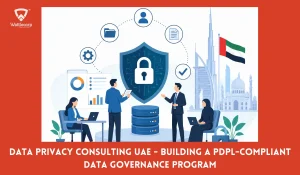 Data Privacy Consulting UAE – Building a PDPL-Compliant Data Governance Program
Key Takeaways: PDPL compliance requires ongoing operational governance that goes beyond policies to demonstrate how personal data is collected, used, protected, transferred, retained, and deleted. Data mapping helps businesses move from reactive compliance to proactive risk management by establishing a comprehensive inventory of the data ecosystem, helping build a mature data privacy and governance program. […]
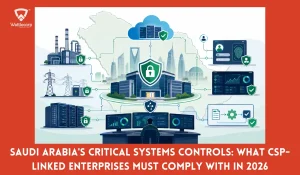 Saudi Arabia’s Critical Systems Controls: What CSP-Linked Enterprises Must Comply With in 2026
Key Takeaways: The Critical Systems Cybersecurity Controls (CSCC) are more applicable to critical systems than to all IT assets owned or operated by an organization. To be in full compliance or to remain in full compliance with CSCC, organizations must maintain continuous adherence to NCA ECC. CSCC has 32 core controls and 73 sub-controls across […]