


SOC 2 Compliance for DIFC and ADGM-Registered Companies: What’s Different?
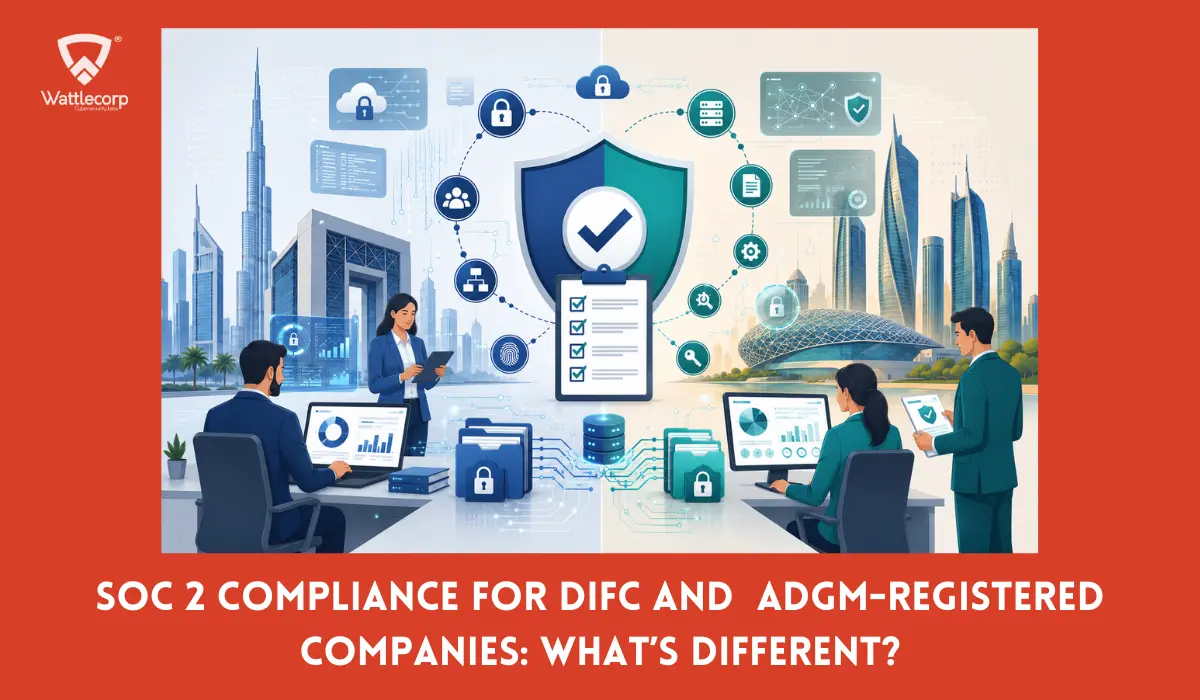
Key Takeaways:
- SOC 2 isn’t a regulatory requirement in DIFC or ADGM but if you’re dealing with enterprise clients, investors, or international partners, it is quickly becoming something the market expects anyway.
- DIFC and ADGM have their own data protection frameworks, but SOC 2 goes further, it asks whether your security, privacy, and operational controls are actually working reliably over time, not just on paper.
- For UAE financial free zone firms, SOC 2 acts as a trust translator. Stakeholders outside the region may not recognize DIFC or ADGM compliance, but they know SOC 2 and that recognition opens doors.
- Type 2 matters more than Type 1 and it proves your controls held up across an entire audit period, not just that they were well-designed on a single day.
- Treat SOC 2 as an integrated compliance layer, not a one-time checkbox. Combine GRC advisory, VAPT, cloud security, SIEM monitoring, and evidence management so you’re audit-ready before the auditor even arrives.
What Makes SOC 2 Compliance Different for DIFC and ADGM Firms?
If your company operates inside the Dubai International Financial Centre or the Abu Dhabi Global Market, you already understand the weight of regulatory expectations.
You have legal counsel reviewing data protection obligations, compliance teams tracking local frameworks, and leadership asking hard questions about cybersecurity governance.
What is increasingly showing up alongside those conversations is a request from enterprise clients, institutional investors, or international partners, for a SOC 2 report. And for many leadership teams in UAE financial free zones, that request creates genuine confusion.
Let’s break down what makes SOC 2 compliance for DIFC and ADGM companies different, why it matters commercially, and how to approach it strategically.
What is SOC 2 Compliance and Why UAE Firms Need It
SOC 2, developed by the AICPA, is an assurance reporting framework that evaluates controls relevant to security and, where included in scope, availability, processing integrity, confidentiality, and privacy.
It is not a product certification or a legal requirement. It is a signal, one that enterprise buyers, auditors, and investors in the US, UK, Europe, and increasingly the GCC have come to rely on when evaluating whether a third-party vendor can be trusted with sensitive data or critical processes.
For companies registered in DIFC or ADGM, SOC 2 compliance for DIFC and ADGM operations serves a specific commercial function: it translates local regulatory maturity into a globally recognized trust language.
Local compliance frameworks are valuable, but not always legible to international procurement and risk teams.
Key Differences Between SOC 2, DIFC, and ADGM
This is where most leadership teams need clarity.
DIFC operates under its own Data Protection Law, DIFC Law No. 5 of 2020, enforced by the DIFC Commissioner of Data Protection, which is enforced by the DIFC Commissioner of Data Protection.
The law establishes obligations around lawful processing, data subject rights, controller and processor accountability, breach notification, and international data transfers, all supervised within the free zone’s independent legal framework.
ADGM operates under the Data Protection Regulations 2021, administered by the ADGM Office of Data Protection.
Also Read : Gap Assessment 101: Your First Step to SOC 2 or ISO 27001 Compliance in the UAE
These regulations carry requirements for controller and processor accountability, records of processing activities, breach notification timelines, and processor agreement standards. Both regimes are rigorous, modern, and aligned with international privacy principles.
SOC 2 compliance for DIFC and ADGM sits in a completely different category. It is not a regulatory obligation.
It is a voluntary, customer-facing assurance report produced by an independent CPA firm.
Where DIFC and ADGM compliance answers the question, Is this company meeting local legal obligations? SOC 2 answers the question enterprise buyers actually ask during procurement: Are the controls that protect our data operating reliably and consistently over time?
That is the real difference. And it matters enormously for companies trying to close international deals.
Understanding How SOC 2 Compliance Varies for ADGM and DIFC Companies
From a regulatory standpoint, DIFC and ADGM are separate jurisdictions with separate legal personalities, regulators, and enforcement mechanisms.
In practice, SOC 2 compliance for DIFC and ADGM firms follows the same AICPA Trust Services Criteria regardless of which free zone the company is registered in. The audit process, evidence requirements, and report structure are consistent.
What differs is the underlying regulatory context that shapes your control environment.
A DIFC-registered FinTech with obligations under DIFC Law No. 5 of 2020 will find that many of its privacy and data protection controls map naturally onto SOC 2’s Privacy and Confidentiality criteria.
An ADGM-registered payment platform subject to the 2021 Data Protection Regulations will discover similar alignment, particularly around processor agreements, breach response, and records management.
The smart approach is to treat your existing DIFC or ADGM compliance posture as a foundation, not a substitute.
SOC 2 compliance for DIFC and ADGM companies works best when it is built on top of, and integrated with, local regulatory obligations, not treated as a parallel exercise.
Is SOC 2 Compliance Required for DIFC and ADGM Companies?
No. SOC 2 compliance for DIFC and ADGM registered companies is not a mandatory regulatory requirement under either free zone’s rules.
DIFC and ADGM each have their own data protection and governance obligations, and SOC 2 does not replace those.
What makes SOC 2 practically necessary is commercial pressure, not regulatory pressure.
Enterprise clients, particularly those based in North America, the UK, or Europe, frequently include SOC 2 Type 2 as a prerequisite in procurement questionnaires, vendor agreements, and security due diligence reviews.
For DIFC and ADGM companies scaling into international markets or dealing with financial institutions and regulated enterprises, SOC 2 compliance for DIFC and ADGM operations often becomes a market-driven requirement for growth.
Why SOC 2 Type 2 Matters More Than Type 1 for Trust-Sensitive Companies
SOC 2 Type 1 helps to evaluate whether controls are suitably designed at a single point in time.
SOC 2 Type 2 evaluates whether those controls were suitably designed and operated effectively over a defined observation period, commonly six to twelve months depending on auditor scope and business requirements.
For regulated, trust-sensitive firms, this difference is significant, especially when approaching SOC 2 compliance for DIFC and ADGM operations. Type 1 shows a snapshot. Type 2 shows a sustained track record.
Also Read : UAE Cybersecurity Council Mandatory Resilience Framework 2026: What Every Enterprise Must Do
Enterprise buyers, institutional partners, and sophisticated investors are not interested in a policy document or a point-in-time snapshot.
They want evidence of consistent control operation, log reviews, access audits, vulnerability assessment cycles, incident response tests, and vendor oversight captured, retained, and reviewed across the audit window. That is what Type 2 delivers.
Preparing for SOC 2: What DIFC and ADGM Companies Need to Address
SOC 2 compliance for DIFC and ADGM companies typically runs into the same set of readiness challenges.
Evidence is scattered across tools, spreadsheets, and email threads. Control ownership is informal.
Cloud environments carry misconfigurations that would not survive audit scrutiny.
Logging and monitoring exist but are not centralized or correlated in a way that demonstrates meaningful security visibility.
Vendor risk management is underbuilt. VAPT has been treated as a one-off assessment rather than a repeatable cycle.
Fixing these gaps requires a structured approach. Start with scope definition: identify the systems, cloud environments, customer data flows, and business processes that should fall within the SOC 2 boundary.
Map your existing DIFC and ADGM compliance controls to the relevant Trust Services Criteria.
Validate your technical environment through a thorough cloud configuration review, IAM assessment, application-level penetration testing, and log management review.
If you are in the UAE, working with a qualified VAPT company in Dubai that understands both the technical requirements and the evidence standards SOC 2 auditors expect is considerably more efficient than running assessments independently.
Once controls are validated, build a repeatable evidence model that includes access reviews, risk assessments, vendor due diligence, backup testing, incident response exercises, and change management documentation, which feeds a continuous compliance posture rather than a one-time audit scramble. Then move into the Type 2 observation period with confidence.
How SOC 2 Helps DIFC and ADGM Firms Win Enterprise Trust
SOC 2 compliance for DIFC and ADGM companies is not purely a security exercise. It is a revenue enablement strategy.
Enterprise deals that stall at security due diligence get unstuck when a Type 2 report is on the table.
RFP responses become more competitive. Investor confidence in governance maturity improves.
Cyber insurance applications move faster when controls are documented and demonstrably operating.
In financial free zones where trust, governance, and regulatory credibility are core to the brand, strong cybersecurity compliance UAE posture supported by a SOC 2 report converts internal security investment into external commercial advantage.
The companies that treat SOC 2 compliance for DIFC and ADGM as a trust infrastructure decision, rather than a compliance checkbox are the ones that move fastest in international markets.
Turning DIFC and ADGM Compliance into International Trust
SOC 2 compliance for DIFC and ADGM registered companies is not another certificate to collect.
It is the mechanism through which local regulatory maturity becomes internationally credible. As enterprise sales cycles grow more security-intensive and due diligence standards rise across financial services, SaaS, and regulated technology sectors, the companies that build defensible, evidence-backed control environments will consistently outperform those relying on policies and self-attestation.
Wattlecorp works with DIFC and ADGM-registered organisations to move from readiness assessment through to SOC 2 Type 2, integrating GRC advisory, technical validation, SIEM implementation, and continuous monitoring into one coherent compliance architecture.
If you are ready to move from regulatory alignment to international trust readiness, explore Wattlecorp’s dedicated SOC 2 compliance services for UAE financial free zone companies.
SOC 2 compliance for DIFC and ADGM FAQs
1.Is SOC 2 mandatory for DIFC and ADGM-registered companies?
2.What is different about SOC 2 compliance for DIFC firms?
3.What is different about SOC 2 compliance for ADGM firms?
4.How does SOC 2 support DIFC and ADGM data protection obligations?
5.Why should DIFC and ADGM firms in the UAE combine SOC 2 readiness with VAPT?

 Third-Party Vendor Security Risk Assessment Under DPDP: A Guide for Indian Enterprises
Key Takeaways: Third-party vendor risk assessment with DPDP practices helps Indian enterprises to verify that external partners handle personal data with adequate safeguards. The Digital Personal Data Protection Act holds data fiduciaries accountable for vendor conduct, which makes due diligence a legal and operational necessity. A structured vendor security questionnaire, covering encryption, access control, and […]
 Virtual CISO Services for UAE Free Zone Startups: Affordable Security Leadership for Growing Companies
Key Takeaways: Most startups already hold sensitive data such as customer info, source code, financials, long before they feel big enough to take security seriously, and that’s exactly when the risk starts. A virtual CISO gets you someone who’s done this before, setting up strategy and guiding compliance, without the cost of putting a full-time […]
 SOC as a Service for Indian BFSI and FinTech Companies: 24/7 Monitoring for CERT-In Readiness
Key Takeaways: SOC as a Service for BFSI and FinTech India gives banks, NBFCs, insurers and digital lenders continuous security visibility without the cost and hiring effort of building an in-house operations centre. CERT-In directions require regulated entities to report qualifying cyber incidents within six hours of detection, and implementing SOC for BFSI and FinTech […]
 SOC as a Service in India: How It Works, Pricing, and Why Businesses Need It
Key Takeaways: SOC as a Service helps Indian businesses to get 24×7 security monitoring without huge cost and complexity of building a full in-house security operations center. A managed SOC check and analyse beyond basic log monitoring, which combining SIEM, threat intelligence, analyst-led alert triage, incident escalation, reporting, and security response support. SOC as a […]
 Mobile App Security Testing for Indian Digital Lending Apps RBI, DPDP and API Risk Checklist
Key Takeaways: Mobile app security testing forms an important part of meeting RBI cybersecurity expectations, secure application development practices, and periodic security assessment requirements for digital lending platforms. APIs in lending apps are constantly under attack. Broken object-level authorization, data leaking where it shouldn’t, weak token validation, and missing rate limiting, these aren’t edge cases, […]
 Cybersecurity Risk Assessment for Saudi Supply Chain Vendors Under Aramco and NCA Expectations
Key Takeaways: Cybersecurity risk assessment becomes a practical requirement for proving security maturity, with protecting vendor relationships, and moving forward in procurement processes with Aramco and critical infrastructure clients. Vendors will need to provide evidence of access review documentation, patch deployment, monitoring artifacts, technical assessment results and more that demonstrates the controls in place are […]