


UAE Cybersecurity Council Mandatory Resilience Framework 2026: What Every Enterprise Must Do
Key Takeaways:
- UAE cybersecurity mandatory resilience is no longer a back-office security project, it is a board-level business requirement that is directly influencing deals, audits, and investor confidence in 2026.
- The UAE Cybersecurity Council framework has moved well beyond annual compliance reviews, enterprises are now expected to demonstrate continuous validation across governance, detection, response, recovery, and evidence readiness.
- Most UAE enterprises are carrying real gaps in detection coverage, incident response readiness, and audit evidence, gaps that stay invisible until an audit, a procurement review, or an actual incident forces them into the open.
- The cyber resilience UAE enterprises build proactively does not just reduce risk, it accelerates deal approvals, strengthens insurance positions, and gives boards the confidence to make faster, better-informed decisions.
- A phased implementation roadmap aligned to UAE Cybersecurity Council guidelines is not just the most practical path forward, it is the clearest way to close the distance between where most enterprises stand today and where mandatory resilience expectations require them to be.
How UAE Cybersecurity Mandatory Resilience Is Changing the Way Enterprises Approach Security in 2026
There was a time when cybersecurity sat comfortably inside the IT department. Leadership signed off on budgets, nodded at annual reports, and moved on. That time is over.
UAE cybersecurity mandatory resilience has become a question that boards, investors, enterprise clients, and regulators are all asking at once and the enterprises that cannot answer it clearly are starting to feel it where it hurts most.
In delayed contracts. In difficult audit conversations. In insurance reviews that come back with harder questions than they did the year before.
The UAE Cybersecurity Council has been pushing in this direction for some time. But 2026 is the year the expectations have sharpened into something that feels less like guidance and more like a baseline that every serious enterprise is expected to meet.
If your security posture was built around prevention tools and annual compliance reviews, it is worth being honest about whether that is still enough.
What the UAE Cybersecurity Council Framework Actually Expects
Cyber resilience and information assurance are complementary. Cyber resilience helps to build on information assurance by including the capacity for an organization to detect, respond, recover, and report on cyber incidents.
Information assurance still forms the foundation for governance, control, and assurance practices.
The focus now is on cyber resilience, meaning the ability to withstand, detect, respond to, recover from, and report on cyber incidents in a way that is documented, tested, and defensible.
That is a meaningfully higher bar than most enterprises are currently clearing.
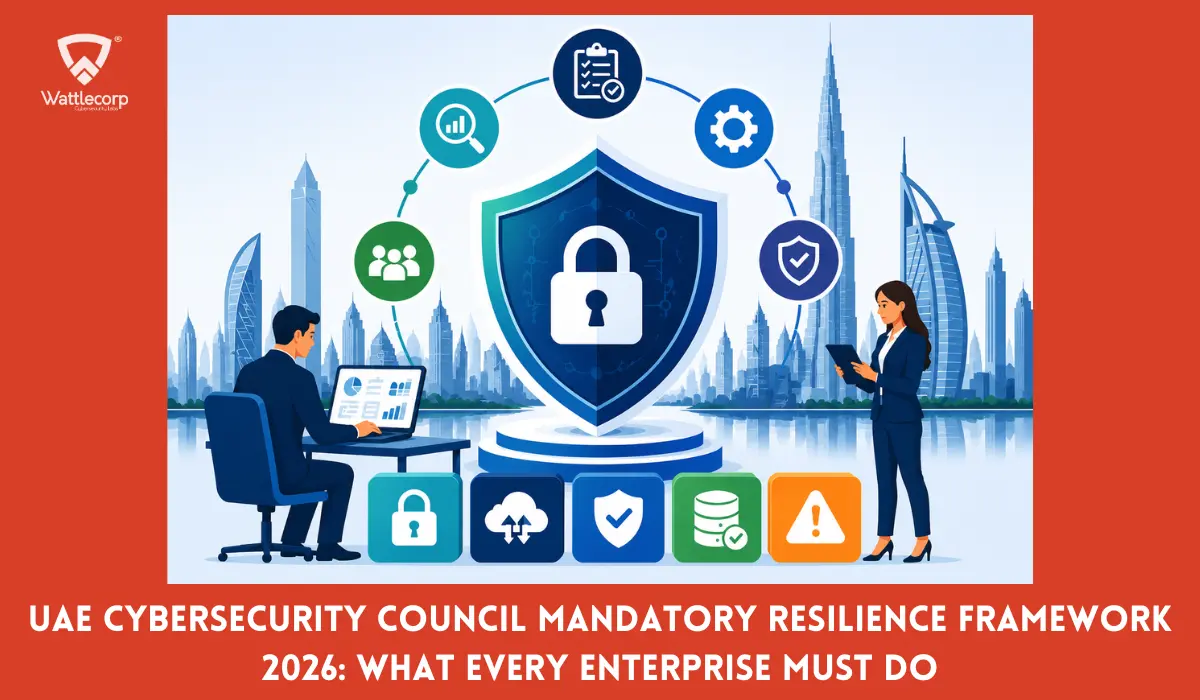
UAE cybersecurity mandatory resilience under this framework covers five core areas.
- Governance and control ownership, understand who is accountable, what is documented, and how risk is reported to leadership.
- Visibility – whether you have a complete and current picture of your assets, environments, and third-party dependencies.
- Detection – whether your monitoring actually catches real attack behavior or just generates noise.
- Response – whether your incident playbooks have been tested or just written.
- Recovery – whether your backup systems can be restored effectively within the defined recovery time and point objectives.
Most enterprises have partial answers across all five. Very few have strong answers across all of them.
The Hidden Cybersecurity Gaps Across UAE Enterprises
The gaps that appear most consistently are not always the obvious ones. Enterprises often have the tools. What they are missing is confidence that the tools are working.
SIEM platforms get deployed and then left largely untuned. Logs are collected without meaningful detection use cases mapped to real UAE cybersecurity threats.
Incident response plans may exist in documents that haven’t been regularly tested or updated, leading to a gap in preparedness when an actual incident occurs.
Cloud environments get stood up quickly and reviewed slowly.
Third-party integrations accumulate without anyone maintaining a clear picture of the data flowing through them.
The result is a security posture that looks reasonable on paper and feels fragile the moment it is actually tested.
UAE cybersecurity council expectations are increasingly being used as the benchmark by enterprise procurement teams and auditors alike, which means that the gap between documentation and operational reality is showing up at exactly the wrong moments.
The Real Business Consequences of Cybersecurity Gaps in UAE Enterprises
Cybersecurity conversations tend to focus on incidents – breaches, ransomware, data loss. Those risks are real.
But the business consequences of weak UAE cybersecurity mandatory resilience posture show up long before any incident occurs.
Enterprise deals slow down when security questionnaires cannot be answered with evidence.
Also Read : UAE Enterprise Cyber Response 2026: How Enterprises Should Respond to Middle East Cyber Conflict
Procurement teams in regulated industries have become significantly more specific about what they expect to see, not just whether you have a SOC 2 report, but what your detection coverage looks like, how your incident response has been tested, and whether you can demonstrate ongoing monitoring rather than periodic reviews.
Cyber insurance is moving in the same direction. Insurers are asking harder questions about MFA enforcement, EDR deployment, backup recovery testing, and third-party risk management.
Enterprises that cannot produce clear answers are seeing premiums rise and coverage conditions tighten.
UAE cybersecurity council framework alignment, in 2026, is less about regulatory compliance and more about being taken seriously by the people and organizations that matter most to your growth.
A Practical Path to Cyber Resilience Framework Compliance
Getting from where most enterprises are today to a defensible UAE cybersecurity mandatory resilience posture does not require rebuilding everything at once. It requires a clear sequence.
Start with an honest baseline. Map what you actually have against what the cyber resilience framework expects.
Asset inventory, control documentation, log coverage, incident response maturity, backup validation, assessed against UAE Cybersecurity Council guidelines, not against an internal standard that has not been externally validated.
From that baseline, prioritize ruthlessly. Identity and access controls deserve the most immediate attention because they are the most consistently exploited entry points in real attacks.
MFA enforcement, least privilege access, and abnormal login monitoring should be running before anything else.
Also Read : Business Continuity and Cyber Resilience in the UAE: 2026 Executive Guide
Detection engineering comes next. Not more tools, better use of what you have.
SIEM use cases mapped to actual UAE cybersecurity threats, behavioral detection logic that surfaces real signals rather than alert volume, and SOC workflows designed around prioritization rather than reaction.
Then test everything. Run tabletop exercises against your incident response playbooks.
Restore from backup in a controlled environment before you need to do it under pressure.
Engage a VAPT company in Dubai to validate whether your controls hold under realistic attack conditions, because the UAE Cybersecurity Council framework expects control validation, not just control documentation.
Finally, build the evidence layer. Board-ready risk reporting, audit evidence repositories, compliance dashboards that reflect your current posture rather than your posture at the time of your last review.
UAE cybersecurity mandatory resilience is not something you prove once. It is something you demonstrate continuously.
How Wattlecorp Supports UAE Enterprise Resilience
Wattlecorp works with UAE enterprises across the full scope of what the UAE Cybersecurity Council framework requires from initial resilience gap assessments through to SIEM implementation, VAPT, red team exercises, OT and IoT security testing, and ongoing posture monitoring.
The engagement model is built around an assessment-first approach that gives enterprises a clear picture of where they stand before committing to a broader program.
The goal is not to add more tools to an already crowded environment.
It is to help security and leadership teams understand what their current posture actually looks like, where the highest-risk gaps are, and what a credible path to UAE cybersecurity mandatory resilience looks like for their specific environment.
Resilience Is the Competitive Advantage Nobody Expected
The enterprises investing seriously in UAE cybersecurity mandatory resilience right now are not just reducing risk; they are also working with partners like Wattlecorp to operationalize and strengthen their security posture.
They are building something that differentiates them in enterprise sales conversations, strengthens their position in regulatory reviews, and gives their boards a level of confidence that translates into faster decision-making and cleaner governance.
Cyber Security Strategic Consulting & Security Advisory Services in the UAE help organizations align their security posture with regulatory expectations, strengthen resilience against evolving threats, and build a defensible, enterprise-ready cybersecurity framework.
The ones treating it as a future project will eventually face those same conversations just from a harder position, with less time to prepare.
If 2026 is the year the UAE Cybersecurity Council framework becomes the benchmark your clients, auditors, and insurers are measuring you against, the time to close the gap is now not after the first audit finding.
UAE Cybersecurity Mandatory Resilience FAQs
1.What is the UAE Cybersecurity Council’s resilience framework?
It is a national governance model built around UAE IA v2.1 that shifts the security focus from basic information assurance to enterprise-wide cyber resilience covering governance, detection, response, recovery, and the ability to produce evidence of all of the above when auditors or enterprise buyers ask for it.
2.Why is the UAE Cybersecurity Council’s resilience framework mandatory for enterprises?
Because the consequences of cyber incidents now extend far beyond IT. Regulatory exposure, enterprise deal friction, insurance complications, and board accountability have all made UAE cybersecurity mandatory resilience a commercial requirement that enterprises cannot afford to treat as optional.
3.How can enterprises align with the UAE Cybersecurity Council’s guidelines?
Start with a baseline gap assessment mapped to the framework’s core pillars. Identify the highest-risk gaps, prioritize identity hardening and detection maturity, test your incident response and backup recovery processes, and build the evidence documentation that auditors and enterprise procurement teams will expect to see.
4.What are the key elements of the mandatory cybersecurity resilience framework?
Governance and control ownership, real-time asset visibility, behavior-based detection, tested incident response playbooks, validated backup and recovery procedures, and audit-ready evidence that can be produced on demand without scrambling.
5.What steps must UAE enterprises take to comply with the cybersecurity resilience framework?
Complete a full asset and control inventory, assess gaps against UAE Cybersecurity Council guidelines, harden identity and access controls, build meaningful detection coverage, test your response capability through tabletop exercises, validate your backup restoration process, and move toward continuous monitoring rather than periodic reviews.

 Mobile Application Penetration Testing for Qatar Government Digital Services: NCSA- Aligned Security Assurance
Key Takeaways: Mobile Application Penetration Testing Qatar must cover the app, device storage, APIs, authentication and third-party components. Qatar’s NCSA assurance environment combines the National Information Assurance (NIA) Standard, the National Information Security Compliance Framework (NISCF) and accredited security assessment services. OWASP MASVS defines mobile security controls, while MASTG supplies practical test methods for Android […]
 Qatar Data Protection Law: Implementing PDPPL Data Subject Rights Processes for Businesses
Key Takeaways: The Qatar Data Protection Law (Law No. 13 of 2016) for Personal Data Privacy Protection, grants individuals specific rights such as right to access, correct, erase, object, withdraw consent, and right to be notified of processing or inaccurate disclosure. Beyond having a privacy policy, businesses or controllers, under Article 11 of Personal Data […]
 AI Governance for Indian Enterprises: Building Internal Controls Before Key DPDP Obligations Take Effect
Key Takeaways: The DPDP Act does not contain AI-specific provisions. Its requirements, however, apply in situations when an AI system processes digital personal data within its territorial and material scope. India is working on building a broader governance framework around safety, accountability, transparency and trust via programs like the IndiaAI Mission. Indian organizations should inventory […]
 Cloud Security Audit for UAE Government Cloud Migration: NCAP and Security Requirements
Key Takeaways: A cloud security audit UAE helps government entities identify security, governance, configuration, access, data-protection and resilience gaps, before and after shifting critical workloads to the cloud. UAE National Cloud Security Policy has defined cloud governance, data security, data sovereignty, IAM, incident management, resilience, portability and cloud operations requirements. The National Cyber Accreditation Program […]
 Data Privacy Consulting UAE – Building a PDPL-Compliant Data Governance Program
Key Takeaways: PDPL compliance requires ongoing operational governance that goes beyond policies to demonstrate how personal data is collected, used, protected, transferred, retained, and deleted. Data mapping helps businesses move from reactive compliance to proactive risk management by establishing a comprehensive inventory of the data ecosystem, helping build a mature data privacy and governance program. […]
 Saudi Arabia’s Critical Systems Controls: What CSP-Linked Enterprises Must Comply With in 2026
Key Takeaways: The Critical Systems Cybersecurity Controls (CSCC) are more applicable to critical systems than to all IT assets owned or operated by an organization. To be in full compliance or to remain in full compliance with CSCC, organizations must maintain continuous adherence to NCA ECC. CSCC has 32 core controls and 73 sub-controls across […]