


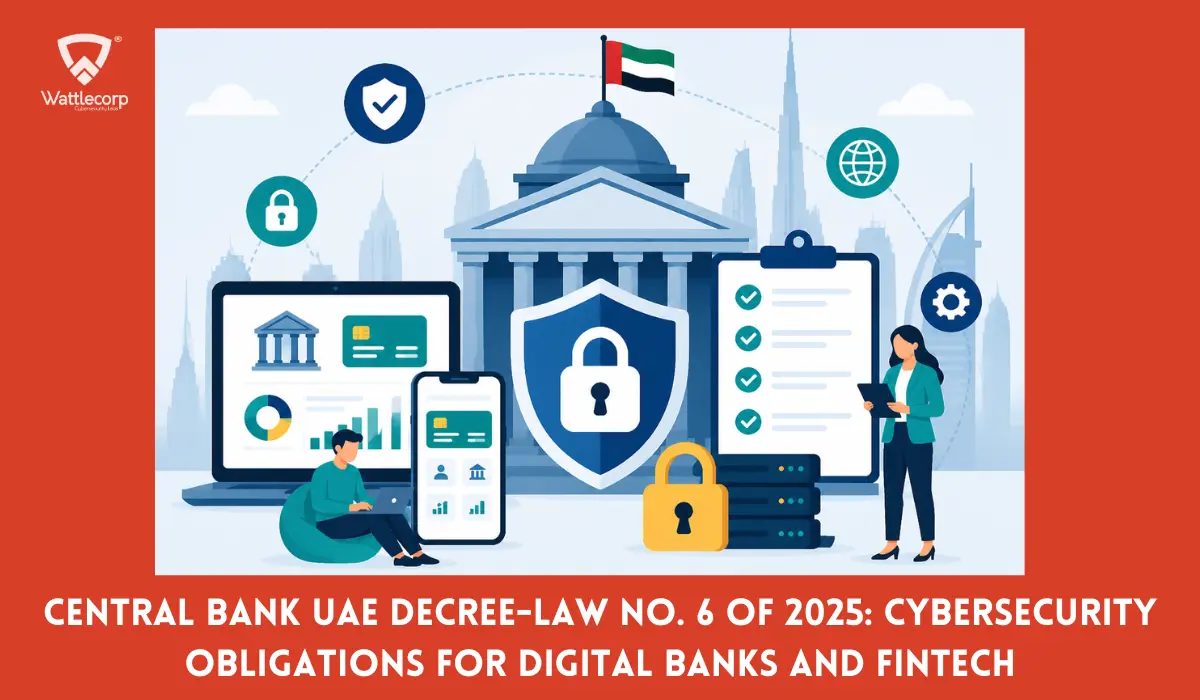
Central Bank UAE Decree-Law No. 6 of 2025: Cybersecurity Obligations for Digital Banks and FinTech
Key Takeaways:
- UAE Decree-Law No. 6 (2025) translates cybersecurity from a suggested best practice into a regulatory obligation.
- Cybersecurity obligations for digital banks and fintech organizations involves implementing and continuously enforcing operational security controls instead of plainly treating them as documentation exercises.
- API security, transaction monitoring, and continuous visibility are critical, highest-risk gaps that shouldn’t be ignored.
- Cyber maturity directly decides licensing, partnerships, and revenue growth.
- Early adopters of compliance gain a measurable competitive advantage in the UAE fintech ecosystem.
Why UAE Digital Banks & FinTechs Must Meet Cybersecurity Obligations Under Decree-Law No. 6 of 2025?
Cybersecurity in the UAE financial ecosystem has entered a new phase, thanks to the UAE Decree-Law No. 6 of 2025, which now sees security as a regulatory requirement linked to business survival rather than that being an internal IT responsibility.
Going in line with this new framework is the emphasis put on meeting cybersecurity obligations for digital banks, compelling the latter to align their security measures with national regulations to ensure continued compliance by safeguarding critical digital assets and information against evolving threats.
For digital banks, fintech platforms, and open finance participants, this means:
- Security must be based on evidence, measurable, and supported by continuous monitoring, accompanied by periodic validation via testing and audits.
- Regulatory expectations extend beyond infrastructure into application-layer controls, including APIs, transaction flows, and ecosystem integrations.
Compliance now combines continuous operational monitoring with periodic audit validation, thus making it more dynamic than traditional models.
And when it regards complying with cybersecurity regulations, this completely shifts the focus to making it a prerequisite for operating in the UAE financial ecosystem, not an afterthought.
The current blog takes you through the key requirements of the law by simultaneously prompting you to understand what it takes to meet cybersecurity obligations for digital banks in the UAE.
What Is UAE Decree-Law No. 6 of 2025 and Who It Applies To?
Effective since September 16, 2025, the Central Bank (Federal) Decree-Law No. 6 of 2025 happens to be a complete revision of financial regulations in the UAE. It mandates digital banks, open finance providers, and fintechs to maintain strict operational security, shifting cybersecurity to an evidence-based practice and also issuing harsher penalties to invoke urgent compliance requirements.
The law expands its regulatory scope to cover critical areas like APIs, virtual assets, and digital financial infrastructure, with high-impact penalties of up to AED 1 billion in case of non-compliance.
The law significantly expands the regulatory scope for cybersecurity across the UAE financial sector by including mandatory cybersecurity obligations for digital banks with fintech oversight. These simultaneously enforce strict actionable measures in case of fraudulent incidents.
Entities Covered under UAE Decree-Law No 6 of 2025
Digital Banks
Fully digital financial institutions for whom cloud, APIs, and mobile platforms reliance counts, enough to turn them into prime targets for cyber threats and subject to strict regulatory oversight.
FinTech Platforms
The technology-driven financial service providers, who handle payments, lending, or investments, and mostly deal with complex integrations, increasing attack surface and compliance requirements in the event.
Payment Service Providers (PSPs)
Entities managing digital payments and transactions, requiring strong controls around data protection, fraud prevention, and maintain transaction integrity.
Open Banking / Open Finance Participants
Organizations exposing or consuming financial data via APIs, where secure data sharing, authentication, and API protection become critical.
Technology Enablers Supporting Financial Infrastructure
Third-party vendors (cloud providers, SaaS platforms, API gateways) that underpin financial systems and introduce supply chain and shared-risk exposure.
Key Regulatory Expectations
- Continuous monitoring of systems and transactions
- Detect and prevent fraudulent mechanisms
- Incident response readiness and breach reporting
- Secure API and data exchange across ecosystems
Why Traditional Compliance Measures Fail for Digital Banks & Fintechs in the UAE?
When it comes to complying with the relevant cybersecurity laws for financial institutions in Middle-East lands like the UAE, most of the organizations either fail or find it hard to cope with the same due to:
Higher dependence on manual processes that cannot keep up with the pace of voluminous cross-border digital financial transactions in real-time.
The need to shift to automated compliance techniques that require ongoing monitoring of online transactions.
Also Read : Fintech Penetration Testing in the UAE: A Complete Security Assessment Case Study for Digital Banks
Inability to report and deliver automated, scalable solutions as per CBUAE mandates on a faster and immediate basis.
The UAE Decree-Law No 6 of 2025 offers a modernized way of meeting financial regulatory requirements. Traditional approaches no longer fit in this context because:
- Regulators expect real-time operational controls
- Evidence must reflect actual system behavior
- Security must align with customer protection and fraud prevention
Why Cybersecurity Obligations Have Become a Board-Level Risk for UAE Digital Banks & FinTechs?
For leadership teams, cybersecurity transitions from being merely an abstract concept to a boardroom agenda. Cybersecurity obligations directly influence regulatory compliance and pave the way for business continuity.
Key Cybersecurity Challenges that CISOs, CTOs, and Boards Face
- Increasing regulatory scrutiny and enforcement risk
- Board pressure to demonstrate measurable cyber maturity
- Difficulty translating cyber risk into business impact
- Expansion of attack surface due to open finance and APIs
- Cyber insurance and audit defensibility challenges
Also Read : Virtual CISO vs Full-Time CISO: Cost Comparison & Benefits for UAE Businesses
Overlooking on these aspects is enough to result in:
- Regulatory penalties
- Licensing delays
- Reputational damage
- Loss of investor confidence
To reiterate, maintaining cybersecurity obligations from the leadership angle is now equivalent to gaining licensing confidence, building investor trust, and ensuring executive accountability.
Key Cybersecurity Risks UAE Digital Banks & FinTechs Face
Despite heavily investing in tools, most organizations remain operationally weak in terms of visibility and response.
Common Exposure Areas
- Critical API security vulnerabilities like BOLA (Broken Object Level Authorization), where attackers manipulate object identifiers for accessing unauthorized data, weak authentication mechanisms, such as basic auth/OAuth flows inappropriately implemented, and injection vulnerabilities (SQL, NoSQL) are often associated with third-party integrations. Mitigating all these risks should include validating user access at the object level and adopting secure authentication protocols such as OAuth 2.0, also using parameterized queries for preventing injections.
- Lack of real-time monitoring across payment systems. This can be addressed by utilizing SIEM (Security Information & Event Management) systems like Splunk or ELK Stack for aggregating logs and detecting anomalies. Intrusion Detection/Prevention Systems (IDS/IPS) can also help identify and prevent attacks when they occur.
- Poor visibility due to fragmented telemetry sources, incomplete log ingestion, and ineffective SIEM correlation, leading to delays in threat detection and incident response.
- Poor Incident response capabilities that often lack defined playbooks, response SLAs, and regulatory-aligned breach notification mechanisms. Incident response capabilities should include well-defined playbooks, response SLAs, and regulatory-aligned breach notification mechanisms. This includes immediate notification to regulatory authorities within 72 hours of discovering a breach, and informing affected customers as per applicable data protection laws.
- Vendor and third-party risks not fully mapped.
Most fintechs are:
- Tool-heavy, but visibility-poor
- Can generate alerts, but lack actionable intelligence
- Maintain compliance documentation, though without audit defensibility
The Cost of Non-Compliance for UAE Digital Banks & FinTechs
Non-compliance in the UAE financial sector can prove highly costly, including massive fines up to AED 1 billion, severe reputational damage, loss of trust, and subsequently, operational disruptions.
Noncompliance per the new 2025 banking law incites:
- Delayed partnerships and enterprise deals
- Licensing risks and regulatory intervention
- Customer trust erosion after fraud or breach
- Revenue loss due to downtime or incidents
- Investor due diligence failures
- Competitive disadvantage within the UAE fintech ecosystem
If cybersecurity maturity level decides upon growth velocity, non-compliance drastically impacts growth and revenue.
Key Cybersecurity Obligations for Digital Banks & Fintechs Under UAE Decree-Law No. 6 of 2025
Under the new Central Bank UAE Decree-Law No 6 of 2025, digital banks and fintech organizations are bound to achieve mandatory resilience by fulfilling regulatory requirements that include introducing robust fraud prevention measures and enforcing biometric authentication.
1. Authentication and Security: Adopt phishing-resistant MFA mechanisms, i.e., FIDO2 or WebAuthn to strengthen authentication, utilizing biometrics where applicable or appropriate.
2. Data Protection and Privacy: Strengthen measures around maintaining data confidentiality and privacy, especially when safeguarding customer data.
3. Anti-Fraud and Transaction Monitoring: Implementing fraud prevention systems on a compulsory basis, effectively targeting social engineering and identity theft in real-time.
4. Incident Notification: Adhere to the legal requirement of promptly notifying CBUAE and affected customers regarding security breaches.
5. Licensing and Penalties: Extend licensing requirements to offering virtual asset services. Increase penalty costs for nonadherence.
6. Governance and Risk Management: Ensure strengthened cybersecurity posture by maintaining strict governance through structured risk assessments, control validation, and audit-ready documentation.
7. Real-time Anomaly Detection: Emphasize a risk-based approach to detect and respond to security threats on an ongoing basis.
8. Data Lifecycle Protection: Encrypt data at rest by using strong standards like AES-256, and during transit with TLS 1.3 or TLS 1.2 in case of legacy compatibility requisition).
9. Third-Party and Vendor Risk Management: Carry out vendor risk assessments continuously before onboarding them.
What Compliance Actually Looks Like in Practice?
Compliance under this law is not theoretical—it is execution-driven.
- Conduct a cybersecurity gap assessment aligned with regulation.
- Map controls to fraud prevention and customer protection.
- Validate controls through Vulnerability Assessment and Penetration Testing (VAPT), API security testing, and advanced techniques, including Red Teaming and continuous security validation.
- Ensure logs, alerts, and response workflows are integrated.
- Conduct audit-ready validation, not just documentation.
A Proper Route for CISOs to Implement Compliance Measures Under UAE Decree-Law No 6 of 2025
A structured, phased approach is critical to achieving compliance.
Phase 1: Regulatory Mapping & Gap Assessment. Identify scope and maturity level.
Phase 2: Strengthen Controls. Provide optimum coverage for API security, IAM, monitoring, and fraud detection.
Phase 3: Evaluate Detection & Response Maturity. Validate SIEM (Security Information and Event Management) tuning, SOC workflows, and alerts.
Phase 4: Prepare for Audit Readiness & Board Reporting.
Common Mistakes That Lead to Regulatory Failure
It is not due to the lack of proper tools that most organizations fail at. Rather, it’s the incorrect approach that acts as the culprit here.
Much of the problem stems from treating cybersecurity obligations for digital banks as a documentation exercise, not like a structured operationalized process.
- Overlooking API and third-party security risks
- Lack of real-time monitoring capabilities
- Weak incident response readiness mechanisms
- Over-reliance on disconnected, non-updated tools
- Not implementing measurable security KPIs
How Fintechs and Digital Banks Can Turn Cybersecurity Obligations Into Competitive Advantage
Organizations that treat cybersecurity regulation as a strategic opportunity, not as a compliance burden, gain measurable advantages through:
- Faster enterprise and banking partnerships
- Stronger investor confidence
- Improved regulatory relationships
- Higher customer trust
- Differentiation in the UAE’s competitive fintech ecosystem
How Wattlecorp Helps UAE Digital Banks & Fintechs Meet Cybersecurity Obligations
Wattlecorp supports organizations in aligning cybersecurity with real regulatory expectations, not just theoretical compliance.
Our assessment-first approach, combined with cybersecurity risk and compliance consulting through VAPT and API security testing help expose real-world attack surfaces for your systems, applications, and network.
Then follows our SIEM and SOC maturity enhancement procedure to help you achieve a stronger, more reliable security and compliance posture.
- Compliance advisory aligned with UAE regulatory requirements
- Incident readiness to ensure breach defensibility
Achieve cybersecurity regulatory compliance with confidence and spearhead your business built on trust and credibility.
Cybersecurity Obligations for Digital Banks FAQs
1.What is Federal Decree-Law No. 6 of 2025 in the UAE?
The new Central Bank UAE (CBUAE) Decree-Law No. 6 of 2025 has been introduced as a unified regulatory framework for the UAE financial sector. This being stated, the law acts as a supervisory umbrella for banking, insurance, and financial activities in the UAE. It also replaces the previous 2018 banking and 2023 insurance laws. The objective is to strengthen the Central Bank of the UAE’s (CBUAE) oversight on digital assets, open finance, and governance.
2.How does the law affect digital banks and fintech companies?
Introduced as the “Banking Law”, CBUAE Decree-Law No 6 of 2025 modernizes regulation for UAE financial organizations, including insurance service providers and fintechs, placing direct accountability on these firms to implement robust cybersecurity controls.
The law prompts securing digital platforms, APIs, and customer data. It also deals with establishing continuous monitoring and threat detection while not excluding to ensure rapid incident response and reporting mechanisms. Equal focus is placed on managing third-party risks.
Non-compliance with the CBUAE Decree-Law No 6 of 2025 invites regulatory penalties, operational disruptions, and reputational damage, especially within the highly regulated financial environment.
3.What cybersecurity obligations should UAE financial institutions prioritize?
As per the revised law, cybersecurity obligations for digital banks should prioritize
● Identity & Access Management (IAM) to enforce least privilege and strong authentication
● API Security, protecting open banking and fintech integrations
● Cloud Security to manage misconfigurations and shared responsibility risks
● Incident Response by building tested and rapid response capabilities
● Third-Party Risk Management for securing vendor and partner ecosystems
● Continuous Security Testing through regularly performing VAPT
Ensure that all the aforementioned areas align with regulatory expectations around risk reduction and resilience.
4.Do fintech platforms using APIs, cloud, AI, or biometrics need stronger security reviews?
Yes, they need to because these technologies tend to significantly expand the attack surface.
Platforms leveraging APIs, cloud infrastructure, AI models, or biometric authentication must engage in deeper and more frequent security assessments. These should cover:
● API penetration testing and abuse case validation
● Review cloud configuration and access controls
● Check AI/ML model security and data integrity
● Biometric data protection and storage validation
Without rigorous validation, it is likely that these systems can introduce high-impact vulnerabilities and compliance risks.
5.How can a VAPT company in Dubai support compliance readiness?
A specialized VAPT provider such as Wattlecorp helps organizations transform regulatory expectations into actionable security improvements by:
●Identifying real-world exploitable vulnerabilities across applications, APIs, and infrastructure
● Simulating attacker behavior that aligns with fintech threat models
● Providing clear remediation guidance mapped to compliance requirements
● Supporting continuous testing cycles and revalidation
Measures like these not only help ensure compliance, but also demonstrate security maturity and resilience, which regulators and enterprise partners increasingly expect.

 Qatar Data Protection Law: Implementing PDPPL Data Subject Rights Processes for Businesses
Key Takeaways: The Qatar Data Protection Law (Law No. 13 of 2016) for Personal Data Privacy Protection, grants individuals specific rights such as right to access, correct, erase, object, withdraw consent, and right to be notified of processing or inaccurate disclosure. Beyond having a privacy policy, businesses or controllers, under Article 11 of Personal Data […]
 AI Governance for Indian Enterprises: Building Internal Controls Before Key DPDP Obligations Take Effect
Key Takeaways: The DPDP Act does not contain AI-specific provisions. Its requirements, however, apply in situations when an AI system processes digital personal data within its territorial and material scope. India is working on building a broader governance framework around safety, accountability, transparency and trust via programs like the IndiaAI Mission. Indian organizations should inventory […]
 Cloud Security Audit for UAE Government Cloud Migration: NCAP and Security Requirements
Key Takeaways: A cloud security audit UAE helps government entities identify security, governance, configuration, access, data-protection and resilience gaps, before and after shifting critical workloads to the cloud. UAE National Cloud Security Policy has defined cloud governance, data security, data sovereignty, IAM, incident management, resilience, portability and cloud operations requirements. The National Cyber Accreditation Program […]
 Data Privacy Consulting UAE – Building a PDPL-Compliant Data Governance Program
Key Takeaways: PDPL compliance requires ongoing operational governance that goes beyond policies to demonstrate how personal data is collected, used, protected, transferred, retained, and deleted. Data mapping helps businesses move from reactive compliance to proactive risk management by establishing a comprehensive inventory of the data ecosystem, helping build a mature data privacy and governance program. […]
 Saudi Arabia’s Critical Systems Controls: What CSP-Linked Enterprises Must Comply With in 2026
Key Takeaways: The Critical Systems Cybersecurity Controls (CSCC) are more applicable to critical systems than to all IT assets owned or operated by an organization. To be in full compliance or to remain in full compliance with CSCC, organizations must maintain continuous adherence to NCA ECC. CSCC has 32 core controls and 73 sub-controls across […]
 DevSecOps for Saudi Banking and FinTech Applications: Building a SAMA-Aligned Secure Development Lifecycle
Key Takeaways: DevSecOps Saudi Arabia for banks & FinTech enterprises doesn’t make security journey a last stop but embeds it into the software development life cycle. Mapping DevSecOps methods to the SAMA Cybersecurity Framework improves security governance and application resilience while boosting audit readiness. Continuous security testing such as SAST, DAST, SCA, IaC scanning, and […]