

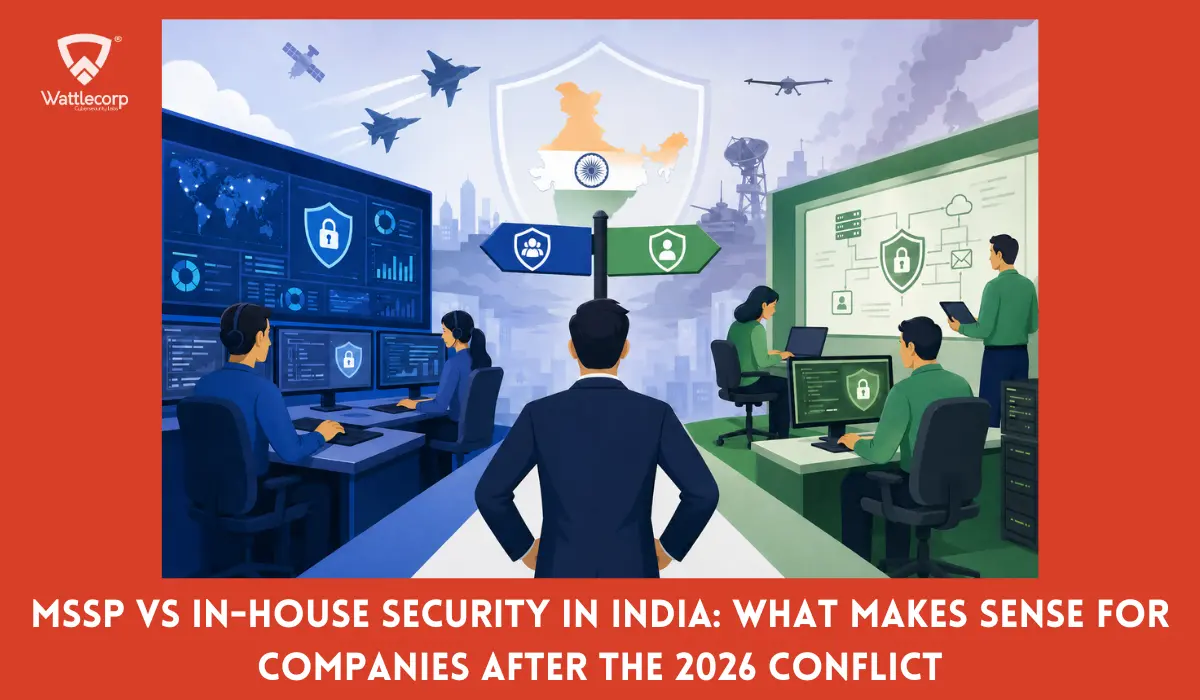
MSSP vs In-House Security in India: What Makes Sense for Companies After the 2026 Conflict
Key Takeaways:
- Most Indian mid-sized companies underestimate the true cost of an in-house SOC because hiring, retention, and retraining expenses are rarely factored into the initial budget.
- The cost of assigning an MSSP service differ based on your business scope, scalability, and service requirements.
- Internal teams with strong governance but limited bandwidth are strong candidates for a co-managed hybrid model, provided there are clearly defined SLAs, escalation workflows, and integration with internal security tools, where MSSPs serve as partners rather than full dependency.
India, with its rapid digitization adoption across banking, healthcare, and government services, has significantly expanded the attack surface. With such a change, the range of threat incidents is growing year after year.
Based on The Pioneer News, in 2025, cybercrimes have increased. The report says that Telangana faced more than 17,000 ransomware cases, and a few cities have lost over 200 crore Indian rupees.
For Indian companies evaluating MSSP vs in-house security in India, the prime struggle is finding the perfect model that delivers real protection at scale. In this blog, you can differentiate between both approaches and determine the suitable model that works for your business post the 2026 war conflict.
Knowing About MSSP vs In-house Security
A managed security service provider/MSSP is a third-party organization that you outsource to handle your business’s cybersecurity needs, where the assigned experts monitor, manage, and respond to cybersecurity threats on behalf of your business.
Basically, in the service, depending on the provider and service model, MSSPs may offer capabilities such as firewall monitoring, intrusion detection, endpoint security, vulnerability scanning, and 24/7 SOC operations.
When it comes to in-house security, management must build efficient full-time experts alongside the existing team. Whereas managed cybersecurity services can provide or augment SOC capabilities, including continuous monitoring and incident response, depending on the engagement model.
CRN Asia reports that total Indian cybersecurity spending is expected to reach $1.44 billion. This is solid proof that enterprises in India are investing in securing their environment, especially when the threats post-war are predicted to be serious.
Comparison of MSSP vs In-House Security in India
While choosing an in-house cybersecurity team, know that it requires an expert team of experienced analysts, threat hunters, and incident responders. A few concerning things about building such a team are the associated hiring cost, polishing talent based on the evolving needs, and the expenses in building a leadership team to monitor.
In addition to expert assignment, you need to invest in adding SIEM platforms, endpoint detection tools, threat intelligence subscriptions, 24/7 shift coverage, and an internal SOC. While these are critical for a growing company, the overall cost can be the biggest concern for startups and mid-sized enterprises.
Challenges in building an in-house team:
- Retaining the experts in the internal team long term is mostly critical.
- Skilled experts are in high demand and look for job upgrades frequently, leaving disruption in the organized workflow.
- When threats are actively evolving, building a new in-house security team can take significant time to reach operational maturity, especially in rapidly evolving threat environments.
The cost structure for the managed security service provider works differently. Instead of building a team for hiring and training, you are subscribing to an already operational security infrastructure. So primarily, you are outsourcing trained analysts, tested processes, and enterprise-grade tools in a single package.
While hiring an MSSP team, the investment covers monitoring, detection, incident response, and compliance reporting under this engagement model.
For Indian businesses evaluating MSSP vs in-house security in India from a cost perspective, assigning a security service provider can significantly help in cost-cutting. The in-house management doesn’t need to worry about recruitment procedures, tool procurement, and learning delays.
Also Read : Business Security Improvement Through Manual and Automated Penetration Testing in India
Challenges of opting for an MSSP:
- As the MSSP is the outsourced provider, your internal team has less visibility into day-to-day security operations. Eventually, the in-house team is dependent on the provider for updates and decisions.
- Customization can vary depending on the MSSP and service tier. Some providers offer advanced customization, detection engineering, and industry-specific configurations, so it is essential to know in detail if they are experts in your area of specialization and if the package provides the particular service.
How to Choose the Right Model in MSSP vs In-House Security India
The security model choices can differ based on the needs, and one specific model cannot be termed as an appropriate one for all business types in India. It mainly depends on size, budget, sector, internal capabilities, and the kind of threats an organization is most exposed to. Organizations have evolved from perimeter-based defenses to multi-layered security models that include endpoint detection, identity security, cloud monitoring, and zero-trust architectures.
Here is a breakdown of the models that will help you with decision-making:
Choose an MSSP if:
- The organization is a startup or mid-sized enterprise and is finding it challenging to source an entire in-house team, with cost as a major concern
- A 24/7 monitoring and incident-responding team is needed, but the headcount or shift coverage to support it internally is not in place
- The internal team has limited experience with CERT-In compliance, RBI guidelines, or sector-specific regulatory requirements
- The business operates in BFSI, healthcare, or SaaS, where threat volume is high and response time directly impacts business continuity
- Predictable security costs matter, and investing separately in tools, licenses, and team training is not viable
- The current security setup has visible gaps in threat detection, vulnerability management, or endpoint coverage
Also Read : Top 10 Cybersecurity Companies in India for SaaS Businesses in 2026
Choose In-House Security if:
- The organization handles classified or highly sensitive data, where the in-house restricts third-party access, which does not support contractual services
- A large enterprise has a good security budget to spend, a stable team, and an existing, mature infrastructure
- Full internal control over SOC compliance operations, security architecture, and incident decision-making is a business or regulatory requirement
- The organization has the capacity to hire, train, and retain experienced security professionals consistently over the long term
Choose a Hybrid Model if:
- Internal leadership needs to own compliance strategy and risk decisions, while an MSSP handles round-the-clock monitoring
- The internal team is strong in governance but lacks the bandwidth or tooling for continuous threat detection
- The business is scaling rapidly, and security coverage needs to grow alongside it without restructuring the internal team each time
- The cost efficiency of an MSSP is needed without fully giving up visibility and control over security operations
Who Provides the Best Managed Cybersecurity Services In Your Budget?
This is where the right partner changes the outcome. Wattlecorp is a recognized cybersecurity firm that works with enterprises to resolve the gap between their current security posture and the protection level. Their work begins with an in-depth assessment of where your organization is exposed and what model actually makes sense for your size, sector, and risk appetite.
As a dedicated managed security service provider, Wattlecorp helps in scaling up your business with 24/7 threat monitoring with the outsourced team and an option of co-managed hybrid models, where your internal team has control and visibility.
For Indian companies still working through the MSSP vs in-house security in India, Wattlecorp offers a practical starting point: a security assessment that maps your real exposure, followed by a protection model built around it.
MSSP vs In-House Security India FAQs
1.Is MSSP better than building an in-house SOC for Indian mid-sized companies?
While analyzing MSSP vs in-house security in India, MSSP is considered a feasible option as it delivers 24-hour coverage with the needed tools and is monitored by experienced analysts. This comes at a predictable pricing, without huge capital investment, hiring challenges, or the retention risk of an internal SOC. For companies without mature existing security infrastructure, MSSP is the more cost-efficient path.
2.What are the real cost differences between MSSP and in-house security in India?
An internal SOC team would require an expert crew consisting of analysts, threat hunters, and incident response specialists. On average, security analysts in India earn about 17 lakhs INR. In addition, it requires essential tools that support security capabilities, and the expenditure is high for a mid-sized organization. In comparison, while outsourcing an MSSP package, the cost can be significantly less, where the organization covers everything in a single package.
3.Can Indian companies use a hybrid model with internal leadership and outsourced monitoring?
Yes, and it is a growing choice among mature Indian businesses. Internal security leadership establishes policy, vendor relationships, and compliance and owns escalations. The MSSP manages continuous monitoring, threat triage, and first incident response. This will maintain organizational control and eliminate the 24-hour staffing load on your own team.

 Cyber Security Strategic Consulting for UAE Boards: Aligning Security Investment with the NCSS 2025–2031
Key Takeaways: The Cyber Security Strategic Consulting UAE programmes help organizations align their cybersecurity roadmaps with the five NCSS pillars, namely governance, protection, innovation, establishing and building, and partnership. Boards should connect cybersecurity spending to material business risks, critical services, regulatory duties, and measurable resilience outcomes. Cyber security strategic consulting UAE programmes translate national direction […]
 Mobile Application Penetration Testing for Qatar Government Digital Services: NCSA- Aligned Security Assurance
Key Takeaways: Mobile Application Penetration Testing Qatar must cover the app, device storage, APIs, authentication and third-party components. Qatar’s NCSA assurance environment combines the National Information Assurance (NIA) Standard, the National Information Security Compliance Framework (NISCF) and accredited security assessment services. OWASP MASVS defines mobile security controls, while MASTG supplies practical test methods for Android […]
 Qatar Data Protection Law: Implementing PDPPL Data Subject Rights Processes for Businesses
Key Takeaways: The Qatar Data Protection Law (Law No. 13 of 2016) for Personal Data Privacy Protection, grants individuals specific rights such as right to access, correct, erase, object, withdraw consent, and right to be notified of processing or inaccurate disclosure. Beyond having a privacy policy, businesses or controllers, under Article 11 of Personal Data […]
 AI Governance for Indian Enterprises: Building Internal Controls Before Key DPDP Obligations Take Effect
Key Takeaways: The DPDP Act does not contain AI-specific provisions. Its requirements, however, apply in situations when an AI system processes digital personal data within its territorial and material scope. India is working on building a broader governance framework around safety, accountability, transparency and trust via programs like the IndiaAI Mission. Indian organizations should inventory […]
 Cloud Security Audit for UAE Government Cloud Migration: NCAP and Security Requirements
Key Takeaways: A cloud security audit UAE helps government entities identify security, governance, configuration, access, data-protection and resilience gaps, before and after shifting critical workloads to the cloud. UAE National Cloud Security Policy has defined cloud governance, data security, data sovereignty, IAM, incident management, resilience, portability and cloud operations requirements. The National Cyber Accreditation Program […]
 Data Privacy Consulting UAE – Building a PDPL-Compliant Data Governance Program
Key Takeaways: PDPL compliance requires ongoing operational governance that goes beyond policies to demonstrate how personal data is collected, used, protected, transferred, retained, and deleted. Data mapping helps businesses move from reactive compliance to proactive risk management by establishing a comprehensive inventory of the data ecosystem, helping build a mature data privacy and governance program. […]