

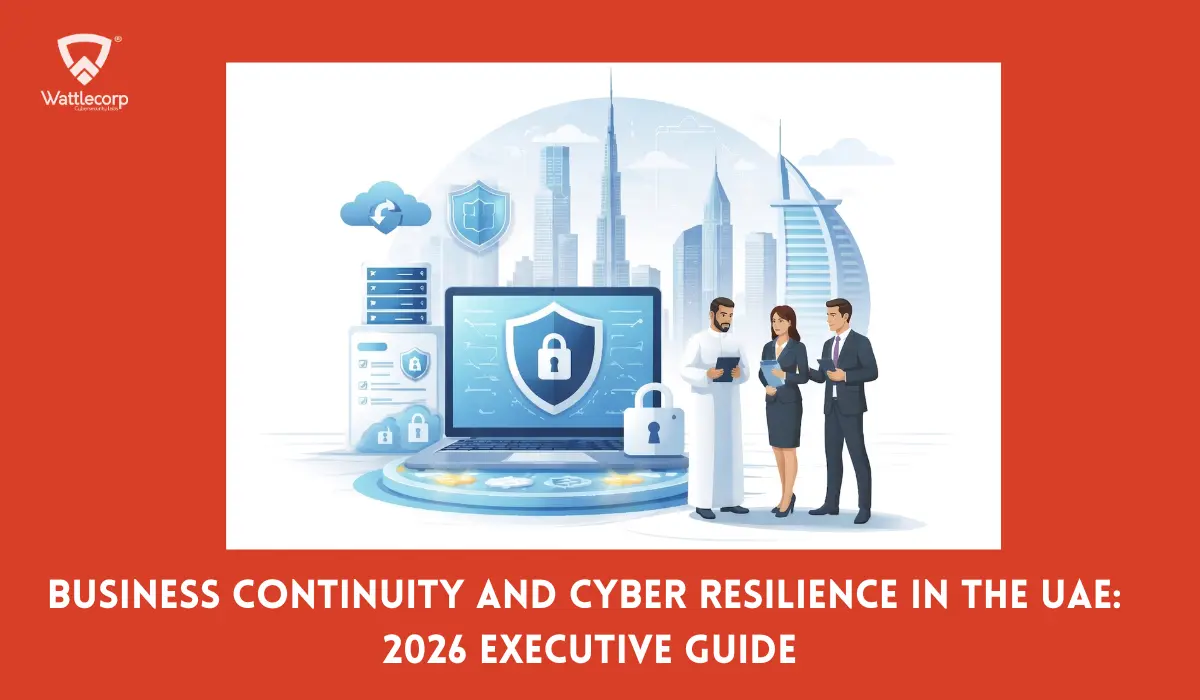
Business Continuity and Cyber Resilience in the UAE: 2026 Executive Guide
Key Takeaways:
- Cybersecurity prevents digital attacks and breaches. Cyber resilience makes sure that even when a breach is successful, your operations will carry on and recover.
- Organisations that treat them as separate functions will have gaps in customer communication, regulatory response, and operational recovery when it counts.
- Your infrastructure can be safe, but a vulnerable connection of a vendor can be a direct entry point. Your resiliency posture should include supply chain security.
- The appropriate partner knows the UAE regulatory needs, combines business continuity with technical security, and could demonstrate quantifiable results.
Growing Need for Business continuity and cyber resilience in the UAE
The scale of the threat facing UAE enterprises is massive today. According to Security Middle East, the UAE is currently targeted with around 500,000 to 700,000 cyberattacks every single day. This is mainly focused on strategic sectors, says the chairman of the UAE Cyber Security Council.
The UAE is seeing significant progress in digital transformation across various sectors, including finance, healthcare, energy, and government, and so is the attack scenario expansion. Cloud adoption, hybrid work models, and IoT expansion has significantly increases the possibility of threats and complexity for the UAE enterprises.
This is an alarming challenge for businesses on how to keep operations running in such a high-risk environment. The solution is that enterprises must prioritize business continuity and cyber resilience in the UAE as a core aspect, and not just as an IT improvement.
Zero-Day Threat and Why to Build Cyber Resilience in the UAE
In early April 2026, Forbes reported that Google issued a warning to 3.5 billion Chrome users. This security alert was issued after confirming the high-severity zero-day vulnerability was detected. It is considered critical, as it is the fourth occurrence of a zero-day vulnerability identified within three months this year.
For UAE enterprises, this is not just a browser-level concern. Zero-day threat signals that preventive controls are not enough to be defensive. Organizattions must be prepared with strong detection capabilities, containment measures, defined patch management, and a structured business continuity plan to respond.
What Is Cyber Resilience, and Is Cybersecurity Different?
Cybersecurity and cyber resilience are closely related to your business’s digital aspects. Cybersecurity is about securing systems, data, identities and digital operations. When you enable cybersecurity practices you are protecting your business by securing all your business operations through prevention, detection, response, and recovery controls. This keeps your infrastructure protected for business continuity and cyber resilience in the UAE.
Next, cyber resilience refers to the ability of an organization to predict, defend, contain, recover, and adapt after cyber incidents while running critical business operations actively. That means that a strong business should be capable of recovering its operations to a satisfactory point and changing its posture to minimize exposure in the future. In such a way, a strong environment will facilitate business continuity management in times of crisis.
To brief it in an instance: Imagine a cybersecurity incident, like a malware attack, happened on a patient management system. It can be because of poor cybersecurity infrastructure. When this organization can continue operation with essential patient services, isolate affected systems, and restore priority processes within defined recovery objectives, that defines a cyber resilient environment.
Why Business Continuity Management and Cyber Resilience Must Work as One
Most UAE businesses focusing on organizational growth fail to recognize that both business continuity management and cybersecurity should go hand-in-hand for smooth operational processes. Uninterrupted business continuity is mostly the result of a highly resilient business ecosystem.
Organizations that can handle cyber incidents with less damage are built upon broader business continuity frameworks. They are usually equipped with a well-planned strategy for business continuity and cyber resilience in the UAE addressing concerns like:
- How customer communications will be managed
- How regulatory obligations will be met
- How alternate operational pathways will be activated
- How the board will be kept informed in real time
These capabilities are validated through practices like pentesting, incident response exercise, tabletop simulations, backup restoration testing, and crisis communication drills. Also, this determines how quickly regular operations can start.
The Cyber Resilience Framework UAE Enterprises Need in 2026
Cyber threats can be the biggest blow to UAE organizations if it was not figured out earlier and fixed. There needs to be a working framework that can evaluate an organization’s resilience posture. Here are some doable points that work as a cyber resilience framework:
Threat Monitoring and Detection
Periodic audits and penetration tests performed on your UAE businesses remain crucial, but they are not sufficient enough when the threat environment is evolving more complex. So, continuous monitoring is strictly followed in organizations that strive to establish resilient operations. These businesses strengthen cyber resilience in the UAE through continuous monitoring, centralized logging, SIEM, EDX/XDR, threat intelligence and clearly defined incident response workflows.
Zero Trust Architecture
Zero Trust is a security model that continuously verifies users, devices, sessions, and access context before granting or maintaining access to systems and data. This implies that there are no assumptions that users or systems inside the network are safe. Each access request is authenticated, preventing insider-based breaches or compromised credentials.
Identity-Centric Access Management
Identity has become a primary target for hackers and many breaches occur through credential theft, session abuse, weak authentication, or overprevileged access. Organizations need to use authentication checks, screen user behavior, and control access strictly. So, enabling identity-approved access helps in building a secure environment, impacting overall business cyber resilience in the UAE businesses.
Incident Response Planning
Every growing organization is exposed to cyber threats, and the concern is how proactive your business detects, contains and responds when an incident surfaces. Resilient businesses create clear incident response plans, define roles and communication steps. These plans are regularly put into effect to verify if they work during real situations.
Third-Party Risk Management
Your business might have a secure infrastructure and can stay defensive during threat incidents. However, you are vulnerable to attacks if your third-party vendor has weak security, drawing you significant cost for ignoring security testing. Moreover, it can affect the cyber resilience of your UAE business. So, enterprises must check for strong vendor security and include security requirements in contracts to avoid breaches through third parties.
How to Choose the Right Business Continuity Management Services in the UAE
Selecting the right cybersecurity partner for the UAE businesses must be done carefully after critical evaluation, but many organizations rush into it without proper evaluation. Here is a structured approach that helps businesses like yours choose the right partner through which you can prosper with business continuity and cyber resilience in the UAE:
Assess your risk posture
The initial step is to determine the threat posture of your business, detection capability, and recovery readiness. An efficient partner will help you assess your external and internal attack surface, exploitable weaknesses through VAPT assessment, access risks, incident readiness,.and operational recovery
Expertise in UAE-specific regulatory rules
Verify if the cybersecurity partner has experts with knowledge in UAE-aligned regulatory and sectoral expectation, especially where cyber resilience intersects with personal data protection, operational continuity, critical service availability, and incident governance.. They must have sector-specific expertise related to different industries, including banking and healthcare, as they are evolving faster in particular. A partner lacking current knowledge in compliance might not be able to address the evolving needs.
Evaluate cybersecurity and business continuity integration depth
Some providers focus on technical security and ignore business continuity. A good partner should show how they handle real incidents while keeping business operations running. Discuss about the strategies they put forth when a cyber incident happens and how they bridge the gaps in promoting business continuity.
Prioritise proven regional experience
Look for partners who can show measurable outcomes. The metric includes faster response times, improved recovery, and reduced risks they have practically drawn from the UAE-based businesses they worked with.
By following these evaluation standards, you can narrow down the right partner. Every UAE business look for someone who understands cybersecurity, business continuity and business resilience. And only the ideal choice will lead your business through success even when adverse situations arise.
Who is the Right Partner for Your Business Continuity and Cyber Resilience in the UAE
Wattlecorp supports UAE organizations with integrated cybersecurity, resilience, and assurance services designed to reduce operational risk and improve incident readiness. with professionals having decades of experience. The experts follow an integrated approach by combining cybersecurity, technical implementation, and business continuity as a combined model.
With a wide range of experience in various fields, including banking, healthcare, SaaS, aviation, and more, Wattlecorp has the best and certified experts for your UAE businesses building efficient business continuity and cyber resilience ecosystem.
cyber resilience UAE FAQs
1. What is the difference between business continuity and cyber resilience in the UAE context?
Business Continuity Management focuses on running business operations despite of any disruption like cyber threats. At the same time, cyber resilience in particular equips organizations to mitigate, react and recover to cyberattacks. In the UAE, the two are closely coupled as there is a regulatory expectation concerning the uptime of operations and data protection.
2. Why should UAE executives treat cyber resilience as a board-level priority in 2026?
Cyber attacks on UAE businesses can heavily impact revenue, compliance structure, and deter reputation on the brand. In addition, as the requirement to evolve in accordance with the new regulatory regulations and to protect against the increase in the number of attacks, the leadership invests in more robust resilience planning to endure the intricate threat events.
3. How does the UAE business continuity framework support cyber incident recovery?
The UAE business continuity models combine incident response, disaster recovery and crisis communication to provide a rapid recovery of cyber incident. They assist organizations to reduce downtime, keep in line with regulatory needs and maintain customer trust in times of disruptions.
4. What should a UAE cyber resilience roadmap include for critical operations?
Mainly, businesses should regularly do risk assessments, VAPT, incident response planning, and disaster recovery strategies, and regular monitoring. A resilient business should also align with UAE’s current compliance standards and prioritize protection of critical business functions.
5. When should a UAE enterprise engage a VAPT company in Dubai as part of resilience planning?
VAPT provider should be involved in the process of initial risk assessment, prior to significant system deployments, and on a regular basis as part of ongoing security testing. Periodic VAPT is strongly recommended and may be required in certain regulated sectors, contractual environments, or enterprise assurance programs in the UAE.

 Mobile Application Penetration Testing for Qatar Government Digital Services: NCSA- Aligned Security Assurance
Key Takeaways: Mobile Application Penetration Testing Qatar must cover the app, device storage, APIs, authentication and third-party components. Qatar’s NCSA assurance environment combines the National Information Assurance (NIA) Standard, the National Information Security Compliance Framework (NISCF) and accredited security assessment services. OWASP MASVS defines mobile security controls, while MASTG supplies practical test methods for Android […]
 Qatar Data Protection Law: Implementing PDPPL Data Subject Rights Processes for Businesses
Key Takeaways: The Qatar Data Protection Law (Law No. 13 of 2016) for Personal Data Privacy Protection, grants individuals specific rights such as right to access, correct, erase, object, withdraw consent, and right to be notified of processing or inaccurate disclosure. Beyond having a privacy policy, businesses or controllers, under Article 11 of Personal Data […]
 AI Governance for Indian Enterprises: Building Internal Controls Before Key DPDP Obligations Take Effect
Key Takeaways: The DPDP Act does not contain AI-specific provisions. Its requirements, however, apply in situations when an AI system processes digital personal data within its territorial and material scope. India is working on building a broader governance framework around safety, accountability, transparency and trust via programs like the IndiaAI Mission. Indian organizations should inventory […]
 Cloud Security Audit for UAE Government Cloud Migration: NCAP and Security Requirements
Key Takeaways: A cloud security audit UAE helps government entities identify security, governance, configuration, access, data-protection and resilience gaps, before and after shifting critical workloads to the cloud. UAE National Cloud Security Policy has defined cloud governance, data security, data sovereignty, IAM, incident management, resilience, portability and cloud operations requirements. The National Cyber Accreditation Program […]
 Data Privacy Consulting UAE – Building a PDPL-Compliant Data Governance Program
Key Takeaways: PDPL compliance requires ongoing operational governance that goes beyond policies to demonstrate how personal data is collected, used, protected, transferred, retained, and deleted. Data mapping helps businesses move from reactive compliance to proactive risk management by establishing a comprehensive inventory of the data ecosystem, helping build a mature data privacy and governance program. […]
 Saudi Arabia’s Critical Systems Controls: What CSP-Linked Enterprises Must Comply With in 2026
Key Takeaways: The Critical Systems Cybersecurity Controls (CSCC) are more applicable to critical systems than to all IT assets owned or operated by an organization. To be in full compliance or to remain in full compliance with CSCC, organizations must maintain continuous adherence to NCA ECC. CSCC has 32 core controls and 73 sub-controls across […]