


UAE Enterprise Cyber Response 2026: How Enterprises Should Respond to Middle East Cyber Conflict
Key Takeaways:
- UAE enterprises in BFSI, SaaS, and critical infrastructure face a new class of threat where geopolitics pulls the trigger and most are nowhere near ready.
- A weak cyber response framework increases the risk of operational downtime and regulatory scrutiny, and it leads to business impacts like reputational damage or client loss depending on the severity of the breach and mitigation actions taken thereafter.
- While unpatched systems and third-party vulnerabilities are common entry points, not all enterprises are automatically exposed. Maintaining up-to-date security measures and proactive threat intelligence can significantly reduce exposure.
- CISOs must treat conflict-scenario tabletop simulations and documented IR playbooks as non-negotiable priorities, not optional exercises, heading into 2026.
- Managed Security Services Providers are no longer a contingency plan, during conflict-period surges, they are the primary line of enterprise defense.
How Should UAE Enterprises Respond to Middle East Cyber Conflict Threatening Business Survival in 2026?
When a missile strikes infrastructure, markets react within minutes. Cyberattacks also work the same way, except the damage starts long before anyone notices.
In the Middle East, where regional conflict and digital warfare now operate on the same timeline, the gap between a threat and a breach has never been smaller.
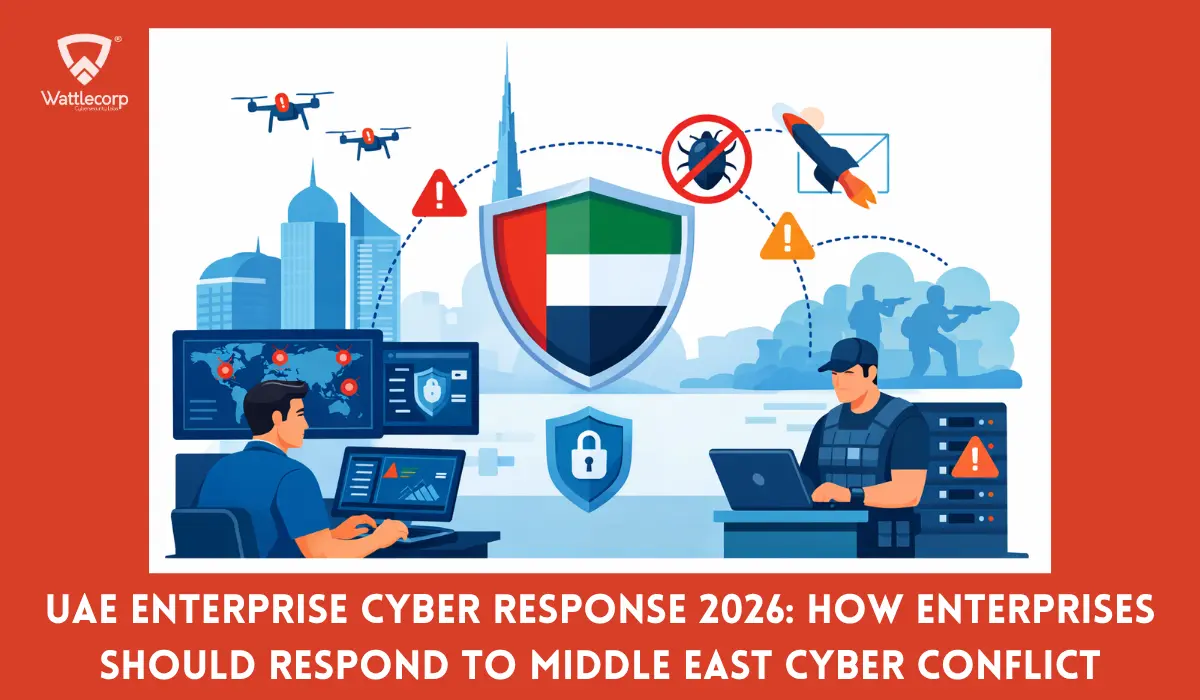
In 2026, the escalating geopolitical tensions across the Middle East have transformed UAE Enterprise Cyber Response from an IT department checklist into a boardroom survival strategy.
Enterprises that operate in Banking, Financial Services and Insurance (BFSI), SaaS, and critical infrastructure are no longer asking if they will be targeted. They are asking when.
What separates businesses that recover quickly from those that collapse entirely is not the size of their security budget, it is the strength of their UAE Enterprise Cyber Response framework.
Let’s break down what a strong UAE Enterprise Cyber Response looks like and why most businesses remain underprepared, and what are the changes to do before the next incident hits.
Why Middle East Geopolitics Directly Threatens UAE Enterprises?
Regional conflict does not only stay on the battlefield. Nation-state actors, hacktivists, and state-sponsored groups consistently use cyberspace as a second operational front, which also creates a huge impact.
UAE enterprises, particularly those in BFSI, multi-tenant SaaS platforms, and OT-heavy critical infrastructure are high-value targets by design.
Conflict-period attacks follow recognisable patterns such as DDoS campaigns, wiper malware, ransomware targeting financial systems, and supply chain infiltration.
Without a tested UAE Enterprise Cyber Response plan, even a mid-tier attack can escalate into a full operational crisis fast.
The problem is not about awareness. Most security teams know the threats exist but the real problem is lack of incident response readiness.
The Real Business Impact of Conflict Driven Cyberattacks on UAE Enterprises
Most UAE enterprises measure cyber risk in technical terms such as compromised systems, patched vulnerabilities, and restored backups.
What they consistently fail to measure is the business cost that begins the moment an attack is detected and continues long after the systems are back online.
- Operational Downtime: A payment processing failure or database breach in BFSI doesn’t just cause financial loss, it triggers regulatory investigations. Under UAE PDPL and NESA frameworks, the clock starts the moment an incident occurs. A delayed UAE Enterprise Cyber Response can turn a containable breach into a compliance catastrophe.
- Reputational Damage: For SaaS providers, trust is the product. Service outages during a conflict period push enterprise clients to competitors within days. Recovery takes months. A fast, transparent UAE Enterprise Cyber Response is what separates market leaders from those who quietly lose accounts.
Also Read : 5 Reasons Why UAE Enterprises Trust Wattlecorp for Managed Security Services
- Regulatory Exposure: UAE regulators expect documented security postures, not verbal assurances. NESA, UAE PDPL, and sector-specific mandates require demonstrable, active risk management. Failure to provide evidence of a structured UAE Enterprise Cyber Response framework could result in regulatory penalties, operational shutdowns, and severe reputational damage.
- Third-Party and Vendor Risk: This is where most enterprises are blindsided. A cloud vendor compromise, an API breach, or a logistics partner failure can cascade directly into your environment. UAE Enterprise Cyber Response planning must include continuous vendor risk assessments, not annual ones.
This is exactly why UAE Enterprise Cyber Response is no longer just an IT function; it is responsible for ensuring business continuity.
Building a UAE Enterprise Cyber Response Framework That Actually Works
Most enterprises have a response plan but very few have one that holds up when a real conflict-driven attack hits. There comes the need for building a UAE cyber safety framework.
1. Establish Crisis Governance Before a Crisis Happens
The first 24 hours after a cyberattack define the outcome. Most enterprises lose this critical time because roles are unclear. Therefore, it is essential to understand who declares the incident? Who contacts regulators? And who speaks to clients?
A strong UAE Enterprise Cyber Response framework starts with a defined Crisis Governance Structure, which includes:
- Executive ownership – The CISO and CEO must have clearly documented roles in the IR (Incident Response) playbook.
- Cross-functional teams -Legal, communications, operations, and finance must be engaged from hour one.
- Pre-approved communication templates – Regulatory notifications must never be drafted during an active incident.
Also Read : Top 15 Cybersecurity Frameworks in 2025
2. Run Conflict-Scenario Tabletop Exercises
Generic simulations no longer cut it and an efficient UAE Enterprise Cyber Response exercises must mirror real geopolitical scenarios.
- BFSI teams: Simulate a ransomware attack targeting critical payment infrastructure while a DDoS (Distributed Denial-of-Service) attack overwhelms customer-facing systems, diverting attention during a high-volume trading window.
- SaaS companies: Simulate a third-party API breach exposing multi-tenant client data during a regional network disruption.
- Critical infrastructure: Simulate an OT system failure triggered by a supply chain compromise under peak operational load.
These are not worst-case projections. These are 2026 threat realities. Running them in controlled environments is the only way to honestly measure UAE Enterprise Cyber Response capability.
3. Upgrade Detection and Response Capabilities
During the geopolitical conflict periods, attack velocity automatically increases sharply. So, traditional SOC workflows get overwhelmed quickly.
A mature UAE Enterprise Cyber Response posture requires:
- SIEM (Security Information and Event Management) configured with live conflict-period threat intelligence feeds
- EDR (Endpoint Detection and Response) deployed across all endpoints with behavioural detection fully enabled
- SOAR (Security Orchestration, Automation, and Response) to automate Tier-1 response tasks and reduce analyst fatigue under surge conditions
- Proactive threat hunting aligned to nation-state TTPs relevant to your sector
If your current stack relies on reactive alerting alone, it is not built for conflict-period UAE Enterprise Cyber Response.
How Regulatory Compliance Strengthens Your UAE Enterprise Cyber Response?
UAE enterprises must treat compliance as a core pillar of UAE Enterprise Cyber Response, not an operational afterthought.
NESA and UAE PDPL Alignment, both frameworks require documented evidence of security controls, breach notification procedures, and active data protection measures.
ISO 27001 and SOC 2 certifications strengthen regulatory defensibility significantly. Post-incident, your UAE Enterprise Cyber Response documentation becomes your primary line of defence with auditors.
Annual audits are insufficient for 2026 threat conditions. Enterprises must run quarterly vulnerability assessments, red team exercises, and supply chain security reviews.
Compliance gaps exposed during a conflict-driven attack carry far heavier regulatory consequences than those identified internally. There comes the importance of continuous auditing during the crisis landscape.
The Role of Managed Security Services in UAE Enterprise Cyber Response
In-house security teams, however skilled, operate within capacity limits. During conflict-period surges, those limits become critical vulnerabilities.
Managed Security Services Providers directly address this gap. For UAE Enterprise Cyber Response, MSSPs ( Managed Security Services providers) deliver:
- 24/7 threat monitoring – continuous network visibility even when internal teams are offline
- Incident response expertise – responders experienced in managing conflict-period attacks
- Compliance advisory – guidance on NESA, UAE PDPL, and sector-specific mandates
- Threat intelligence – real-time feeds on nation-state TTPs targeting your industry
At Wattlecorp , we provide support to UAE enterprises across BFSI, SaaS, and critical infrastructure to design, test, and operationalise UAE Enterprise Cyber Response frameworks purpose-built for today’s threat environment.
Geopolitical conflict has permanently changed the cybersecurity equation for UAE businesses and UAE Enterprise Cyber Response is no longer a technical function sitting inside the IT department, it needs to be a strategic business imperative with Managed Security Services.
Enterprises that invest now in governance, detection, simulation, and regulatory alignment will be the ones that survive, retain client trust, and maintain competitive standing when the next wave of conflict-driven attacks arrives.
UAE Enterprise Cyber Response FAQs
1.What does the 2026 Middle East cyber conflict mean for UAE enterprises?
The threat surface has expanded beyond conventional vectors. UAE Enterprise Cyber Response strategies must now account for nation-state actors, hacktivists, supply chain attacks, and OT-targeting malware, all potentially active simultaneously during regional escalation.
2.What should UAE CISOs prioritise first during heightened threat periods?
During the threat period, ensure to activate IR (Incident Respond) playbooks, audit public-facing asset exposure, verify SIEM alert thresholds, and brief executive stakeholders immediately. UAE Enterprise Cyber Response readiness must be tested before the escalation, not triggered by it.
3.How can UAE enterprises strengthen IR readiness against nation-state and hacktivist threats?
Through conflict-scenario simulations, SIEM and EDR optimisation, integrated threat intelligence, and cross-departmental crisis governance. A documented, tested UAE Enterprise Cyber Response plan is the single most valuable asset an enterprise can hold.
4.Why should UAE enterprises review third-party exposure during regional cyber escalation?
Attackers target the weakest link. Exposed APIs, unpatched applications, and third-party vendor access are primary entry points during conflict-driven campaigns. UAE Enterprise Cyber Response planning must include continuous third-party risk monitoring.
5.When should a UAE business engage an MSSP or VAPT provider?
Businesses should engage a managed security service before an incident not during one. Engaging Wattlecorp Cybersecurity Labs ahead of conflict escalation, which ensures your UAE Enterprise Cyber Response framework is tested, documented, and operational. Waiting until an attack is in progress dramatically reduces containment capability.

 Mobile Application Penetration Testing for Qatar Government Digital Services: NCSA- Aligned Security Assurance
Key Takeaways: Mobile Application Penetration Testing Qatar must cover the app, device storage, APIs, authentication and third-party components. Qatar’s NCSA assurance environment combines the National Information Assurance (NIA) Standard, the National Information Security Compliance Framework (NISCF) and accredited security assessment services. OWASP MASVS defines mobile security controls, while MASTG supplies practical test methods for Android […]
 Qatar Data Protection Law: Implementing PDPPL Data Subject Rights Processes for Businesses
Key Takeaways: The Qatar Data Protection Law (Law No. 13 of 2016) for Personal Data Privacy Protection, grants individuals specific rights such as right to access, correct, erase, object, withdraw consent, and right to be notified of processing or inaccurate disclosure. Beyond having a privacy policy, businesses or controllers, under Article 11 of Personal Data […]
 AI Governance for Indian Enterprises: Building Internal Controls Before Key DPDP Obligations Take Effect
Key Takeaways: The DPDP Act does not contain AI-specific provisions. Its requirements, however, apply in situations when an AI system processes digital personal data within its territorial and material scope. India is working on building a broader governance framework around safety, accountability, transparency and trust via programs like the IndiaAI Mission. Indian organizations should inventory […]
 Cloud Security Audit for UAE Government Cloud Migration: NCAP and Security Requirements
Key Takeaways: A cloud security audit UAE helps government entities identify security, governance, configuration, access, data-protection and resilience gaps, before and after shifting critical workloads to the cloud. UAE National Cloud Security Policy has defined cloud governance, data security, data sovereignty, IAM, incident management, resilience, portability and cloud operations requirements. The National Cyber Accreditation Program […]
 Data Privacy Consulting UAE – Building a PDPL-Compliant Data Governance Program
Key Takeaways: PDPL compliance requires ongoing operational governance that goes beyond policies to demonstrate how personal data is collected, used, protected, transferred, retained, and deleted. Data mapping helps businesses move from reactive compliance to proactive risk management by establishing a comprehensive inventory of the data ecosystem, helping build a mature data privacy and governance program. […]
 Saudi Arabia’s Critical Systems Controls: What CSP-Linked Enterprises Must Comply With in 2026
Key Takeaways: The Critical Systems Cybersecurity Controls (CSCC) are more applicable to critical systems than to all IT assets owned or operated by an organization. To be in full compliance or to remain in full compliance with CSCC, organizations must maintain continuous adherence to NCA ECC. CSCC has 32 core controls and 73 sub-controls across […]