


Cyber Incident Response Planning for Saudi Enterprises: NCA and SAMA Requirements Explained
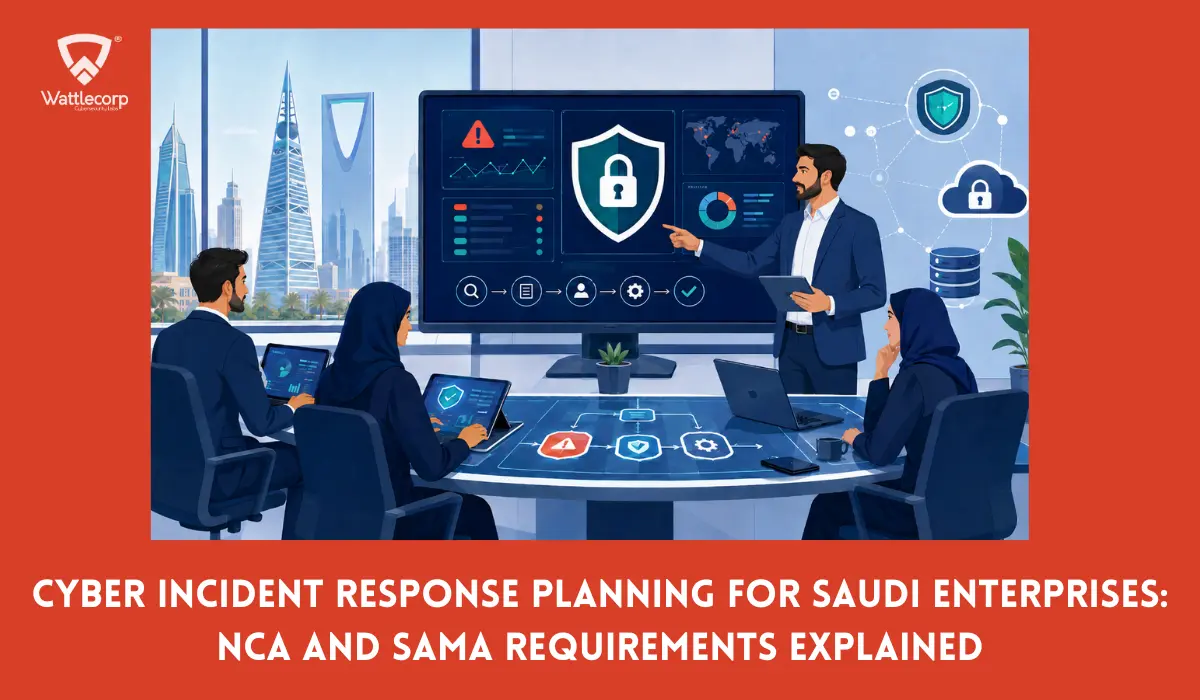
Key Takeaways:
- Cyber incident response in Saudi Arabia is a binding obligation under both the NCA Essential Cybersecurity Controls and the SAMA cybersecurity framework.
- A documented IRP means nothing if it has never been tested, execution under breach conditions is what NCA and SAMA assessors measure.
- SAMA compliance requires more than documentation. Regulated entities are expected to maintain cyber event monitoring, defined incident handling procedures, escalation paths, evidence preservation, regulatory reporting, and periodic evaluation of incident response effectiveness.
- The NCA cybersecurity framework places stringent cyber incident response requirements on critical infrastructure operators in energy, water, and communications.
- Regular VAPT validates that your incident response plan reflects your actual security posture and produces the evidence NCA and SAMA audits require.
Cyber Incident Response Saudi Arabia: NCA and SAMA Requirements Explained for 2026
Every security team dreads the moment a breach goes live and nobody in the room can agree on who does what next.
Somewhere on a shared drive, or buried in a printed binder no one has opened in months, sits an incident response plan, written eighteen months ago by a consultant who has long since moved on, and silent on the cloud migration that reshaped the environment just last quarter.
This is not a thought experiment. It is Tuesday morning in a Riyadh office, and across the Kingdom, it is happening far more often than anyone is willing to publicly admit.
Cyber incident response Saudi Arabia has crossed a threshold. It is no longer a technical project owned by the IT department.
It is a governance obligation with real regulatory teeth, and two frameworks, the NCA Essential Cybersecurity Controls and the SAMA Cybersecurity Framework have made that unambiguously clear to every enterprise operating in KSA.
What Is Incident Response in Cyber Security, and Why Does It Matter Here?
Incident response in cyber security is the structured process an organization uses to prepare for, detect, contain, and recover from a breach or attack.
That definition sounds clean on paper. In practice, it is a cross-functional pressure test, IT, legal, communications, and executive leadership all working together under significant time constraints, with incomplete information, against an adversary who planned their move in advance.
Cyber security and incident response are often treated as separate disciplines. They are not. Prevention reduces how often you face a crisis.
Cyber incident response Saudi Arabia determines how badly that crisis damages you when prevention is not enough.
Regulators in the Kingdom understand this distinction, which is why both NCA and SAMA require not just security controls, but tested, documented response capabilities.
The Regulatory Reality: NCA ECC and the SAMA Cybersecurity Framework
The National Cybersecurity Authority governs cybersecurity across Saudi Arabia’s government entities, critical infrastructure operators, and an expanding scope of private sector organizations.
The NCA Essential Cybersecurity Controls organize cybersecurity requirements across core areas such as Cybersecurity Governance, Cybersecurity Defense, Cybersecurity Resilience, and Third-Party and Cloud Computing Cybersecurity, with specific subdomains covering risk management, identity and access management, event logging, incident management, vulnerability management, and penetration testing.
In the NCA ECC structure, incident and threat management is addressed under Cybersecurity Defense, while the Cybersecurity Resilience domain strengthens business continuity and recovery capabilities after disruptive cyber events.
The Critical Systems Cybersecurity Controls place additional requirements on organizations that own or operate critical systems, including but not limited to sectors such as energy, water, communications, finance, healthcare, and other high-impact services.
Also Read : Preparing for NCA ECC Audits: Implementation Guide for Your Business
The SAMA cybersecurity framework governs Saudi financial institutions, banks, insurers, fintechs, payment service providers under the Saudi Central Bank’s supervision.
The SAMA cybersecurity framework Saudi Arabia is not a checklist. It is a strategic model for building long-term operational resilience.
SAMA compliance is mandatory. Its Incident Management domain requires documented procedures for detecting, reporting, containing, and recovering from cyber incidents, alongside regular compliance reporting and audit trail maintenance.
For SAMA-regulated financial institutions, the SAMA Cyber Security Framework provides sector-specific cybersecurity requirements. NCA controls may also apply depending on the entity’s classification, national cybersecurity obligations, and whether it owns or operates critical systems.
The SAMA cybersecurity framework adds sector-specific depth. Together they define the regulatory environment within which every CISO responsible for cyber incident response Saudi Arabia must operate in 2026.
Why Most Saudi Enterprises Are Not Ready
Regulatory awareness has improved significantly in recent years. Compliance readiness has not kept pace.
The gap between knowing what the regulations require and executing under pressure is wide and widening as digital environments grow more complex.
Organizations running cloud workloads alongside on-premise infrastructure, managing dozens of SaaS applications, and integrating IoT devices into operational workflows are asking their cyber incident response Saudi Arabia procedures to cover terrain those procedures were never designed to address.
Several failure patterns appear repeatedly in KSA enterprises. SIEM tools are often misconfigured, generating alert volumes that exhaust security teams rather than focusing their attention.
Log visibility is inconsistent, some systems produce detailed records, others produce nothing useful at all, and forensic investigators are left trying to reconstruct timelines from gaps.
Third-party risk is systematically underweighted: a vendor incident that touches your systems is your regulatory incident, but most IRPs treat the enterprise boundary as if it were also the accountability boundary.
The most damaging failure is treating the cyber incident response Saudi Arabia plan as a compliance document rather than an operational tool.
Organizations draft IRPs to satisfy an NCA or SAMA audit, then shelve them until the next examination.
If the plan has never been practiced, it will not function under the stress of a real breach. The team will not know their roles.
The escalation paths will be outdated. The regulatory notification templates will reference a compliance officer who left the company.
Building a Compliant Cyber Incident Response Plan: What NCA and SAMA Actually Expect
A cyber incident response Saudi Arabia plan that satisfies NCA and SAMA requirements and actually works under pressure shares several defining characteristics.
It starts with preparation. That means a current risk assessment that maps your most critical assets to your most significant threats, a formal IRP document that explicitly references NCA ECC and SAMA Incident Management requirements, a defined Incident Response Team with roles assigned across IT, GRC, legal, and communications, and tools configured well enough to generate the forensic evidence you will need for regulatory reporting.
Detection and analysis requires continuous monitoring, not periodic reviews, but real-time visibility across networks, endpoints, cloud environments, and OT systems.
The SAMA compliance requirement here is unambiguous: continuous monitoring is expected, not optional.
Also Read : Integrating GRC with SAMA & NCA Frameworks: A Holistic Approach for Saudi Enterprises
That means your SIEM needs to be tuned, your SOC needs to be staffed with the skills to interpret what it surfaces, and your severity classification criteria need to be documented so the team can prioritize correctly rather than treating every alert with the same urgency.
Containment and eradication is where pre-built playbooks earn their value. Organizations that improvise during this phase lose time and lose evidence.
Scenario-specific playbooks for ransomware, data exfiltration, insider threats, and Business Email Compromise allow teams to move decisively rather than debating options during the worst moments of a breach.
Post-incident activity is where organizations most consistently underinvest. Cyber incident response in Saudi Arabia does not end when systems are restored.
Root cause analysis, lessons-learned documentation, evidence preservation, regulatory reporting where applicable, and updates to the IRP are all expected outcomes. SAMA-regulated entities must also follow SAMA’s incident notification and reporting requirements for relevant classified incidents.
Boards need quantified impact assessments. Regulators need evidence that you have addressed the root cause, not just the symptoms.
The Role of VAPT in Incident Response Readiness
Knowing what your response plan says and knowing what an attacker can actually exploit are two different things. VAPT services that cyber incident response Saudi Arabia enterprises rely on close that gap.
Vulnerability Assessment and Penetration Testing provides an attacker’s-eye view of your systems, identifying and validating exploitable weaknesses before a threat actor does.
VAPT findings directly inform your IRP by revealing which assets carry the highest exploitability risk, validating whether your detection tools would recognize a real attack in progress, and generating documented evidence of proactive risk management for NCA and SAMA audits.
A cyber incident response Saudi Arabia plan built on untested assumptions about your security posture is a plan waiting to fail.
Strengthen Your Cybersecurity with NCA & SAMA Compliance
Cyber incident response in Saudi Arabia is no longer just a technical checkbox; it is a competitive edge and a board-level priority.
Wattlecorp partners with Saudi enterprises to transform these regulatory requirements into a robust, operational defense.
Organizations that prove their readiness don’t just satisfy NCA and SAMA examiners, they secure better insurance terms and win the trust of high-tier enterprise clients.
The difference between a leader and a laggard is simple:
True resilience requires moving beyond paperwork. It means aligning your IRP with specific NCA and SAMA mandates, maturing your SOC, conducting aggressive VAPT assessments, and using tabletop exercises to find your breaking point before a hacker does.
Wattlecorp’s NCA Compliance Consulting Services help Saudi enterprises get their cybersecurity controls, governance, and risk management in line with what the National Cybersecurity Authority actually requires.
For financial institutions, our SAMA Compliance Consulting Services in Saudi Arabia are built around strengthening cyber resilience, meeting supervisory expectations, and staying audit-ready without the last-minute scramble.
Cyber Incident Response Saudi Arabia FAQs
1.What is the NCA cybersecurity framework in Saudi Arabia?
The NCA cybersecurity framework is a set of standards issued by Saudi Arabia’s National Cybersecurity Authority to regulate cybersecurity across government, critical infrastructure, and private sector organizations. Its core instrument is the Essential Cybersecurity Controls (ECC), which covers Governance, Risk Management, Resilience, Identity and Access Management, and Third-Party Risk.
2.How can Saudi enterprises prepare for cybersecurity incidents?
Start with a formal risk assessment, build a documented IRP with clearly assigned roles, invest in continuous monitoring and detection, and test your plan regularly through tabletop exercises. Conduct VAPT assessments to validate that your controls would hold up against a real attack, not just a theoretical one.
3.What are the SAMA compliance requirements for incident response?
SAMA requires regulated financial institutions to maintain a documented IRP, deploy continuous monitoring, define regulatory notification timelines, conduct periodic response exercises, and submit regular compliance reports to the Saudi Central Bank. Third-party service providers are expected to align with relevant controls as well.
4.Why is a cyber incident response plan essential for Saudi businesses?
Without a tested IRP, a breach defaults to improvisation, which produces slower containment, greater data loss, and missed regulatory notification deadlines. In KSA, both NCA and SAMA treat cyber incident response in Saudi Arabia as a compliance requirement, meaning the absence of a credible plan creates regulatory exposure on top of the direct cost of the breach itself.
5.How does VAPT help with cybersecurity in Saudi Arabia?
VAPT gives organizations an attacker’s view of their own systems, identifying exploitable weaknesses before threat actors do. It validates whether your detection tools would surface a real attack, tests containment procedures, and produces documented evidence of proactive risk management that NCA and SAMA assessors expect during compliance reviews.

 Mobile Application Penetration Testing for Qatar Government Digital Services: NCSA- Aligned Security Assurance
Key Takeaways: Mobile Application Penetration Testing Qatar must cover the app, device storage, APIs, authentication and third-party components. Qatar’s NCSA assurance environment combines the National Information Assurance (NIA) Standard, the National Information Security Compliance Framework (NISCF) and accredited security assessment services. OWASP MASVS defines mobile security controls, while MASTG supplies practical test methods for Android […]
 Qatar Data Protection Law: Implementing PDPPL Data Subject Rights Processes for Businesses
Key Takeaways: The Qatar Data Protection Law (Law No. 13 of 2016) for Personal Data Privacy Protection, grants individuals specific rights such as right to access, correct, erase, object, withdraw consent, and right to be notified of processing or inaccurate disclosure. Beyond having a privacy policy, businesses or controllers, under Article 11 of Personal Data […]
 AI Governance for Indian Enterprises: Building Internal Controls Before Key DPDP Obligations Take Effect
Key Takeaways: The DPDP Act does not contain AI-specific provisions. Its requirements, however, apply in situations when an AI system processes digital personal data within its territorial and material scope. India is working on building a broader governance framework around safety, accountability, transparency and trust via programs like the IndiaAI Mission. Indian organizations should inventory […]
 Cloud Security Audit for UAE Government Cloud Migration: NCAP and Security Requirements
Key Takeaways: A cloud security audit UAE helps government entities identify security, governance, configuration, access, data-protection and resilience gaps, before and after shifting critical workloads to the cloud. UAE National Cloud Security Policy has defined cloud governance, data security, data sovereignty, IAM, incident management, resilience, portability and cloud operations requirements. The National Cyber Accreditation Program […]
 Data Privacy Consulting UAE – Building a PDPL-Compliant Data Governance Program
Key Takeaways: PDPL compliance requires ongoing operational governance that goes beyond policies to demonstrate how personal data is collected, used, protected, transferred, retained, and deleted. Data mapping helps businesses move from reactive compliance to proactive risk management by establishing a comprehensive inventory of the data ecosystem, helping build a mature data privacy and governance program. […]
 Saudi Arabia’s Critical Systems Controls: What CSP-Linked Enterprises Must Comply With in 2026
Key Takeaways: The Critical Systems Cybersecurity Controls (CSCC) are more applicable to critical systems than to all IT assets owned or operated by an organization. To be in full compliance or to remain in full compliance with CSCC, organizations must maintain continuous adherence to NCA ECC. CSCC has 32 core controls and 73 sub-controls across […]