


Qatar NCSA Framework 2026: What Critical Infrastructure Operators Must Do Now
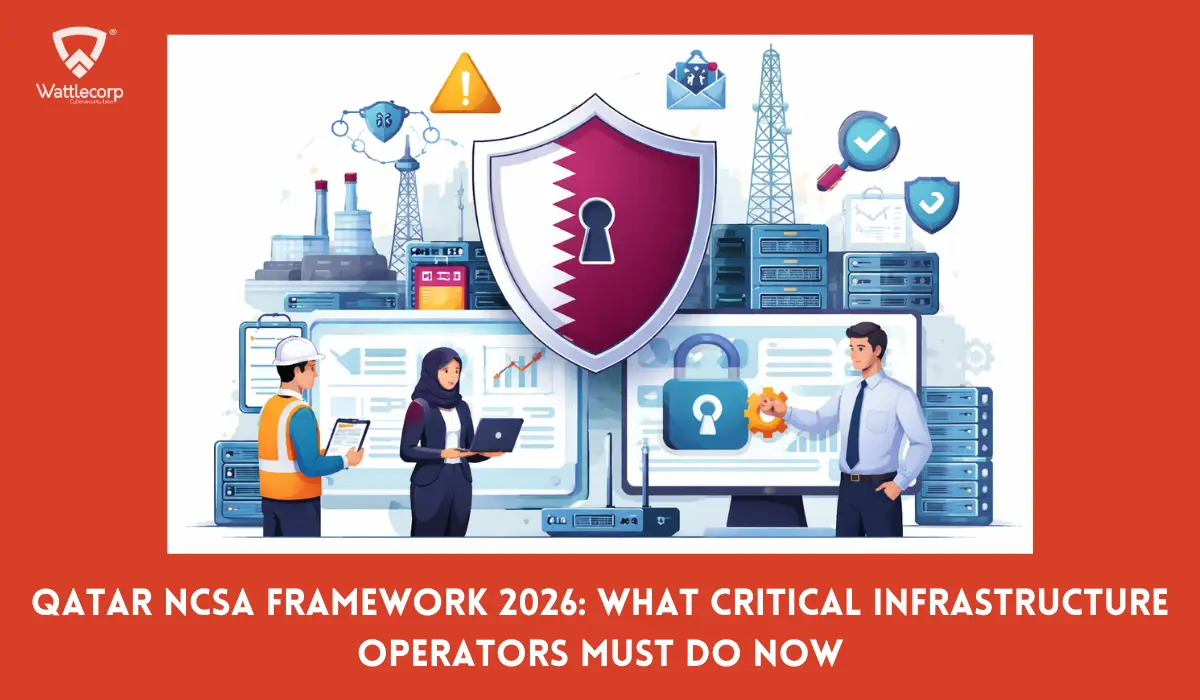
Key Takeaways:
- The Qatar NCSA framework in 2026 has moved beyond documentation, critical infrastructure operators are now being evaluated on operational resilience, not just compliance paperwork.
- Most critical infrastructure operators in Qatar have a dangerous blind spot. They have tools and policies but still lack the integrated visibility and tested readiness needed for a real disruption scenario.
- IT and OT environments in Qatar’s critical infrastructure carry fundamentally different risk assumptions, forcing IT security logic onto OT systems is one of the most common and costly mistakes operators make.
- Effective detection requires comprehensive log coverage, precise alert tuning, and well-defined response ownership, which many Qatar operators still lack.
- The critical infrastructure operators that get ahead under the Qatar NCSA framework will not be the ones with the biggest budgets, they will be the ones that understand their exposure, test their assumptions, and build a cyber program leadership can actually defend.
What Should Critical Infrastructure Operators Prioritize Under the Qatar NCSA Framework?
In Qatar, cybersecurity for critical infrastructure is no longer just a compliance discussion. It is now a resilience discussion.
That is the real shift many operators still underestimate in 2026.
For years, organisations treated cybersecurity frameworks as something to satisfy auditors, respond to procurement requirements, or support internal governance.
But in Qatar, the current regulatory and strategic environment is clearly moving beyond documentation.
The expectation is increasingly about whether a critical infrastructure operator can withstand disruption, recover quickly, and prove cyber defensibility under pressure.
That matters because Qatar’s cyber governance environment is being shaped by the National Cyber Security Agency, the National Cyber Security Strategy 2024–2030, the National Information Assurance (NIA) regime, and sector-relevant industrial and crisis-management expectations.
Together, they point to one reality: critical operators are expected to mature from control ownership to operational resilience.
For CISOs, CIOs, OT security leaders, and board stakeholders in Qatar, the question is no longer “Are we compliant enough?” It is: Can we defend critical operations if a serious cyber event happens tomorrow?
Why Cybersecurity for Critical Infrastructure in Qatar Has Entered a New Phase
Critical infrastructure operators in Qatar are not dealing with ordinary business risk.
They are protecting systems and services that support energy, transport, logistics, finance, healthcare, telecom, utilities, and public operations.
In these sectors, a cyber incident is not just an IT problem. It can become an operational outage, a regulatory issue, a public confidence issue, and a board-level crisis at the same time.
That is why Qatar’s national cybersecurity direction matters so much in 2026.
Also Read : 7 Powerful Benefits of Wattlecorp’s Security Assessment Services in Qatar
The country’s National Cyber Security Strategy 2024–2030 explicitly emphasizes resilience, coordinated response, and trusted digital growth, while maintaining a necessary focus on technical compliance as part of broader cybersecurity resilience.
This is an important signal for enterprise leaders: the national expectation is shifting toward continuity, recoverability, and measurable readiness.
For critical infrastructure operators, that means three things:
- Controls must work in real operating conditions
- Incident response must function across technical and executive teams
- Cyber posture must be explainable and defensible to regulators, boards, and stakeholders
This is where many organisations still have a critical visibility gap.
They may have tools, policies, and even periodic audits, but they still lack the integrated visibility and tested readiness needed for a real disruption scenario.
What the Qatar NCSA Framework Really Means in 2026
One of the biggest mistakes organisations make is searching for a single Qatar NCSA framework 2026 document and assuming compliance begins and ends there.
That is not how this environment actually works.
In practice, The Qatar NCSA framework in 2026 integrates various standards and guidelines, including:
- Qatar’s National Cyber Security Strategy 2024–2030
- National Information Assurance (NIA) standard and certification structure
- Sector and infrastructure-oriented control expectations
- Cyber crisis and resilience planning expectations
- Increasing emphasis on governance, evidence, and critical asset protection
The NIA regime is especially important because it provides organisations with a formal mechanism to not only demonstrate alignment with Qatar’s information security expectations but also to enforce active risk management and continuous security improvement.
NCSA’s own materials make clear that NIA is part of the National Information Security Compliance Framework (NISCF), and that it is designed to help organisations implement a robust managed security system aligned to national requirements.
That matters for critical operators because this is no longer just about having policies on paper.
It is about proving that controls, governance, asset classification, monitoring, and business continuity are functioning together.
In other words, Qatar NCSA framework expectations are becoming operational, not just administrative. Moreover, Qatar’s Digital Agenda 2030 represents that significant step in this direction, and a digital economy can power business outcomes, improve the ease of doing business, and get high returns.
What Critical Infrastructure Operators in Qatar Must Do Now
If you operate in a critical sector in Qatar, the right response in 2026 is not to launch another documentation exercise. It is to reduce exposure in the areas that most often fail under real-world pressure.
1.Identify and Classify What Is Actually Critical
Many cyber programs still start with the wrong assumption: that the asset inventory is already good enough. It usually is not.
Critical infrastructure operators must move beyond static inventories and build operationally relevant asset intelligence, including:
- Identification of systems that directly impact national or business-critical operations
- Mapping of industrial control systems (ICS) and OT environments
- Visibility into externally exposed assets and remote access points
- Identification of high-value data and mission-critical workflows
- Understanding of interdependencies across IT, OT, and third-party systems
This sounds basic, but it is where many resilience failures begin. If your team cannot clearly map what systems support the most important services, you cannot prioritise protection, monitoring, segmentation, or response effectively.
This is especially important in environments where IT and OT overlap but are still managed separately.
2.Treat IT and OT as Related, but Not the Same
This is one of the most important realities for critical infrastructure cybersecurity under the Qatar NCSA framework.
Enterprise IT and operational technology are connected from a business continuity perspective, but they do not carry the same risk assumptions.
That means operators need to stop forcing IT-style security logic onto ICS and OT environments.
In industrial and critical environments, availability and operational safety often matter more than aggressive control enforcement. A technically “secure” change can still create operational risk if it is not designed for the environment.
That is why critical operators in Qatar need a specific focus on:
- Segmentation between IT and OT zones
- Secure remote access for engineers and vendors
- Protocol-aware exposure analysis
- Privileged access governance
- Industrial asset visibility
- Change control aligned with operational constraints
Qatar’s alignment with industrial cybersecurity maturity is also becoming more visible.
Qatar’s National Cyber Security Agency (NCSA) partnered with ISASecure to support the adoption of the ISA/IEC 62443 cybersecurity standards for industrial automation and control systems, signaling a stronger national focus on OT security and industrial cyber resilience.
For operators in critical sectors, the implication is clear: OT security is no longer a secondary technical domain. Under the Qatar NCSA Framework, it is becoming a core component of operational resilience and infrastructure protection.
3.Fix Logging and Monitoring Gaps Before They Become Detection Failures
Many organisations think they have monitoring because they have a SIEM. That is not the same thing.
In reality, a lot of critical infrastructure environments in Qatar still suffer from:
- Incomplete log coverage
- Poor retention discipline
- Weak alert tuning
- Noisy detection logic
- Unclear ownership of response workflows
- Missing visibility into privileged activity and remote access
That creates a dangerous illusion of maturity.
Qatar’s cyber governance materials already place strong emphasis on assurance, visibility, and compliance evidence. For critical operators, this means logging should not be treated as a compliance checkbox.
It should be treated as the foundation for detection maturity, incident reconstruction, and board-defensible reporting.
The practical question is not “Are logs being collected?”
It is: Would your team reliably detect and investigate a high-impact attack path in time?
If the answer is unclear, the organisation is not as ready as it appears.
That is why many operators are moving toward stronger managed detection, log monitoring, and continuous security validation instead of relying only on periodic reviews.
Where Most Critical Infrastructure Operators in Qatar Are Still Exposed
The biggest cyber risks in 2026 are not always caused by a lack of security products.
More often, they come from structural gaps that remain unresolved because the environment has grown faster than governance and visibility.
These are the most common failure points for Qatar NCSA framework readiness:
- Incomplete OT Visibility: Operators often do not have a current, trusted view of all industrial assets, vendor dependencies, and communication paths.
- Weak Segmentation: IT and OT boundaries exist on diagrams, but not always in enforceable architecture.
- SIEM Without Detection Maturity: Logs are centralized, but alerting is noisy, shallow, or too dependent on manual analyst interpretation.
- Untested Incident Response: Playbooks exist, but executive decision-making, escalation logic, and operational coordination are untested.
- Over-Reliance on Vendors: Organisations assume suppliers, integrators, or managed providers are handling risk that is still fundamentally the operator’s responsibility.
- Compliance Without Validation: Controls are documented, but not continuously tested for effectiveness.
This is where a continuous security testing mindset becomes much more valuable than annual checkbox assessments.
A Qatar NCSA framework-aligned cyber program only becomes credible when controls are validated against realistic attack paths, privilege abuse scenarios, segmentation failures, and detection blind spots.
That is also why organisations with complex digital environments increasingly combine:
- Posture management
- Targeted assessments
- Red team style validation
- Logging maturity reviews
- Incident response testing
Rather than treating each as a separate workstream.
A Practical Roadmap to Align With Qatar NCSA Framework Expectations
The right way to approach this NCSA framework in 2026 is not to boil the ocean. It is to move in a disciplined sequence.
Phase 1: Exposure Mapping
Start with clarity. Map critical business services, critical applications and infrastructure, OT and ICS dependencies, third-party access paths, privileged identities, and high-impact failure scenarios. This gives leadership a real risk baseline instead of a theoretical one.
Phase 2: Baseline Against National and Sector Expectations
Next, identify what good actually needs to look like in your environment.
That means mapping current controls against NIA expectations, operational continuity requirements, OT-specific security needs, and evidence and governance obligations.
This phase should not be reduced to paperwork. The goal is to identify what would fail under pressure.
Phase 3: Reduce High-Impact Risk First
Prioritise the controls that reduce the likelihood of disruption, not just the controls that look good in audits.
That usually includes network segmentation, privileged access hardening, remote access control, backup integrity and recovery validation, detection coverage for critical systems, and contractor and third-party access governance.
This is where focused assessments, architecture reviews, and penetration-led validation become especially valuable.
Phase 4: Improve Detection and Response Maturity
At this stage, the goal is not just “seeing alerts.” It is building an operating model that can actually respond.
That means improving log quality, tuning detection use cases, clarifying escalation ownership, testing incident workflows, and aligning technical response with executive crisis decisions.
If the organisation has a SOC, it must be measured by response clarity and operational usefulness, not dashboard volume.
Phase 5: Build Continuous Defensibility
This is where mature organisations separate themselves from everyone else.
Instead of preparing for audits reactively, they maintain a rhythm of retesting, evidence updates, executive reporting, posture reviews, control validation, and targeted security improvements.
That is what makes a cyber program defensible in front of regulators, auditors, boards, and clients and fully aligned with Qatar NCSA framework expectations.
What the Qatar NCSA Framework Means for CISOs and Boards
Cybersecurity is no longer just a technology risk. It is becoming a direct measure of whether leadership can protect continuity, defend decisions, and absorb disruption without operational failure.
That changes what boards should be asking. Not whether the right tools exist. Not whether the last audit was passed.
But whether critical services survive a real incident. Whether serious attack paths get detected in time. Whether leadership can defend the organisation’s cyber readiness under pressure.
Also Read : How vCISO-Led VAPT Improves Cybersecurity for Mid-Sized Businesses
That is the maturity gap many organisations still need to close under the Qatar NCSA framework.
The operators that get ahead in Qatar over the next 12–24 months will not necessarily be the ones with the biggest cyber budgets.
They will be the ones that understand their critical exposure clearly, test assumptions continuously, integrate OT and enterprise risk properly, improve detection and response maturity, and build a cyber program leadership can actually defend.
The Qatar NCSA Framework 2026 Requires Operational Readiness, Not Just Compliance Documentation
For critical infrastructure operators in Qatar, 2026 is not the year to treat cybersecurity as a periodic compliance activity.
This is where Wattlecorp helps organisations translate compliance expectations into practical, security-led operational readiness.
It is the year to treat it as an operational resilience program.
That means moving beyond policy comfort, beyond tool accumulation, and beyond one-time assessments.
Because when a serious incident happens, the organisations that hold up best are rarely the ones with the most documentation.
They are the ones that already know what matters most, where they are exposed, how they will detect issues, how they will respond, and how they will keep critical operations running.
That is the real meaning of cybersecurity maturity under Qatar’s current NCSA environment.
And for critical operators, aligning security maturity with the Qatar Cybersecurity Framework is what must be done now.
Qatar NCSA Framework FAQs
1.What is the Qatar NCSA Framework in 2026?
The Qatar NCSA framework in 2026 is not a single compliance document, it is a layered operating ecosystem. It draws from Qatar’s National Cyber Security Strategy 2024–2030, the National Information Assurance (NIA) regime, the National Information Security Compliance Framework (NISCF), and sector-specific resilience expectations. For critical infrastructure operators in Qatar, the framework signals a clear shift from administrative compliance to operational cyber defensibility.
2.Who needs to comply with Qatar’s cyber assurance and NIA requirements?
Any organisation operating in or supporting Qatar’s critical infrastructure sectors including energy, finance, healthcare, transport, telecom, logistics, and utilities falls within the scope of Qatar’s cyber assurance expectations. The NIA regime applies to organisations handling sensitive information systems, and the Qatar NCSA framework makes clear that critical operators carry the highest accountability for demonstrating active compliance and resilience readiness.
3.How does the Qatar NCSA Framework apply to critical infrastructure operators?
For critical infrastructure operators, the Qatar NCSA framework translates into operational obligations, not just policy documents. Operators are expected to classify critical assets, implement and validate security controls, maintain detection and response capability, manage OT and IT risk separately, and demonstrate continuous governance. The framework expects operators to prove their cyber posture holds up under real disruption, not just under audit conditions.
4.What is the role of NIA certification in Qatar cybersecurity compliance?
NIA certification is the formal mechanism through which organisations in Qatar demonstrate alignment with national information security expectations. Under the Qatar NCSA framework, NIA sits within the National Information Security Compliance Framework and provides a structured path for organisations to implement and validate an information security management system that meets Qatar’s regulatory standards. For critical infrastructure operators, NIA certification is an important marker of governance maturity and regulatory defensibility.
5.How can VAPT support Qatar NCSA Framework readiness?
Vulnerability Assessment and Penetration Testing directly supports Qatar NCSA framework readiness by validating whether security controls actually work under realistic attack conditions, not just on paper. For critical infrastructure operators in Qatar, VAPT helps identify gaps in network segmentation, privileged access controls, OT exposure, detection coverage, and third-party risk before regulators or attackers find them first. It transforms compliance documentation into evidence-backed operational assurance.

 Virtual CISO Services for UAE Free Zone Startups: Affordable Security Leadership for Growing Companies
Key Takeaways: Most startups already hold sensitive data such as customer info, source code, financials, long before they feel big enough to take security seriously, and that’s exactly when the risk starts. A virtual CISO gets you someone who’s done this before, setting up strategy and guiding compliance, without the cost of putting a full-time […]
 SOC as a Service for Indian BFSI and FinTech Companies: 24/7 Monitoring for CERT-In Readiness
Key Takeaways: SOC as a Service for BFSI and FinTech India gives banks, NBFCs, insurers and digital lenders continuous security visibility without the cost and hiring effort of building an in-house operations centre. CERT-In directions require regulated entities to report qualifying cyber incidents within six hours of detection, and implementing SOC for BFSI and FinTech […]
 SOC as a Service in India: How It Works, Pricing, and Why Businesses Need It
Key Takeaways: SOC as a Service helps Indian businesses to get 24×7 security monitoring without huge cost and complexity of building a full in-house security operations center. A managed SOC check and analyse beyond basic log monitoring, which combining SIEM, threat intelligence, analyst-led alert triage, incident escalation, reporting, and security response support. SOC as a […]
 Mobile App Security Testing for Indian Digital Lending Apps RBI, DPDP and API Risk Checklist
Key Takeaways: Mobile app security testing forms an important part of meeting RBI cybersecurity expectations, secure application development practices, and periodic security assessment requirements for digital lending platforms. APIs in lending apps are constantly under attack. Broken object-level authorization, data leaking where it shouldn’t, weak token validation, and missing rate limiting, these aren’t edge cases, […]
 Cybersecurity Risk Assessment for Saudi Supply Chain Vendors Under Aramco and NCA Expectations
Key Takeaways: Cybersecurity risk assessment becomes a practical requirement for proving security maturity, with protecting vendor relationships, and moving forward in procurement processes with Aramco and critical infrastructure clients. Vendors will need to provide evidence of access review documentation, patch deployment, monitoring artifacts, technical assessment results and more that demonstrates the controls in place are […]
 Qatar Personal Data Privacy Compliance: Security Controls for Data Protection Readiness
Key Takeaways: Qatar’s Personal Data Privacy Protection Law applies to organizations that process personal data within its scope, including many businesses handling personal data of individuals in Qatar. Non-compliance isn’t just risky; it can result in hefty fines, operational chaos, and serious damage to your company’s reputation. Personal data privacy compliance Qatar isn’t just about […]