


Why Both Manual and Automated Penetration Testing Are Essential for Continuous Security in UAE
Key Takeaways:
- Automated vs manual penetration testing in the UAE is an excellent model because it is a combination of speed and scale as well as profound vulnerability analysis performed by humans.
- Automated penetration testing assists UAE organisations in staying constantly secure by swiftly identifying frequent vulnerabilities and exposures with locating misconfigurations in cloud and on-premises settings.
- The UAE necessitates manual penetration testing to pinpoint the business logic vulnerabilities, chained attacks and compliance risks that automated tools might overlook.
- A combined penetration testing approach assists in adherence to the UAE cybersecurity requirements, such as NESA standards and local data protection rules.
- Collaboration with a VAPT provider in the UAE will guarantee that penetration testing is intended to match local threat environments, compliance requirements and practical attack conditions.
What is Penetration Testing? A Guide to Manual and Automated Testing
Penetration testing is a simulated cyberattack to identify security vulnerabilities and test the defences of organizations. As the digital landscape is continually updating, a single exploit can disrupt enterprise operations in seconds.
Testing your defenses is no longer an optional task. The real focus now centers on the method we use ; manual or automated testing. Companies have to prioritise speed and thorough investigation to ensure there is perpetual security.
Manual penetration testing offers a detailed analysis and assistance to uncover complex vulnerabilities. Automated testing runs at defined scheduled intervals, which enables routine issues to be detected efficiently, independent of how frequently those checks are executed.
Integration of both approaches provides a holistic security assessment planning with the advantages of both strategies.
This guide is an analysis of the decision between manual and automated penetration testing and reasons why the most desirable approach to protect your infrastructure is a hybrid one.
Why Automated Penetration Testing Scans are Faster and More Extensive?
Automated penetration testing acts as your cyber-early warning system. Security teams use dedicated automated penetration testing tools.
These tools can scan thousands of network points, cloud points and endpoints simultaneously. And they quickly highlight the known risks and typical misconfigurations.
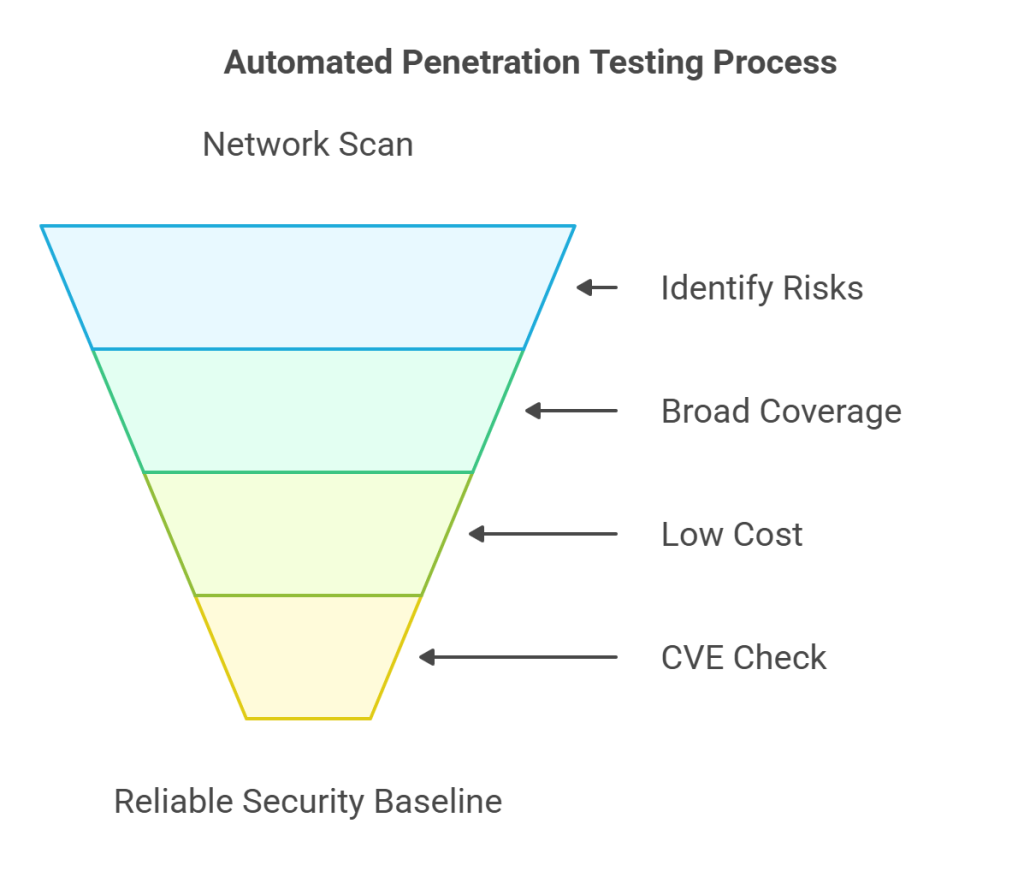
The biggest benefits of automated penetration testing are its broad coverage and low operational cost. It is the only practical way to keep up with continuous security testing when your development team is shipping new code or updates several times a week.
Furthermore, automated pentesting ensures that every documented vulnerability (CVE) is checked against a global, updated list without the risk of human mistake or oversight, giving your team a steady and reliable baseline for your organizational safety.
Manual Penetration Testing: Gain Human Insight and Complexity
If automation is the shield that blocks the most common vulnerabilities quickly and manual penetration testing is the smart thinking that spots a clever trick before it happens.
There are some security gaps that even the most expensive software simply cannot catch.
This includes logic flaws, where the steps of a digital process are technically correct but can be cheated or chained attacks, where a hacker links several tiny, harmless-looking bugs together to cause a total system crash or a massive data theft.
Also Read : VAPT Cost in UAE: What to Expect and Why It’s Worth It
A manual tester explores your network exactly like a real intruder would.
They don’t just look for basic error messages or missing updates. They search for creative ways to trick your system into doing things it shouldn’t, such as letting one person peek at another user’s private files.
This deep, human-led investigation is essential for keeping sensitive financial records safe and meeting the safety rules set by global standards like ISO 27001 and local UAE government laws.
Automated vs Manual Penetration Testing: Find Your Perfect Balance
When debating the question, “Manual vs automated penetration testing, which is better?” The reality is that they work best as a combined test.
An efficient penetration testing strategy for continuous security uses both methodologies in a cyclical process.
The automated penetration testing handles the routine, repetitive and boring tasks like checking for old software versions or open ports. Which lets your highly skilled human experts focus their energy on high-stakes, architectural flaws that require deep thinking.

By blending both manual vs automated penetration testing services, UAE firms ensure that we aren’t leaving any doors unlocked or windows activated.
This setup pairs the relentless, 24/7 watch of software with the sharp, investigative skills of a security professional, offering a full-circle, 360-degree view of your company’s actual risk profile, rather than just a surface-level scan.
Continuous Penetration Testing: Build Unbreakable Security Resilience
The UAE enforces strong cyber rules, particularly under the SAMA framework and NESA guidelines, there comes the importance of continuous penetration testing.
Choosing the right VAPT company in Dubai requires more than just checking a technical box. You need to choose a perfect partner who understands the local legal landscape and the specific threat actors targeting UAE infrastructure.
Also Read : 7 Key Benefits of Partnering with Wattlecorp for Penetration Testing in UAE
A local partner knows the regional nuances that a generic global provider might miss. At Wattlecorp, our testers focus on an 80% manual and 20% automated testing approach to ensure accuracy, helping organizations fix security issues while staying aligned with government regulations.
Whether you are dealing with the Saudi PDPL or regional privacy mandates in the UAE, the VAPT provider makes sure that your security posture is technically strong and legally compliant.
Best Practices for Effective Ongoing Penetration Testing Strategies
To stay on the frontline against current threat challenges, Wattlecorp suggests the following necessary steps that UAE businesses need to take in order to create a more strong and secured defense:
- Incorporate testing into everyday work: Experts recommend that you have to do automated pentesting each time a new code or updates are introduced in your systems. This assists you to locate and correct security bugs at the earliest stages before they turn out to be costly issues.

- Double Check With Human Testing: Computerized tools are both quick and efficient, but they have a propensity to give out false alarms which can be time-wasting. We have an insistence that at Wattlecorp there must be a real person reviewing each automated finding. This guarantees that your end report is correct, simple to read and depicts the actual risks to your business.
- Fix Problems Fast: You can effectively fix problems well with a security test by conducting thorough tests to fix the holes in a short time. Prioritize your fixes in terms of the real threat to your business. Check the loopholes that may allow an attacker to interrupt your work or take away the most valuable information.
- Plan against Local Threats: A generic security plan is not sufficient. You need to design a plan that works in the Middle East, taking into consideration the nature of cyberattacks and intelligent fake emails that are most prevalent in the UAE today.
Master Security with Automated and Manual Penetration Testing
The key to keeping our data safe and secure is achieved through the combination of smart technology and human skill.
By mixing the speed of automated pentesting with the deep-dive precision of manual penetration testing, you can build a strong defense that is as broad as it is deep.
In today’s world, relying on one approach without the other is insufficient to maintain truly secure. With specialized hands-on support and local insight, Wattlecorp’s expert team helps you master complex security tasks while keeping your business resilient.
Real security is not an objective but a systematic practice. Having a personalized strategy to ensure ongoing security, your business will be in a position to keep up with emerging threats and win the trust of your customers and partners in the long run.
Are you planning to harden your infrastructure and secure your resources? Contact Wattlecorp for Continuous Penetration Testing and begin creating a more resilient, compliant future of your business today.

Manual vs Automated Penetration Testing FAQs
1.What is the difference between automated and manual penetration testing?
Automated testing uses software programs to quickly scan for well-known bugs and vulnerabilities across a large network area. Manual testing is a hands-on process where security professionals use their experience and creative problem-solving to find subtle, custom flaws that software simply isn’t programmed to detect.
2.When should you use automated penetration testing?
Automated penetration testing is best used for day-to-day monitoring and maintaining a baseline level of safety. We can use it after small updates, configuration changes, or as a daily health check to catch common risks across your entire network infrastructure without waiting for a human schedule.
3.How does manual penetration testing add value to automated methods?
Manual testing goes where the software cannot reach and exposes a zero-day threat and sophisticated logic holes. It also creates value by doing checks to ensure the accuracy of the automated reports, eliminating time-wasting false alerts and simulates the creative and random nature of a real human intruder attempting to break in.
4.What are the benefits of continuous penetration testing for businesses in the UAE?
The major benefits of continuous penetration testing is to keep companies in perfect line with local rules like SAMA and PDPL while offering real-time defense. It stops vulnerabilities from sitting open and unnoticed for months. It helps to protect you from the very latest threats emerging in the competitive UAE market.
5.How to choose the right penetration testing strategy for my organization?
The most effective choice is always using both manual and automated models. Use automation for constant, broad coverage and baseline security. Manual testing for high-risk systems and yearly compliance checks. A specialized VAPT company in Dubai like Wattlecorp can help you build a plan that fits your industry-specific rules.

 Mobile Application Penetration Testing for Qatar Government Digital Services: NCSA- Aligned Security Assurance
Key Takeaways: Mobile Application Penetration Testing Qatar must cover the app, device storage, APIs, authentication and third-party components. Qatar’s NCSA assurance environment combines the National Information Assurance (NIA) Standard, the National Information Security Compliance Framework (NISCF) and accredited security assessment services. OWASP MASVS defines mobile security controls, while MASTG supplies practical test methods for Android […]
 Qatar Data Protection Law: Implementing PDPPL Data Subject Rights Processes for Businesses
Key Takeaways: The Qatar Data Protection Law (Law No. 13 of 2016) for Personal Data Privacy Protection, grants individuals specific rights such as right to access, correct, erase, object, withdraw consent, and right to be notified of processing or inaccurate disclosure. Beyond having a privacy policy, businesses or controllers, under Article 11 of Personal Data […]
 AI Governance for Indian Enterprises: Building Internal Controls Before Key DPDP Obligations Take Effect
Key Takeaways: The DPDP Act does not contain AI-specific provisions. Its requirements, however, apply in situations when an AI system processes digital personal data within its territorial and material scope. India is working on building a broader governance framework around safety, accountability, transparency and trust via programs like the IndiaAI Mission. Indian organizations should inventory […]
 Cloud Security Audit for UAE Government Cloud Migration: NCAP and Security Requirements
Key Takeaways: A cloud security audit UAE helps government entities identify security, governance, configuration, access, data-protection and resilience gaps, before and after shifting critical workloads to the cloud. UAE National Cloud Security Policy has defined cloud governance, data security, data sovereignty, IAM, incident management, resilience, portability and cloud operations requirements. The National Cyber Accreditation Program […]
 Data Privacy Consulting UAE – Building a PDPL-Compliant Data Governance Program
Key Takeaways: PDPL compliance requires ongoing operational governance that goes beyond policies to demonstrate how personal data is collected, used, protected, transferred, retained, and deleted. Data mapping helps businesses move from reactive compliance to proactive risk management by establishing a comprehensive inventory of the data ecosystem, helping build a mature data privacy and governance program. […]
 Saudi Arabia’s Critical Systems Controls: What CSP-Linked Enterprises Must Comply With in 2026
Key Takeaways: The Critical Systems Cybersecurity Controls (CSCC) are more applicable to critical systems than to all IT assets owned or operated by an organization. To be in full compliance or to remain in full compliance with CSCC, organizations must maintain continuous adherence to NCA ECC. CSCC has 32 core controls and 73 sub-controls across […]