

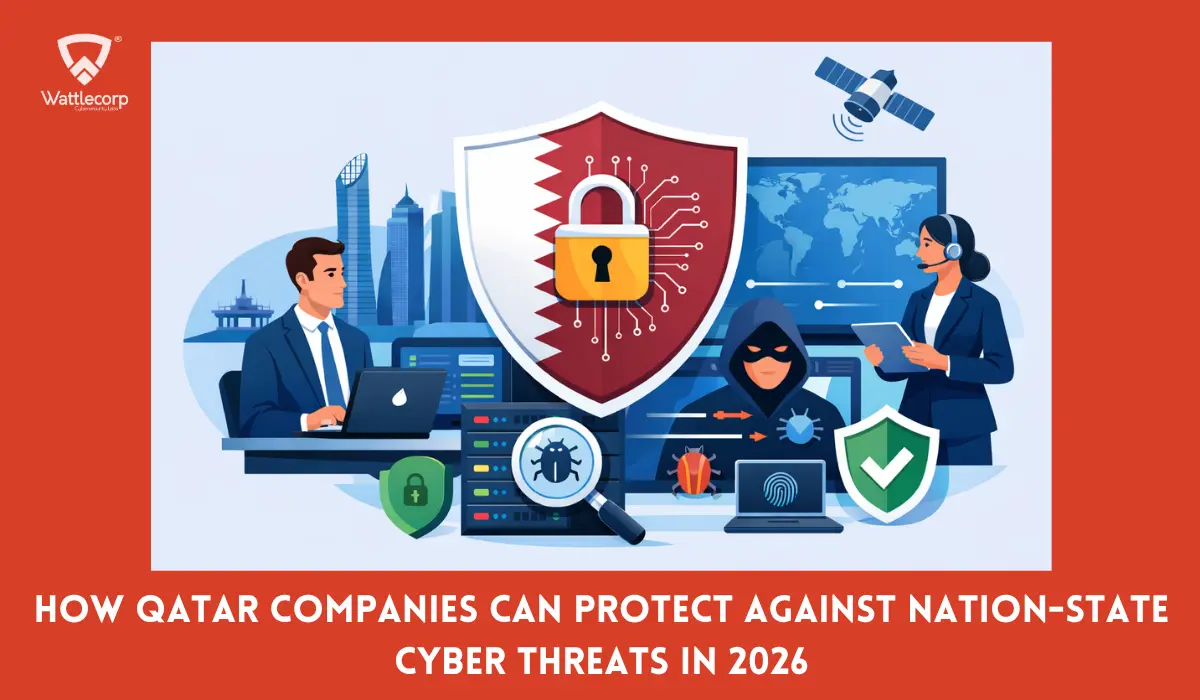
How Qatar Companies Can Protect Against Nation-State Cyber Threats in 2026
Key Takeaways:
- Nation state actors operate with government budgets and long timelines. They are designed to stay invisible, making behavioral detection and continuous monitoring non-negotiable.
- Energy, finance, telecoms, and government-linked entities in Qatar face the most concentrated state-sponsored targeting.
- VAPT is one of the most practical tools for finding exploitable weaknesses before adversaries do.
- Smaller organizations are viable targets, frequently used as pivot points into larger, better-protected entities in the same supply chain.
- Alignment with the Qatar National Cybersecurity Framework, ISO 27001, and NIST builds a governance foundation that holds under real-world pressure.
A Practical Guide to Defending Qatar Companies from Nation-State Cyber Threats in 2026
One quiet breach, maintained for months, is enough to hand a foreign government intelligence worth far more than any ransom demand.
Qatar’s position as a global energy hub, diplomatic player, and financial center hasn’t gone unnoticed by state-sponsored adversaries.
Businesses here aren’t dealing with opportunistic hackers anymore, they’re in the path of government-backed operations with deep resources and very specific objectives.
What are nation-state cyber threats?
Offensive campaigns funded or directed by foreign governments are not for money, but for access and intelligence.
The nation state cyber threats Qatar organizations face today aren’t loud or disruptive by design. They’re quiet, deliberate, and built to last. That’s what makes them dangerous.
Nation-state cyber attacks across the Gulf have grown sharper and more frequent.
The nation state cyber threats Qatar businesses now navigate demand a different posture entirely threat-informed defense, not just compliance.
The cyber threat protection Qatar organizations need starts with understanding who is coming and what they’re actually after.
Why Qatar Is a Target for Nation-State Cyber Threats and How to Safeguard Against Them
Nation-State Cyber Threats don’t behave like conventional attacks and that distinction matters. These operations are persistent.
Adversaries establish access quietly, sit inside a network for months, and act only when the timing suits them. They don’t cast wide nets.
Every target is chosen deliberately, every move calculated. And when one avenue closes, they find another.
Phishing remains a common initial access vector, but nation-state actors also exploit supply chains, zero-day vulnerabilities, and exposed services to gain entry. But what follows is a different category of threat entirely.
This includes custom malware, zero-day exploits, and compromised vendors and supply chains.
Initial access is only the first stage; the real operation involves persistence, privilege escalation, lateral movement, and data exfiltration.
Qatar’s profile makes it hard to ignore for foreign intelligence services. Qatar hosts western military infrastructure on its soil.
A dominant share of global LNG supply running through its networks. A diplomatic footprint that punches well above its geographic size.
Any one of those factors would draw attention. Together, they create overlapping intelligence-gathering incentives for multiple state actors simultaneously.
Understanding how companies can protect against nation-state cyber threats means looking inward first.
What data do you hold? What systems, if disrupted or surveilled, would carry strategic value to a foreign government? Those answers shape your actual threat model far more than generic security frameworks ever will.
Protecting a company from cyber attacks at this level isn’t about buying better tools, it’s about replacing checkbox compliance with defense that’s built around what specific adversaries are genuinely after.
Which Sectors Get Hit First: Mapping the Qatar Cyber Threat Landscape
Energy and utilities, financial services, government entities, and telecoms industries in Qatar are most targeted by advanced cyber attacks.
These aren’t random selections, disrupting or surveilling them creates the highest strategic impact for an adversary.
The Qatar cyber threat in the energy sector is especially serious because much of the infrastructure runs on operational technology, where a breach can mean physical consequences, not just data loss.
In finance, nation state cyber threats Qatar-based institutions face tend to focus on long-term surveillance, transaction records, client communications, executive correspondence.
Also Read : Firewall Security Explained: How to Protect Your Network from Cyber Threats (2025 Guide)
Cyber resilience Qatar companies need to build must be sector-specific.
A critical infrastructure operator faces a fundamentally different threat model than a mid-sized logistics firm, and defenses should reflect that gap.
The right question isn’t just could we be breached?
It is what would an adversary most want from us, and how would they try to get it?
Why Qatar Enterprises Are Struggling to Combat Nation-State Cyber Threats
Can small and mid-sized businesses in Qatar be targeted by state-sponsored actors? Yes, regularly.
Smaller organizations with weaker defenses are often used as pivot points into larger, better-protected targets.
Third-party vendors and subcontractors have been exploited this way repeatedly.
Qatar enterprise cyber security faces real structural constraints.
Resource asymmetry is the most obvious, nation-state actors work with government budgets; no private company competes on equal terms.
The realistic goal is making an attack costly enough that adversaries pursue softer targets instead.
Skills gaps compound the problem. Qatar enterprise cybersecurity teams compete globally for a limited talent pool.
Hiring experienced threat hunters or red teamers in Doha is genuinely difficult, and coverage gaps during transitions create windows that adversaries notice.
Regulatory pressure adds another layer. Aligning with the Qatar National Cybersecurity. Frameworks like ISO 27001, NIST CSF, and SOC 2 provide complementary governance, risk management, and assurance structures.
Protecting against nation state cyber threats Qatar is far harder when your team is already running reactively.
From Vulnerable to Resilient: Cyber Threat Protection Strategies for Qatar Businesses
Cybersecurity Threats in Qatar at this level require overlapping layers of defense. No single control holds. The assumption that a firewall and antivirus are sufficient was outdated years ago.
Then, what are the warning signs of a nation-state cyber intrusion?
Watch for unusual authentication patterns, off-hours access to sensitive systems, quiet lateral movement across the network, and small, compressed outbound data transfers.
Most organizations catch these after the fact, which is exactly why behavioral detection and real-time monitoring matter.
- Threat Intelligence: Threat intelligence improves detection when integrated with SIEM, telemetry, and automated correlation workflows. Integrating curated intelligence into your SIEM, and participating in sector ISACs, gives security teams a genuine chance at early detection.
- VAPT: VAPT services in Qatar have become a practical necessity for organizations serious about understanding their real attack surface. Vulnerability Assessment and Penetration Testing doesn’t just find weaknesses, it tests whether they can be chained into something an adversary can actually exploit.
- Incident Response: What should Qatar businesses do after a cyber attack? The answer should already be written and rehearsed before anything happens. A documented plan with defined roles, communication trees, and containment playbooks significantly reduces dwell time.
- Employee Awareness: Spear-phishing targeting executives remains one of the most reliable entry vectors for nation-state actors. These campaigns are researched, personalized, and convincing. Scenario-based training updated quarterly and not annual click-through modules builds awareness that actually holds under pressure.
- Qatar Cyber Risk Management: Qatar cyber risk management requires continuous posture assessment, not periodic audits. Configuration monitoring, privilege access reviews, and attack surface management tools catch new exposures as they appear, not months later during a scheduled scan.
Protecting against nation state cyber threats Qatar-style requires all of these working together. Gaps between layers are where state actors operate.
Aligning Enterprise Security With Qatar’s National Cybersecurity Architecture
Nation State Threats rarely hit a single organization in isolation, they’re usually part of coordinated campaigns targeting a sector or country.
The Qatar National Cybersecurity Strategy accounts for this through cross-sector coordination and incident-sharing mechanisms.
For private organizations, reporting incidents to national authorities isn’t just a compliance step, it contributes to a collective threat picture that improves everyone’s response capabilities.
Also Read : Qatar NCSA Framework 2026: What Critical Infrastructure Operators Must Do Now
Public-private collaboration through joint exercises and threat briefings creates a collective defense posture that state-sponsored adversaries find significantly harder to navigate.
International standards, ISO 27001, NIST CSF, SOC 2 form the operational backbone of cyber threat protection Qatar organizations can point to when demonstrating maturity to regulators, partners, and customers.
How Wattlecorp Supports Qatar’s Defenses Against Nation-State Actors
Defending against Nation State Cyber Threats Qatar takes more than commercial security tools. It takes a partner with technical depth and direct knowledge of the Gulf threat environment.
Wattlecorp delivers both. Red Team engagements and VAPT programs simulate nation-state intrusion tactics against your real environment.
GRC advisory services help organizations align with national and international compliance requirements without losing focus on actual security outcomes.
Managed Security Services provide 24/7 monitoring so that early indicators of compromise are caught before they escalate.
When an incident does occur, Wattlecorp’s response team works alongside internal stakeholders to contain, investigate, and recover, with forensic integrity maintained throughout.
For organizations serious about nation state cyber threats Qatar defenses must address, Wattlecorp operates as a strategic partner, not a vendor.
Proactively Defend Against Nation-State Cyber Threats Before They Strike
The threat reality around nation state cyber threats Qatar businesses face in 2026 is precise, patient, and growing.
Waiting for an incident to reveal gaps, rather than partnering with specialists like Wattlecorp to proactively close them is not a strategy against state-sponsored adversaries; it’s a liability.
Cyber threat protection Qatar organizations can build starts with honest asset prioritization, runs through rigorous penetration testing, and is sustained by continuous improvement at every level.
Qatar cyber threats 2026 will be better resourced and harder to detect than anything that came before.
Assess your exposure. Commission independent VAPT. Align with national frameworks. Train your people. The adversary is already planning your defenses should be too.
Nation State Cyber Threats Qatar FAQs
1.What are nation state cyber threats, and why do they matter for companies in Qatar?
Nation state threats are government-directed operations built to steal intelligence, disrupt infrastructure, or gain political advantage. Qatar sits in a difficult position, with major energy reserves, US military presence, and deep regional ties make it a recurring target. These attacks don’t announce themselves. By the time something surfaces, the attacker has usually been inside for months.
2.Which sectors in Qatar face the highest exposure to targeted cyber campaigns?
Energy, financial services, telecoms, and government-linked entities take the most hits. Qatar’s LNG sector is a constant focus given what it means to global supply. Banks are rarely targeted for quick theft, the goal is long-term intelligence collection. Critical infrastructure faces a different risk: attackers who want operations to stop, not just data to walk out the door.
3.How does Qatar’s National Cyber Security Strategy affect private-sector security priorities?
The strategy gives companies a governance reference point and opens the door to coordinated response when major incidents hit. More practically, aligning with it connects private organizations to national threat intelligence, the kind of visibility that individual companies rarely build on their own.
4.What controls should Qatar companies prioritize first against APTs?
Network segmentation and privileged access management cut down how far an attacker can move once they’re in. EDR/XDR on endpoints, MFA across privileged accounts, and centralized SIEM-based monitoring are essential for detecting advanced threats. VAPT needs to be a recurring program, not something done once to satisfy an audit.
5.Why should VAPT be part of a Qatar cyber resilience plan?
Traditional scanners identify vulnerabilities, but advanced techniques like penetration testing and attack path analysis demonstrate how attackers can chain them. VAPT puts a real adversary mindset against your environment, testing lateral movement, privilege escalation, and the actual path to your most sensitive assets. A list of CVEs tells you what’s broken and VAPT tells you what’s at risk.

 Mobile Application Penetration Testing for Qatar Government Digital Services: NCSA- Aligned Security Assurance
Key Takeaways: Mobile Application Penetration Testing Qatar must cover the app, device storage, APIs, authentication and third-party components. Qatar’s NCSA assurance environment combines the National Information Assurance (NIA) Standard, the National Information Security Compliance Framework (NISCF) and accredited security assessment services. OWASP MASVS defines mobile security controls, while MASTG supplies practical test methods for Android […]
 Qatar Data Protection Law: Implementing PDPPL Data Subject Rights Processes for Businesses
Key Takeaways: The Qatar Data Protection Law (Law No. 13 of 2016) for Personal Data Privacy Protection, grants individuals specific rights such as right to access, correct, erase, object, withdraw consent, and right to be notified of processing or inaccurate disclosure. Beyond having a privacy policy, businesses or controllers, under Article 11 of Personal Data […]
 AI Governance for Indian Enterprises: Building Internal Controls Before Key DPDP Obligations Take Effect
Key Takeaways: The DPDP Act does not contain AI-specific provisions. Its requirements, however, apply in situations when an AI system processes digital personal data within its territorial and material scope. India is working on building a broader governance framework around safety, accountability, transparency and trust via programs like the IndiaAI Mission. Indian organizations should inventory […]
 Cloud Security Audit for UAE Government Cloud Migration: NCAP and Security Requirements
Key Takeaways: A cloud security audit UAE helps government entities identify security, governance, configuration, access, data-protection and resilience gaps, before and after shifting critical workloads to the cloud. UAE National Cloud Security Policy has defined cloud governance, data security, data sovereignty, IAM, incident management, resilience, portability and cloud operations requirements. The National Cyber Accreditation Program […]
 Data Privacy Consulting UAE – Building a PDPL-Compliant Data Governance Program
Key Takeaways: PDPL compliance requires ongoing operational governance that goes beyond policies to demonstrate how personal data is collected, used, protected, transferred, retained, and deleted. Data mapping helps businesses move from reactive compliance to proactive risk management by establishing a comprehensive inventory of the data ecosystem, helping build a mature data privacy and governance program. […]
 Saudi Arabia’s Critical Systems Controls: What CSP-Linked Enterprises Must Comply With in 2026
Key Takeaways: The Critical Systems Cybersecurity Controls (CSCC) are more applicable to critical systems than to all IT assets owned or operated by an organization. To be in full compliance or to remain in full compliance with CSCC, organizations must maintain continuous adherence to NCA ECC. CSCC has 32 core controls and 73 sub-controls across […]