


Why Continuous Pentesting is Essential for Defending against Zero-Day Vulnerabilities in the UAE
Key Takeaways:
- Annual pentests represent a snapshot in time-there are rapid changes between zero-days that pentests fail to capture.
- Zero-days are difficult to detect since they lack any known signature and may frequently evade the traditional scanners before causing damage.
- Constant pentesting minimizes the auditing blind window as new endpoints, code modifications and configuration changes are constantly observed.
- Tight loop remediation (discover validate fix re-test), rather than one PDF report, can yield real security outcomes.
- Real security outcomes come from tight remediation loops discover, validate, fix, re-test, not from a single report.
- To UAE businesses, continuous pentesting is becoming compliance-correlative and operationally required, particularly of finance/tech-intensive ecosystems.
Importance of Prioritizing Continuous Pentesting for UAE Businesses to Protect against Zero-Day Vulnerabilities
The traditional approach to security is focused on yearly pentests. That is no longer enough to protect a UAE business against zero-day vulnerabilities.
Zero-day vulnerabilities don’t wait for your annual audit; they emerge daily. These zero-day vulnerabilities are unknown flaws that hackers exploit before a patch is even created.
For a business in the UAE, ignoring zero-day vulnerabilities creates a massive risk. With the UAE being a global hub for finance and technology, the exposure to a major security breach caused by zero-day vulnerabilities is higher than ever.
The latest industry reports show a sharp increase in the exploitation of zero-day vulnerabilities. This is why preventing cyber breaches requires a shift from one time security audit testing to continuous pentesting.
Continuous pentesting ensures that your environment is constantly checked for zero-day vulnerabilities.
Without continuous pentesting, a UAE organization remains blind to zero-day vulnerabilities that appear between audits.
Continuous pentesting is a critical component of maintaining a strong security posture against zero-day vulnerabilities in the UAE.
A Cyber Security Assessment for a UAE Insurance provider ensures strong protection by identifying and addressing potential threats before they can impact the business.
Why Zero-Day Vulnerabilities are Hard to Detect and How they Impact Security?
A zero-day vulnerability is an unknown software flaw that grants attackers a head start before a patch exists.
Zero-day vulnerabilities lack entries in CVE databases and vendor advisories, meaning vulnerability scanners cannot identify them. Additionally, exploits leveraging zero-days may evade signature-based detection tools.
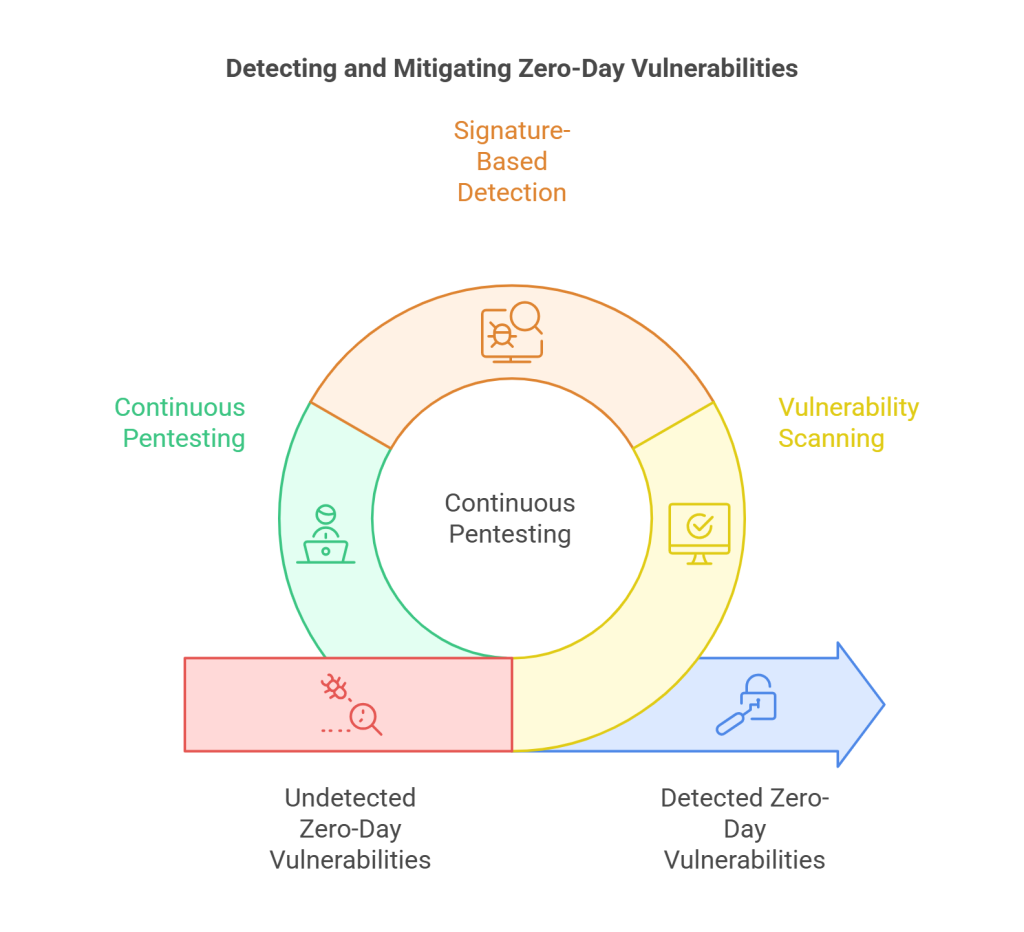
By exploiting zero-day vulnerabilities across high-value targets—including edge appliances such as VPNs and email gateways, as well as client-side applications, cloud services, and supply-chain components—attackers can gain initial access, escalate privileges, and move laterally within the environment.
These invisible threats remain unmasked until a full-scale data breach occurs in the absence of continuous pentesting.
The Critical Gap: Why Traditional Pentesting Fails Zero-Days
Security is dynamic and an annual audit is a picture of a moment in time. Cybersecurity penetration testing is usually conducted at a standard level to take into consideration the effect of decay between tests.
New code deployments, new hidden API endpoints, and even subtle configuration drifts all leave new entry points which will go undetected until the next annual cycle.
This is the gap in which zero-day vulnerabilities flourish. Traditional pentesting cannot account for new attack surface introduced post-assessment, nor can it detect vulnerabilities weaponized after the test window.
Defense should keep up with the pace of contemporary development. In order to overcome this blind spot, constant pentesting substitutes the still snapshots with a fluid stream of intelligence.
Switching a one-time, fixed event to a pattern of unremitting monitoring, companies may at last safeguard their infrastructure against the ever-changing escapades.
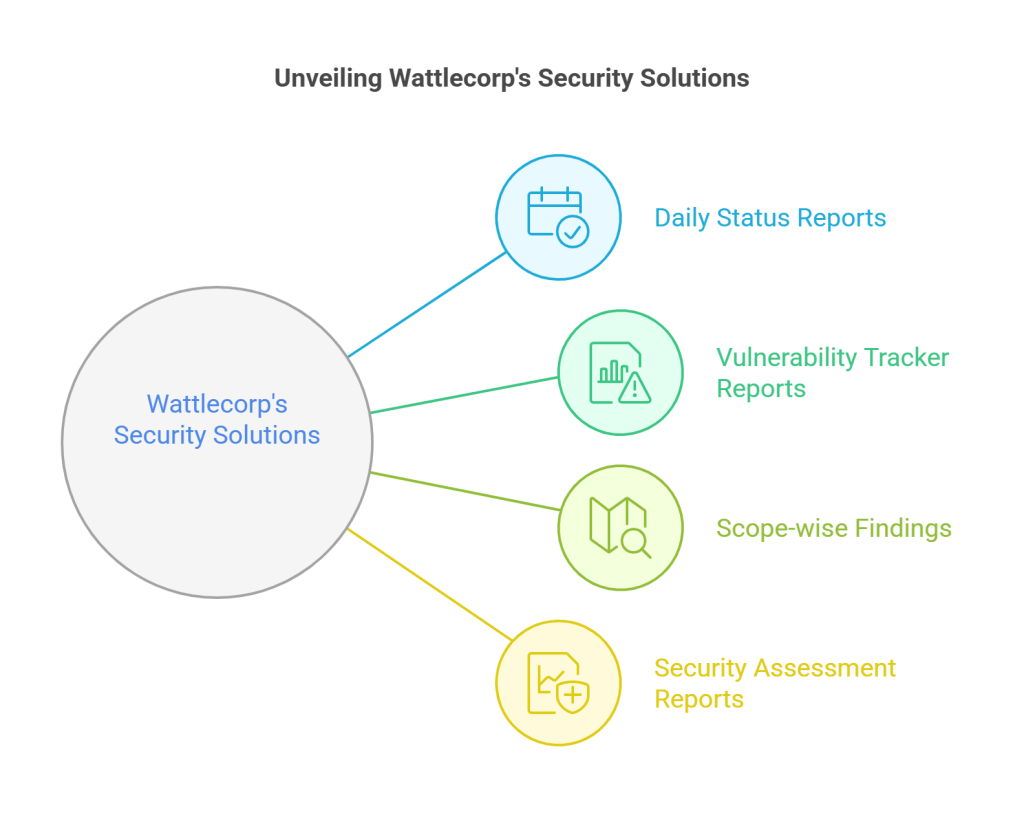
At Wattlecorp, we assist in filling this gap by offering high-frequency visibility by providing:
- Daily Status Reports: Trends in instant changes in the attack surface.
- Vulnerability Tracker Reports: Tracking the real-time remediation.
- Scope-wise Findings: Dividing risks into business and asset-specific units.
- Security Assessment Reports: Providing both high level risk information and detailed technical specifications of your engineers.
By transitioning from one time security audit to a model of continuous pentesting, businesses can finally secure their infrastructure against the persistent threat of ever-evolving exploits.
The Continuous Pentesting: Proactive Defense against Zero-Day Vulnerabilities
Continuous penetration testing is a security model that incorporates real-time attack surface visibility and regular automated scanning and manual comprehensive testing.
After a discovery, testing, validation, remediation, and reporting cycle, we are aligned with methodologies such as PTES and OWASP Testing Guide, while incorporating continuous monitoring best practices. This will be most effective in restricting the effects of the zero-day vulnerabilities.
Also Read : Why Managed VAPT Is the Future of Cybersecurity in the UAE: Continuous Testing vs One-Off Audits
Continuous penetration testing validates compensating controls when patches aren’t immediately available; this is a key zero-day mitigation strategy.
By prioritizing data from active threats, we ensure our security strategy remains deeply integrated with your specific business context and operational needs.
How Continuous Testing Saved a UAE Fintech During a Major Launch?
Situation: A UAE fintech was pushing daily updates to a digital wallet, bridging cloud-native services with legacy backends, a setup prone to configuration drift.
The Trigger: Mid-week, the team deployed APIs for a third-party gateway. Under our continuous testing model, telemetry was already live as the code hit production.
The Discovery: Within hours, we identified a chained exploit such as what type of panel like admin console, debugging interface, internal API documentation.
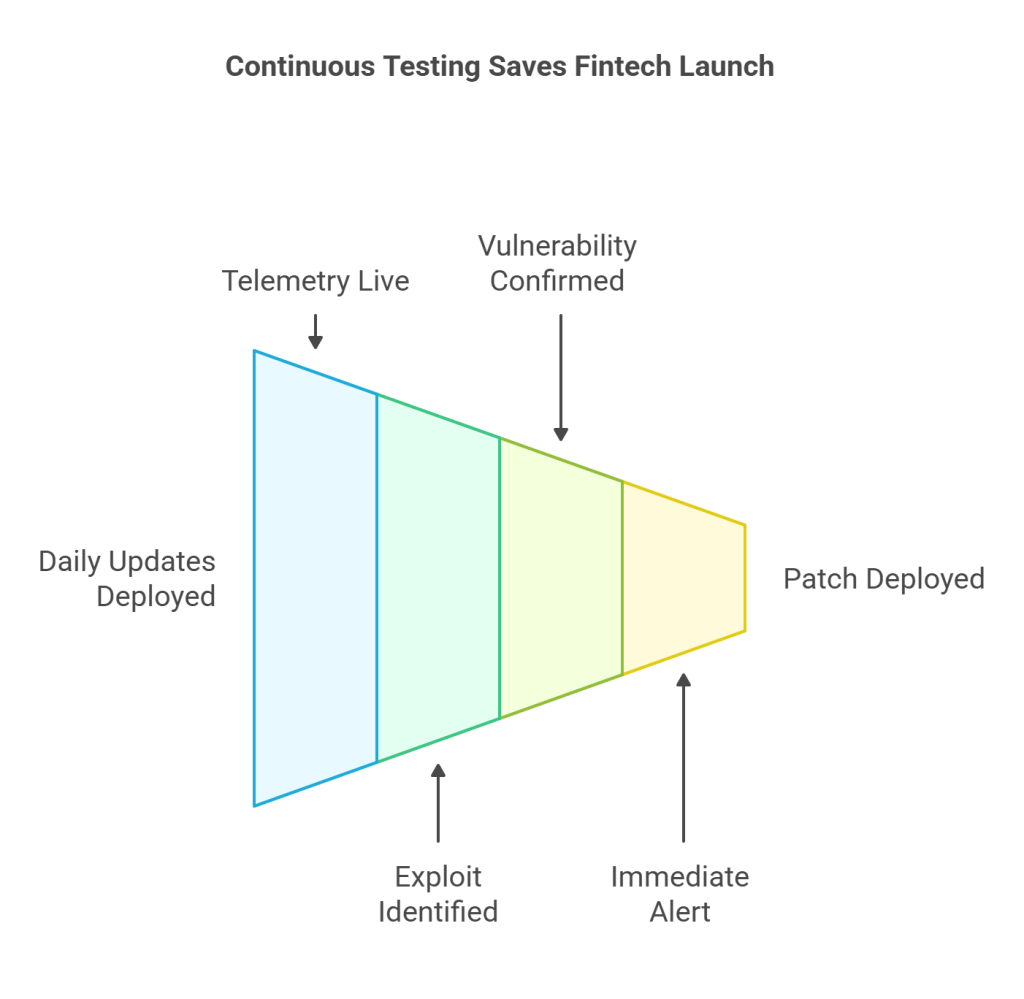
While seemingly minor, we proved it could be paired with a permission error to exfiltrate raw customer transaction data. We mapped the exact lateral path an attacker would have utilized.
The Outcome: We bypassed the monthly report cycle, alerting engineers immediately. The patch was identified that afternoon, for configuration-based issues, rapid remediation is achievable; code-level vulnerabilities may require longer cycles depending on complexity.
Request a continuous pentesting plan aligned to your stack.
Why Continuous Security Assessment is Becoming Non-Optional?
In the UAE, cybersecurity has evolved from a simple yearly checkbox into a mandate for constant vigilance.
Governance frameworks, specifically the UAE National Cybersecurity Strategy and TDGRA’s Information Assurance Regulation which is depending on sector and entity classification, now demand a rigorous, high-level baseline for protecting information systems.
Because the Dubai Cyber Security Strategy (DESC) places such a heavy emphasis on emirate-wide resilience, traditional point-in-time audits are no longer enough to stay compliant.
Instead, continuous security assessment supports ongoing risk reduction, moving firms into a state of permanent audit readiness.
This proactive stance is the only real defense when considering what is a zero-day vulnerability and how it affects security.
Also Read : Top 15 Cybersecurity Frameworks in 2025
These unknown threats create immediate exposure that a static annual test will almost certainly miss.
To truly address how to protect against zero-day attacks, UAE enterprises are turning to continuous penetration testing benefits, specifically the ability to find flaws in real-time.
When stakeholders ask, How does continuous pentesting prevent major breaches? The answer is simple: it significantly increases the likelihood of finding the open door before the intruder does.
Ultimately, understanding the benefits of continuous pentesting ensures that UAE businesses can stop a major security breach before it happens, keeping them perfectly aligned with the nation’s digital sovereignty goals.
Choosing a Strategic Partner: What to Look for in a VAPT Company in Dubai
Choosing a VAPT company in Dubai today is not about checking a compliance box and more about architectural survival. With the gap between exploit release and a major security breach now measured in hours, your partner needs the technical depth to kill a zero-day vulnerability before it’s weaponized against you.
If you’re evaluating firms, look past the marketing. These five technical non-negotiables determine if you’re getting a real defense or just a PDF:
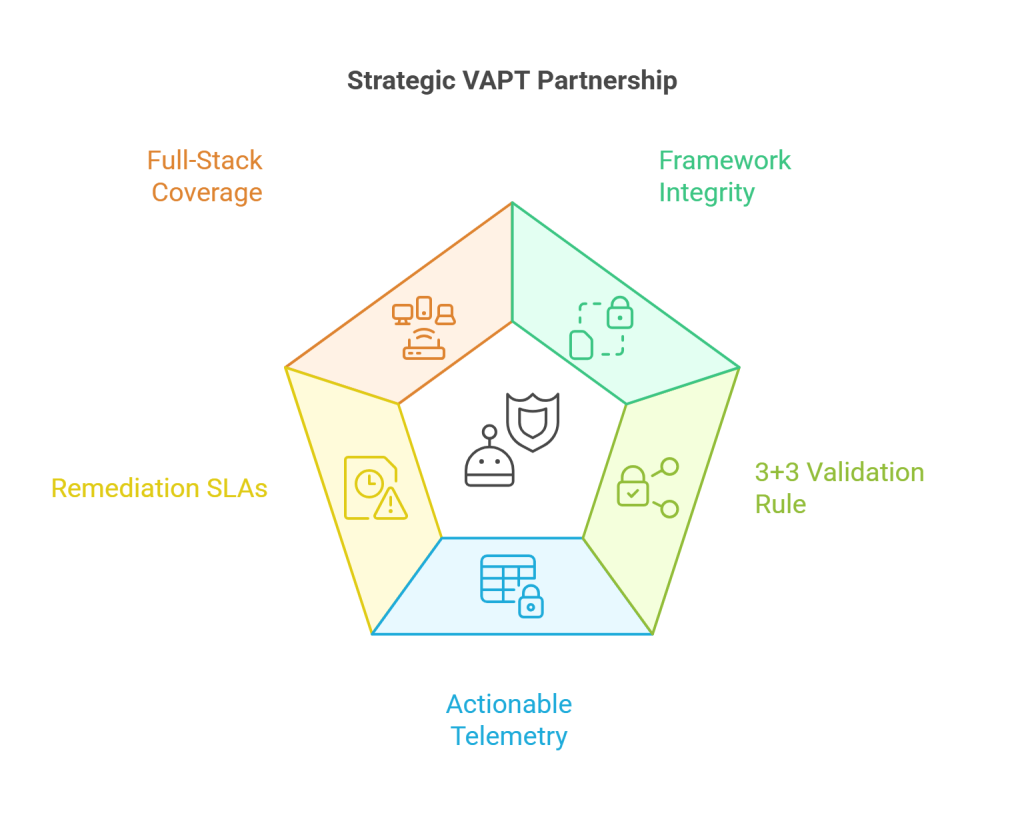
- Framework Integrity: Demand strict alignment with testing methodologies like PTES, OWASP testing guide and OSSTMM with findings mapped to CWE for standardized classification.
- The 3+3 Validation Rule: Maintain integrity through a three-stage retesting phase followed by three distinct validation rounds, as part of an internal quality assurance and verification process.
- Actionable Telemetry: You can’t manage what you can’t see. You need Daily Status Reports for immediate situational awareness, leading into a Detailed Technical Report that maps raw data to a high-level business risk assessment.
- Remediation SLAs: In a volatile landscape, SLAs on critical findings are mandatory. You need a contractual guarantee that high-severity holes are prioritized and closed within a tight window.
- Full-Stack Coverage: Modern infrastructure is fragmented. A competent team must demonstrate the ability to test Web, API, Mobile, Cloud, and Infrastructure continuously to kill off the silos where most hackers hide.
Partnering with a VAPT company in Dubai helps organizations operationalize continuous pentesting with local context and faster remediation cycles. This keeps your posture moving at the same velocity as the threat landscape.
Harden your security with Wattlecorp’s Continuous Penetration Testing Service for 24/7 technical assurance of your mission-critical assets.
Operational Excellence: How Wattlecorp’s Continuous Penetration Testing Works
In a landscape where the window between exploit disclosure and a major security breach is measured in hours, relying on a report from six months ago is a strategic liability.
Wattlecorp’s continuous pentesting model functions as a persistent defensive layer, ensuring that new code deployments don’t inadvertently become backdoors.
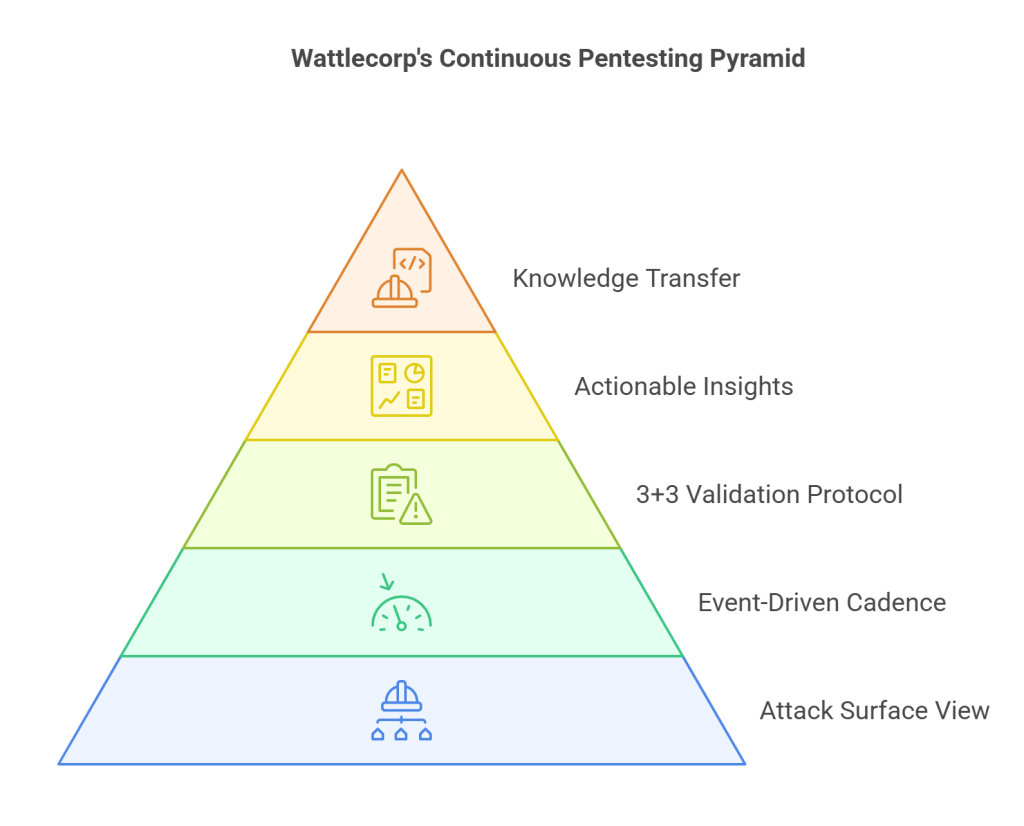
This is how Wattlecorp’s Continuous Pentesting Works:
- Complete Attack Surface View: We conduct manual-led, detailed assessments across Web, API, Mobile, Cloud, and Hybrid Infrastructure. We find the complex logic flaws that automated tools consistently ignore.
- Event-Driven Cadence: Testing is no longer a calendar event; it is dictated by your release velocity. We trigger deep-dives weekly, monthly, or instantly following a major architectural shift.
- The 3+3 Validation Protocol: Every remediation undergoes three stages of retesting followed by three distinct validation rounds. This confirms the exploit is neutralized without triggering secondary regressions.
- Actionable Security Insights: You receive more than a static PDF. Our deliverables include live Risk Dashboards, a Remediation Tracker, and an Executive Summary designed for board-level clarity.
- Knowledge Transfer: We do not gatekeep our methodologies. Every engagement includes a technical deep-dive with your developers, effectively “shifting-left” your team’s security IQ.
Technical Checklist: Neutralizing Zero-Day Risk
Surviving a zero-day vulnerability isn’t a matter of luck; it is a matter of maintaining a disciplined technical baseline. Audit your perimeter against these non-negotiables:
- Asset Intelligence: Map every internet-facing endpoint. You cannot defend Shadow IT that your security team doesn’t know exists.
- Perimeter Hardening: Secure all VPNs and email gateways. Implement phishing-resistant MFA across your entire identity stack with no exceptions.
- Intelligent Prioritization: Move beyond CVSS-chasing. Use Exploited-in-the-Wild signals like CISA KEV-style to prioritize patches that are actively being weaponized.
- Containment & Segmenting: Audit your network segmentation. Your logging must be sharp enough to detect lateral movement before an adversary reaches your core data.
Partnering with the right VAPT company in Dubai helps organizations operationalize continuous pentesting with local context and faster remediation cycles.
Stop treating security as an annual event. Schedule a meeting to see how we can secure your mission-critical assets 24/7.
From Fixing to Preventing: Turning Cyber Threats into Managed Risks
The hard truth of modern security is that you can’t stop every zero-day from existing. But you can stop a single vulnerability from scaling into a total business collapse.
In the UAE, where TDGRA governance sets a high bar, a snapshot audit is no longer a viable defense. A flaw only becomes a breach when it sits undetected.
This is where Wattlecorp transforms your strategy. We move your organization beyond static checklists by running high-velocity remediation loops that act as a persistent shield for your infrastructure.
Partnering with a specialized VAPT company in Dubai means you stop reacting to last year’s exploits and start preparing for tomorrow’s.
Strengthen your infrastructure with Wattlecorp Continuous Penetration Testing in UAE and schedule your readiness call today to lock down a testing cadence that actually protects your mission-critical assets.
Zero Day Vulnerabilities FAQs
1.What is a zero-day vulnerability?
A zero-day vulnerability is a security flaw in software or hardware that is unknown to the vendor. In the UAE, zero-day vulnerabilities are primary targets for hackers seeking a major security breach. Continuous pentesting is the best way to find these zero-day vulnerabilities.
2.How does continuous pentesting help prevent zero-day breaches?
Continuous pentesting provides ongoing visibility into zero-day vulnerabilities. By using continuous pentesting, UAE organizations can detect zero-day vulnerabilities in real-time, preventing a major security breach before an exploit is even released.
3.What are the consequences of ignoring zero-day vulnerabilities?
Ignoring zero-day vulnerabilities leads to data theft, regulatory fines, and loss of trust in the UAE. Without continuous pentesting, zero-day vulnerabilities can remain undetected for months, causing a catastrophic major security breach.
4.How can companies identify vulnerabilities in real-time?
Companies in the UAE use continuous pentesting to find zero-day vulnerabilities. Continuous pentesting uses a mix of automation and human expertise to identify zero-day vulnerabilities before hackers have a chance to strike.
5.Why is continuous security assessment essential for modern enterprises?
Continuous pentesting is essential because the UAE threat landscape changes daily. Continuous pentesting ensures that zero-day vulnerabilities are managed and remediated before they lead to a major security breach.

 Third-Party Vendor Security Risk Assessment Under DPDP: A Guide for Indian Enterprises
Key Takeaways: Third-party vendor risk assessment with DPDP practices helps Indian enterprises to verify that external partners handle personal data with adequate safeguards. The Digital Personal Data Protection Act holds data fiduciaries accountable for vendor conduct, which makes due diligence a legal and operational necessity. A structured vendor security questionnaire, covering encryption, access control, and […]
 Virtual CISO Services for UAE Free Zone Startups: Affordable Security Leadership for Growing Companies
Key Takeaways: Most startups already hold sensitive data such as customer info, source code, financials, long before they feel big enough to take security seriously, and that’s exactly when the risk starts. A virtual CISO gets you someone who’s done this before, setting up strategy and guiding compliance, without the cost of putting a full-time […]
 SOC as a Service for Indian BFSI and FinTech Companies: 24/7 Monitoring for CERT-In Readiness
Key Takeaways: SOC as a Service for BFSI and FinTech India gives banks, NBFCs, insurers and digital lenders continuous security visibility without the cost and hiring effort of building an in-house operations centre. CERT-In directions require regulated entities to report qualifying cyber incidents within six hours of detection, and implementing SOC for BFSI and FinTech […]
 SOC as a Service in India: How It Works, Pricing, and Why Businesses Need It
Key Takeaways: SOC as a Service helps Indian businesses to get 24×7 security monitoring without huge cost and complexity of building a full in-house security operations center. A managed SOC check and analyse beyond basic log monitoring, which combining SIEM, threat intelligence, analyst-led alert triage, incident escalation, reporting, and security response support. SOC as a […]
 Mobile App Security Testing for Indian Digital Lending Apps RBI, DPDP and API Risk Checklist
Key Takeaways: Mobile app security testing forms an important part of meeting RBI cybersecurity expectations, secure application development practices, and periodic security assessment requirements for digital lending platforms. APIs in lending apps are constantly under attack. Broken object-level authorization, data leaking where it shouldn’t, weak token validation, and missing rate limiting, these aren’t edge cases, […]
 Cybersecurity Risk Assessment for Saudi Supply Chain Vendors Under Aramco and NCA Expectations
Key Takeaways: Cybersecurity risk assessment becomes a practical requirement for proving security maturity, with protecting vendor relationships, and moving forward in procurement processes with Aramco and critical infrastructure clients. Vendors will need to provide evidence of access review documentation, patch deployment, monitoring artifacts, technical assessment results and more that demonstrates the controls in place are […]