


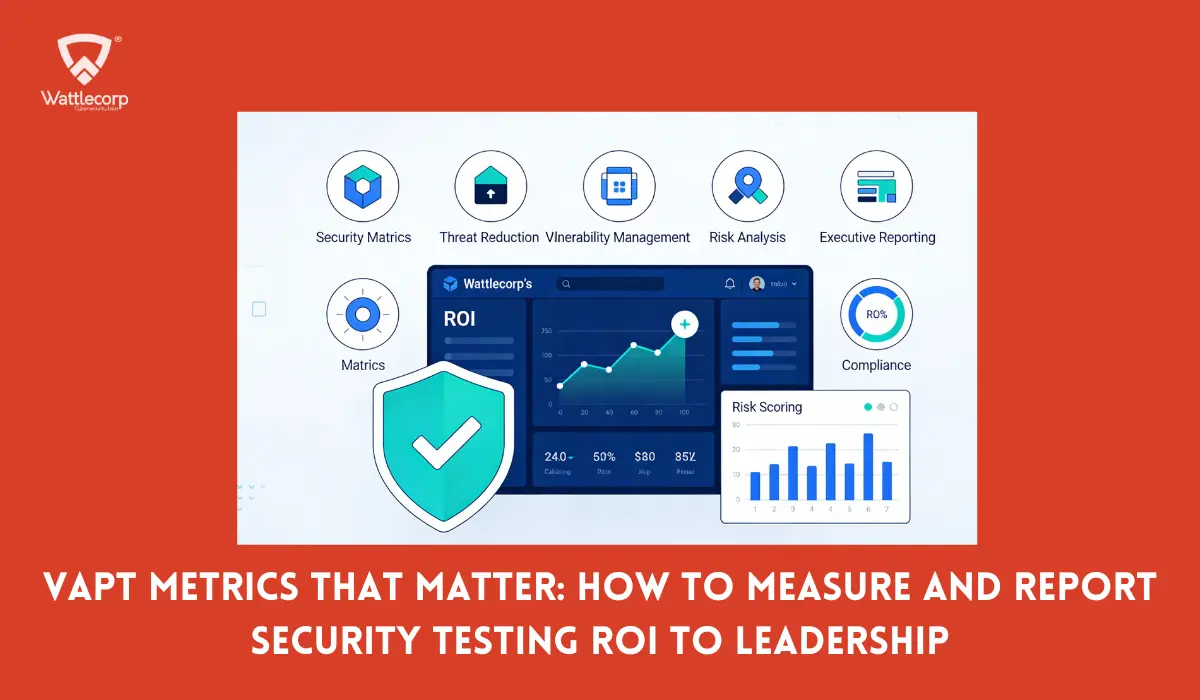
VAPT Metrics That Matter: How to Measure and Report Security Testing ROI to Leadership
Key Takeaways:
- VAPT metrics ensure to provide UAE leadership with clear and measurable insights to understand and reduce the cyber risks, which help protect critical business assets and assist to meet evolving regulations.
- Differentiating the technical KPIs from business KPIs allows organizations to optimize the security operations while demonstrating real world ROI and compliance benefits to decision makers.
- KPI-driven VAPT not only ensures strengthening security posture but also it builds leadership trust and justifies cybersecurity investments in this fast growing UAE digital economy.
Why VAPT Metrics Matter for UAE Business Leaders?
The UAE businesses rely more on the VAPT security testing for secure digital operations and effectively measure real security impact.
Understanding the attack scenarios and effective use of clear penetration testing metrics is essential for effective risk management. The VAPT metrics find and fix the vulnerabilities early, reducing cyber risks and ensures compliance with local regulations and builds customer trust.
What would a data breach cost your business in the UAE market?
With breach costs rising across the UAE and CISOs under pressure to justify their VAPT budgets, measurable outcomes such as VAPT metrics, compliance alignment, and ROI clarity become essential.
VAPT metrics not just helps organisations to meet ISO 27001, NESA, and UAE Cybersecurity Council expectations. It strengthens resilience and builds leadership confidence in every security investment.
In this blog, we explain why VAPT Metrics Matter and how our penetration tests help to identify gaps in cyber risk visibility.
Defining ROI in VAPT: What Leadership Expects
Can VAPT reduce risks fast and ensure ROI for your leadership?
Vulnerability Assessment and Penetration Testing serves as providing preventive security measures in today’s digital world to effectively identify and fix security flaws.
VAPT metrics mainly show how well your security tests are working.
And the technical KPIs measure the system issues like vulnerability count, its severity, and the time for fixing it.
Business KPIs are more focused to measure impact such as risk reduction, cost savings, and compliance.
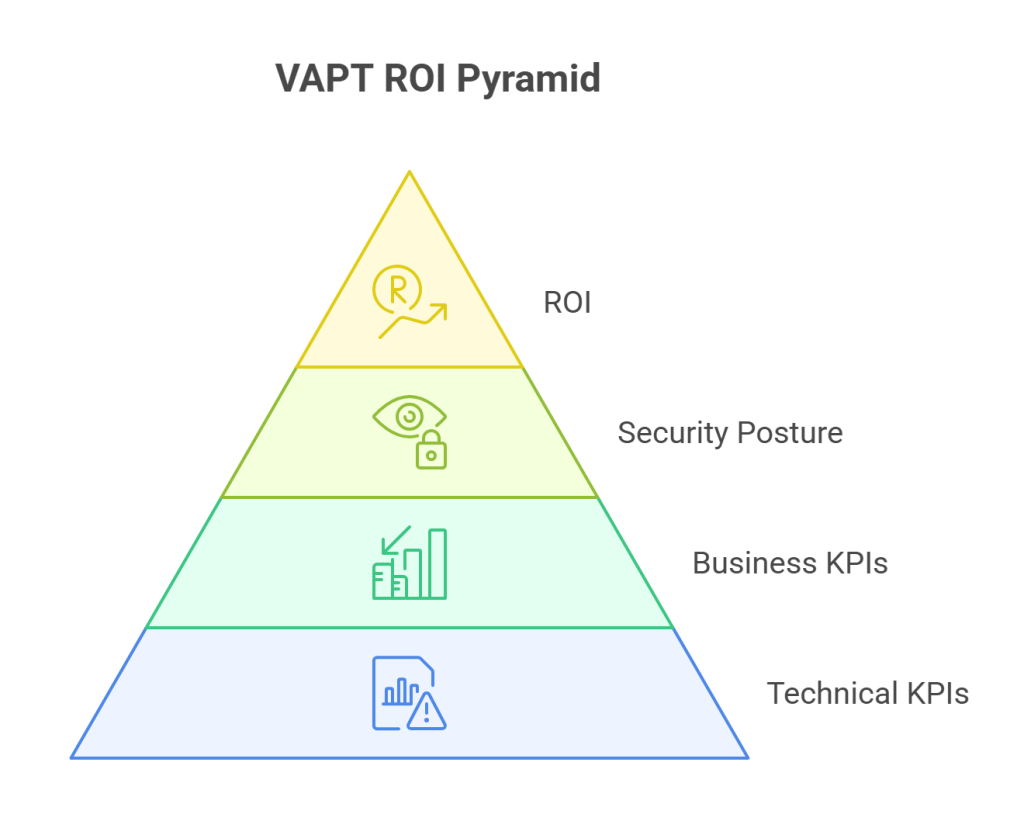
Moreover the technical KPIs guide engineers, while business KPIs guide leadership.
Vulnerability Assessment and Penetration Testing act as both a compliance checkbox to satisfy auditors and a tool for driving real security value.
But the true ROI of VAPT security testing isn’t just found in the report itself, it comes more from what happens later.
This approach delivers measurable Return on Investment (ROI) by significantly strengthening and enhancing the organisation’s overall security posture.
Core Metrics That Show the True Value of VAPT
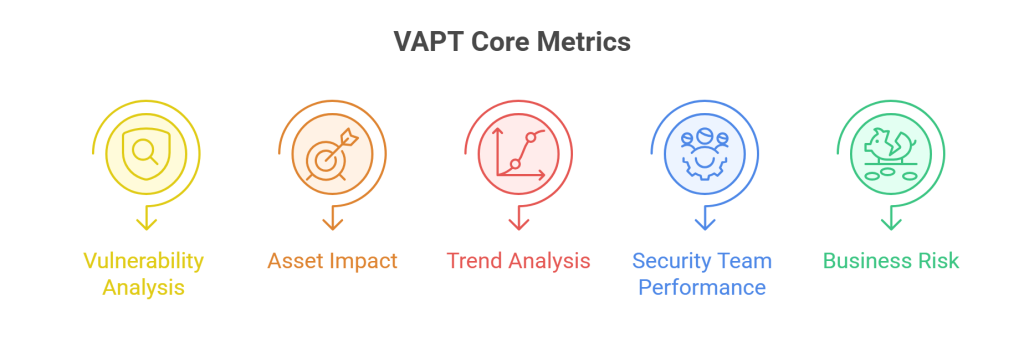
Evaluating the core metrics is essential for truly understanding VAPT’s effectiveness.
The core metrics provide clarity on:
- The volume and severity of vulnerabilities
- Identify how many assets are impacted
- Explains the trends in vulnerability discovery and remediation
- Focus on the efficiency and responsiveness of security teams
- Analyze the business risk implications linked to findings
And the key Benefits of Undertaking VAPT helps to
- Early threat detection
- Strengthened compliance posture
- Improved customer trust
- Reduced downtime risk
Technical Metrics vs Business Metrics: What to Report
Recognizing the distinction between technical metrics and business metrics is essential and each of these addresses unique audiences and objectives in cybersecurity reporting.
Technical metrics focus on specific security operations and threat management details. This reveals how effectively your security tools, systems and teams are performing on a daily basis.
Technical metrics focus on specific security operations and threat management details, revealing how effectively your security tools, systems, and teams perform on a daily basis.
Also Read : Why Managed VAPT Is the Future of Cybersecurity in the UAE: Continuous Testing vs One-Off Audits
And the business metrics focus more on the translation of technical cybersecurity data into impact focused insights, which is relevant to executives, stakeholders and the decision-makers.
MITRE ATT&CK and NIST CSF are the globally accessible frameworks that prioritize continuous measurement for identifying detection gaps and assure control effectiveness. This enables leadership to track improvements in resilience over time.
KPIs for Measuring The Risk Reduction in UAE Organizations
Still confused about how to measure VAPT ROI in the UAE?
The key performance indicators or KPIs help organizations to track how the Vulnerability Assessment and Penetration Testing reduces risk effectively.
- High-risk vulnerability identification: Measures the number of critical vulnerabilities detected to prioritize risk mitigation.
- Remediation Time: Tracks how quickly vulnerabilities are addressed after finding and reducing the risk exposure.
- Reduction in Recurring Incidents: Analyzes the improvements in security controls with pointing to fewer recurring vulnerabilities and breaches.
- Compliance Achievement: Indicates how VAPT security testing supports to meet mandatory local data protection requirements to smoother audit preparedness.
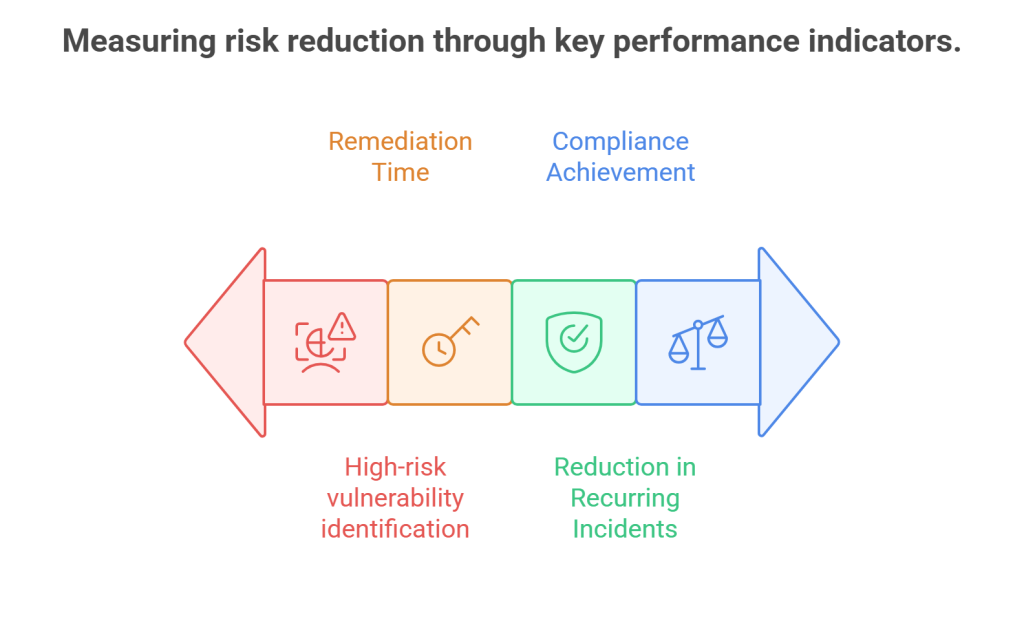
All these KPIs show Wattlecorp’s experience in translating technical testing results into measurable business benefits for UAE organizations.
How To Calculate ROI for VAPT (Step-by-Step)?
Calculations of ROI of VAPT step by steps:
- Total Cost Estimation: Calculate your total cost that you used on VAPT services, including the fee, internal time spent by the team and the cost of fixing the vulnerabilities found.
- Evaluate Risk Reduction: Analyze the quantity of vulnerabilities detected and fixed. And measure the reduction of the time of exposure to cyberattacks.
- Determine Estimated Losses Prevented: Research the possible cost of breach such as fines as mandated by the UAE such as PDPL, lost business time, lost reputation, and lost customers. VAPT assists in avoiding such expensive cases.
- Factor in Compliance Benefits: Assists to reduce penalties and ease audits in compliance with regulations. VAPT is usually worth investing in just because of compliance.
- Determine ROI: This is done with a simple formula subtracting all the costs incurred with the benefits obtained divided by the total costs multiplied by 100. This percentage will indicate the amount of value your organization will receive in terms of every dirham spent on VAPT.
- Take into Account Long-Term Value: ROI is not only instant savings. Continuous VAPT programs are encouraged in Wattlecorp in order to sustain reduction in risk over time, enhance security maturity and expand business confidence.
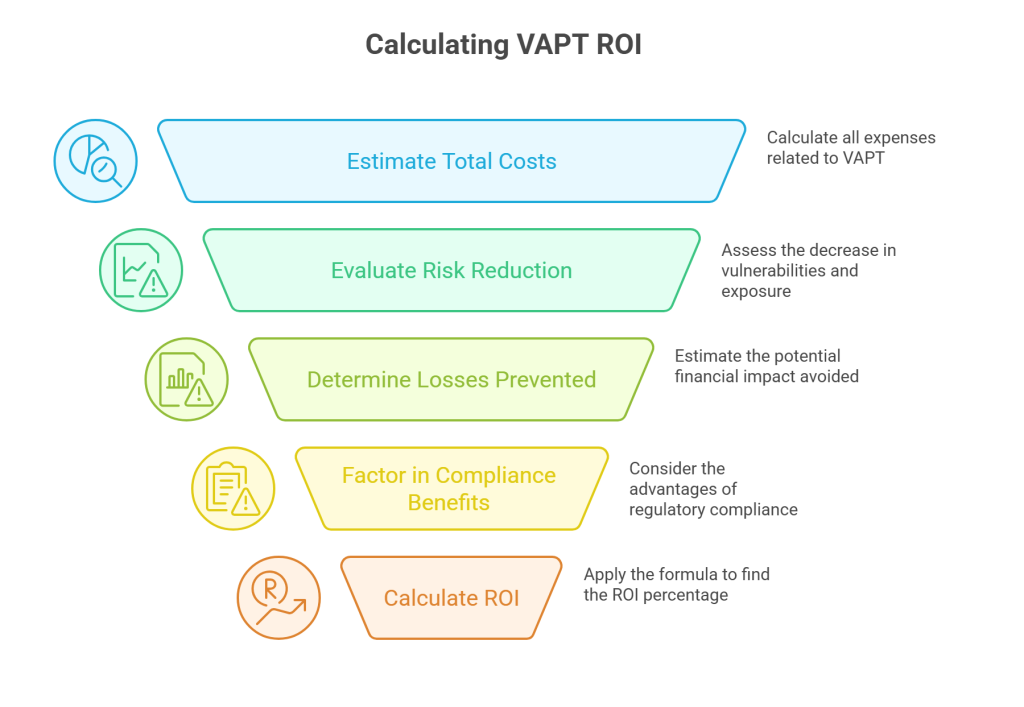
It shows the fact that this security process is not only about providing technical solutions. This approach will transform complicated cybersecurity efforts into explicit business deliverables, making the leaders realize why continuous VAPT is vital.
Reporting VAPT Outcomes to the Board: Do’s and Don’ts
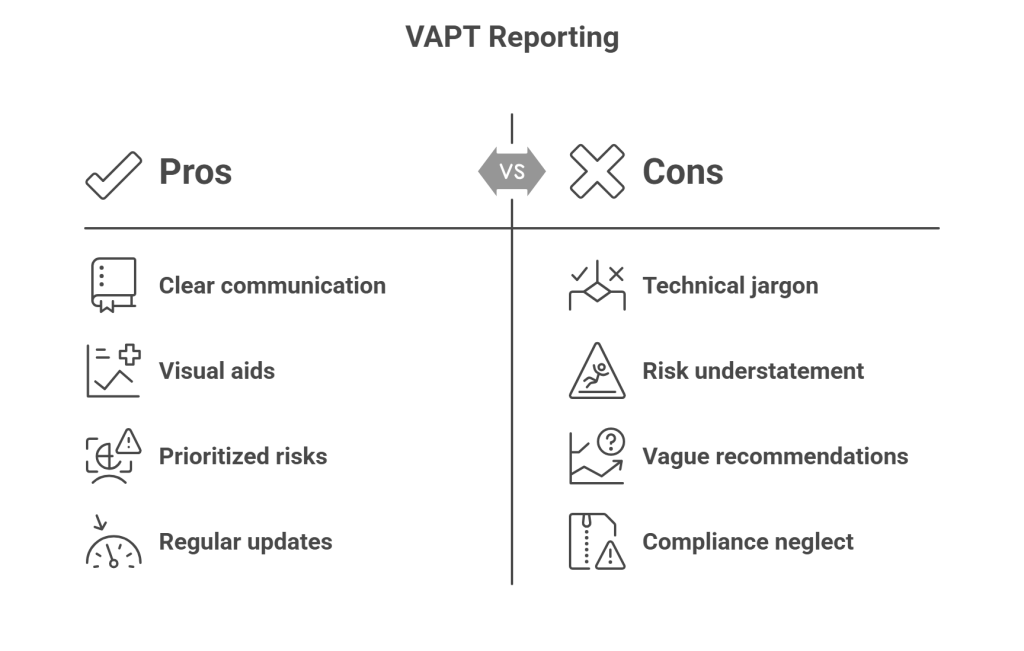
Reporting VAPT results are important to secure support and provide guidance to informed decision making.
Do’s:
- Make simple and prioritize business from risks and impact.
- Use of simple images in order to understand.
- Identify the most crucial areas of vulnerability and focus on steps to be taken.
- Make regular updates on progress and risk reduction.
Don’ts:
- Avoid technical jargon or raw data overload.
- Don’t hide or understate serious risks and be transparent.
- Don’t give vague recommendations; be specific.
- Don’t ignore compliance or regulatory implications.
Why UAE Needs ROI-Driven VAPT Services?
The cybersecurity market in the UAE is developing rapidly and simultaneously increasing cyber threats too.
Governmental authorities show their support of smart city initiatives and regulations, and commercial enterprises in the key industries including finance and healthcare require powerful, quantifiable security solutions.
Also Read : How VAPT Helps Enhance Application Security Testing in CI/CD Pipelines for UAE Businesses
What are common challenges in measuring VAPT ROI, and how can they be addressed?
VAPT services powered by ROI are valuable because they assist such organizations to safeguard sensitive information, adhere to the law and ensure maximum returns on security investment.
That is why VAPT service in UAE is important to remain resilient and competitive in the current market of the UAE.

Measuring and reporting VAPT with Wattlecorp’s expertise builds a real trust with leadership by proving how these risks are lowered.
Understanding the ROI Leadership in VAPT is more than just a metrics, it’s about building real trust with leadership through transparent and meaningful insights.
UAE organizations benefit greatly from the KPI-driven security testing, which ensures compliance and assists to strengthen defenses. You can protect digital assets through precise and proactive penetration testing.
Choose Wattlecorp’s penetration testing services for expert customized security testing that uncovers the vulnerabilities before attackers do.
Penetration Testing Metrics FAQs
1.What are the key VAPT metrics leadership cares about?
VAPT metrics leadership measures the critical vulnerabilities found, the duration to fix it, overall risk reduction and compliance status to understand security impact. These metrics help to prioritize the resources, which align cybersecurity efforts with business goals and objectives.
2.How do organizations calculate ROI from VAPT?
Calculating the ROI from VAPT is usually based on comparing the cost of services to risks avoided from breach losses, fines and downtime. It helps organizations to quantify the financial impact and effectiveness of their security investments.
3.Why are remediation metrics critical in VAPT reporting?
Remediation metrics are important in VAPT reporting because it clearly shows how quickly and effectively identified vulnerabilities are fixed. Tracking of these metrics ensures accountability and helps to improve future response processes.
4.What benchmarks should UAE companies use for VAPT?
Regulatory compliance such as PDPL, ADHICS, industry best practices and risk reduction according to the unique threat environment and business objectives of the UAE are benchmarks.

 Qatar Data Protection Law: Implementing PDPPL Data Subject Rights Processes for Businesses
Key Takeaways: The Qatar Data Protection Law (Law No. 13 of 2016) for Personal Data Privacy Protection, grants individuals specific rights such as right to access, correct, erase, object, withdraw consent, and right to be notified of processing or inaccurate disclosure. Beyond having a privacy policy, businesses or controllers, under Article 11 of Personal Data […]
 AI Governance for Indian Enterprises: Building Internal Controls Before Key DPDP Obligations Take Effect
Key Takeaways: The DPDP Act does not contain AI-specific provisions. Its requirements, however, apply in situations when an AI system processes digital personal data within its territorial and material scope. India is working on building a broader governance framework around safety, accountability, transparency and trust via programs like the IndiaAI Mission. Indian organizations should inventory […]
 Cloud Security Audit for UAE Government Cloud Migration: NCAP and Security Requirements
Key Takeaways: A cloud security audit UAE helps government entities identify security, governance, configuration, access, data-protection and resilience gaps, before and after shifting critical workloads to the cloud. UAE National Cloud Security Policy has defined cloud governance, data security, data sovereignty, IAM, incident management, resilience, portability and cloud operations requirements. The National Cyber Accreditation Program […]
 Data Privacy Consulting UAE – Building a PDPL-Compliant Data Governance Program
Key Takeaways: PDPL compliance requires ongoing operational governance that goes beyond policies to demonstrate how personal data is collected, used, protected, transferred, retained, and deleted. Data mapping helps businesses move from reactive compliance to proactive risk management by establishing a comprehensive inventory of the data ecosystem, helping build a mature data privacy and governance program. […]
 Saudi Arabia’s Critical Systems Controls: What CSP-Linked Enterprises Must Comply With in 2026
Key Takeaways: The Critical Systems Cybersecurity Controls (CSCC) are more applicable to critical systems than to all IT assets owned or operated by an organization. To be in full compliance or to remain in full compliance with CSCC, organizations must maintain continuous adherence to NCA ECC. CSCC has 32 core controls and 73 sub-controls across […]
 DevSecOps for Saudi Banking and FinTech Applications: Building a SAMA-Aligned Secure Development Lifecycle
Key Takeaways: DevSecOps Saudi Arabia for banks & FinTech enterprises doesn’t make security journey a last stop but embeds it into the software development life cycle. Mapping DevSecOps methods to the SAMA Cybersecurity Framework improves security governance and application resilience while boosting audit readiness. Continuous security testing such as SAST, DAST, SCA, IaC scanning, and […]