

AI-Powered Cyberattacks in India 2026: What CISOs Need to Know Now
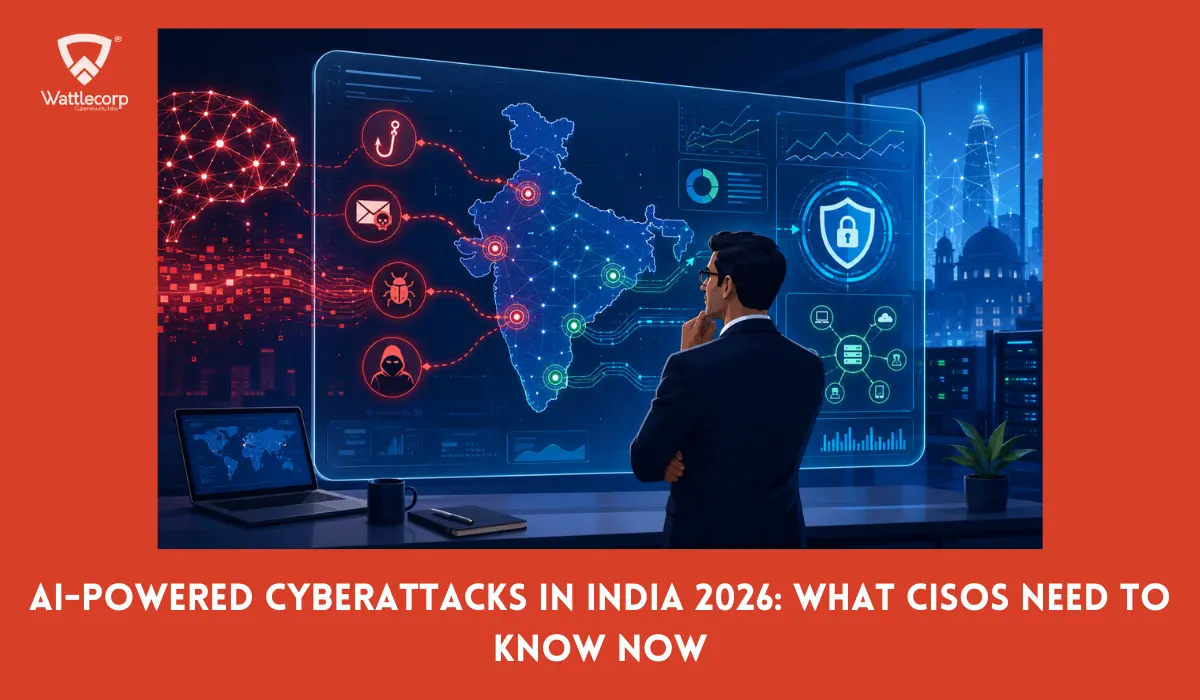
Key Takeaways:
- Generative AI has sharply accelerated the attacker’s advantage by making phishing, reconnaissance, and exploit preparation faster and easier to scale.
- Being a CISO in 2026 means making real-time threat decisions at board level, that’s a different job from what most security leaders are trained for, and the skill gap is already showing.
- CERT-In’s 6-hour reporting requirement for covered cyber incidents is not a suggestion, and CISOs should automate incident triage, evidence collection, and escalation wherever possible to meet the deadline reliably.
- Annual pen tests belong in the past, if you’re not running continuous security testing, you’re essentially handing attackers a head start every single time a new vulnerability drops.
- Mobile apps may become one of the most exposed attack surfaces, especially where APIs, authentication flows, session tokens, or sensitive data handling are weak.
What Should Indian CISOs Know About AI-Powered Cyberattacks in 2026?
A human attacker makes mistakes, takes breaks, and eventually moves on. AI-assisted attack tooling can accelerate reconnaissance, phishing generation, vulnerability research, and exploit preparation at a scale and speed that human-only operations cannot easily match.
It’s time to forget what you thought a cyberattack looked like. That script has been rewritten. AI powered cyberattacks India aren’t being run by lone actors typing furiously in dark rooms.
Many modern campaigns are becoming more automated and AI-assisted, using tools that can accelerate infrastructure scanning, personalize social engineering, and improve attacker workflows between attempts.
For CISO cyber security leaders across Indian enterprises, the weight of that has landed hard.
What used to mean managing firewalls and passing audits now looks closer to commanding a cyber intelligence unit.
The Chief Information Security Officers (CISOs) who don’t internalize that shift in 2026 are already behind.
What is a cyberattack today? It’s an AI system probing your defenses at machine speed while simultaneously writing a phishing email personalized enough to fool your CFO’s assistant. That’s not a theoretical future scenario.
How India Is Emerging as Ground Zero for Advanced Cyberattacks
There’s a blunt reason why threat actors are pointing AI-driven toolkits at India, the attack surface is massive and growing by the day.
Over 900 million internet users. A fintech sector expanding at pace few markets can match. Aggressive cloud adoption across BFSI, manufacturing, healthcare, and logistics.
AI powered cyberattacks India have found near-ideal conditions.
The CISO-Economic Times reporting indicates that AI-assisted threats are becoming a major concern for Indian enterprises, especially in phishing, social engineering, vulnerability discovery, and large-scale attack automation. This is no longer an emerging trend; it is a current, documented reality.
AI-enhanced techniques are increasingly strengthening traditional compromise vectors such as phishing, credential theft, vulnerability discovery, and social engineering. India is squarely in that crosshair.
What makes this genuinely unsettling is how these attacks learn.
In more advanced campaigns, attackers may use delivery failures, user responses, and detection patterns to refine future phishing attempts.
CISO cyber security teams relying only on signature-based detection will struggle against AI-assisted, polymorphic, and behavior-shifting threats. Signatures still matter, but they must be combined with behavioral analytics, EDR/XDR telemetry, threat intelligence, and anomaly detection.
That’s not a fair fight, and it’s not a winnable one, at least not with legacy tools.
What Changed in the CISO’s Role After AI-Powered Cyberattacks?
Ask any experienced security consultant what the role of CISO in risk management looked like five years ago versus today. You’ll hear the same answer: it’s a fundamentally different job.
What is CISO in cyber security? It’s an executive operating at the intersection of AI threat intelligence, live regulatory compliance, board communication, and real-time operational judgment.
CISO roles and responsibilities have expanded so fast that plenty of organizations haven’t updated their expectations accordingly and their security posture is paying for it.
Also Read : How vCISO-Led VAPT Improves Cybersecurity for Mid-Sized Businesses
Practically speaking, a CISO cyber security professional in India now has to:
- Evaluate CERT-In advisories quickly and maintain incident response workflows capable of reporting covered cyber incidents within the required 6-hour window
- Build multi-cloud security solutions for CISOs that hold across hybrid, multi-vendor environments without creating new blind spots
- Embed AI threat mitigation strategies 2026 directly into MeitY’s Digital Personal Data Protection (DPDP) compliance architecture, these can’t run as separate workstreams
- Design a cybersecurity strategy for CISOs India, which considers AI as both the primary threat vector and the primary defensive tool
- Evaluate AI-powered threat detection platforms for CISOs that go well beyond signature matching into behavioral pattern recognition and predictive analytics
Then present all of it to a board that wants a one-pager. The enterprise AI security framework India needs in 2026 demands CISO cyber security leaders who translate technical reality into business risk, clearly, quickly, and under pressure.
Four Ways Hackers Are Turning AI Against Your Organization Right Now
Understanding how generative AI is used in cyberattacks isn’t a nice-to-have anymore. It’s table stakes for any serious CISO cyber security posture in 2026.
Here’s what AI powered cyberattacks India actually look like on the ground:
1. Phishing Emails Smart Enough to Fool Your Own Team
Attackers are feeding LLMs real scraped data through LinkedIn profiles, vendor press releases, public filings to write phishing emails that sound like internal communications.
Threats powered by AI tend to bypass keyword filters simply because the content looks and reads like legitimate communication. They were written by studying your company. Every CISO cyber security program needs AI-native email filtering, not last decade’s rules engine.
2. Your CFO’s Voice, Cloned and Ready to Deploy
Deepfake audio has already been used in India’s banking sector to authorize fraudulent transfers.
AI powered cyberattacks India have moved deepfakes from proof-of-concept to executed, documented fraud.
CISO cyber security protocols now need deepfake detection embedded into any communication channel tied to financial authorization, not added after the incident.
Also Read : Key Cybersecurity Threats Addressed By VAPT In 2025
3. Automated Exploit Discovery Running 24/7
AI-powered cyber threats can scan enterprise environments, identify vulnerabilities, and stage exploits in hours, where no human is required.
A human-led red team can’t match that pattern, and frankly it was never designed to.
CERT-In has flagged AI powered cyberattacks in India targeting government infrastructure where autonomous exploitation was confirmed. If your security testing runs quarterly, you’re behind.
4. Malware That Evolves to Avoid Your Detection Tools
Adversarial AI mutates malware signatures in real time after every scan.
CISO cyber security stacks built on static detection libraries are effectively blind to this class of threat.
AI-driven cyber threats that self-modify require behavioral analysis — watching what the code does rather than what it looks like.
Stop Auditing Annually, Start Defending Continuously: Your 2026 Action Plan
Let’s be direct: the question isn’t whether AI powered cyberattacks India will target your infrastructure, they likely already are.
The question is whether your defenses are actually running when they do. Here’s an AI threat mitigation strategies 2026 action plan built around that reality:
- Deploy AI Against AI: CISO cyber security teams can’t outpace AI-powered adversaries using manual processes and rule-based tools. Behavioral analytics and AI-powered threat detection platforms for CISOs identify anomalies in real time, before a breach becomes a crisis. You either match the attacker’s technology or accept the disadvantage.
- Automate Your CERT-In Response Pipeline: India’s 6-hour incident reporting mandate demands a speed your team can’t achieve manually at 2 AM. Automating CERT-In advisory AI cyber threats workflows isn’t a nice optimization, it’s a compliance requirement that most enterprises are dangerously behind on.
- Run Continuous Security Testing – Not Annual Reviews: Periodic audits find yesterday’s vulnerabilities. Continuous security testing simulates AI powered cyberattacks India against your live infrastructure around the clock, finding real gaps before adversaries map them.
- Extend Your Coverage With Managed Security Services: Not every CISO cyber security function has a 40-person SOC. Managed security services deliver AI-augmented 24/7 threat monitoring without unsustainable headcount overhead and they scale with your organization’s growth.
- Stop Treating Mobile as an Afterthought: India runs on mobile. So do most enterprise workflows and so do most AI-driven attack campaigns. Mobile app penetration testing India surfaces vulnerabilities in mobile APIs, authentication tokens, and session management before threat actors find them. CISO cyber security programs that exclude mobile testing are leaving a major entry point completely unguarded, and attackers know it.
AI-Powered Cyberattacks Demand Continuous Defense, Not Annual Security Reviews
AI powered cyberattacks India aren’t coming, they’re already here and it’s operating now. And every CISO cyber security leader still running reactive, audit-driven security in 2026 is operating on borrowed time, whether they know it or not.
Wattlecorp helps Indian enterprises move from periodic security checks to continuous cyber defense through VAPT, managed security services, mobile app penetration testing, and AI-ready threat monitoring.
The enterprises that come through this threat landscape intact will be the ones whose defenses move at the same speed as the attacks. Not the ones hoping their last pen test was thorough enough.
If your 2026 security roadmap does not include Continuous Security Testing and Managed Security Services, then it has gaps worth fixing.
Threats targeting businesses in India do not slow down after hours, which means security validation shouldn’t either.
Ongoing testing keeps exposures from sitting open until someone notices.
And since most teams aren’t staffed to watch everything around the clock, having expert-led monitoring in place means nothing slips through while leadership focuses elsewhere.
CISO Cyber Security FAQs
1.What are AI-powered cyberattacks and why are they rising in India?
2.What should a CISO prioritize first against AI-driven phishing, deepfakes, and impersonation?
3.How do CERT-In advisories and MeitY rules affect enterprise response planning?
4.Why should Indian CISOs combine continuous security testing with managed security monitoring?
5.How does mobile app penetration testing India fit into an AI-threat defense strategy?

 Third-Party Vendor Security Risk Assessment Under DPDP: A Guide for Indian Enterprises
Key Takeaways: Third-party vendor risk assessment with DPDP practices helps Indian enterprises to verify that external partners handle personal data with adequate safeguards. The Digital Personal Data Protection Act holds data fiduciaries accountable for vendor conduct, which makes due diligence a legal and operational necessity. A structured vendor security questionnaire, covering encryption, access control, and […]
 Virtual CISO Services for UAE Free Zone Startups: Affordable Security Leadership for Growing Companies
Key Takeaways: Most startups already hold sensitive data such as customer info, source code, financials, long before they feel big enough to take security seriously, and that’s exactly when the risk starts. A virtual CISO gets you someone who’s done this before, setting up strategy and guiding compliance, without the cost of putting a full-time […]
 SOC as a Service for Indian BFSI and FinTech Companies: 24/7 Monitoring for CERT-In Readiness
Key Takeaways: SOC as a Service for BFSI and FinTech India gives banks, NBFCs, insurers and digital lenders continuous security visibility without the cost and hiring effort of building an in-house operations centre. CERT-In directions require regulated entities to report qualifying cyber incidents within six hours of detection, and implementing SOC for BFSI and FinTech […]
 SOC as a Service in India: How It Works, Pricing, and Why Businesses Need It
Key Takeaways: SOC as a Service helps Indian businesses to get 24×7 security monitoring without huge cost and complexity of building a full in-house security operations center. A managed SOC check and analyse beyond basic log monitoring, which combining SIEM, threat intelligence, analyst-led alert triage, incident escalation, reporting, and security response support. SOC as a […]
 Mobile App Security Testing for Indian Digital Lending Apps RBI, DPDP and API Risk Checklist
Key Takeaways: Mobile app security testing forms an important part of meeting RBI cybersecurity expectations, secure application development practices, and periodic security assessment requirements for digital lending platforms. APIs in lending apps are constantly under attack. Broken object-level authorization, data leaking where it shouldn’t, weak token validation, and missing rate limiting, these aren’t edge cases, […]
 Cybersecurity Risk Assessment for Saudi Supply Chain Vendors Under Aramco and NCA Expectations
Key Takeaways: Cybersecurity risk assessment becomes a practical requirement for proving security maturity, with protecting vendor relationships, and moving forward in procurement processes with Aramco and critical infrastructure clients. Vendors will need to provide evidence of access review documentation, patch deployment, monitoring artifacts, technical assessment results and more that demonstrates the controls in place are […]