


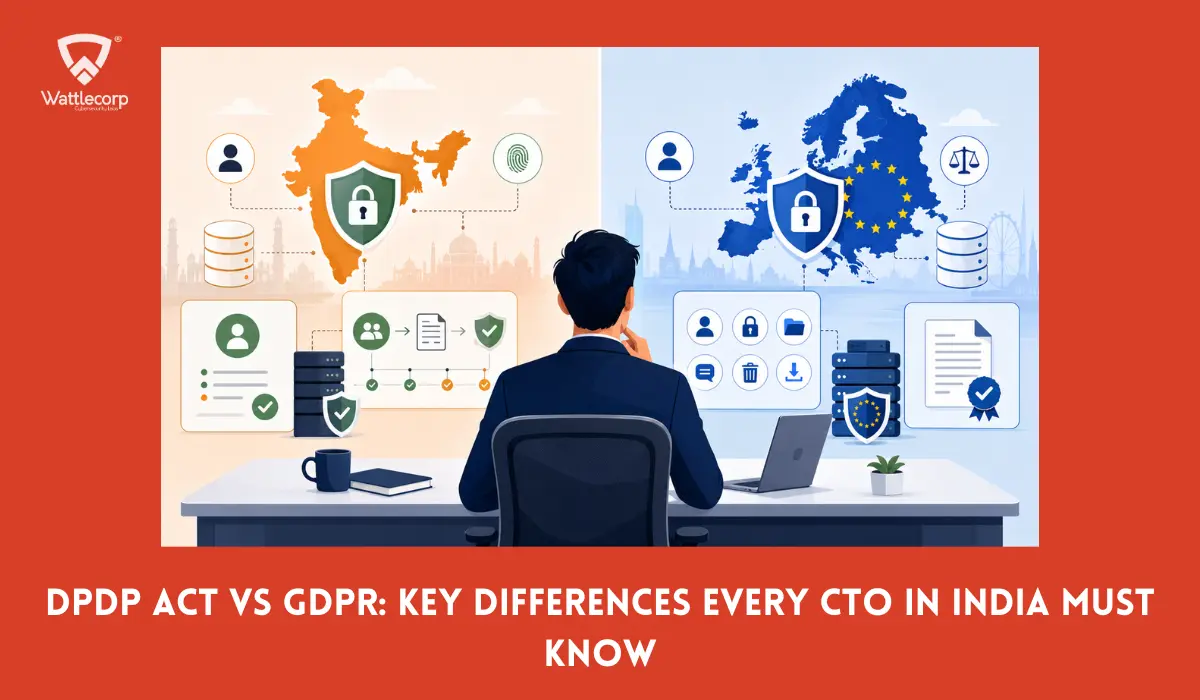
DPDP Act vs GDPR: Key Differences Every CTO in India Must Know
Key Takeaways:
- GDPR compliance provides a baseline, but DPDP introduces India-specific obligations that require additional operational and technical implementation. Simplified notices, grievance redressal, and children’s data controls are India-specific obligations that most GDPR programs simply do not cover.
- The DPDP Act and GDPR are built differently and the GDPR gives organizations six legal grounds to process data. DPDP keeps it tighter with consent and legitimate uses. Fewer exceptions, more accountability. Indian CTOs need to understand this difference before assuming their existing policies are enough.
- Compliance lives in your systems, not your documents. Privacy obligations only mean something if they are technically implemented. Data inventories, deletion workflows, consent logs, vendor agreements, and breach response plans must actually work and hold up when tested.
- If you serve both Indian and EU users, you need both frameworks. Indian SaaS, FinTech, HealthTech, and EdTech companies often operate across both markets. A unified compliance program that satisfies DPDP and GDPR together is more efficient and more defensible than managing them separately.
- DPDP readiness is a trust signal, demonstrated through auditable technical and operational controls, helping organizations close enterprise deals more efficiently. Getting this right is a competitive advantage, not just a compliance checkbox.
For any CTO leading a technology-first organization in India, the DPDP Act vs GDPR conversation is no longer optional.
It is a board-level governance question with direct consequences on product architecture, vendor relationships, breach response, and enterprise sales.
Many Indian companies built their privacy posture around GDPR-style frameworks.
That was a reasonable starting point. But the Digital Personal Data Protection Act, 2023 introduces a distinct India-specific compliance model and assuming that GDPR compliance equals DPDP readiness is one of the most common and costly mistakes Indian CTOs can make today.
Mapping the DPDP Act vs GDPR side by side is where that correction begins, not as an academic exercise, but as a practical step toward building systems and policies that actually hold up under Indian law.
The differences run deeper than most teams expect, and catching them early is what separates organizations that scale confidently from those that retrofit compliance under pressure.
What Is the DPDP Act and How Did It Come About?
The Digital Personal Data Protection Act India (DPDP Act, 2023) was enacted to regulate the processing of digital personal data within India and outside India when that processing relates to offering goods or services to individuals (Data Principals) in India.
The DPDP Act is administered by the MeitY and it is enforced through the newly established Data Protection Board of India.
The DPDP Act India introduces duties for Data Fiduciaries organizations, including clarifying the goal and methods of processing personal information and guidelines on consent, data minimization, security measures, notifications in case of data breaches, and safeguarding children’s data.
The DPDP Rules, 2025, issued by MeitY, contain a phased introduction schedule and organizations should plan ahead and prepare readiness plans well in advance of the pressure from enforcement.
For organizations that are already familiar with GDPR, understanding the DPDP Act vs GDPR distinctions early helps to avoid the trap of assuming existing frameworks. That is sufficient when the Digital Personal Data Protection Act India operates on its own distinct legal logic.
DPDP Act vs GDPR: The Core Structural Differences
Understanding the DPDP Act vs GDPR distinction begins with the legal architecture of each framework.
One of the most comprehensive privacy laws in the world is GDPR (General Data Protection Regulation), which has been in effect for all the EU since 2018.
It includes several legal grounds for processing such as consent, contract, legal obligation, vital interests, public task, and legitimate interests.
It imposes Data Protection Impact Assessments (DPIAs), specifies the situations in which Data Protection Officers (DPOs) are required, and lays out the processor contract requirements outlined in Article 28.
One of the differences between the two, DPDP Act and GDPR, is that the DPDP Act is more targeted in scope.
It applies to digital personal data specifically, has a consent and legitimate use model, rather than the six lawful bases of GDPR, and introduces new concepts that are specific to India, including Data Fiduciary (akin to GDPR’s Controller) and the Data Protection Board of India as the Regulatory Authority.
Also Read : DPDP Act 2025 Compliance Checklist for Indian Businesses
It is important to note some key distinctions between the DPDP Act and GDPR:
- Lawful bases: Under GDPR, there are six lawful bases, with ‘consent’ and ‘legitimate interests’ being the most commonly used.
- Roles: Under GDPR, organizations are classified as Controllers or Processors, while the DPDP Act defines them as Data Fiduciaries and Data Processors.
- Enforcement authority: GDPR is governed by the EU supervisory authorities whereas DPDP is governed by the Data Protection Board of India.
- Territorial scope: Both have an extraterritorial effect, but the DPDP specifically applies to digital processing of data of users in India.
- DPIAs: GDPR requires DPIAs for high-risk processing. DPDP does not explicitly mandate DPIAs but enforces risk-based processing decisions to ensure appropriate safeguards are applied.
- Data localization: While earlier privacy drafts in India were stricter on cross-border flow of data, DPDP is more relaxed in that regard, but still will call for governance on cloud hosting and accountability of processors.
Why GDPR Compliance Does Not Mean DPDP Readiness
When comparing the DPDP Act with GDPR, every CTO should understand one critical point: an existing GDPR-aligned privacy program can support DPDP preparation, but it cannot be treated as complete DPDP compliance.
GDPR compliance does not end DPDP readiness, moreover it speeds it up. An organisation that has identified data flows, put in place consent management and agreements with processors within the framework of GDPR is well established.
However, the India data protection law (DPDP) has a number of India-specific obligations that are not automatically covered by GDPR programs:
- Clearly written privacy notices: Privacy notices must be easily understandable and accessible, an EU-style, dense legal notice is not appropriate for Data Principals in India.
- Grievance redressal: accessible grievance mechanisms, beyond what GDPR requires in terms of complaints.
- Children’s data obligations: DPDP has robust expectations on verifiable parental consent and minimises tracking and behavioural targeting of children.
- GDPR notification period: GDPR specifies a 72-hour breach notification requirement. DPDP mandates timely breach reporting to the Data Protection Board and affected individuals but allows flexibility on the timeline.
For GDPR compliance India-focused teams, the DPDP Act vs GDPR gap analysis must be done systematically not assumed away.
Operational Implications for CTOs: What Must Change in Your Architecture
The DPDP Act vs GDPR difference is not only a legal question. It is an engineering and architecture challenge.
CTOs must ensure their systems can demonstrate:
- Consent management at scale: Consent must be granular, withdrawable, and auditable. This requires product-level changes, not just policy updates.
- Data inventory and classification: You need to know where Indian user data lives: applications, CRMs, analytics tools, backups, third-party SaaS platforms, and support systems.
Also Read : Top SaaS Security Testing Tools Every CTO Should Evaluate in 2025
- Deletion and access workflows: Data Principal rights under DPDP must be technically implemented. Deletion requests that fail because data is replicated across systems are a compliance gap.
- Vendor governance: Every SaaS tool, cloud provider, and analytics platform processing Indian personal data is a potential data fiduciary obligations risk. Processor agreements and risk reviews must reflect DPDP expectations.
- Breach detection and response: SIEM, SOC, and incident response workflows must connect security alerts with privacy breach escalation paths. The breach clock starts before the evidence is ready.
For organizations that conduct mobile app penetration testing India, it is equally important to include personal data exposure scenarios, insecure APIs, excessive data collection, and weak access controls as part of the testing scope.
DPDP Act vs GDPR: A Quick Comparison Table
A direct DPDP Act vs GDPR comparison cuts through the assumptions, which show where the two frameworks overlap, where they part ways, and what those differences mean for how your organization actually builds, contracts, and responds.
| Dimension | GDPR | DPDP Act |
| Lawful bases | 6 (including legitimate interest) | Consent + legitimate uses |
| Roles | Controller / Processor | Data Fiduciary / Data Processor |
| Regulatory body | EU supervisory authorities | Data Protection Board of India |
| DPIA requirement | Mandatory in high-risk cases | Not explicitly prescribed |
| Children’s data | Special category protections | Explicit parental consent required |
| Cross-border transfers | Adequacy decisions, SCCs | Flexible, government-notified countries |
| Breach notification | 72-hour rule | Prescribed notification obligations |
| Data localization | Not mandated | More flexible than earlier drafts |
The gaps in this DPDP Act vs GDPR table are not minor footnotes. They are operational decisions waiting to happen, and organizations that treat the DPDP Act as a lighter version of GDPR will feel that assumption in their architecture, their contracts, and eventually their compliance standing.
How Indian Startups and SaaS Companies Should Approach Compliance
For how DPDP compares with GDPR for startups, the answer depends on who your users are.
If you serve Indian users, DPDP compliance is non-negotiable. If you serve EU users, GDPR applies.
If you serve both, which is common for Indian SaaS, FinTech, HealthTech, and EdTech companies, you need a unified data privacy compliance program that satisfies both frameworks without duplicating effort.
The good news is that building to the higher standard in each area often GDPR for documentation depth, often DPDP for India-specific consent and grievance design creates a strong baseline. The risk is assuming alignment without verifying it.
Difference between DPDP Act and GDPR for Indian companies comes down to this: GDPR is prescriptive and process-heavy DPDP is more outcome-focused and India-contextual. Both require real engineering evidence, not just privacy policies.
Turn DPDP Readiness Into a Competitive Advantage
The DPDP Act vs GDPR gap is not a legal formality, it is a technology trust gap. With Wattlecorp, Indian companies that can demonstrate clean data inventories, strong consent management, secure application architecture, tested breach response, and vendor accountability will win enterprise deals faster, defend audits better, and carry less regulatory risk.
DPDP readiness signals product maturity. It tells your enterprise buyers, investors, and board that your organization knows where data lives, who accesses it, and how it is protected.
If you are ready to assess your DPDP Act vs GDPR readiness gap and build an audit-defensible privacy security program, Wattlecorp’s Data Privacy Consulting services help Indian CTOs translate regulatory obligations into working technical controls from gap assessment and data flow mapping to VAPT, SIEM integration, and board-ready compliance reporting.
DPDP Act vs GDPR FAQs
1. What is the main difference between the DPDP Act and GDPR?
2. Is GDPR applicable to Indian companies?
3. What are the penalties under the DPDP Act in India?
4. How does consent differ between DPDP and GDPR?
5. Do Indian startups need to comply with both DPDP and GDPR?

 Mobile Application Penetration Testing for Qatar Government Digital Services: NCSA- Aligned Security Assurance
Key Takeaways: Mobile Application Penetration Testing Qatar must cover the app, device storage, APIs, authentication and third-party components. Qatar’s NCSA assurance environment combines the National Information Assurance (NIA) Standard, the National Information Security Compliance Framework (NISCF) and accredited security assessment services. OWASP MASVS defines mobile security controls, while MASTG supplies practical test methods for Android […]
 Qatar Data Protection Law: Implementing PDPPL Data Subject Rights Processes for Businesses
Key Takeaways: The Qatar Data Protection Law (Law No. 13 of 2016) for Personal Data Privacy Protection, grants individuals specific rights such as right to access, correct, erase, object, withdraw consent, and right to be notified of processing or inaccurate disclosure. Beyond having a privacy policy, businesses or controllers, under Article 11 of Personal Data […]
 AI Governance for Indian Enterprises: Building Internal Controls Before Key DPDP Obligations Take Effect
Key Takeaways: The DPDP Act does not contain AI-specific provisions. Its requirements, however, apply in situations when an AI system processes digital personal data within its territorial and material scope. India is working on building a broader governance framework around safety, accountability, transparency and trust via programs like the IndiaAI Mission. Indian organizations should inventory […]
 Cloud Security Audit for UAE Government Cloud Migration: NCAP and Security Requirements
Key Takeaways: A cloud security audit UAE helps government entities identify security, governance, configuration, access, data-protection and resilience gaps, before and after shifting critical workloads to the cloud. UAE National Cloud Security Policy has defined cloud governance, data security, data sovereignty, IAM, incident management, resilience, portability and cloud operations requirements. The National Cyber Accreditation Program […]
 Data Privacy Consulting UAE – Building a PDPL-Compliant Data Governance Program
Key Takeaways: PDPL compliance requires ongoing operational governance that goes beyond policies to demonstrate how personal data is collected, used, protected, transferred, retained, and deleted. Data mapping helps businesses move from reactive compliance to proactive risk management by establishing a comprehensive inventory of the data ecosystem, helping build a mature data privacy and governance program. […]
 Saudi Arabia’s Critical Systems Controls: What CSP-Linked Enterprises Must Comply With in 2026
Key Takeaways: The Critical Systems Cybersecurity Controls (CSCC) are more applicable to critical systems than to all IT assets owned or operated by an organization. To be in full compliance or to remain in full compliance with CSCC, organizations must maintain continuous adherence to NCA ECC. CSCC has 32 core controls and 73 sub-controls across […]