

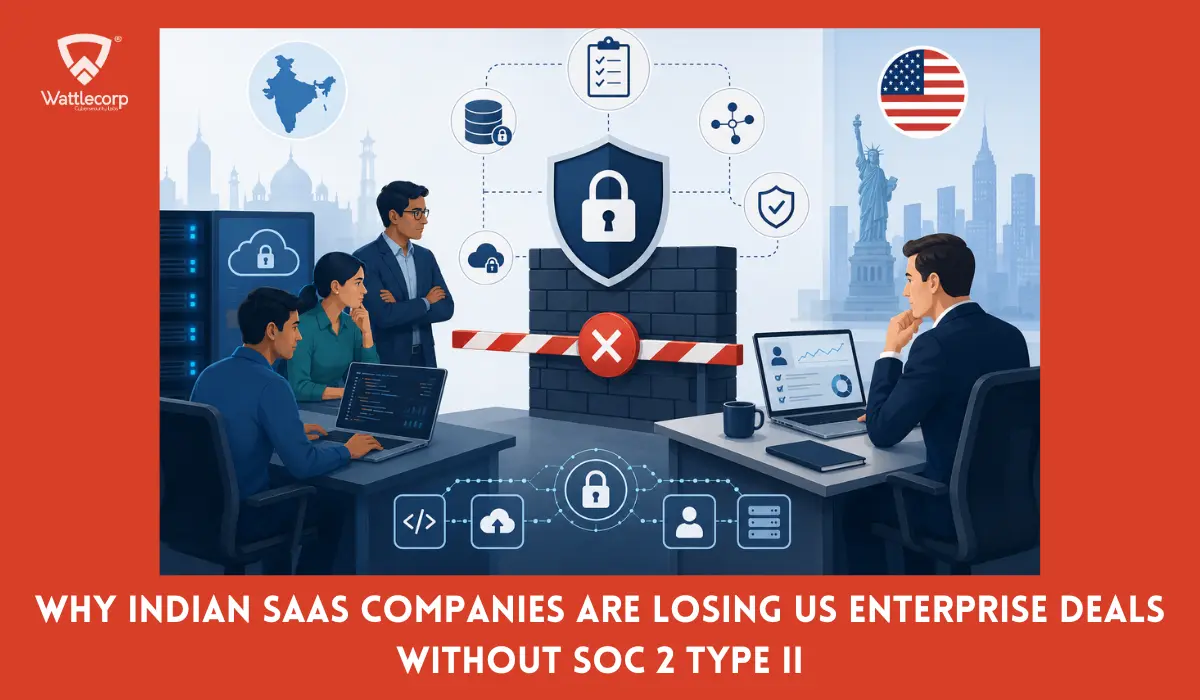
Why Indian SaaS Companies Are Losing US Enterprise Deals Without SOC 2 Type II
Key Takeaways:
- Type I is a starting point. Type II is the deal-maker. US enterprise procurement teams do not settle for a point-in-time audit when vendor risk is on the line.
- Operational evidence is non-negotiable. Continuous controls, not just documented policies, are what Fortune 500 legal and compliance teams demand before signing contracts.
- SOC 2 Type II for SaaS companies is your competitive differentiator. In a market crowded with global vendors, Indian SaaS startups that hold SOC 2 Type II report close deals faster, command premium pricing, and earn long-term client trust.
- Early investment pays compound dividends. Teams that build Type II readiness into their product roadmap eliminate last-minute deal blockers and attract institutional investors with stronger security posture.
The Compliance Gap Costing Indian SaaS Startups Their Most Valuable US Enterprise Deals
There is a pattern emerging across the Indian SaaS landscape that does not show up in pitch decks but shows up consistently in stalled pipelines and enterprise contracts that land with competitors instead.
The product is competitive, the pricing is right, and every sales conversation builds genuine momentum.
But the moment a US enterprise procurement team steps in and requests a vendor security review, the dynamic shifts entirely. Weeks pass. Follow-ups go unanswered. A deal that was practically signed quietly moves to a competitor and no one explicitly tells you why.
In most cases, the underlying cause is the same: no SOC 2 Type II.
US enterprise procurement is a structured risk process. Before approving a new vendor, legal and security teams need auditor-verified evidence that your controls have been working reliably over time, not just documented on paper.
That is precisely what SOC 2 Type II for SaaS companies provides. A Type I report or a security questionnaire does not carry the same weight, and attempting to substitute one signals exactly the kind of immaturity enterprise buyers are screening for.
The cost of this gap goes beyond losing individual deals. It affects how investors assess your readiness, how procurement teams perceive your maturity, and how effectively your team can compete against certified vendors who clear the security review without friction.
Let’s break down why SOC 2 Type II for SaaS companies has become the entry requirement for US enterprise deals, where Indian SaaS startups most commonly go wrong, and what a practical path to certification looks like.
The Gap Between Type I and Type II Compliance
Before addressing the business consequences, it is essential to understand what separates these two reports at a technical and operational level.
SOC 2 Type I is a point in time audit. An independent auditor visits your organization, physically or virtually and evaluates whether your security, availability, processing integrity, confidentiality, and privacy controls are suitably designed and implemented at a specific point in time. It is the equivalent of a health check on a single morning: useful, but not conclusive.
SOC 2 Type II evaluates whether controls were suitably designed and operated effectively over a defined review period, commonly three to twelve months depending on auditor approach, buyer expectations, scope, and organizational readiness.
Also Read : How Indian Startups Can Pass Enterprise Security Reviews: SOC 2, ISO 27001, or VAPT?
The report does not ask whether controls exist. It asks whether they worked, consistently, over a defined period.
Log review cadences, access provisioning and deprovisioning timelines, patch management cycles, incident response tests, vendor risk reviews, all of it produces evidence that must be retained and presented.
This distinction is not a technicality. It is the core reason why SOC 2 Type II for SaaS companies carries so much weight in US enterprise procurement.
Why Type II Drives Enterprise Confidence
US enterprise procurement teams, especially in financial services, healthcare, legal, and government-adjacent sectors have formalized enterprise risk management into multi-stage frameworks.
When a new SaaS vendor enters their supply chain, the security review is not a formality. It is a structured process involving legal, information security, compliance, and sometimes the board.
SOC 2 Type II for SaaS companies satisfies this process in several critical ways:
- It demonstrates that security practices are not performative. Controls were tested under real operating conditions, not staged for a one-day assessment.
- It aligns with the AICPA Trust Services Criteria, a framework that US-based auditors and compliance professionals recognize and trust by default.
- It signals organizational maturity. A company that has sustained Type II controls over a defined review period, especially a longer six- or twelve-month window, has invested in people, process, and tooling, not just documentation.
- It simplifies the vendor questionnaire process. Most Fortune 500 security questionnaires map directly to the five trust service categories. A clean Type II report answers dozens of questions at once, accelerating the procurement cycle measurably.
For Indian SaaS startups selling into the US market, this translates directly to shorter sales cycles, fewer blockers at the security review stage, and a stronger negotiating position when commercial terms are being finalized.
Strategic Risks for Indian SaaS Startups
The impact of missing SOC 2 Type II compliance is not confined to the sales pipeline. It ripples upward into the boardroom and outward to potential investors.
When enterprise deals stall repeatedly at the vendor security review stage, it surfaces in board reporting as a scalability concern.
Investors evaluating Indian SaaS startups for Series A and beyond increasingly treat security posture as a proxy for operational maturity.
Also Read : AI Security Testing for US SaaS Platforms: What 2026 Standards Require
A company that cannot close enterprise deals because it lacks SOC 2 Type II for SaaS companies is, in investor language, leaving an addressable market on the table due to a controllable risk.
Venture-backed SaaS companies in India that are targeting US enterprise ARR targets will find that the absence of SOC 2 Type II report increasingly triggers diligence flags during funding rounds.
It is no longer simply a compliance checkbox, it is a signal about how the founding team thinks about risk, trust, and long-term enterprise readiness.
Operational Challenges Behind the Compliance Gap
Most Indian SaaS startups aren’t failing at SOC 2 Type II for SaaS companies because their security is weak. They’re failing because they cannot prove their controls operated consistently.
The technical controls are usually there. Cloud-native infrastructure, role-based access, endpoint security, teams have done the work. What’s missing is the evidence trail that shows those controls actually ran, consistently, for twelve months straight.
Where things typically fall apart:
- Evidence is everywhere and nowhere: It’s buried across JIRA, cloud dashboards, HR tools, and email threads. When audit time comes, pulling it together becomes a firefighting exercise.
- Access reviews get skipped: Periodic access reviews are commonly expected in SOC 2 programs, and if your control design commits to quarterly reviews, missed reviews can create audit exceptions. But during a product sprint, they’re the first thing dropped and one clean review won’t cover for three missed ones.
- DevSecOps isn’t tight enough: Developers committing directly to main branches and deployments with no change tickets break the audit trail completely.
- Incidents were handled over Slack: If your team resolved security events informally without structured logging, auditors will notice. Good intent doesn’t substitute for documentation.
- Vendors were never formally reviewed: Every subprocessor your product relies on needs a documented security review. Most startups skip this entirely.
Closing the SOC 2 Type II for SaaS companies gap isn’t about adding more tools. It’s about building habits that generate proof automatically, because when auditors come knocking, good intentions don’t count, evidence does.
Business Consequences That Compound Over Time
The business consequences of losing enterprise deals without SOC 2 Type II certification are both immediate and cumulative.
- RFP disqualification: Large enterprises often include security certification requirements directly in RFP response templates. Without SOC 2 Type II for SaaS companies, your response is technically non-compliant before a human even reads it.
- Competitor displacement: When two vendors offer comparable functionality and pricing, the one with Type II wins. Every time. The compliance-certified competitor is simply a lower-risk choice for a procurement team that answers to a CISO.
- Brand perception erosion: Enterprise procurement circles are tighter than they appear. A reputation for being “not audit-ready” travels fast through referral networks, especially in verticals like fintech, healthtech, and legaltech where SOC 2 compliance requirements are particularly stringent.
- Revenue concentration risk: Without Type II, Indian SaaS startups are often confined to selling to mid-market and SMB clients who do not require it. This creates revenue concentration in lower ACV segments and slows the path to the kind of enterprise ARR that drives meaningful valuation multiples.
How to Close the Gap and Secure Enterprise Deals
Phase 1: Assessment and Planning
If you’re serious about landing US enterprise clients, SOC 2 Type II for SaaS companies isn’t optional anymore, it’s the price of entry.
Review your current controls against the five AICPA Trust Services Criteria: Security, Availability, Processing Integrity, Confidentiality, and Privacy.
Figure out what’s working, what’s halfway there, and what doesn’t exist yet. Security comes first, it’s non-negotiable.
Phase 2: Implementation and Evidence Collection
Here’s what most teams get wrong, they implement controls but forget to prove they’re running. Every access grant, code deployment, and vendor review needs a paper trail:
- Automate user provisioning tied to your HR system
- Require pull request approvals before anything hits production
- Centralize security-relevant logs in a SIEM or logging platform and retain them according to your risk profile, customer commitments, regulatory obligations, and audit evidence needs
- Run vulnerability assessment scans on a fixed schedule and track every finding
- Document incidents, even the small ones
- Review critical vendors at least annually, and apply more frequent reviews where vendors process sensitive data, support critical services, or introduce elevated operational risk
Once this infrastructure is in place, it mostly runs itself.
Phase 3: Audit Readiness and Engagement
After a defined period of documented operations, engage an independent licensed CPA firm qualified to issue SOC 2 reports and acceptable to your target enterprise buyers. Organize your evidence clearly, walk through every control internally before the auditor does, and if something went wrong during the year, own it, explain it, and show what changed.
The truth is, SOC 2 Type II for SaaS companies isn’t just about the certificate. It’s about building a company that enterprise buyers can actually trust. And that’s what wins deals.
How Wattlecorp Helps SaaS Startups Achieve SOC 2 Type II Readiness
For Indian SaaS companies with serious US enterprise ambitions, compliance cannot be an afterthought.
As one of India’s leading cybersecurity and GRC consulting firms, Wattlecorp has taken startups from their first compliance conversation all the way to a clean, defensible Type II opinion.
Every engagement opens with a hands-on readiness assessment across all five AICPA Trust Services Criteria. The output is a prioritized remediation roadmap with clear ownership and realistic timelines, not a checklist that sits in a shared drive.
Sustainable SOC 2 Type II for SaaS companies’ readiness demands documentation that reflects how your team actually operates. Wattlecorp builds policies and workflows that hold up when an auditor starts asking the hard questions.
Vulnerabilities discovered by an auditor carry far heavier consequences than those caught internally. Wattlecorp pressure-tests your controls before the observation period begins, with remediation support included. For mobile-first products, this covers mobile app penetration testing in India across web, API, and mobile attack surfaces.
Engagements begin with the assessment, then transition into a retainer or continuous monitoring program structured around what your compliance posture actually needs long-term.
Adopting SOC 2 Type II for SaaS companies with SOC as a Service in real time ensures continuous compliance and operational confidence.
SOC 2 Type II for SaaS Companies FAQs
1. Why do US enterprises ask Indian SaaS companies for SOC 2 Type II?
2. Is SOC 2 Type II mandatory for SaaS companies in India?
3. What is the difference between SOC 2 Type I and SOC 2 Type II?
4. How does SOC 2 Type II help Indian SaaS companies close US enterprise deals?
5. Should mobile-first SaaS companies also consider mobile app penetration testing in India?

 Qatar Cybersecurity Boardroom Accountability: Why QCB and NCSA Now Expect Executive Ownership
Key Takeaways: Cybersecurity in Qatar is increasingly becoming an executive governance responsibility, with national cybersecurity initiatives and sector-specific requirements encouraging organizations to establish stronger leadership oversight. QCB and NCSA play important roles in strengthening cybersecurity governance in Qatar, with QCB focusing on financial sector requirements and NCSA supporting national-level cybersecurity coordination and guidance. Executives can’t […]
 Data Privacy Consulting for Saudi Enterprises: How to Operationalize PDPL Data Subject Rights in 2026
Key Takeaways: The Saudi data protection law may apply to organizations outside the Kingdom when they process personal data related to individuals in Saudi Arabia, meaning geographic location alone does not automatically exclude an organization from PDPL obligations. PDPL data subject rights span access, correction, deletion, and consent withdrawal, and enterprises are on the hook […]
 Third-Party Vendor Security Risk Assessment Under DPDP: A Guide for Indian Enterprises
Key Takeaways: Third-party vendor risk assessment with DPDP practices helps Indian enterprises to verify that external partners handle personal data with adequate safeguards. The Digital Personal Data Protection Act holds data fiduciaries accountable for vendor conduct, which makes due diligence a legal and operational necessity. A structured vendor security questionnaire, covering encryption, access control, and […]
 Virtual CISO Services for UAE Free Zone Startups: Affordable Security Leadership for Growing Companies
Key Takeaways: Most startups already hold sensitive data such as customer info, source code, financials, long before they feel big enough to take security seriously, and that’s exactly when the risk starts. A virtual CISO gets you someone who’s done this before, setting up strategy and guiding compliance, without the cost of putting a full-time […]
 SOC as a Service for Indian BFSI and FinTech Companies: 24/7 Monitoring for CERT-In Readiness
Key Takeaways: SOC as a Service for BFSI and FinTech India gives banks, NBFCs, insurers and digital lenders continuous security visibility without the cost and hiring effort of building an in-house operations centre. CERT-In directions require regulated entities to report qualifying cyber incidents within six hours of detection, and implementing SOC for BFSI and FinTech […]
 SOC as a Service in India: How It Works, Pricing, and Why Businesses Need It
Key Takeaways: SOC as a Service helps Indian businesses to get 24×7 security monitoring without huge cost and complexity of building a full in-house security operations center. A managed SOC check and analyse beyond basic log monitoring, which combining SIEM, threat intelligence, analyst-led alert triage, incident escalation, reporting, and security response support. SOC as a […]