


Cloud Security Checklist for Indian Startups Using AWS and Azure (2025 Edition)
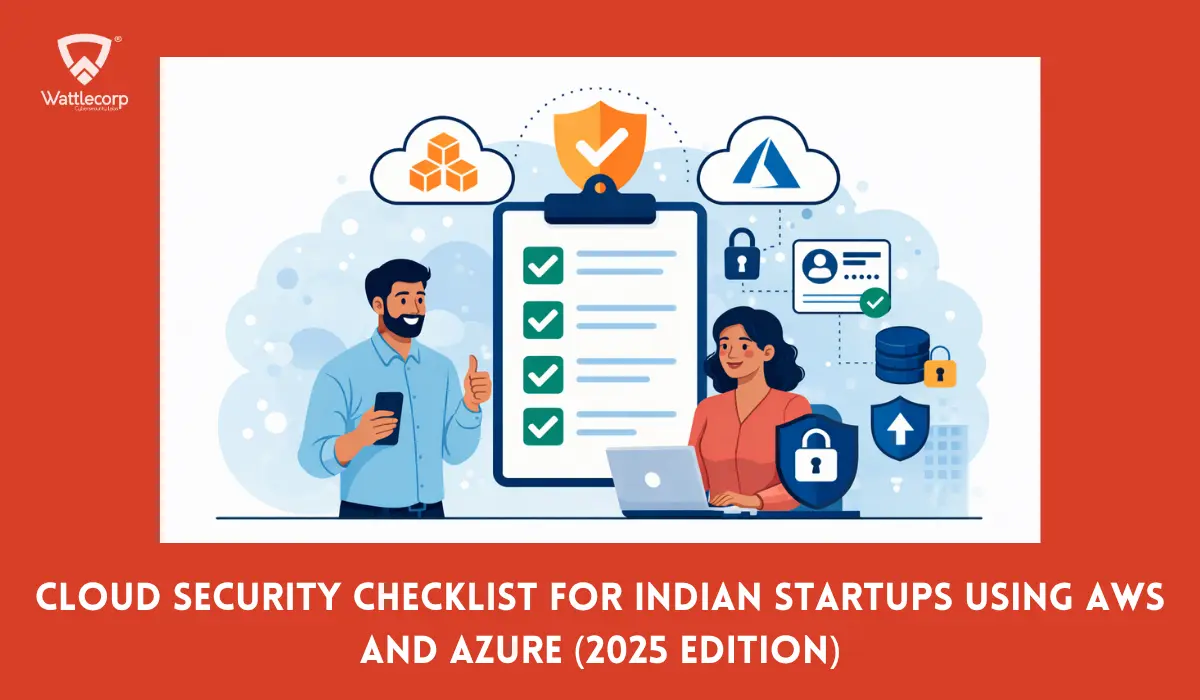
Key Takeaways:
- Most Indian startup cloud breaches aren’t caused by sophisticated attacks — 82% stem from misconfiguration that takes minutes to fix once you know where to look.
- AWS and Azure each provide robust native security tooling included in base pricing. The gap is not capability — it is activation and configuration.
- India’s DPDPA creates binding legal obligations on any startup processing personal data, with penalties reaching ₹250 crore per violation. Cloud configuration directly determines compliance.
- CERT-In’s 6-hour incident reporting mandate makes real-time monitoring non-negotiable — passive logging alone will not meet the deadline.
- Cloud security for Indian startups does not require large budgets. Most zero-cost controls in this checklist can be enabled in an afternoon and dramatically reduce exposure.
- A cloud penetration test validates what a configuration checklist cannot: whether your controls hold under real attack conditions.
Why Indian Startups Are the First Target for Cloud Attacks
Your startup just went live on AWS. Funding is in. The product is scaling. Then, three months later, an exposed S3 bucket leaks 80,000 customer records and you are staring at a CERT-In incident reporting deadline with no IR playbook in sight.
This is not hypothetical. It is the pattern Wattlecorp sees repeatedly with high-growth Indian startups: world-class engineering built on dangerously thin cloud security foundations. Speed-to-market pressure turns misconfiguration from a mistake into a habit.
The shared responsibility model is where most founding teams get it wrong. AWS and Azure secure the physical infrastructure, the hypervisor, and the network layer. Everything above that IAM, application configuration, data encryption, access controls is your responsibility. The cloud provider’s security does not automatically become your security.
Three converging pressures make Indian startups disproportionately exposed. Multi-tenant SaaS architectures create API isolation risks where one tenant’s data can bleed into another’s without triggering a single alert. Cloud sprawl means Indian startups average multiple cloud accounts per company by Series A, each with independent and often inconsistent IAM configurations. And regulatory blind spots mean that DPDPA, CERT-In, and RBI guidelines create hard legal deadlines that most founding teams discover only after an incident.
AWS Security Best Practices for Indian Startups: Account Hardening Checklist
Identity and Access Management is where every AWS hardening exercise must begin.Enable MFA on the root account immediately and disable root access keys entirely, the root account should be used for emergency break-glass situations only, never for day-to-day operations. Create individual IAM users per developer and apply the Principle of Least Privilege using IAM policies: no wildcard permissions in production, ever. Use IAM Roles with temporary credentials instead of long-lived access keys, and rotate any remaining access keys every 90 days.
For organisations running multiple AWS accounts, enable AWS Organizations with Service Control Policies to enforce guardrails across every account simultaneously. This single step prevents entire categories of IAM misconfiguration from being possible at the account level.
Storage misconfiguration is the most common cause of Indian startup data breaches. Enable S3 Block Public Access at the account level this is a single toggle that costs nothing and takes thirty seconds. Enable server-side encryption using AWS KMS on all buckets. Audit bucket policies and ACLs monthly using AWS Config. Never store secrets, tokens, or credentials in S3: use AWS Secrets Manager for all sensitive values.
On the monitoring side, passive logging is not the same as active detection. Enable AWS CloudTrail across all regions and store logs in a separate, write-protected account. Enable AWS GuardDuty for ML-powered threat detection the cost for most startups is negligible relative to the risk it covers. Set up AWS Security Hub to centralise findings from GuardDuty, Inspector, and Macie into a single view. Create CloudWatch Alarms for root login events, IAM policy changes, failed console logins, and any modification to S3 public access settings. Set log retention to a minimum of 180 days across all CloudWatch log groups this is a hard requirement under CERT-In’s 2022 directive.
For network security, never expose databases to the internet. Use private subnets within a VPC for all database and backend services. Restrict security group rules to specific IP ranges: no 0.0.0.0/0 on port 22 or 3389, ever. Enable VPC Flow Logs for all production VPCs. Place AWS WAF in front of all Application Load Balancers and API Gateways, and use AWS PrivateLink or VPC Endpoints for AWS service communication to avoid traffic traversing the public internet.
Azure Security Configuration Checklist for Indian Startups
Azure is rapidly gaining ground among Indian B2B SaaS startups, particularly those with enterprise clients requiring Microsoft ecosystem integration. Azure’s native security tooling matches AWS in depth but only delivers value when correctly configured. The following azure security configuration checklist covers the controls every Indian startup should validate before going to production.
Azure identity security starts with Conditional Access Policies, not just MFA enablement. Many teams enable MFA in Azure AD but fail to enforce it via Conditional Access, leaving gaps that attackers exploit through legacy authentication protocols. Disable Basic Auth and SMTP Auth at the tenant level: they bypass MFA entirely and remain enabled by default in many Azure tenants. Use Azure Managed Identities for all application workloads to eliminate stored credentials completely. Apply Role-Based Access Control with custom roles scoped to resource groups rather than subscriptions, and enable Azure AD Privileged Identity Management for just-in-time admin access.
For storage and data security, disable public blob access at the storage account level not just the container level. Enable Azure Defender for Storage to detect anomalous access patterns and malware uploads. Use Azure Key Vault for all secrets, certificates, and encryption keys without exception: hardcoding values in App Settings or environment variables is the Azure equivalent of leaving credentials in a public repository. Configure Azure Private Endpoints for storage accounts accessed by backend services, and encrypt all sensitive data at rest using customer-managed keys via Azure Key Vault.
Microsoft Defender for Cloud is the most underused native Azure security tool among Indian startups. The free tier covers most baseline checks and provides a Secure Score a single number that quantifies your security posture and tracks improvement over time. Enable it, review the score, and work through the recommendations in order of severity. Set up Azure Monitor with a centralised Log Analytics workspace and route all diagnostic logs there. Enable Azure Policy to auto-remediate common misconfigurations for example, automatically enforcing HTTPS on all storage accounts so that configuration drift is corrected without manual intervention.
For network security, use Network Security Groups with allowlist-only inbound rules on every subnet. Enable Azure DDoS Protection Standard on public-facing Application Gateways and Load Balancers. Deploy Azure Firewall or Azure Application Gateway with WAF for all internet-facing workloads. Use Azure Private Link for all PaaS services Azure SQL, Cosmos DB, Service Bus to keep traffic off the public internet. Enable Just-in-Time VM access through Defender for Cloud to eliminate always-open management ports, which remain one of the most common initial access vectors in Azure environments.
AWS vs. Azure: Security Tool Reference for Startups
Both platforms provide native security tooling that covers the most common threat categories. Knowing the equivalent tools on each platform allows engineering teams to implement consistent controls regardless of which cloud they are running.
| Security Domain | AWS Tool | Azure Equivalent |
| API Logging | CloudTrail | Activity Log + Diagnostics |
| Threat Detection | GuardDuty | Defender for Cloud |
| CSPM | Security Hub | Defender for Cloud (CSPM) |
| PII Discovery | Amazon Macie | Purview Information Protection |
| Vuln Scanning | Amazon Inspector | Defender for Servers |
| Secrets Management | Secrets Manager | Azure Key Vault |
| Web App Firewall | AWS WAF | Azure WAF (App Gateway) |
| DDoS Protection | Shield Standard | DDoS Protection Standard |
| SIEM | Security Hub + SIEM | Microsoft Sentinel |
Both platforms offer free tiers for most baseline security controls. Activating these tools costs nothing beyond the time required to configure them correctly. Indian startups running either platform have no technical reason to leave these disabled.
DPDPA and CERT-In Compliance on Cloud: What Indian Startups Must Do
India’s regulatory environment for cloud-hosted startups changed materially in 2023. The Digital Personal Data Protection Act creates binding obligations on any entity processing the personal data of Indian citizens, which includes virtually every B2C and B2B SaaS startup operating in India. Non-compliance penalties can reach ₹250 crore per violation, a figure that makes even modest compliance investment look economical by comparison.
CERT-In’s 2022 directive adds an operational urgency that most startups underestimate. The mandate requires reporting of cybersecurity incidents to CERT-In within six hours of detection. This is not a guideline, it is an enforceable legal deadline. Meeting it requires real-time detection capability. Passive logging, where logs are stored and reviewed reactively, will not meet a six-hour window. The only startups that reliably meet the CERT-In deadline are those running active threat detection with alerting configured to notify a responsible person immediately upon detection.
Also Read : Data Minimization and Purpose Limitation: Core Principles of the DPDPA (INDIA)
For DPDPA cloud compliance, classify all data stored in cloud environments before applying controls personal data, sensitive personal data, and operational data each carry different obligations. Enable encryption at rest using AWS KMS or Azure Key Vault for all data stores containing personal data. Enforce TLS 1.2 or above for all data in transit and disable older protocol versions. Define and automate data retention policies using S3 Lifecycle rules or Azure Blob Lifecycle management DPDPA requires deletion of personal data when it is no longer needed for the purpose it was collected.
Cross-border data transfers require particular attention. DPDPA places restrictions on transferring personal data outside India without explicit consent from the data principal. Cloud architectures that replicate data to non-India regions as a default for disaster recovery, latency, or backup purposes need to be reviewed against these obligations. AWS and Azure both offer India-region options for data residency, and these should be the default choice for workloads processing Indian personal data.
For financial sector startups, RBI’s Master Direction on IT Governance requires documented cloud risk assessments and third-party cloud audits for payment system operators. NBFC-licensed startups running on AWS or Azure must factor this into their cloud security programme regardless of size.
Cloud Penetration Testing for Indian Startups: Why Checklists Aren’t Enough
A cloud security checklist tells you what to configure. A cloud penetration test tells you whether those configurations actually hold under attack conditions. These are meaningfully different questions, and the answer to the second is what enterprise buyers, investors, and auditors are asking for when they request evidence of security controls.
Cloud penetration testing for Indian startups covers the attack paths that misconfiguration makes possible: IAM privilege escalation paths that allow an attacker to move from developer access to administrator; S3 and Azure Blob enumeration that allows an unauthenticated attacker to discover and access storage; metadata service exploitation through SSRF vulnerabilities that allows an attacker on a compromised compute instance to steal instance credentials; lateral movement simulation that tests how far an attacker can pivot once inside one service; and serverless and container security issues that standard configuration reviews miss.
The question of when to commission a cloud pentest has a clear answer for Indian startups. Before your first enterprise sales contract procurement teams at enterprise buyers routinely include security questionnaires and pentest evidence requirements at the first stage of vendor evaluation. Before Series A due diligence institutional investors are increasingly including technical security assessments in their due diligence process. After any major infrastructure change: cloud migration, new region, new service tier, or significant architectural change. And annually as part of an ongoing cloud security assessment programme.
Most Indian startups commission their first cloud penetration test after a compliance audit forces the issue. The window of undetected exposure between deployment and first test is typically measured in months. The cost of a cloud pentest is a fraction of the cost of a single breach or a failed enterprise procurement cycle.
How a Bengaluru SaaS Startup Protected 50,000 Customer Records
A mid-sized B2B SaaS company based in Bengaluru, processing data for enterprise customers across India and Southeast Asia, engaged Wattlecorp for a cloud security assessment ahead of a Series A fundraise. Their engineering team had followed standard cloud setup practices and believed their AWS environment was reasonably secured.
“We thought we had covered the basics. Wattlecorp found a multi-tenant data isolation flaw in our API layer that would have allowed any authenticated customer to access another customer’s data. We had no idea it existed.” – CTO, Bengaluru SaaS Company
The assessment identified a BOLA (Broken Object Level Authorisation) vulnerability in the company’s REST API, a flaw that would have allowed any authenticated user to access data belonging to other tenants by manipulating object identifiers in API requests. The vulnerability existed in the production environment and had been present since the initial deployment.
Also Read : Multi-Tenant Data Isolation: How a SaaS Platform Protected 50K+ Customer Records
In addition to the API flaw, the assessment identified seventeen IAM misconfigurations including three developer accounts with administrator-level access, two S3 buckets with overly permissive ACLs, and an absence of CloudTrail logging in a secondary AWS region used for disaster recovery.
Wattlecorp’s team worked alongside the startup’s engineering team to remediate all findings within three weeks ahead of the Series A data room opening. The fundraise completed without a security-related delay.
The results: 50,000 customer records protected from potential unauthorised access, 17 IAM misconfigurations remediated, Series A due diligence passed without security qualification, and an ongoing cloud security posture assessment programme established for post-raise scaling.
Building Cloud Security Without Breaking the Runway
The most common objection Wattlecorp hears from Indian startup founders is that security investment has to wait until after the next funding round. This calculation inverts the actual risk. The average cost of a cloud data breach in India is ₹17.6 crore, according to IBM’s 2023 research. A proactive cloud security assessment costs less than two percent of that figure. A single failed enterprise procurement cycle, where a security questionnaire surfaces the absence of basic controls costs more in lost revenue than a comprehensive security programme.
The zero-cost quick wins are the starting point, not the finish line. Enable MFA on all accounts free on both AWS and Azure. Block public S3 and Azure Blob access at the account level, a single toggle, zero cost. Enable CloudTrail and Azure Activity Log that included in base platform pricing. Run the AWS Well-Architected Tool or Azure Security Benchmark both free. Move all hardcoded credentials to AWS Secrets Manager or Azure Key Vault. Set up billing alerts anomalous spend is often the first visible sign of a crypto-mining breach.
These controls can be enabled in an afternoon and dramatically reduce the most common attack surface. They require no budget approval, no procurement process, and no security expertise beyond following documented steps. Every Indian startup running on AWS or Azure should have all of them active before the end of this week.
Beyond the zero-cost baseline, the pre-Series A security investments with the highest return are a Cloud Security Posture Assessment to establish a documented baseline and identify accumulated drift, a SIEM implementation using Azure Sentinel’s consumption-based pricing or AWS Security Hub for centralised visibility, and a cloud penetration test before the first enterprise deal or fundraise. Each of these investments pays for itself in the first contract it enables or the first breach it prevents.
Strengthening Your Cloud Security Posture with Wattlecorp
The cloud security checklist in this guide covers the foundational controls every Indian startup on AWS or Azure should have in place. AWS and Azure provide the tooling. The gap is activation, configuration, and validation and that gap is where breaches happen.
DPDPA is live. CERT-In is enforcing. Enterprise buyers are issuing security questionnaires at the first meeting. Investors are adding technical security reviews to Series A due diligence. The startups that treat cloud security as a competitive advantage will close enterprise deals faster, raise cleaner rounds, and build products that customers can trust with their data.
Wattlecorp’s cloud security practice is built for Indian startups at exactly this stage. Our certified team conducts cloud security posture assessments, cloud penetration testing, and DPDPA compliance reviews with OSCP, CEH, and AWS-certified professionals who understand both the technical controls and the Indian regulatory landscape.
If your board is asking cloud security questions without confident answers, that gap already carries a cost. Book a consultation with Wattlecorp’s cloud security team.
Cloud Security Checklist FAQs
1.What is the most important item on a cloud security checklist for Indian startups?
IAM configuration is the highest-priority item. Weak or overly permissive IAM is the entry point for the majority of AWS and Azure breaches. Enable MFA on all accounts, apply the Principle of Least Privilege across all IAM roles and users, and eliminate long-lived access keys before addressing any other control. Every other item on the cloud security checklist builds on a correctly configured identity layer.
2.How does the cloud security checklist for AWS differ from the one for Azure?
The controls address the same risk categories — identity, storage, monitoring, and network — but through platform-specific tooling. On AWS, the primary tools are CloudTrail, GuardDuty, Security Hub, and Macie. On Azure, the equivalent tools are Activity Log, Microsoft Defender for Cloud, Azure Policy, and Microsoft Sentinel. The underlying security principles are identical; the implementation path differs by platform. Indian startups running both AWS and Azure should implement equivalent controls on each platform rather than treating one as a primary and the other as secondary.
3.Does the cloud security checklist cover DPDPA compliance requirements for Indian startups?
The cloud security checklist in this guide addresses the technical controls most directly relevant to DPDPA: encryption at rest and in transit, data classification, retention policy automation, cross-border data transfer controls, and monitoring for data access anomalies. However, DPDPA compliance extends beyond technical controls to include legal documentation, consent management, and Data Protection Impact Assessments. A full DPDPA compliance programme combines the technical controls in this cloud security checklist with a dedicated compliance engagement.
4.When should an Indian startup commission a cloud security assessment rather than relying on this checklist?
A cloud security assessment goes beyond what any checklist can validate. A checklist confirms that controls are configured; a cloud security assessment tests whether those configurations hold under real attack conditions and identifies vulnerabilities that configuration reviews miss — privilege escalation paths, API isolation flaws, lateral movement opportunities, and serverless misconfigurations. Indian startups should commission a cloud security assessment before their first enterprise sales process, before Series A fundraising, after any significant infrastructure change, and annually thereafter. The cloud security checklist in this guide is the baseline; a professional assessment is the validation.

 Qatar Data Protection Law: Implementing PDPPL Data Subject Rights Processes for Businesses
Key Takeaways: The Qatar Data Protection Law (Law No. 13 of 2016) for Personal Data Privacy Protection, grants individuals specific rights such as right to access, correct, erase, object, withdraw consent, and right to be notified of processing or inaccurate disclosure. Beyond having a privacy policy, businesses or controllers, under Article 11 of Personal Data […]
 AI Governance for Indian Enterprises: Building Internal Controls Before Key DPDP Obligations Take Effect
Key Takeaways: The DPDP Act does not contain AI-specific provisions. Its requirements, however, apply in situations when an AI system processes digital personal data within its territorial and material scope. India is working on building a broader governance framework around safety, accountability, transparency and trust via programs like the IndiaAI Mission. Indian organizations should inventory […]
 Cloud Security Audit for UAE Government Cloud Migration: NCAP and Security Requirements
Key Takeaways: A cloud security audit UAE helps government entities identify security, governance, configuration, access, data-protection and resilience gaps, before and after shifting critical workloads to the cloud. UAE National Cloud Security Policy has defined cloud governance, data security, data sovereignty, IAM, incident management, resilience, portability and cloud operations requirements. The National Cyber Accreditation Program […]
 Data Privacy Consulting UAE – Building a PDPL-Compliant Data Governance Program
Key Takeaways: PDPL compliance requires ongoing operational governance that goes beyond policies to demonstrate how personal data is collected, used, protected, transferred, retained, and deleted. Data mapping helps businesses move from reactive compliance to proactive risk management by establishing a comprehensive inventory of the data ecosystem, helping build a mature data privacy and governance program. […]
 Saudi Arabia’s Critical Systems Controls: What CSP-Linked Enterprises Must Comply With in 2026
Key Takeaways: The Critical Systems Cybersecurity Controls (CSCC) are more applicable to critical systems than to all IT assets owned or operated by an organization. To be in full compliance or to remain in full compliance with CSCC, organizations must maintain continuous adherence to NCA ECC. CSCC has 32 core controls and 73 sub-controls across […]
 DevSecOps for Saudi Banking and FinTech Applications: Building a SAMA-Aligned Secure Development Lifecycle
Key Takeaways: DevSecOps Saudi Arabia for banks & FinTech enterprises doesn’t make security journey a last stop but embeds it into the software development life cycle. Mapping DevSecOps methods to the SAMA Cybersecurity Framework improves security governance and application resilience while boosting audit readiness. Continuous security testing such as SAST, DAST, SCA, IaC scanning, and […]