


Compromise Assessment for UAE Enterprises: How to Find Out If You Have Already Been Breached
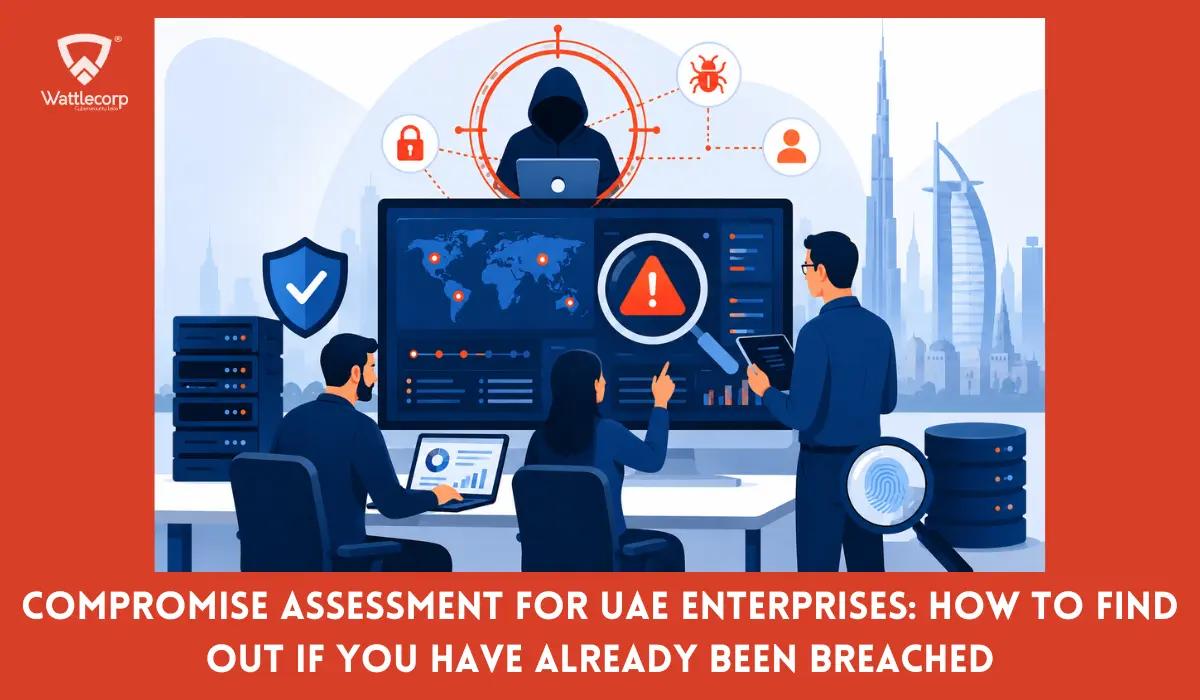
Key Takeaways:
- Compromise Assessment for UAE enterprises is an evidence-based investigation that determines whether attackers have already accessed your systems, replacing assumptions with documented proof of what happened in your infrastructure.
- Hidden compromise costs more to remediate the longer it remains undetected, making early investigation critical for minimizing financial impact, regulatory exposure, and customer trust damage in the UAE market.
- Compromise Assessment for UAE services help examine identity logs, endpoint telemetry, cloud audit data, email records, and network activity simultaneously to reconstruct the attacker behaviour and business impact across your entire enterprise.
- Unlike VAPT services in UAE that test for vulnerabilities you could fix, a compromise assessment investigates whether vulnerabilities were already exploited and whether attackers remain inside your systems.
- Organisations that do frequent Compromise Assessment for UAE investigations establish greater incident response capabilities, regulatory defensibility, cyber insurance confidence and customer assurance, than those organisations that only react when visible events occur.
Your enterprise has security tools in place. Firewalls are configured, compliance audits have been completed, and vulnerability reports look reasonable. But here’s the question that keeps security leaders awake at night: what if attackers are already inside your systems right now, and you just don’t know it yet?
This is where Compromise Assessment for UAE enterprises become critical. As UAE organizations expand into cloud environments, remote work, and digital transformation, the attack surface grows faster than traditional security reviews can validate.
A Compromise Assessment for UAE is not another compliance checkbox; it is an urgent investigation that answers whether your enterprise has already been breached. This guide explains how to move from passive security assumptions to evidence-based breach validation, how VAPT helps and the need for compromise assessment and why these matters for your board, your customers, and business continuity.
Why Compromise Assessment Matters for UAE Organizations
Many UAE enterprises discover compromise the hard way. A customer reports suspicious activity. A regulator asks questions. Ransomware appears on screens. Only then does the organization realize that attackers had access for months.
The problem is that most security tools are designed to prevent attacks, not to reconstruct what already happened. A Compromise Assessment for UAE services turns this around. Instead of hoping preventive controls worked, you actively investigate whether attackers have already accessed endpoints, cloud accounts, email systems, identity services, or critical applications.
Think about what you know about your environment. Can you confidently say no attacker has touched your Azure AD environment? Do you know if someone logged into a privileged account from an impossible location? Have you verified that your email systems haven’t been compromised? Without this evidence, you’re operating on assumptions, not facts.
A Compromise Assessment for UAE organizations provides more than a vulnerability list. It delivers documented evidence of suspicious or confirmed attacker activity, identifies affected systems where telemetry is available, and highlights visibility gaps where data access cannot be conclusively determined.
Understanding Indicators of Compromise and Breach Assessment
Not all suspicious activity looks obvious, attackers often work quietly, which may move between systems without triggering alerts. A Compromise Assessment for UAE investigation looks for indicators that something is wrong even when your security testing tools haven’t flagged anything.
These indicators include impossible login patterns, where someone logs in from two geographic locations simultaneously. They include privilege escalation events, where regular user accounts suddenly gain administrative rights. They include unusual mailbox rules, where email is forwarding to external accounts. They include suspicious PowerShell activity, where scripts are running commands that shouldn’t be executed.
Also Read : Data Breach Prevention Strategies and Best Practices In 2025
A comprehensive breach assessment examines whether your logs capture this activity. Many organizations discover that critical log sources are missing entirely. Azure AD logs might not be flowing to your SIEM. AWS CloudTrail data might be incomplete. Email audit logs might not be retained long enough to investigate historical activity.
This gap between what you think you’re logging and what you’re logging is where compromise hides.
How Compromise Assessment Works Across Your Infrastructure
A Compromise Assessment for UAE investigation is methodical, hypothesis-driven, and evidence-led. Investigators do not rely on unsupported assumptions; they validate findings against logs, endpoint telemetry, cloud audit trails, and other available evidence.
First, it examines your identity systems. Every legitimate user login creates logs. Every privilege elevation creates records. By analysing these patterns, forensic investigators can identify logins that look different from normal activity, different times, different locations, different behaviour patterns.
Second, it reviews endpoint activity. Your endpoints generate enormous amounts of telemetry about processes, network connections, file access, and registry changes. A Compromise Assessment for UAE expert reviews this data to identify whether malware, persistence mechanisms, or lateral movement activity exists.
Third, it investigates cloud environments. Cloud security services generate detailed audit logs about who accessed what, when, and from where. But most organizations are not actively monitoring these logs. Attackers often exploit excessive cloud permissions, abused credentials, weak logging, or poorly correlated monitoring to create persistence, access sensitive resources, and stage data for exfiltration.
Fourth, it examines email systems. Email compromise is one of the most common initial access points for attackers. A Compromise Assessment for UAE investigation reviews inbox rules, forwarding settings, delegate access, and suspicious login activity to determine if email accounts have been compromised.
This multi-layer approach called Compromise Assessment for UAE services cannot be fully automated. It requires skilled investigators who understand attacker behaviour, know what normal looks like in your environment, and can connect individual events into an incident narrative.
The Business Impact of Hidden Compromise
Before you conduct a Compromise Assessment for UAE investigation, understand what you might discover and why it matters.
Under the UAE Personal Data Protection Law and applicable sector or free-zone regulations, organizations may have breach notification obligations when a personal data breach prejudices the privacy, confidentiality, or security of affected individuals. Early investigation helps determine whether notification is required and what evidence should support the response.
If attackers accessed financial systems, the impact is direct revenue risk. Fraudulent transactions, manipulation of accounts, or extortion demands all flow from undetected system access.
Also Read : Proactive Threat Hunting for UAE Enterprises: Finding Attackers Before They Strike
If attackers compromised privileged accounts, they could access virtually anything in your environment. They can move between systems, create backdoor accounts, steal credentials, or insert persistence mechanisms that keep them inside even after you patch vulnerabilities.
If attackers staged customer data for exfiltration, the exposure timeline can vary from rapid extortion attempts to delayed misuse. Early detection improves containment, legal response, customer notification readiness, and evidence preservation.
Compromise Assessment for UAE services deliver business value beyond finding malware; they provide evidence-based confidence about your cyber reality.
When to Conduct a Compromise Assessment
Some organizations wait for obvious signs before investigating. This is expensive. By the time you notice ransomware, attackers have often been inside for weeks.
Smarter organizations conduct a Compromise Assessment for UAE investigation proactively. Timing triggers include suspicious login activity that your SOC cannot explain, unusual network traffic patterns, employee reports of strange account activity, or preparation before major business events like M&A transactions or regulatory audits.
A Compromise Assessment for UAE should also happen after any significant infrastructure change. Cloud migrations, identity platform upgrades, email system transitions, or remote work deployments all create windows where attackers can hide in the noise of legitimate activity.
The most mature approach is treating Compromise Assessment for UAE services as part of your regular security governance. Annual or semi-annual investigations reduce the technology risk of long-term undetected compromise, especially when combined with continuous monitoring, endpoint detection, SIEM correlation, identity threat detection, and incident response readiness.
Build Cyber Confidence with Evidence-Based Visibility
The difference between enterprises that manage cyber incidents effectively and those that suffer devastating breaches often comes down to one thing: visibility. Organizations that know what happened in their infrastructure can respond decisively. Organizations that operate blind discover problems only when attackers or regulators force the conversation.
A Compromise Assessment for UAE enterprises gives you that visibility. It transforms uncertainty into evidence, hunches into facts, and reactive panic into measured response.
Wattlecorp’s compromise assessment services help UAE organizations analyse your logs across identity systems, endpoints, cloud platforms, and email infrastructure to reconstruct attacker behaviour and quantify business impact.
Whether you suspect compromise, prepare for audits, strengthen cyber insurance negotiations, or simply want to validate your detection readiness, a Compromise Assessment for UAE is a strategic investment in your security confidence.
Compromise Assessment for UAE FAQs
1. What is a compromise assessment for UAE enterprises?
2. How is compromise assessment different from VAPT services in UAE?
3. What are the signs that a UAE company may already be breached?
4. What systems are checked during a compromise assessment?
5. How often should UAE enterprises conduct compromise assessments?

 Mobile Application Penetration Testing for Qatar Government Digital Services: NCSA- Aligned Security Assurance
Key Takeaways: Mobile Application Penetration Testing Qatar must cover the app, device storage, APIs, authentication and third-party components. Qatar’s NCSA assurance environment combines the National Information Assurance (NIA) Standard, the National Information Security Compliance Framework (NISCF) and accredited security assessment services. OWASP MASVS defines mobile security controls, while MASTG supplies practical test methods for Android […]
 Qatar Data Protection Law: Implementing PDPPL Data Subject Rights Processes for Businesses
Key Takeaways: The Qatar Data Protection Law (Law No. 13 of 2016) for Personal Data Privacy Protection, grants individuals specific rights such as right to access, correct, erase, object, withdraw consent, and right to be notified of processing or inaccurate disclosure. Beyond having a privacy policy, businesses or controllers, under Article 11 of Personal Data […]
 AI Governance for Indian Enterprises: Building Internal Controls Before Key DPDP Obligations Take Effect
Key Takeaways: The DPDP Act does not contain AI-specific provisions. Its requirements, however, apply in situations when an AI system processes digital personal data within its territorial and material scope. India is working on building a broader governance framework around safety, accountability, transparency and trust via programs like the IndiaAI Mission. Indian organizations should inventory […]
 Cloud Security Audit for UAE Government Cloud Migration: NCAP and Security Requirements
Key Takeaways: A cloud security audit UAE helps government entities identify security, governance, configuration, access, data-protection and resilience gaps, before and after shifting critical workloads to the cloud. UAE National Cloud Security Policy has defined cloud governance, data security, data sovereignty, IAM, incident management, resilience, portability and cloud operations requirements. The National Cyber Accreditation Program […]
 Data Privacy Consulting UAE – Building a PDPL-Compliant Data Governance Program
Key Takeaways: PDPL compliance requires ongoing operational governance that goes beyond policies to demonstrate how personal data is collected, used, protected, transferred, retained, and deleted. Data mapping helps businesses move from reactive compliance to proactive risk management by establishing a comprehensive inventory of the data ecosystem, helping build a mature data privacy and governance program. […]
 Saudi Arabia’s Critical Systems Controls: What CSP-Linked Enterprises Must Comply With in 2026
Key Takeaways: The Critical Systems Cybersecurity Controls (CSCC) are more applicable to critical systems than to all IT assets owned or operated by an organization. To be in full compliance or to remain in full compliance with CSCC, organizations must maintain continuous adherence to NCA ECC. CSCC has 32 core controls and 73 sub-controls across […]