ISO 27001 Internal Audit vs Gap Assessment in Saudi Arabia: What’s the Difference?
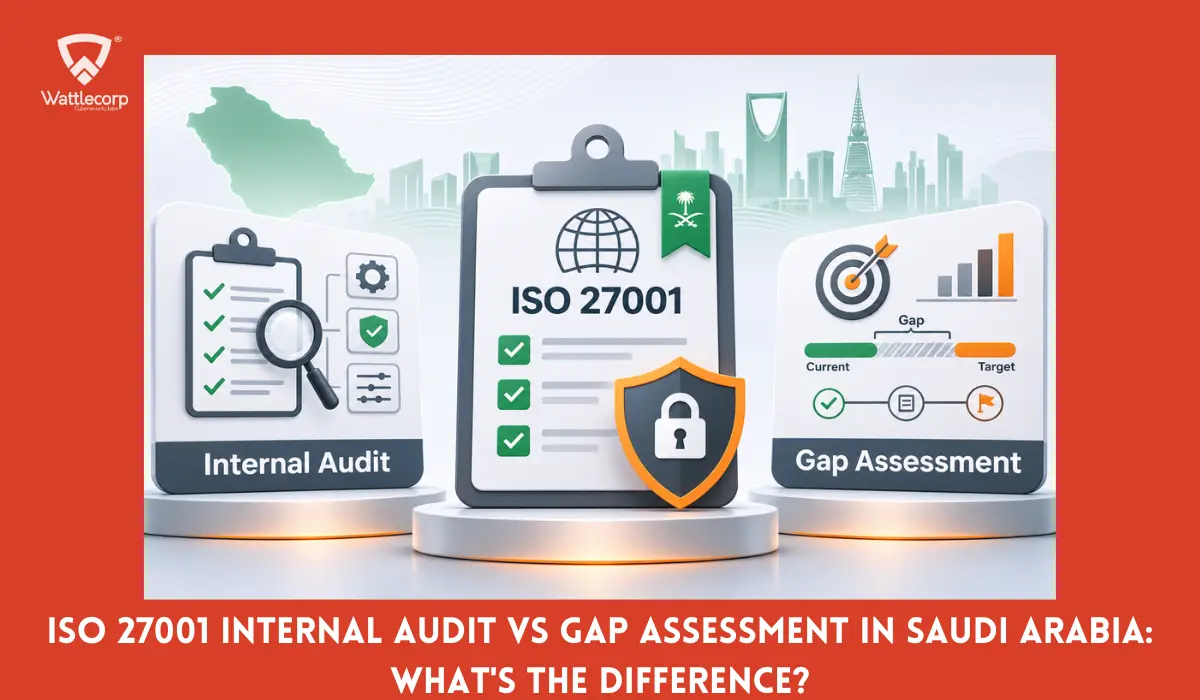
Key Takeaways:
- A standalone gap assessment is optional; internal audits are required.
- Gap assessments can review new or existing systems.
- Internal audits require competent auditors and an objective, impartial process.
- Annex A controls should reflect your risks and obligations.
- Internal audits need to be scheduled early enough to address nonconformities and review corrective action effectiveness before the actual certification audit.
ISO 27001 Internal Audit or Gap Assessment: Which One Do Saudi Organisations Need?
A Saudi-based SaaS company sets out to do a gap assessment and finds out that it lacks a formal access review process and clear supplier security responsibilities. The team assigns owners and implements both processes. Later, an internal audit samples completed access reviews and supplier assessments. It finds that access reviews occurred, but actions to remove unnecessary permissions remain unfinished. The company addresses the finding and verifies its corrective action before the actual certification.
While this scenario explains what a gap assessment and internal audit does, it also conveys what your organisation should focus on first. The former tells you what you should improve; the latter, i.e., internal audit, checks whether your implemented information security management system (ISMS) meets the requirements and expectations effectively.
Understanding ISO 27001 internal audit vs gap assessment helps you choose the right activity, allocate resources, and avoid discovering unfinished work near certification. What you need to know here is that though both these activities examine weaknesses, they serve different decisions.
The short answer: one measures the distance, the other checks the system
A gap assessment compares current practices with a target. It then recommends process improvement by creating a roadmap for implementation planning upon identifying the missing elements.
An internal audit evaluates the implemented ISMS against defined standards, ISO 27001 by default and other relevant regulatory criteria. It uses evidence to evaluate conformity and effectiveness. Nonconformities require correction plus an evaluation of the need for corrective action. Other findings may inform improvement and management oversight.
What an ISO 27001 gap assessment is?
A gap assessment establishes your starting position against ISO/IEC 27001. It helps leadership understand the work, ownership, and resources needed to establish or improve the ISMS.
It commonly happens before implementation, when expanding certification scope, or when preparing for changes to the standard. It can also help an existing programme identify weaknesses following organisational changes.
An internal GRC team or external consultant may review your:
- Clauses 4–10, covering context, leadership, planning, support, operations, performance evaluation, and improvement.
- Risk assessment and treatment arrangements.
- Control selection, using Annex A as a reference.
- Available documentation, responsibilities, and operational evidence.
Annex A does not require implementing every listed control. You need to determine which controls you need to treat information security risks and meet applicable obligations. The next step is comparing them with Annex A to make sure that no necessary controls are missed or overlooked. The Statement of Applicability should then identify necessary controls, justify their inclusion, state their implementation status, and justify any exclusions from Annex A.
Also Read : ISO 27001 Internal Audit for Saudi Companies: Preparing Evidence Before Certification
ISO 27001 gap assessment for Saudi businesses should consider applicable Saudi legal, regulatory, and contractual obligations. These may include NCA ECC (ECC-2:2024), the SAMA Cyber Security Framework, and PDPL requirements. These depend on the organisation’s sector, activities, and scope. Mapping overlapping requirements helps reduce duplicate work and ease severe compliance fatigue.
Typical deliverables should include a gap report, a prioritised remediation plan, suggested owners and dates, and recommendations for the proposed ISMS scope. Prioritisation should reflect information security risks and implementation dependencies.
For related planning, read our ISO 27001 and SOC 2 gap assessment guide for UAE businesses.
What an ISO 27001 Internal Audit Covers For Saudi Businesses
For Saudi organisations comparing ISO 27001 internal audit vs gap assessment, the key distinction is that internal auditing is a formal ISMS requirement, while a separate gap assessment supports readiness and implementation planning.
Clause 9.2 of ISO/IEC 27001 requires internal audits at planned intervals. These audits assess whether the ISMS conforms to the standard and the organisation’s own requirements, including relevant internal policies, and whether it is effectively implemented and maintained.
The organisation must establish an audit programme, define each audit’s criteria and scope, report results to relevant management, and retain documented evidence. Frequency should consider process importance and previous audit results; the standard does not prescribe one universal annual timetable.
Auditors need appropriate competence. Auditor selection and audit delivery must ensure objectivity and impartiality. Assigning someone to evaluate controls they operate undermines this objective.
Also Read : What is an ISO 27001 Surveillance Audit
Evidence review should look beyond policies. Auditors may sample access approvals, employee departures, supplier reviews, incident records, and controls identified in the SoA.
A gap assessment might identify that an access review procedure is missing. An internal audit checks whether scheduled reviews happened, that these covered relevant accounts, and led to completed actions.
In practice, a Saudi organisation may use a gap assessment to identify missing processes, controls, or documentation. Its subsequent internal audit evaluates whether the implemented arrangements meet requirements and operate effectively. Applicable Saudi legal, regulatory, and contractual obligations should also inform ISMS planning and relevant audit criteria
Our ISO 27001 internal audit guide for Saudi companies explains practical evidence preparation.
ISO 27001 internal audit vs gap assessment: A side-by-side comparison
| Area | Gap assessment | Internal audit |
| Purpose | Identify missing or incomplete elements | Evaluate conformity and effective implementation |
| Timing | Before implementation or following change | At planned intervals once activities can be evaluated |
| Mandatory? | No standalone requirement | Required by clause 9.2 |
| Who performs it? | Internal specialists or consultants | Competent internal or outsourced auditors, with impartiality safeguarded |
| Basis | Target requirements and current practices | Defined criteria, including organisational and standard requirements |
| Output | Gap report and remediation roadmap | Audit findings, conclusions, and documented results |
| Next step | Implement and address gaps | Correct nonconformities and evaluate corrective action effectiveness |
For the wider management system context, see our guide to ISO 27001 requirements.
ISO 27001 Gap Assessment vs Internal Audit: Which One Do You Need, and When?
The choice depends on the maturity of your ISMS:
- Starting from scratch: A gap assessment is a useful first step. Establish scope, identify missing processes, and assign implementation responsibilities.
- ISMS operating with evidence available: Conduct an internal audit before certification. Allow time to address findings and verify corrective actions.
- Already certified: Maintain the internal audit programme. Use targeted gap assessments when introducing significant scope, business, or standard changes.
A few months of operation may help generate evidence, but ISO 27001 does not set a universal waiting period before an internal audit.
In case of budgeting, separate assessment, implementation, internal audit, and certification activities, our ISO 27001 certification cost guide provides additional planning context.
Turn Your Assessment Findings into Practical ISO 27001 Improvements
For Saudi organisations, understanding ISO 27001 internal audit vs gap assessment serves as a starting point. Also, the timing of each activity and how organisations act on the findings determine their progress.
- Treating a gap report as the required audit. An informal readiness review does not automatically satisfy clause 9.2. Evaluate the process against audit requirements.
- Auditing your own work. Use cross-functional auditors or independent external support where appropriate to protect impartiality.
- Scheduling too close to certification. Leave realistic time for investigation, remediation, and verification.
- Leaving findings without accountability. Assign owners and target dates. Close nonconformities using evidence and evaluation of corrective action effectiveness.
How Wattlecorp helps
Wattlecorp has proven its expertise in helping organisations across the Middle-East countries become audit ready to relevant regulatory and security standards, including ISO 27001. For more details, visit our ISO 27001 consulting services, where we help organisations assess readiness, plan implementation, and prepare for internal audits. Audit assignments should preserve impartiality when implementation support is also provided.
Discuss your ISO 27001 assessment needs with our team.
ISO 27001 internal audit vs gap assessment FAQs
1. Is a gap assessment the same as an internal audit for ISO 27001?
2. Do I need a gap assessment before an internal audit?
3. When should a company run an ISO 27001 gap assessment?
4. Is an internal audit mandatory for ISO 27001 certification?
5. Who is allowed to carry out the internal audit?

 ISO 27001 Internal Audit vs Gap Assessment in Saudi Arabia: What’s the Difference?
Key Takeaways: A standalone gap assessment is optional; internal audits are required. Gap assessments can review new or existing systems. Internal audits require competent auditors and an objective, impartial process. Annex A controls should reflect your risks and obligations. Internal audits need to be scheduled early enough to address nonconformities and review corrective action effectiveness […]
 Best vCISO Services in the UAE for Large Enterprises
Key Takeaways: Wattlecorp: A governance-first vCISO with UAE regulatory alignment, listed first because this is our blog. CPX: On-demand executive cyber leadership with an Abu Dhabi address and board-ready direction. Crowe UAE: A vCISO service, pitched as an extension of your internal team. Intello: A vCISO covering strategy, risk governance, and board reporting, from Dubai. […]
 Managed Vulnerability Scanning for Indian SaaS Companies: Continuous Security for CERT-In Compliance
Key Takeaways: Recurring vulnerability scanning helps identify weaknesses that new deployments, infrastructure changes, and emerging vulnerabilities introduce. Risk-based prioritisation helps engineering teams focus on exposures with the greatest potential business impact. Remediation tracking and retesting provide evidence that identified vulnerabilities have been appropriately addressed. Recurring vulnerability scanning supports security readiness when combined with timely remediation, […]
 NCA Cloud Cybersecurity Controls: Data Residency in Saudi Arabia
Key Takeaways: The NCA cloud cybersecurity controls (CCC) framework addresses cloud providers and, within their scope, the organizations that use cloud services, so check which side you’re on. Data residency covers more than the main database. Residency usually breaks in backups, logs, support access and analytics copies. Classify your data before you choose a region, […]
 Why DPDP Compliance in India Needs Continuous Security Testing
Key Takeaways: The Digital Personal Data Protection (DPDP) Act, 2023 requires data fiduciaries in its scope (the businesses that decide how personal data is processed) to take reasonable security safeguards, with obligations phasing in under the DPDP Rules. An untested safeguard is an assumption. A once-a-year Vulnerability Assessment and Penetration Testing (VAPT) report describes your […]
 UAE Information Assurance Regulation Audit: What Businesses Should Prepare for in 2026 and Beyond
Key Takeaways: Information Assurance Regulation Audit UAE readiness helps identify controls and evidence gaps prior to conducting a formal audit. Approved policies are only preliminary to achieving audit readiness and need strong verifiable evidence that these are truly working in practice via implemented controls. Missing evidence can cause significant delays in customer assurance and procurement […]