UAE Information Assurance Regulation Audit: What Businesses Should Prepare for in 2026 and Beyond
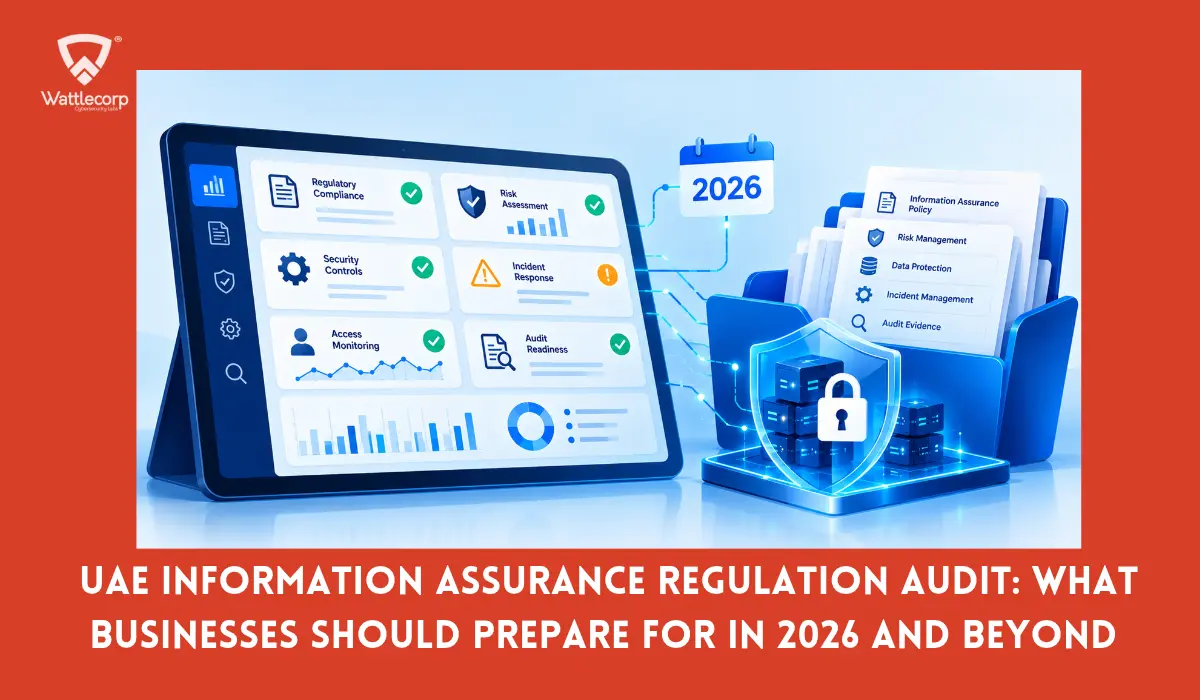
Key Takeaways:
- Information Assurance Regulation Audit UAE readiness helps identify controls and evidence gaps prior to conducting a formal audit.
- Approved policies are only preliminary to achieving audit readiness and need strong verifiable evidence that these are truly working in practice via implemented controls.
- Missing evidence can cause significant delays in customer assurance and procurement reviews.
- Prioritizing weaknesses affecting sensitive data and critical services can go a long way to helping improve audit readiness through planned remediation and effective risk management.
- Combining governance reviews, technical testing, and verified remediation as a practical three-tier strategic approach aids in achieving compliance with the UAE Information Assurance Regulation (IAR).
When Security Gaps Put a Contract at Risk: An Illustrative Scenario
Suppose you are a Dubai technology supplier, who is getting to the final stage of a government procurement process. Your security policies are approved, and management expects the customer’s assurance review to be straightforward.
However, the review exposes an active administrator account belonging to a former contractor. Backup logs reveal successful jobs, yet with no recent restoration evidence existing. Neither can teams establish who owns supplier access reviews.
The customer requests remediation evidence prior to proceeding. The supplier must coordinate IT, procurement, and management while keeping active services running.
For organizations preparing for an information assurance regulation audit UAE, the lesson is clear: Unresolved control gaps can become commercial obstacles before an incident occurs.
What Information Assurance Regulation Audit UAE Holds for Businesses
The UAE Information Assurance Regulation, establishes management and technical security controls to protect information assets and supporting systems and to improve overall security effectiveness under the Telecommunications and Digital Government Regulatory Authority’s (TDRA) published version 1.1, dated March 2020. Organizations bound by this regulation should confirm the applicable assessment baseline with their competent authority before preparing for the audit.
Refer to the key components of information assurance regulation audit UAE in the table below:
| Key Components of UAE Information Security Assurance Audits | Purpose |
| Mandatory Scoping and Applicability | UAE government entities and those designated as critical, subject to confirmation of applicable requirements by the competent authority |
| Controls Evaluation | Involves strategy, risk management, access management, asset protection, cryptography, incident response, network security, and business continuity |
| Prioritization and Categorization | Prioritizing applicable controls in accordance with regulatory requirements, assessed risks, and potential business impact |
| Evidence and Compliance Testing | Rendering documented and measurable proofs for audits through approved policies, operational logs, and training records |
Audits should be context and sector-specific rather than relying on checklist or generic assessment.
Ask your competent authority or customer to confirm the assessment baseline and any transition arrangements. This is particularly important when existing documentation references an earlier framework.
For CISOs and compliance leaders, unclear scope creates practical problems: duplicated assessments, unnecessary expenditure and gaps discovered too late. Agree the requirements, systems, evidence expectations and deliverables before allocating resources.
Who Should Comply with Information Assurance Regulation Audit UAE?
The UAE IAR regulation recognises the government entities and designated critical information infrastructure operators to come within its mandatory implementation scope. It also entails the latter to confirm their obligations with the competent authority, including any applicable sector-specific requirements.
Private businesses need to identify applicable customer, contractual, and sector-specific information assurance requirements. Organizations existing outside the mandatory regulatory scope can also adopt the framework voluntarily.
Also Read : Automating UAE Information Assurance & NESA Compliance: Tools, Strategies & Use Cases
When undertaking an information assurance regulation audit UAE in Dubai, organizations should map their compliance obligations against both national requirements and applicable emirate-level or sector-specific requirements. Documenting scope early helps avoid both missed requirements and unnecessary assessment costs.
What Your Information Assurance Regulation Audit UAE Should Examine
Define the audit scope using applicable requirements and the relevant services, systems, information assets, processes, and dependencies. Prioritize assessment based on business criticality and risk.
Useful assessment questions across the core aspects there include:
- Governance: Who owns controls, approves exceptions and accepts residual risk?
- Access: Are privileged accounts reviewed and leavers’ permissions removed?
- Operations: Are patches, configuration changes and alerts tracked?
- Suppliers: Have the external access and security responsibilities been properly defined and reviewed?
- Data: Are sensitive information flows and protection measures adequately understood and documented?
- Continuity: Can teams demonstrate incident exercises and successful restoration effectively?
If as an organization operating within the Mainland UAE or anywhere in the free zones, DIFC or ADGM, you need to assess your dependencies, control placements, and trust boundaries, a security architecture review UAE would be your right choice as it helps you keep a tight control on these parameters across interconnected systems, including cloud platforms, APIs, remote environments, and legacy infrastructure.
For executives, connect each weakness to a business consequence: unavailable transactions, exposed customer records, delayed delivery or recovery uncertainty.
From Point-in-Time to Continuous Compliance Monitoring
Start with a scoped gap assessment. Record each applicable requirement, existing control, evidence source, owner, and remediation deadline.
Never assume that existing certifications will automatically help you achieve IA regulatory compliance. You should be proactive enough to maintain control monitoring while engaging in evidence collection and remediation tracking all through the year. Confirmation of the applicable framework version, reporting obligations, and transition arrangements with a competent authority should be the next step in this venture.
Reusing useful evidence from ISO 27001 and SOC 2 compliance programmes helps accelerate readiness with information assurance regulation audit UAE. The one thing they ought to make sure is that controls are mapped and validated against UAE-specific regulatory mandates.
Also Read : DIFC AI and Automated Processing Regulation: Full Enforcement Guide for Dubai Financial Firms
For lean teams, schedule short reviews with IT, HR, procurement, and operations. Distributing responsibility for evidence collection helps lift that last-minute pressure on security staff. Where it requires including internally developed applications within the assessment scope, a secure source code review can help identify coding weaknesses there and inform remediation.
Identify and resolve evidence gaps early to help avoid assessment delays and demonstrate audit-readiness with confidence.
Testing That Guides Remediation Priorities
Vulnerability assessments identify potential weaknesses. Penetration testing investigates whether weaknesses are exploitable and what an attacker could achieve there.
Use VAPT services in the UAE within an authorized scope. The regulation’s technical compliance guidance emphasizes security testing that should be appropriately planned, documented, and performed by competent and authorized personnel.
Choose testing according to business exposure, i.e., Infrastructure penetration testing to help identify and assess network and server weaknesses and enterprise penetration testing to uncover vulnerabilities and associated risks within interconnected environments.
Structure your pre-implementation planning without hampering your business continuity or essential services by agreeing on testing windows, escalation contacts, and operational measures.
Retest fixes and retain closure evidence. Reassess changing exposure risks through continuous penetration testing for more regular releases.
Turn Your Audit Findings Into a Security Investment Plan
Achieving long-term security improvement means providing management clarity around urgent fixes and unsolved concerns. This directly translates to bridging the gap between compliance technicalities and executive decision-making, in turn, requiring ranking findings based on compliance significance, exposure, exploitability, and service criticality.
Wattlecorp helps review security gaps, validate technical weaknesses, and guide remediation priorities as these concern improving audit readiness. Our information assurance regulation audit service in the UAE is designed to help improve your audit readiness by understanding your assessment deadline, critical services involved, and existing evidence to discuss a practical starting scope.
Information Assurance Regulation Audit UAE FAQs
1. What is the UAE Information Assurance Regulation and who needs to comply?
2. What does an Information Assurance Regulation audit assess?
3. How can businesses prepare for IAR compliance in Dubai and UAE?
✔. Confirming scope and Prioritizing Controls: Helps identify organizational criticality and asset boundaries
✔. Management and Technical Domains implementation: Establishes management and technical controls through an Information Security Management System (ISMS)
✔. Assess, remediate, and Verify: Evaluate control implementation, remediate identified gaps, retest fixes, and retain evidence for further assessment
4. Why are vulnerability assessments and penetration testing important for IA compliance?

 Why DPDP Compliance in India Needs Continuous Security Testing
Key Takeaways: The Digital Personal Data Protection (DPDP) Act, 2023 requires data fiduciaries in its scope (the businesses that decide how personal data is processed) to take reasonable security safeguards, with obligations phasing in under the DPDP Rules. An untested safeguard is an assumption. A once-a-year Vulnerability Assessment and Penetration Testing (VAPT) report describes your […]
 UAE Information Assurance Regulation Audit: What Businesses Should Prepare for in 2026 and Beyond
Key Takeaways: Information Assurance Regulation Audit UAE readiness helps identify controls and evidence gaps prior to conducting a formal audit. Approved policies are only preliminary to achieving audit readiness and need strong verifiable evidence that these are truly working in practice via implemented controls. Missing evidence can cause significant delays in customer assurance and procurement […]
 Cloud Security Audit for Indian Government Digital Initiatives: MeitY Empanelment Requirements
Key Takeaways: MeitY empanelment is how MeitY approves cloud service offerings for government use. As we understand it, it applies to the cloud offering, not to an auditor. MeitY empanelment and empanelment by the Indian Computer Emergency Response Team (CERT-In) are different things with different subjects. Assessors look at security controls, data handling and evidence, […]
 DPDP Consent Manager Framework: What Indian Businesses Must Prepare Before the 2026 Rollout
Key Takeaways: A consent manager under the DPDP Act, 2023 is an entity registered with the Data Protection Board of India that lets people give, review, and withdraw consent in one place. Most businesses are data fiduciaries, meaning they decide why and how personal data is processed. They don’t register as consent managers. They have […]
 Server Hardening for Indian FinTech Cloud Infrastructure: RBI Outsourcing and Data Localisation Rules
Key Takeaways: RBI doesn’t publish a single server hardening standard for every FinTech. Hardening gets judged through its outsourcing, data localisation, and IT governance expectations. Moving workloads to a cloud provider moves the hosting, not the accountability. The regulated entity still owns the evidence. Data localisation for payment data changes server design: region pinning and […]
 Mobile Application Penetration Testing for Saudi Government Apps: CITC and NCA Security Standards
Key Takeaways: Mobile app penetration testing Saudi Arabia helps government entities identify client-side vulnerabilities and backend API weaknesses that could either expose sensitive citizen information or enable unauthorized actions. Testing should consider evaluating the entire transaction, i.e., mobile client interface and local storage through network transport to server-side APIs, identity verification, and backend authorization. Even […]