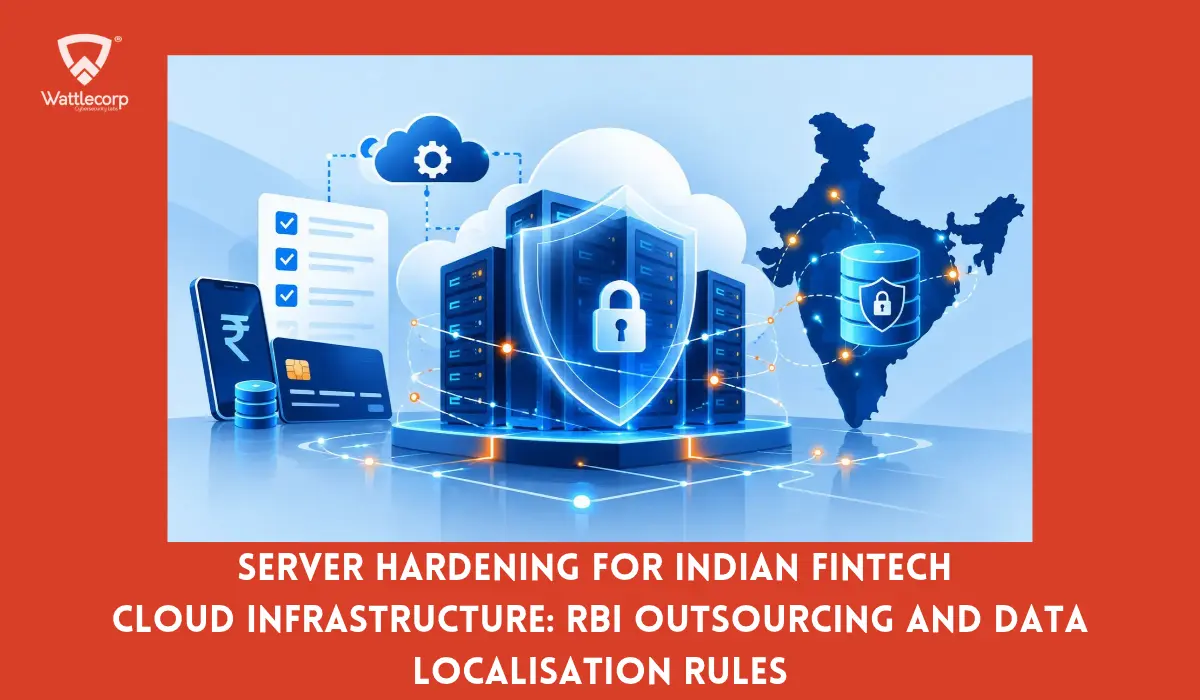
Server Hardening for Indian FinTech Cloud Infrastructure: RBI Outsourcing and Data Localisation Rules
Key Takeaways:
- RBI doesn’t publish a single server hardening standard for every FinTech. Hardening gets judged through its outsourcing, data localisation and IT governance expectations.
- Moving workloads to a cloud provider moves the hosting, not the accountability. The regulated entity still owns the evidence.
- Data localisation for payment data changes server design: region pinning and in-country storage matter as much as patching.
- A short, repeatable baseline (benchmarked configurations, drift detection, tested access) turns an inspection into a document request instead of a scramble.
A FinTech can pass a penetration test and still fail a Reserve Bank of India (RBI) inspection on the same servers. The test asked whether someone could get in. The inspector asks who is accountable for each server, where its data sits, and whether you can prove both.
That gap is where server hardening in India usually starts. Server hardening means removing everything a server doesn’t need (services, accounts, open ports, default settings) and locking down what’s left. It turns a cloud virtual machine from “running” into “defensible.”
If you run payments or lending products on AWS, Azure or Google Cloud, outsourcing and data localisation are the two RBI themes that most often shape how that work gets judged. RBI’s cyber security and IT directions for your licence type sit alongside them. This piece covers what each asks of your cloud servers, and the controls worth building first.
Which RBI Rules Apply to Your FinTech Cloud Servers
Not every RBI instrument applies to every FinTech, so settle scope first. A licensed bank, a non-banking financial company (NBFC) and a payment system operator sit under different directions. The 2016 Cyber Security Framework, for example, applies to scheduled commercial banks and does not extend to NBFCs.
Securities-market platforms, such as wealth and broking products, fall under the Securities and Exchange Board of India (SEBI) instead. If you hold none of these licences, you may still feel the rules through the bank or regulated partner you work with, which will push its requirements down to you by contract.
What RBI Outsourcing Guidelines Expect From Cloud Servers You Don’t Own
RBI treats a cloud provider as an outsourcing arrangement, so a regulated entity stays responsible for the security of what it hosts there. Hardening is how you show that responsibility with evidence rather than assurances.
The instrument that matters most is RBI’s Master Direction on Outsourcing of Information Technology Services . In plain terms, it asks regulated entities to run due diligence on service providers, keep audit and access rights over them, manage dependence on a single provider, and plan an exit. For RBI outsourcing guidelines compliance, that means a vendor file per provider: contract audit clauses, assurance reports and your exit plan.
Two things follow for servers. First, a cloud provider’s certificate doesn’t close the job, because under the shared responsibility model the customer keeps the operating system, configuration and access rules on infrastructure-as-a-service (IaaS) servers. Platform and software services shift more to the provider, so check where the line sits for each service you use. Second, whatever your contract says about audit rights has to be backed by logs and configuration records you can produce.
RBI’s IT governance and controls expectations, plus the cyber security directions for your licence type, and the Indian Computer Emergency Response Team (CERT-In) direction to report specified cyber incidents within 6 hours both assume you can see what happens on your servers. A server nobody monitors can’t meet a 6-hour clock.
Microsoft’s RBI and IRDAI compliance offering page shows what one major cloud provider covers on its side of the line. IRDAI, the Insurance Regulatory and Development Authority of India, is the insurance regulator. It’s a reference for the provider’s controls, not a substitute for your own evidence.
Also read : Cloud Security Checklist for Indian Startups Using AWS and Azure (2025 Edition)
What RBI Data Localisation Rules Mean for FinTech Cloud Infrastructure
RBI’s data localisation rule is explicit for payment data. RBI’s directive on storage of payment system data requires payment system data to be stored only in India. Processing abroad is allowed in narrow cases, but the data has to come back and be removed from foreign systems within a short window. The directive sets the exact window, so read it before designing backups or analytics pipelines. That’s a design constraint engineers rarely see until an audit.
Two terms get confused here. Data localisation is a legal requirement about where data is stored. Data residency is a design choice about where you keep it. A FinTech can keep its main database in Mumbai and still break localisation if a backup, analytics export or log stream carrying payment data lands outside India.
Securiti’s overview of financial-sector data regulation in India and this explainer on RBI, IRDAI and DPDP localisation set out the overlapping rules. The Digital Personal Data Protection (DPDP) Act, 2023, is the privacy-law side, which our piece on cross-border data transfers under the DPDP Act covers.
For data localisation in an Indian FinTech, we’d design the servers around these points:
- Region pinning enforced by policy, not habit. Organisation-level controls such as AWS Service Control Policies, Azure Policy allowed locations or Google Cloud resource location constraints stop anyone launching a workload outside India by mistake.
- Backups, snapshots and exports that carry payment data kept in India.
- Encryption keys and logs placed in India as a sensible default, since it removes arguments later. Log retention duties under CERT-In’s directions are a separate question to confirm.
- A data flow map showing every place a server sends data, so a regulator’s question about a third-party integration has a one-page answer.
Which cloud providers meet these requirements? The honest answer is that no provider “meets RBI localisation” on its own. The major providers operate Indian regions, but your configuration decides whether data stays in them.
Also read : Mobile App Security Testing for Indian Digital Lending Apps RBI, DPDP and API Risk Checklist
Which Server Hardening Controls Matter Most for an Indian FinTech
The strongest baseline is a benchmarked one. Start from the Center for Internet Security (CIS) Benchmarks for your operating system and cloud platform, tailor them to your risk, and record every deviation. Wattlecorp’s server hardening service covers securing servers and, alongside that, scaling and cutting cost while keeping them secure. The order below is the one we’d use on a new estate.
Access first. Disable direct root login, require key-based Secure Shell (SSH) access or a managed session service, remove shared accounts, and enforce multi-factor authentication on every path to the cloud console.
Then the attack surface. Remove unused packages and services, close every port without a named owner and a business reason, and keep management interfaces on a private network or behind a bastion host. When Wattlecorp ran a posture assessment for a digital banking client in the Gulf Cooperation Council (GCC), the 31 risks it found included an exposed VMware ESXi interface and Internet Information Services (IIS) version disclosure (GCC digital banking case study). That was a different region and regulator, and not a cloud-hosted RBI engagement. The shape of the finding carries over: exposed interfaces and version disclosure are what you find when nobody owns the baseline.
Then patching and drift. Set a patch window by severity, record exceptions with an owner and an expiry date, and run drift checks so a server doesn’t wander from its baseline. Tools such as OpenSCAP or CIS-CAT can check operating-system settings against a benchmark, Lynis can audit a host, and cloud services such as AWS Config or Microsoft Defender for Cloud track cloud resource settings.
Finally logging. Send system, authentication and cloud audit logs to a central store, protect them from the people whose actions they record, and test that an alert reaches a human. This is the control that turns the 6-hour reporting clock from a worry into a procedure.
How to Prove Server Hardening to an RBI Auditor
RBI inspections and audits reward evidence you can produce on request. Hardening that lives in an engineer’s head won’t survive one.
Keep four artefacts per environment:
- The baseline configuration standard, with the benchmark version you used.
- The latest scan or drift report, showing deviations and their owners.
- The access review record, showing who can reach each server and when that was last checked.
- The data flow map and region policy, showing where data is allowed to live.
Run a hardening review at least once a year and after any material change, such as a new region, a new payment partner or a platform migration. That cadence is Wattlecorp’s recommendation, not a figure from a circular.
Get Your Cloud Servers Inspection-Ready
Reviewing server configurations against RBI expectations is work Wattlecorp does for Indian FinTechs, and the evidence is usually what’s missing, not the intent. Wattlecorp’s RBI cybersecurity consulting team maps your server estate to the RBI expectations that apply to you and helps you assemble the artefacts above.
If your next audit is within six months, start with access and logging. Both need a trail that only builds up over time.
Server Hardening India FAQs
1. What is server hardening for FinTech companies in India?
It reduces a server’s attack surface by removing unneeded services, tightening access and applying a benchmarked configuration. For Indian FinTechs it also produces the evidence regulators and auditors expect to see.
2. Does RBI require server hardening for FinTech cloud infrastructure?
RBI’s outsourcing, data localisation and IT governance expectations all assume secured, monitored and evidenced servers. Whether a specific baseline is named depends on your licence type, so confirm that with your compliance team.
3. What server hardening controls should Indian FinTech companies implement?
Start with access (no root login, key-based access, multi-factor authentication), then attack surface reduction, patching and drift detection, and logging. Base them on CIS Benchmarks and record every deviation.
4. How does RBI data localisation affect FinTech cloud infrastructure?
It limits where payment data can be stored, so servers, backups and exports carrying that data need to sit in India, enforced by policy. Processing outside India is possible only within narrow conditions.
5. How often should FinTech servers be reviewed for security misconfigurations?
Continuously through automated drift checks, with a formal review at least once a year and after any major change. The annual review is a good-practice recommendation, not a stated RBI figure.

 Server Hardening for Indian FinTech Cloud Infrastructure: RBI Outsourcing and Data Localisation Rules
Key Takeaways: RBI doesn’t publish a single server hardening standard for every FinTech. Hardening gets judged through its outsourcing, data localisation and IT governance expectations. Moving workloads to a cloud provider moves the hosting, not the accountability. The regulated entity still owns the evidence. Data localisation for payment data changes server design: region pinning and […]
 Mobile Application Penetration Testing for Saudi Government Apps: CITC and NCA Security Standards
Key Takeaways: Mobile app penetration testing Saudi Arabia helps government entities identify client-side vulnerabilities and backend API weaknesses that could either expose sensitive citizen information or enable unauthorized actions. Testing should consider evaluating the entire transaction, i.e., mobile client interface and local storage through network transport to server-side APIs, identity verification, and backend authorization. Even […]
 DevSecOps for Indian Government: Meeting CERT-In Audit Requirements
Key Takeaways: CERT-In’s guidelines for application security advise integrating security throughout the Software Development Life Cycle (SDLC) than relying only on post-development audits. DevSecOps helps streamline CERT-In compliance India by moving security from a last-mile bottleneck to an automated, continuous process within the SDLC. Supporting CERT-In-aligned application security involves building a complete security lifecycle that […]
 DIFC AI and Automated Processing Regulation: Full Enforcement Guide for Dubai Financial Firms
Key Takeaways: Regulation 10 of the DIFC Data Protection Regulations applies to any DIFC entity deploying an automated system that processes personal data, including AI tools bought off the shelf from a vendor. The regulation splits responsibility between two defined roles, deployer and operator, and most financial firms are deployers even when they did not […]
 Black Box Penetration Testing for UAE Critical National Infrastructure: NCAP Pre-Accreditation Testing
Key Takeaways: Black box penetration testing examines critical systems from the perspective of an external attacker, who has minimal prior knowledge of the internal environment other than relying primarily on publicly available information and approved testing scope. It helps find shadow assets, exposed services, weak authentication, cloud misconfigurations, and vulnerable third-party access paths. Testing supports […]
 Cyber Security Strategic Consulting for UAE Boards: Aligning Security Investment with the NCSS 2025–2031
Key Takeaways: The Cyber Security Strategic Consulting UAE programmes help organizations align their cybersecurity roadmaps with the five NCSS pillars, namely governance, protection, innovation, establishing and building, and partnership. Boards should connect cybersecurity spending to material business risks, critical services, regulatory duties, and measurable resilience outcomes. Cyber security strategic consulting UAE programmes translate national direction […]