Black Box Penetration Testing for UAE Critical National Infrastructure: NCAP Pre-Accreditation Testing
Key Takeaways:
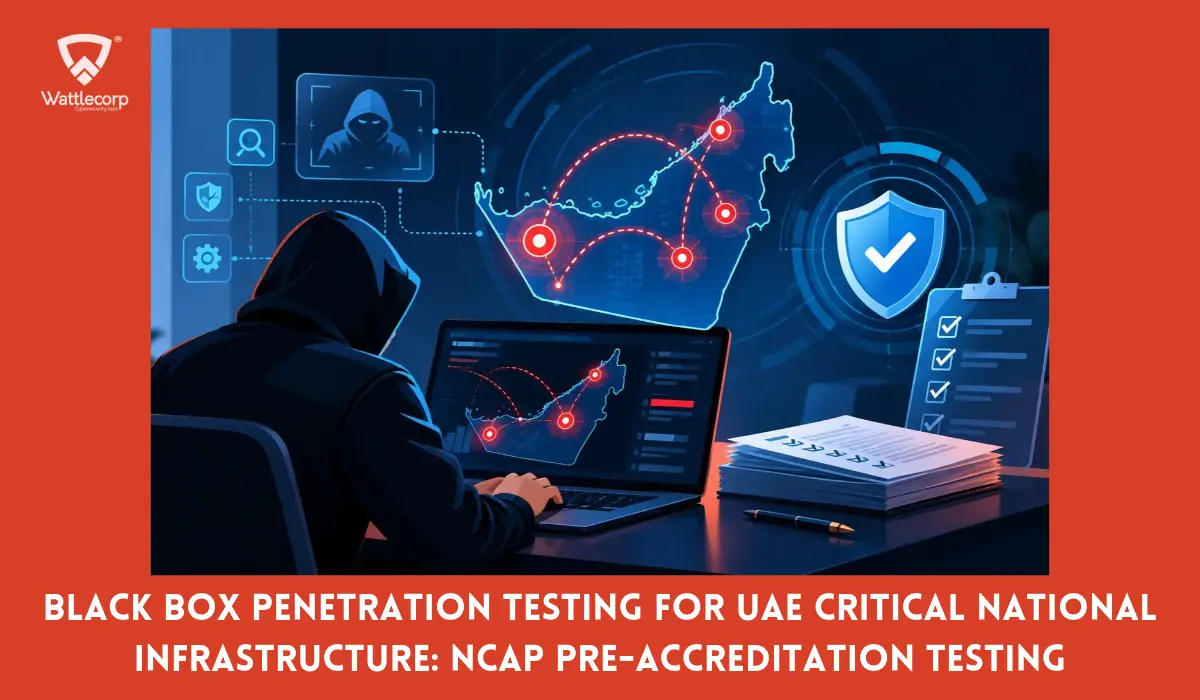
- Black box penetration testing examines critical systems from the perspective of an external attacker, who has minimal prior knowledge of the internal environment other than relying primarily on publicly available information and approved testing scope.
- It helps find shadow assets, exposed services, weak authentication, cloud misconfigurations, and vulnerable third-party access paths.
- Testing supports NCAP readiness by generating technical evidence of control validation, remediation, and retesting.
- Critical infrastructure assessments need clearly defined rules of engagement to protect safety, availability, and operational continuity.
- Black box penetration testing complements governance reviews, configuration assessments and wider NCAP conformity activities, but does not replace them.
Why Black Box Penetration Testing is Essential in the UAE
Imagine a UAE energy operator preparing evidence for National Cybersecurity Accreditation Program assessment. Its dashboards show patched servers, approved policies, and green vulnerability scans. Yet an external tester, given only the organization’s public identity, discovers a forgotten remote-access portal, reuses exposed credentials, detects weaknesses in multifactor authentication controls, and reaches a vendor gateway connected to operational support systems. No insider knowledge was required. The control existed on paper; the attack path remained open.
This scenario explains why black box penetration testing UAE programs matter for Critical Information Infrastructure. They test what a real external adversary can discover and exploit before an assessor finds the gap.
Why Black Box Testing Is Essential for UAE Critical Information Infrastructure Organizations
UAE Critical Information Infrastructure organizations operate services, where a successful cyberattack could disrupt essential operations, compromise sensitive information, affect public safety, or weaken national resilience. Additionally, incomplete asset inventories, legacy systems, exposed third-party connections, and undocumented cloud services can leave exploitable entry points outside the security team’s visibility.
Black box penetration testing evaluates these systems by developing an external attacker’s mindset, and without needing to know internal architecture details or having privileged access. It helps organizations discover exposed assets, validate whether perimeter controls withstand realistic attack techniques, and identify weaknesses that conventional vulnerability scans may leave out. The resulting evidence supports risk-based remediation and strengthens technical readiness before an NCAP assessment.
What Black Box Testing Actually Proves
In a black box engagement, testers begin with little or no internal information, credentials, architecture diagrams, or source code. They perform reconnaissance, map exposed assets, enumerate services, test applications and APIs, and safely validate exploitable weaknesses under an agreed rules-of-engagement (RoE) document.
Also read : Continuous Penetration Testing for UAE Enterprises: Moving Beyond Annual VAPT
Unlike a vulnerability scan, the exercise connects findings to realistic attack paths. It can reveal shadow assets, abandoned subdomains, weak authentication, internet-facing management interfaces, cloud misconfigurations, exposed APIs, exploitable software, and trust relationships that automated tools may not fully identify. These include complex attack chains, business logic weaknesses, authentication issues, or contextual risks. All these need manual validation.
Understanding the UAE Critical Infrastructure and NCAP Context
The UAE Critical Information Infrastructure Protection Policy was introduced with the aim to safeguard both physical and virtual information assets and supporting functions and services that are essential to society, the economy, and national security, facilitated by establishing a unified national framework for cybersecurity and resilience. Environments may include energy, water, transport, telecommunications, finance, healthcare, government services, and other designated critical sectors. This very statement indicates that National Cybersecurity Accreditation Program includes applicability requirements for government entities, CIIP (Critical Information Infrastructure Protection Policy)-designated organizations, and other specified entities based on the Cyber Security Council criteria. NCAP uses controls derived from the UAE Information Assurance Standard and follows a risk-based accreditation process.
Therefore, black box penetration testing for UAE should be described as supporting NCAP readiness, not guaranteeing accreditation. Test results can demonstrate that external controls were technically validated, weaknesses were risk-rated, remediation was tracked, and retesting confirmed closure. Accreditation still requires conformity across the applicable governance, protection, detection, response, and recovery controls.
Why Pre-Accreditation Testing through Black Box Penetration Testing UAE Matters
Critical organizations commonly face fragmented asset inventories, legacy systems, outsourced applications, complex cloud estates, and vendors with remote access. Security teams find it significantly challenging to schedule testing without interrupting essential services. Meanwhile, leadership needs defensible evidence, not a long scanner export, before formal assessment takes place.
A pre-accreditation black box exercise helps expose discrepancies between documented scope and actual security reality. It gives control owners time to remediate weaknesses, collect evidence, update risk registers, and verify corrective actions before assessment. In other words, the process acts as a practical readiness exercise that helps validate control effectiveness and improve an organization’s overall security posture before assessments begin on a formal note. It can also test whether security monitoring detects reconnaissance and exploitation attempts, provided blue-team observation is included in the agreed objectives.
Every finding should identify its owner and remediation deadline. A clean retest trail is especially valuable where multiple teams or suppliers share responsibility.
Defining a Safe, Risk-Based Scope
The scope should follow critical business services and their external dependencies rather than simply listing IP addresses. It may include public web applications, APIs, VPNs, email gateways, identity portals, DNS, cloud workloads, remote-access services, mobile backends, supplier portals, and externally reachable OT support infrastructure.
Testing production operational technology (OT) environments requires particular caution. Destructive exploitation, denial-of-service activity, uncontrolled password spraying, unsafe payloads, and changes to live industrial equipment should be prohibited unless specifically engineered and authorized. Where exploitation could affect safety or availability, it would be highly appropriate to validate findings through non-disruptive methods, replicas, staging environments, or tightly controlled maintenance windows.
Also Read : Why Both Manual and Automated Penetration Testing Are Essential for Continuous Security in UAE
Rules of engagement (RoE) should specify targets, test windows, escalation contacts, data-handling requirements, stop conditions, source IPs, prohibited techniques, evidence retention, and incident coordination.
A Practical NCAP Readiness Workflow
A pragmatic approach to becoming NCAP-ready begins with identifying critical services, confirming ownership, and reconciling asset inventories with external attack-surface discovery. This is followed by agreeing risk-based scenarios and safe testing limits with IT, OT, cloud, compliance, and business-continuity stakeholders.
Testers then go on to perform reconnaissance, enumeration, vulnerability validation, and exploitation. Findings need to prioritize business impact: service disruption, unauthorized control, sensitive-data exposure, identity compromise, supplier-path abuse, or movement toward critical zones.
After remediation, retest every affected path, not merely the individual weakness. Finally, preserve authorization records, scope, methodology, timestamped evidence, findings, exceptions, remediation proof, and retest results for assessors. Black box penetration testing UAE teams should also communicate residual risk clearly when systems cannot be changed because of operational or vendor constraints.
Turning Testing into Resilience
A valuable outcome is not limited to only identifying whether findings exist, but gaining an accurate understanding of exploitable exposure and prioritized improvement actions. For UAE critical infrastructure leaders, that means connecting technical weaknesses to operational continuity, maintaining public trust and safety, meeting regulatory obligations, and safeguarding third-party dependencies.
Wattlecorp helps organizations plan controlled external assessments, validate attacker-visible exposure, document remediation evidence, and coordinate retesting around sensitive operational requirements. Used alongside governance and control assessments, our black box penetration testing services in the UAE are designed to support NCAP readiness before formal accreditation activity takes place for organizations handling critical national infrastructure.
Black Box Penetration Testing UAE FAQs
1. What is black box penetration testing in cybersecurity?
2. How can black box penetration testing support NCAP readiness in the UAE?
3.What systems should be included in a black box penetration test for critical infrastructure?
4.How often should UAE critical infrastructure organizations conduct Black Box Penetration Testing?

 DevSecOps for Indian Government: Meeting CERT-In Audit Requirements
Key Takeaways: CERT-In’s guidelines for application security advise integrating security throughout the Software Development Life Cycle (SDLC) than relying only on post-development audits. DevSecOps helps streamline CERT-In compliance India by moving security from a last-mile bottleneck to an automated, continuous process within the SDLC. Supporting CERT-In-aligned application security involves building a complete security lifecycle that […]
 DIFC AI and Automated Processing Regulation: Full Enforcement Guide for Dubai Financial Firms
Key Takeaways: Regulation 10 of the DIFC Data Protection Regulations applies to any DIFC entity deploying an automated system that processes personal data, including AI tools bought off the shelf from a vendor. The regulation splits responsibility between two defined roles, deployer and operator, and most financial firms are deployers even when they did not […]
 Black Box Penetration Testing for UAE Critical National Infrastructure: NCAP Pre-Accreditation Testing
Key Takeaways: Black box penetration testing examines critical systems from the perspective of an external attacker, who has minimal prior knowledge of the internal environment other than relying primarily on publicly available information and approved testing scope. It helps find shadow assets, exposed services, weak authentication, cloud misconfigurations, and vulnerable third-party access paths. Testing supports […]
 Cyber Security Strategic Consulting for UAE Boards: Aligning Security Investment with the NCSS 2025–2031
Key Takeaways: The Cyber Security Strategic Consulting UAE programmes help organizations align their cybersecurity roadmaps with the five NCSS pillars, namely governance, protection, innovation, establishing and building, and partnership. Boards should connect cybersecurity spending to material business risks, critical services, regulatory duties, and measurable resilience outcomes. Cyber security strategic consulting UAE programmes translate national direction […]
 Mobile Application Penetration Testing for Qatar Government Digital Services: NCSA- Aligned Security Assurance
Key Takeaways: Mobile Application Penetration Testing Qatar must cover the app, device storage, APIs, authentication and third-party components. Qatar’s NCSA assurance environment combines the National Information Assurance (NIA) Standard, the National Information Security Compliance Framework (NISCF) and accredited security assessment services. OWASP MASVS defines mobile security controls, while MASTG supplies practical test methods for Android […]
 Qatar Data Protection Law: Implementing PDPPL Data Subject Rights Processes for Businesses
Key Takeaways: The Qatar Data Protection Law (Law No. 13 of 2016) for Personal Data Privacy Protection, grants individuals specific rights such as right to access, correct, erase, object, withdraw consent, and right to be notified of processing or inaccurate disclosure. Beyond having a privacy policy, businesses or controllers, under Article 11 of Personal Data […]
STRENGTHEN YOUR CYBER DEFENSES
Prevent breaches, protect data and stay ahead of cyber threats with expert security solutions.