Compromise Assessment vs Incident Response in the UAE: What’s the Difference and When Do You Need Each?
Key Takeaways:
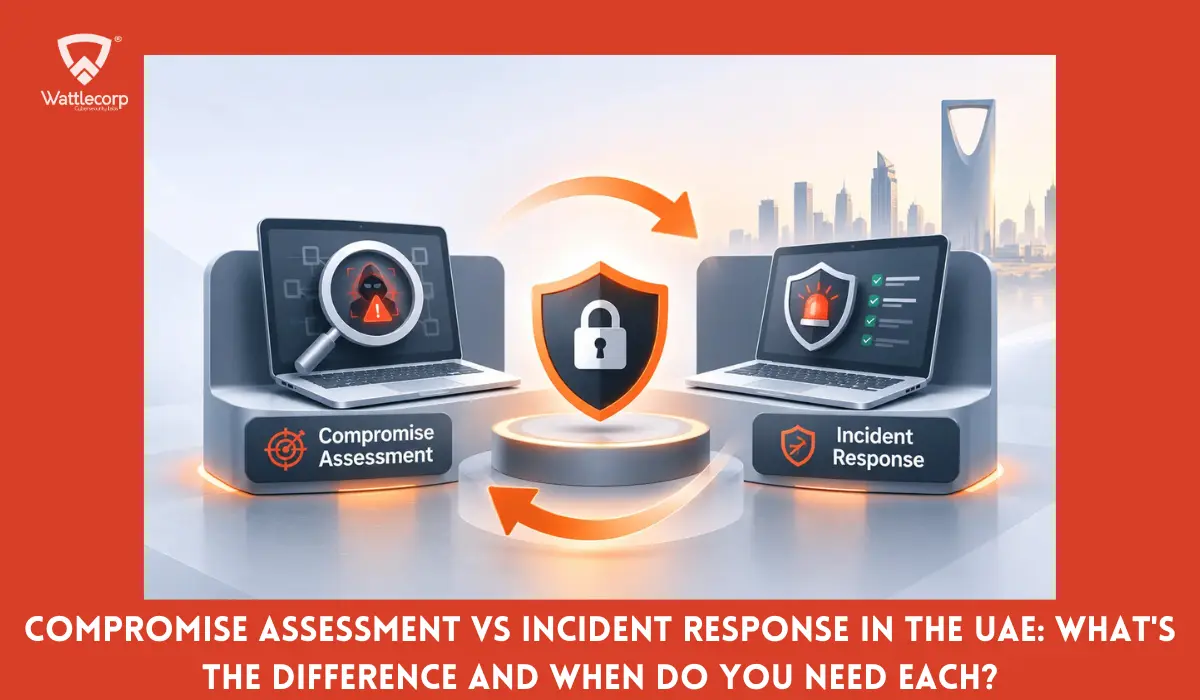
- A compromise assessment is a proactive check for signs that an attacker is already in your environment. Incident response is the reactive work of handling a known or suspected incident.
- The trigger is the clearest dividing line: no known incident means an assessment, an active incident means response.
- The two feed each other. An assessment that finds activity hands over to incident response, and a post-incident assessment checks for signs that the attacker is still there.
- The questions you ask a provider, and what you prepare before calling, decide how useful either service turns out to be.
Picture a finance director at a Dubai logistics firm. A supplier calls to say their own network was breached last month, and the two companies share a file portal. Nothing looks wrong on the director’s side. No alerts, no ransom note, no angry customers.
So which team do they call? An incident response firm, or someone who can check whether anyone is already inside? The two services sound alike, but they solve different problems, and the wrong first call costs time. A compromise assessment looks for a breach you haven’t found. Incident response deals with the one you already know about.
What Is a Compromise Assessment?
This service is a focused investigation that checks whether an attacker is, or has been, active inside your environment. It starts from one question: “Are we already breached?” It does not assume the answer is yes.
Analysts search endpoints, network traffic, logs, cloud accounts and identity systems for indicators of compromise (IOCs), which are the technical traces an attacker leaves behind, such as file hashes, malicious domains or connections to known bad infrastructure. They also look for suspicious behaviour, such as odd logins or unknown scheduled tasks, that no known signature would catch, often described using the MITRE ATT&CK knowledge base of attacker techniques. Anything that looks off gets forensic triage.
Analysts typically also look at the places attackers use to stay in, recent changes to identity and email settings, and how far back your logs reach.
The output is a findings report with what was found, how serious it is and what to do next. Areas where nothing turned up matter more than they sound. A clean result can’t prove nobody is inside, only that no evidence of compromise turned up in the systems and period checked. Documented, that’s still something you can show a board, an auditor or an acquirer.
Wattlecorp’s compromise assessment services are built around this retrospective framing: signs of past or ongoing compromise, not only live monitoring.
Also read : UAE Enterprise Cyber Response 2026: How Enterprises Should Respond to Middle East Cyber Conflict
What Is Incident Response?
Incident response (IR) is the structured handling of a security incident once you know, or strongly suspect, that one is happening. The goal is to stop the damage, remove the attacker and get the business running again.
The SANS Institute’s widely used model runs in six steps: preparation, identification, containment, eradication, recovery, then lessons learned. Containment means cutting off the attacker’s access. Eradication means removing what they left behind.
NIST’s current incident response guide, SP 800-61 Rev. 3, now frames response as a community profile of the NIST Cybersecurity Framework 2.0, but the work on the ground looks much the same.
The trigger is usually loud: an alert, a ransomware note, leaked data, or a notice from a third party. The output is a contained incident, a root cause, a recovery plan and a timeline of what happened.
Compromise Assessment vs Incident Response: Side by Side
The cleanest way to separate the two is to compare what starts them, what they aim for and what you get back.
| Compromise assessment | Incident response | |
|---|---|---|
| Trigger | No known incident. A reason to doubt, or a need for assurance | A known or suspected incident |
| Goal | Find out whether an attacker is present | Contain, remove and recover |
| Timing | Planned, scoped in advance | Urgent, starts immediately |
| Depth | Broad sweep across the environment | Deep on the affected systems |
| Output | Findings, severity and recommended next steps | Contained incident, root cause, timeline |
| Who runs it | Threat hunters and forensic analysts | IR team, often with legal and communications support |
They do overlap. Both rely on digital forensics, and both depend on careful evidence handling, because what you collect today may matter to a regulator or a court later.
Where they differ is pace. An assessment is planned and methodical. Incident response is a race.
People also ask whether a compromise assessment is the same as threat hunting. They’re close cousins. A compromise assessment is a time-boxed check with a report at the end, while managed threat hunting is continuous. A penetration test is different again: it tries to break in to show what’s possible, rather than checking whether someone already has.
When Does a UAE Business Need a Compromise Assessment?
Book one when you have no confirmed incident but a good reason to doubt your environment’s integrity, or when someone needs documented assurance that nothing was found.
The common triggers:
- After an acquisition or a long unmonitored period. You’ve inherited systems nobody has watched closely, and an attacker could have been sitting there for months.
- Before an audit, a funding round or a major migration. You want to know what you’re carrying across or showing to outsiders.
- After a peer or supplier breach. That’s the finance director’s situation. The supplier’s breach doesn’t prove anyone got in, but it’s reason enough to check.
If you work in a regulated sector such as finance, healthcare or government supply chains, a documented assessment gives your auditors evidence that you checked rather than assumed.
For more on how this plays out locally, see our guide to compromise assessment for UAE enterprises.
Also read : UAE Cybersecurity Council Mandatory Resilience Framework 2026: What Every Enterprise Must Do
When Does a UAE Business Need Incident Response?
Call incident response the moment you have an active or confirmed incident: ransomware encrypting files (CISA’s Stop Ransomware hub tracks current guidance), data leaving your network, or a business email compromise (BEC), where a compromised or spoofed account poses as an executive or supplier to redirect payments.
Time is the main variable. Every hour an attacker stays in your environment widens the damage and narrows your options.
Two pressures usually arrive with the incident:
- Notification clocks. If personal data is involved, the UAE’s Personal Data Protection Law (PDPL, Federal Decree-Law No. 45 of 2021) can require you to report a breach, though it doesn’t cover every kind of data and free zones such as DIFC and ADGM run their own regimes. Sector regulators may add duties of their own. Your legal team needs the facts fast, so ask them which regime applies to you before an incident, not during one.
- Customers and partners asking questions. They want to know what happened and whether they’re affected, and a vague answer costs trust.
This is also where a retainer can help. An incident response retainer is a pre-agreed arrangement with a response provider, so you’re not negotiating scope and contracts while systems are down. The point is simple: the first call is already made.
How the Two Work Together
In practice, the services form a loop rather than a choice.
An assessment that finds real attacker activity hands over to incident response. The assessment team documents what it found and where, then the IR team takes over containment and eradication. Done well, nobody starts from zero.
The reverse also holds. After an incident, an assessment can check for signs that the attacker is still there or left a second foothold behind. This matters because visible symptoms stopping isn’t proof the attacker has left.
Both fit into a wider security programme. Continuous monitoring from a security operations centre shortens the time to detect, proactive threat hunting closes the gaps between alerts, and a plan for business continuity and cyber resilience decides how fast you recover. An assessment and an IR retainer are two pieces of that picture, not substitutes for it.
Also read : Central Bank UAE Decree-Law No. 6 of 2025: Cybersecurity Obligations for Digital Banks and FinTech
How Wattlecorp Approaches a Compromise Assessment
Wattlecorp frames this work around signs of past or ongoing compromise, so the work traces earlier attacker activity as well as anything live. The point is a result your board can act on, with findings and recommendations in plain language.
How to Choose a Provider and What to Ask
Whichever service you need, the quality of the provider decides the quality of the answer. Ask these before you sign:
- Scope. Which systems, cloud accounts and identity platforms are covered, and what’s left out?
- Tooling and method. How do they collect data, and does collection disturb your production systems?
- Evidence handling. How is evidence preserved and logged, so that it holds up if a regulator or court asks for it?
- Reporting. Will you get a plain-language summary for the board as well as the technical detail?
Before engaging either service, get your own house ready. Know who owns your critical systems, where your logs live and how long they’re kept, and who inside the business can approve emergency action. These basics save days when the clock is running.
Not Sure Which One You Need?
If you have no confirmed incident but can’t say for certain that nobody is inside, start with the assessment. Wattlecorp’s analysts run these checks for UAE organisations, and when something real turns up, you already have the evidence an incident response team needs.
Attackers don’t announce themselves, and a quiet network isn’t the same as a clean one. Book a compromise assessment with Wattlecorp to confirm whether anyone is already inside your environment.
Compromise Assessment FAQs
1. What is a compromise assessment?
A compromise assessment is a proactive investigation that checks whether an attacker is, or has been, active in your environment, with no assumption that a breach has already been found. The result is a report of what was found and what to do about it.
2. What is the difference between a compromise assessment and incident response?
A compromise assessment looks for a breach you haven’t found. Incident response handles a known or suspected incident by containing it, removing the attacker and recovering.
3. When do you need a compromise assessment?
Consider one after an acquisition or a long unmonitored period, before an audit or major migration, after a supplier or peer breach, or any time you need assurance that nobody is inside.
4. When do you need incident response?
Call for it as soon as you have an active incident, such as ransomware, data exfiltration or business email compromise.
5. Is a compromise assessment the same as threat hunting or a penetration test?
No. Managed threat hunting is similar to compromise assessment, but continuous, while an assessment is a bounded check with a report. A penetration test tries to break in rather than looking for someone already inside.
6. What does a compromise assessment report include?
A compromise assessment reports what the analysts found, how serious it is and what to do next, in terms a board can follow.

 Compromise Assessment vs Incident Response in the UAE: What’s the Difference and When Do You Need Each?
Key Takeaways: A compromise assessment is a proactive check for signs that an attacker is already in your environment. Incident response is the reactive work of handling a known or suspected incident. The trigger is the clearest dividing line: no known incident means an assessment, an active incident means response. The two feed each other. […]
 ISO 27001 Internal Audit vs Gap Assessment in Saudi Arabia: What’s the Difference?
Key Takeaways: A standalone gap assessment is optional; internal audits are required. Gap assessments can review new or existing systems. Internal audits require competent auditors and an objective, impartial process. Annex A controls should reflect your risks and obligations. Internal audits need to be scheduled early enough to address nonconformities and review corrective action effectiveness […]
 Best vCISO Services in the UAE for Large Enterprises
Key Takeaways: Wattlecorp: A governance-first vCISO with UAE regulatory alignment, listed first because this is our blog. CPX: On-demand executive cyber leadership with an Abu Dhabi address and board-ready direction. Crowe UAE: A vCISO service, pitched as an extension of your internal team. Intello: A vCISO covering strategy, risk governance, and board reporting, from Dubai. […]
 Managed Vulnerability Scanning for Indian SaaS Companies: Continuous Security for CERT-In Compliance
Key Takeaways: Recurring vulnerability scanning helps identify weaknesses that new deployments, infrastructure changes, and emerging vulnerabilities introduce. Risk-based prioritisation helps engineering teams focus on exposures with the greatest potential business impact. Remediation tracking and retesting provide evidence that identified vulnerabilities have been appropriately addressed. Recurring vulnerability scanning supports security readiness when combined with timely remediation, […]
 NCA Cloud Cybersecurity Controls: Data Residency in Saudi Arabia
Key Takeaways: The NCA cloud cybersecurity controls (CCC) framework addresses cloud providers and, within their scope, the organizations that use cloud services, so check which side you’re on. Data residency covers more than the main database. Residency usually breaks in backups, logs, support access and analytics copies. Classify your data before you choose a region, […]
 Why DPDP Compliance in India Needs Continuous Security Testing
Key Takeaways: The Digital Personal Data Protection (DPDP) Act, 2023 requires data fiduciaries in its scope (the businesses that decide how personal data is processed) to take reasonable security safeguards, with obligations phasing in under the DPDP Rules. An untested safeguard is an assumption. A once-a-year Vulnerability Assessment and Penetration Testing (VAPT) report describes your […]