

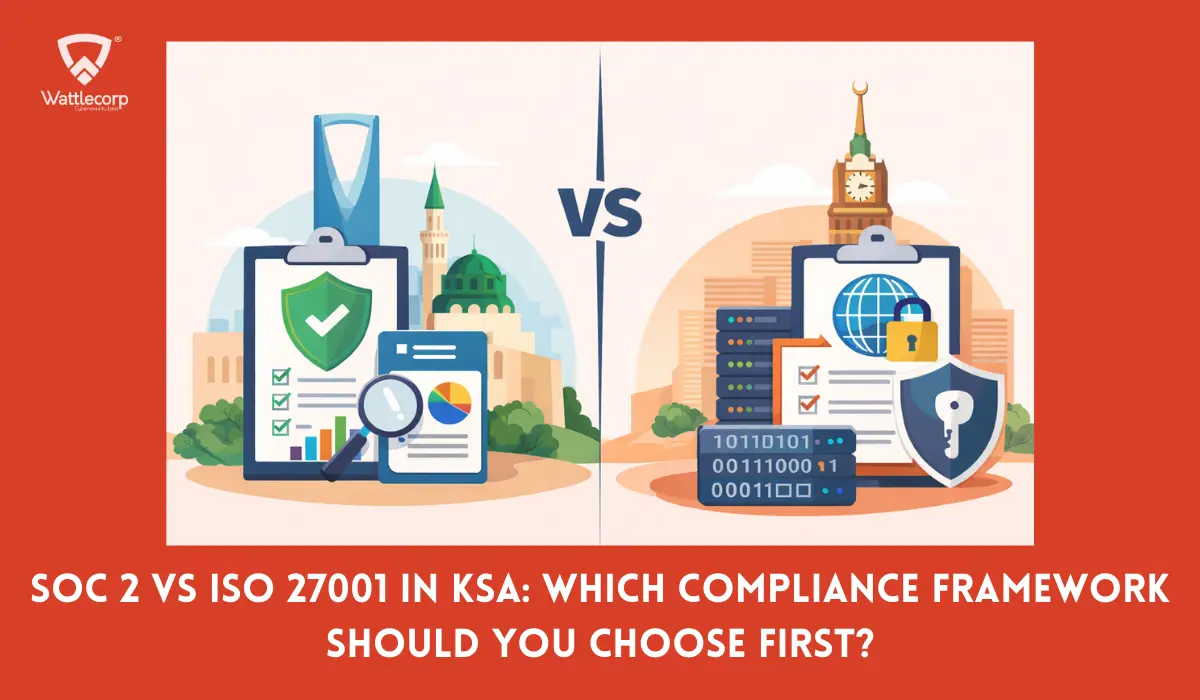
SOC 2 vs ISO 27001 in KSA: Which Compliance Framework Should You Choose First?
Key Takeaways:
- SOC 2 versus ISO 27001 in KSA is not merely a compliance decision but it has a direct effect on whether your organization would unlock government contracts or international business deals first.
- Most Saudi businesses believe that SOC 2 and ISO 27001 can be used interchangeably, yet they are aligned with the priorities of NCA ECC, PDPL and Vision 2030, and a more insightful sequence choice is visible.
- The incorrect first choice of framework may slow down the certifications, stretched out sales and re-work may be expensive, whereas the appropriate sequence may speed up the regulatory clearance as well as overseas consumer confidence.
- In the case of KSA organizations, the actual discussion is not what is better, but what stakeholder, Saudi regulators or international clients, requires evidence first? and the answer to this question is in the shift of the whole roadmap.
- The most competitive Saudi businesses are not adopting a single type of structure, they are designing a transition dual compliance approach that transforms regulatory seriousness into a business edge.
Understanding the Saudi Compliance Crossroads: A Strategic Starting Point for Market Access and Regulatory Readiness
Saudi Arabia’s digital economy is accelerating at a pace that few analysts predicted even three years ago.
Vision 2030 has reshaped the Kingdom’s technology ambitions from giga-project smart cities to AI-powered financial services.
This rapid expansion has a direct cybersecurity cost and leads to a dramatically enlarged attack surface and a surge in sophisticated threats.
In 2025, many regional security leaders flagged AI-driven attacks as their primary concern.
For organizations operating in this environment, compliance has shifted from a background obligation to a front-door requirement.
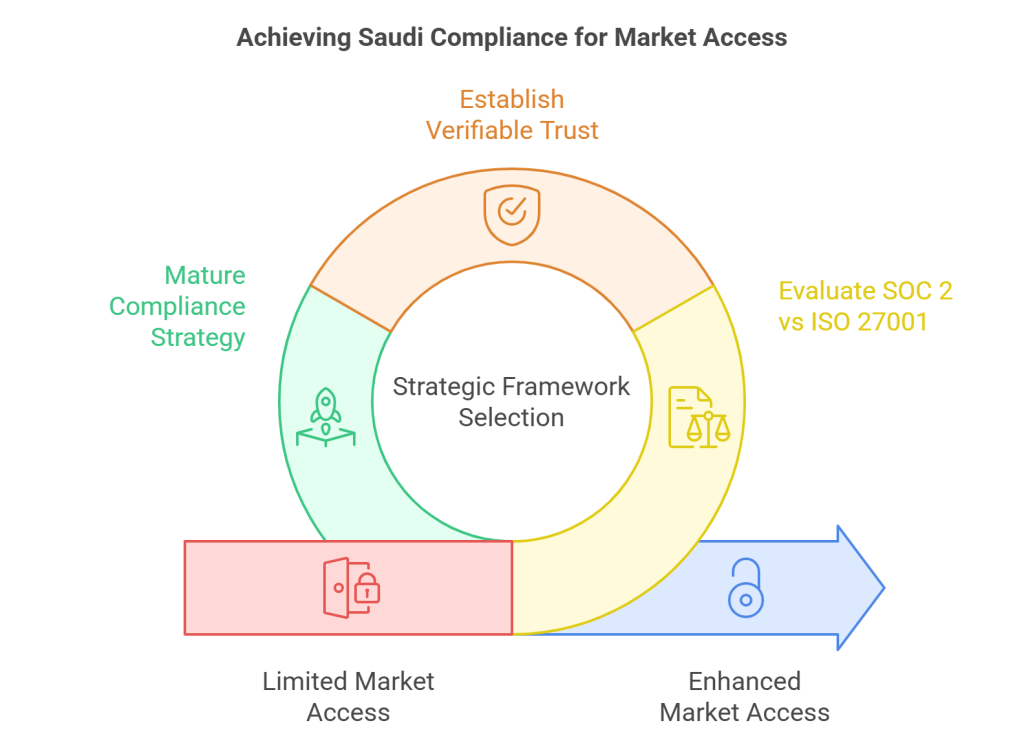
The decision between SOC 2 vs ISO 27001 defines an organization’s market accessibility within the global digital supply chain.
For enterprises in Saudi Arabia, evaluating SOC 2 vs ISO 27001 facilitates the alignment of NCA (National Cybersecurity Authority) maturity with the rigorous expectations of international stakeholders.
Beyond simple risk mitigation, selecting the appropriate framework establishes a foundation of verifiable trust.
Within the framework of Vision 2030, a mature compliance strategy serves as a catalyst for competitive differentiation and sustainable growth in the Kingdom’s evolving digital economy.
Saudi Arabia’s Cybersecurity Governance Stack: Where These Frameworks Fit
Before analysing the SOC 2 vs ISO 27001 decision, it is best to draw a map of the regulatory landscape in which these frameworks will work in Saudi Arabia. Three mandates set the tone:
- NCA ECC (National Cybersecurity Authority – Essential Cybersecurity Controls): The compulsory minimum cybersecurity system of the Saudi government agencies and the entities in the private sector that own, operate, or host Critical National Infrastructure.
- PDPL (Personal Data Protection Law):Saudi Arabia has an extensive data protection law, which is similar to the GDPR, namely the PDPL, and it is applicable to any organization that processes the personal data of people in the Kingdom, irrespective of the location of the organization.
- SAMA and SDAIA: SAMA and SDAIA regulates banks, insurance companies, and financial institutions in Saudi Arabia and mandates cybersecurity and risk management frameworks for these regulated entities, while also issuing broader policy guidance that influences privacy, AI, and data governance practices across other sectors.
Both SOC 2 vs ISO 27001 standards play a vital role in this stack work at radically different strategic levels.
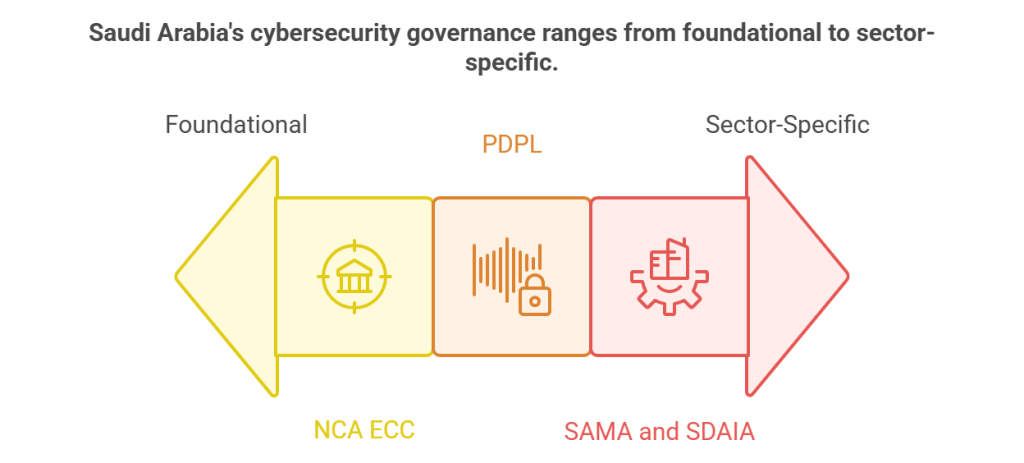
ISO 27001 is a global standard for securing sensitive data and can serve as a foundational framework for aligning with NCA ECC requirements. However, organizations need to perform a detailed gap analysis to ensure full compliance with the NCA ECC.
Understanding this distinction between SOC 2 vs ISO 27001 is the starting point for any structured comparison for Saudi organizations.
SOC 2 provides assurance of operational controls within an organization, particularly in sectors that handle sensitive data like SaaS.
However, it is not a universal entry requirement for all markets or sectors. It’s an important piece of evidence in specific business relationships, especially with clients who value third-party attestation.
SOC 2 as a Strategic Asset: Enabling KSA Tech Companies Win Global Clients
Flip the SOC 2 vs ISO 27001 lens toward export markets and the picture shifts. SOC 2 is developed by the AICPA (American Institute of Certified Public Accountants) around five Trust Services Criteria such as Security, Availability, Processing Integrity, Confidentiality, and Privacy.
These trust services function as a commercial passport for any KSA-based SaaS or cloud company with international ambitions.
For a Saudi technology firm pursuing contracts with US enterprise clients or EU technology partners, a SOC 2 Type II report is often the very first document a procurement team requests.
Also Read : SOC Challenges and Best Practices to Overcome Them
Type II matters more than Type I: while Type I confirms that controls are designed appropriately at a point in time, Type II proves those controls operated effectively across a defined period typically six to twelve months.
That operational evidence is what builds genuine client trust, and it is what separates credible attestation from a checkbox exercise.
Saudi startups targeting North American markets should treat SOC 2 not as a compliance cost, but as a revenue enabler that shortens enterprise sales cycles.
Strategic Breakdown: Choosing the Best Framework for Saudi Enterprises
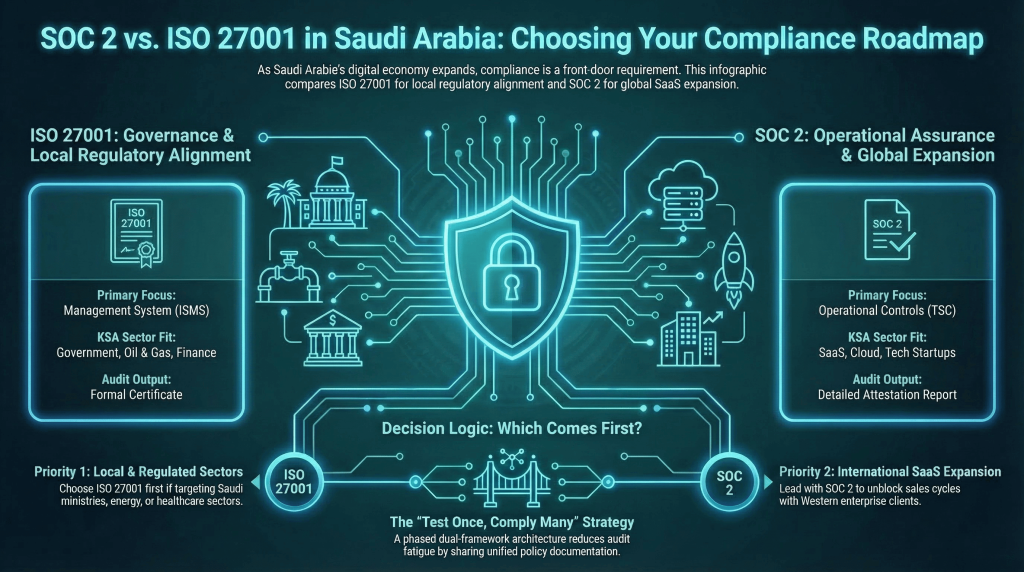
| Feature | ISO 27001 | SOC 2 |
| Output | Formal certificate | Detailed Attestation Report |
| Focus | Management System (ISMS) | Operational Controls (TSC) |
| Saudi Market Preference | Government, Oil & Gas, Banking | SaaS, Cloud, Tech Startups |
| NCA ECC Mapping | High | Moderate (Client Data Focus) |
| Audit Cycle | 3-Year Cycle + Surveillance | Annual Re-assessment |
| Scope | Entire organization | Specific system or service |
| Issued | Accredited Certification Body | Licensed CPA Firm (AICPA) |
The core strategic divide in the SOC 2 vs ISO 27001 decision comes down to stakeholder type and region they focus.
ISO 27001 builds your governance house; SOC 2 shows guests how well the locks work.
Both demand rigorous control design but ISO 27001 requires continuous management of that environment, while SOC 2 brings an independent auditor in periodically to attest to it.
NCA ECC Alignment: Which Framework Gets Saudi Organizations Closer to Compliance?
The NCA ECC alignment question is where the SOC 2 vs ISO 27001 debate becomes most concrete for Saudi organizations.
ISO 27001 provides a comprehensive management framework for information security. However, for full NCA ECC compliance, organizations often need to perform a detailed gap analysis and implement additional specific controls mandated by the ECC.
Also Read : The Intersection of NCA ECC and Data Privacy: Ensuring Comprehensive Protection
Organizations that have implemented ISO 27001 typically find their compliance gap analysis against ECC requirements, which is significantly shorter than those starting from scratch.
Trust Services Criteria of SOC 2 are narrower by design. They answer a client assurance question, not a national regulator’s baseline requirement.
This makes SOC 2 a valuable commercial complement, but not a substitute for ISO 27001 when NCA ECC compliance is the primary obligation on the table.
Decision Logic: Which Framework to Implement First Based on Your Sector
The decision between SOC 2 vs ISO 27001 question depends almost entirely on who your most demanding stakeholder is right now. Three scenarios cover most KSA organizations:
- Scenario A: Government, Energy, Healthcare: If your primary contracts involve Saudi ministries, utility providers, or public health entities, start with ISO 27001. NCA ECC alignment, SAMA, tender prerequisites, and PDPL obligations all pull in that direction. The governance foundation ISO 27001 establishes will also accelerate any future SOC 2 program.
- Scenario B: SaaS Targeting Western Markets: If you are a KSA-based technology company with a pipeline of US or EU enterprise clients, lead with SOC 2. It unblocks sales cycles faster, and you can layer ISO 27001 on top once commercial momentum is established.
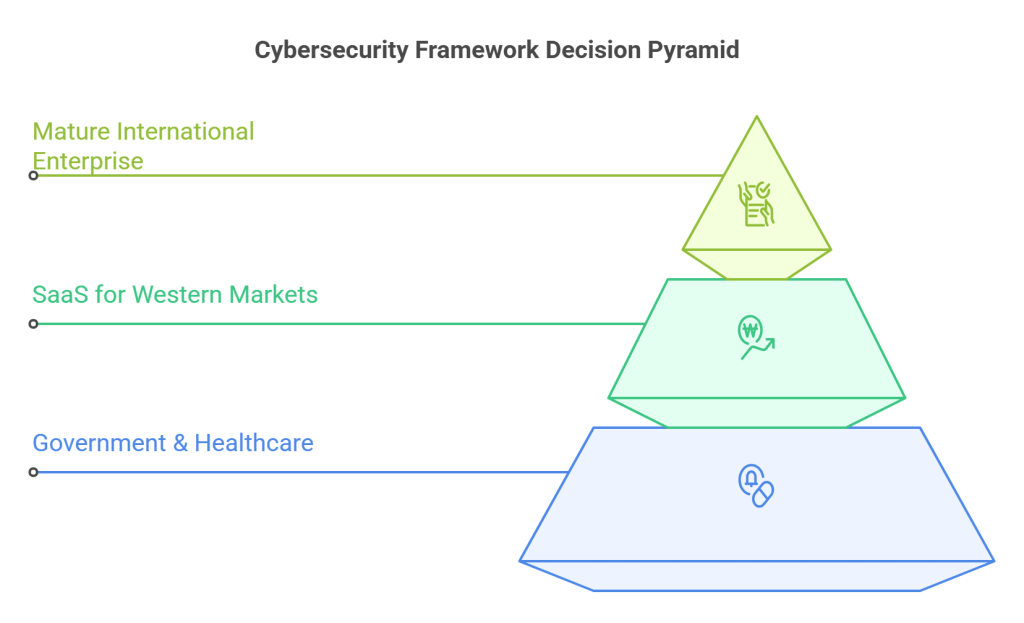
- Scenario C: Mature Enterprise Scaling Internationally: Pursue a phased dual-framework architecture. Many controls satisfy both standards simultaneously. Such as unified risk registers, shared policy documentation, and reusable audit evidence reduce the total compliance burden considerably. This test once and comply with many methods is how scaling organizations eliminate audit fatigue.
Implementation Reality: Timelines, Effort, and the Role of Penetration Testing
Neither framework is a quick win. A realistic ISO 27001 certification journey for a mid-sized organization runs six to twelve months.
SOC 2 Type II requires a minimum observation period before the audit can even begin. Building a dual-framework compliance architecture in KSA typically takes twelve to eighteen months when done properly.
One element both frameworks share and which many teams underestimate is the technical validation layer. ISO 27001 explicitly covers vulnerability management.
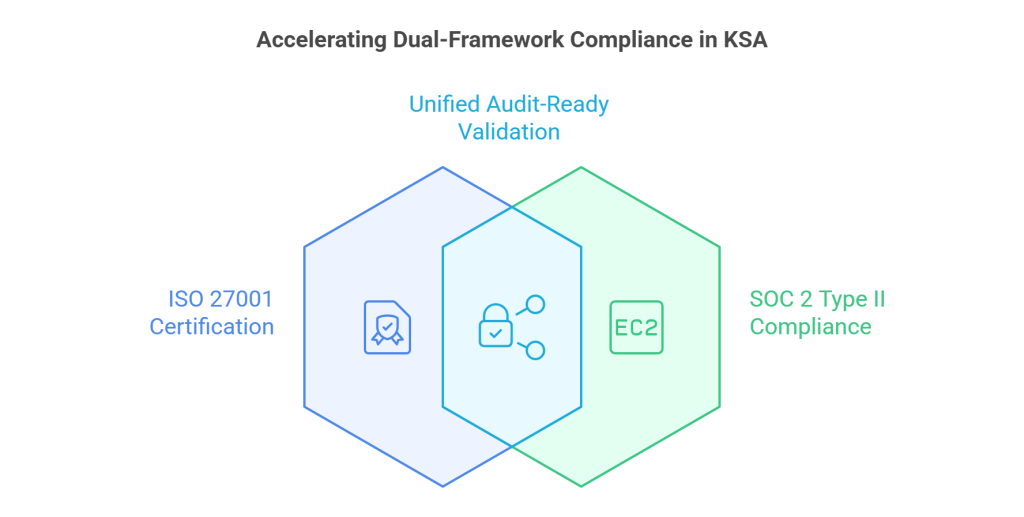
SOC 2’s Common Criteria CC4.1 requires that risk assessments identify technical vulnerabilities. For organizations in KSA, investing in credible penetration testing services in Saudi is not optional; it is the evidence layer that makes both certifications credible under audit.
Wattlecorp’s penetration testing services in Saudi are structured to generate audit-ready findings that satisfy both frameworks simultaneously, reducing rework and accelerating certification timelines.
Aligning Your Compliance Roadmap with Saudi Regulatory Gravity
The decision between SOC 2 and ISO 27001 is not merely an IT assignment, rather it is a strategic business matter.
The ISO 27001 sets the framework of governance anticipated by Saudi regulators, suppliers and enterprise partners.
Wattlecorp ISO 27001 and SOC 2 advisory services assist in meeting KSA regulatory and enterprise procurement requirements.
In the landscape of Vision 2030, trust is the currency of the digital economy, organizations that build it deliberately through a structured, regulator-aligned compliance roadmap will be the ones that win the contracts, the partnerships, and the market access that define the next decade.
Finding it difficult to comply with Saudi regulatory and enterprise security requirements?
The ISO 27001 Compliance Services in Saudi Arabia helps with the standards of alignment with local regulatory requirements and procurements standards.
SOC 2 vs ISO 27001 FAQs
1. Is ISO 27001 mandatory in Saudi Arabia?
ISO 27001 is not universally mandatory by statute, but it functions as an effective requirement in practice. The NCA ECC baseline aligns closely with ISO 27001 controls, and government procurement processes frequently list ISO 27001 certification as a qualification criterion. For any organisation handling sensitive government data or operating critical national infrastructure in Saudi Arabia, it functions as an operational necessity rather than a voluntary choice.
2. Is SOC 2 recognized by Saudi regulators?
SOC 2 is an attestation report issued by a licensed CPA firm under AICPA standards. but it does not currently serve as a substitute for NCA ECC compliance or other national regulatory requirements in KSA. It carries significant weight with international clients and technology partners, particularly in North America. Saudi organisations pursuing global expansion should treat it as a commercial complement to not a replacement for the local regulatory baseline.
3. Can a company implement both ISO 27001 and SOC 2?
Absolutely. Many companies in KSA are adopting both ISO 27001 and SOC 2 because there are many similarities in their requirements, registers, shared policy documentation, and centralized audit evidence. The effort of achieving both ISO 27001 and SOC 2 is considerably lower than building two independent compliance programmes.
4. Which framework is better for Saudi SaaS startups?
Choosing between SOC 2 vs ISO 27001 depends on your primary market. If you are targeting US or EU enterprise clients, SOC 2 will improve sales cycles faster and deliver more immediate commercial return. If Saudi government contracts, SAMA-regulated institutions, or other KSA-regulated sectors anchor your growth, ISO 27001 offers more immediate and durable value.
5. How does NCA ECC relate to ISO 27001 and SOC 2?
NCA ECC is Saudi Arabia’s mandatory cybersecurity baseline for government entities and critical infrastructure operators. However, ECC compliance requires a dedicated control-by-control mapping and gap assessment against the official NCA ECC requirements. SOC 2 is an essential compliance framework for organizations handling sensitive data, particularly in SaaS and cloud environments. While it is not a substitute for national regulations like NCA ECC, it serves as a recognized industry standard, particularly for demonstrating trustworthiness in global markets.

 Mobile Application Penetration Testing for Qatar Government Digital Services: NCSA- Aligned Security Assurance
Key Takeaways: Mobile Application Penetration Testing Qatar must cover the app, device storage, APIs, authentication and third-party components. Qatar’s NCSA assurance environment combines the National Information Assurance (NIA) Standard, the National Information Security Compliance Framework (NISCF) and accredited security assessment services. OWASP MASVS defines mobile security controls, while MASTG supplies practical test methods for Android […]
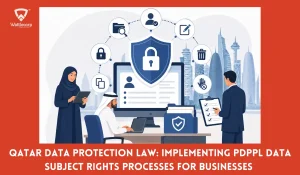 Qatar Data Protection Law: Implementing PDPPL Data Subject Rights Processes for Businesses
Key Takeaways: The Qatar Data Protection Law (Law No. 13 of 2016) for Personal Data Privacy Protection, grants individuals specific rights such as right to access, correct, erase, object, withdraw consent, and right to be notified of processing or inaccurate disclosure. Beyond having a privacy policy, businesses or controllers, under Article 11 of Personal Data […]
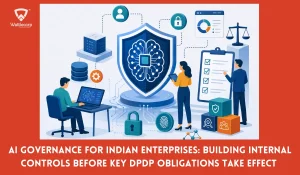 AI Governance for Indian Enterprises: Building Internal Controls Before Key DPDP Obligations Take Effect
Key Takeaways: The DPDP Act does not contain AI-specific provisions. Its requirements, however, apply in situations when an AI system processes digital personal data within its territorial and material scope. India is working on building a broader governance framework around safety, accountability, transparency and trust via programs like the IndiaAI Mission. Indian organizations should inventory […]
 Cloud Security Audit for UAE Government Cloud Migration: NCAP and Security Requirements
Key Takeaways: A cloud security audit UAE helps government entities identify security, governance, configuration, access, data-protection and resilience gaps, before and after shifting critical workloads to the cloud. UAE National Cloud Security Policy has defined cloud governance, data security, data sovereignty, IAM, incident management, resilience, portability and cloud operations requirements. The National Cyber Accreditation Program […]
 Data Privacy Consulting UAE – Building a PDPL-Compliant Data Governance Program
Key Takeaways: PDPL compliance requires ongoing operational governance that goes beyond policies to demonstrate how personal data is collected, used, protected, transferred, retained, and deleted. Data mapping helps businesses move from reactive compliance to proactive risk management by establishing a comprehensive inventory of the data ecosystem, helping build a mature data privacy and governance program. […]
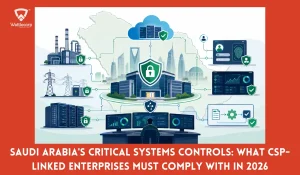 Saudi Arabia’s Critical Systems Controls: What CSP-Linked Enterprises Must Comply With in 2026
Key Takeaways: The Critical Systems Cybersecurity Controls (CSCC) are more applicable to critical systems than to all IT assets owned or operated by an organization. To be in full compliance or to remain in full compliance with CSCC, organizations must maintain continuous adherence to NCA ECC. CSCC has 32 core controls and 73 sub-controls across […]