

Regulatory Reporting and Data Privacy: A GRC Perspective
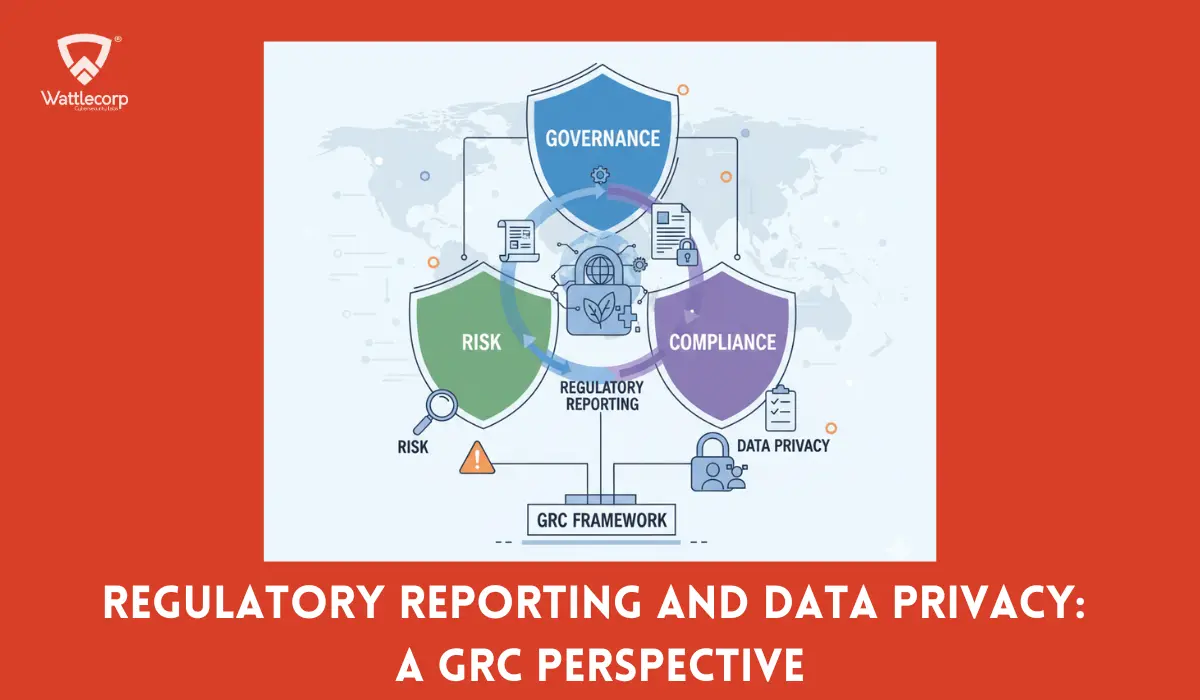
What does GRC mean?
GRC is a short-term derived from Governance, Risk, and Compliance.
This GRC data privacy is a structured approach that every business must follow, especially that in the UAE. Organizations follow these practices in their business processes to run a smooth operation to effectively manage the three core elements, like governance, managing risks, and obeying regulatory requirements.
We see that, next to the government systems getting attacked, 21% of UAE’s financial institutions have been targeted until recently. And this serves as a caution call for businesses to focus on every part, from leadership decisions to handling data.
What Should Your UAE Business Know About GRC?
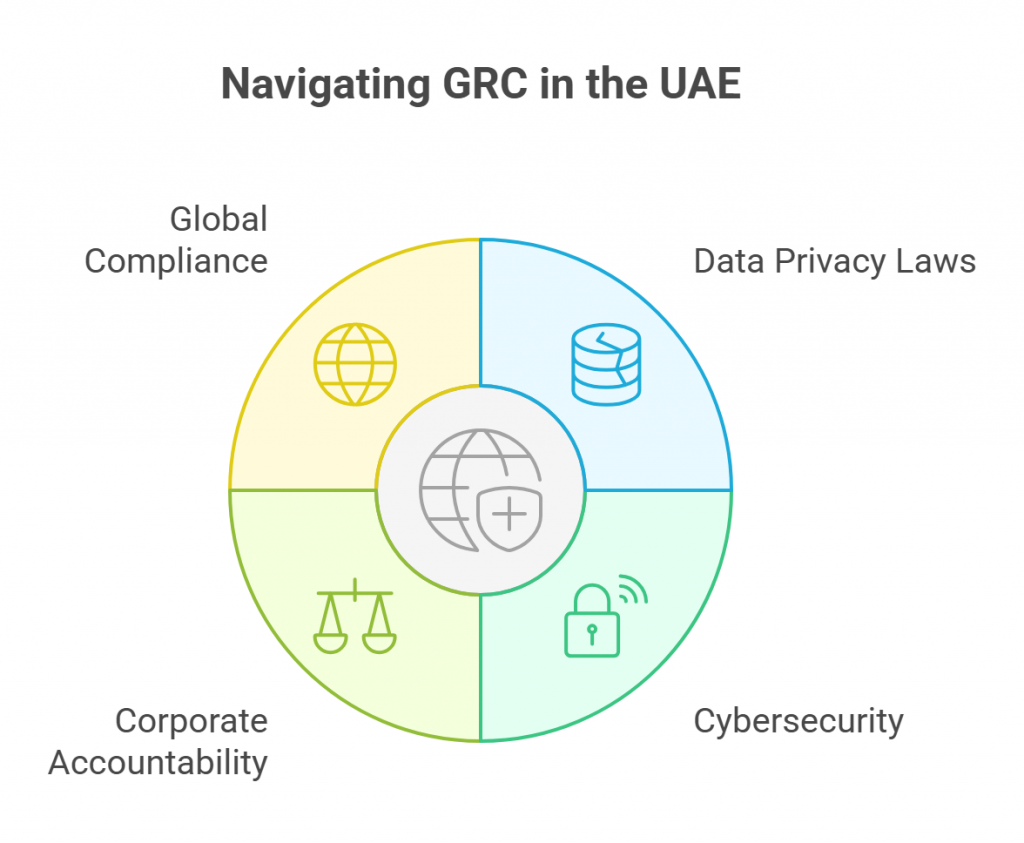
If you are running a business in the UAE, you might be aware that businesses in the region are experiencing rapid digital transformation. With advanced digital adaptations, there are also new regulations compiled for data privacy, cybersecurity, and corporate accountability to keep up with the growing threat factors.
The UAE has introduced its data protection laws (PDPL), inspired by international standards like GDPR, which is mandatory for companies to follow. GRC data privacy frameworks help you with the tools to manage compliance obligations, reduce cyber risks, and establish strong internal governance.
Many UAE businesses are also expanding globally or serving international clients. Taking such instances also into account, GRC practices make it easier to meet different countries’ compliance standards like GDPR (EU), CCPA (California), and LGPD (Brazil). All these regulations are strictly imposed on the respective regions on how personal data is collected, used, and protected.
How Does GRC Data Privacy Practice Impact UAE Businesses?
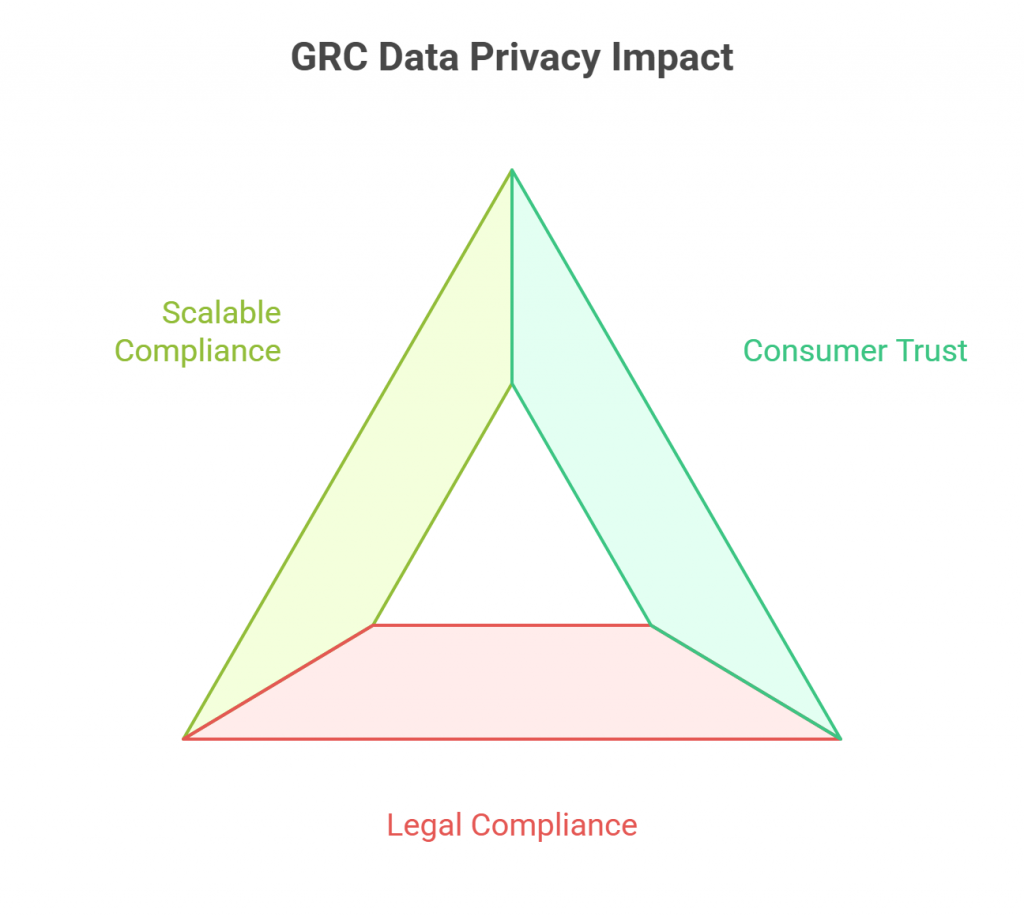
Builds Consumer Trust and Confidence
When your brand makes efforts in securing the personal information of the customers, you are giving them a safer ground, and this will lead towards building a trusted brand.
Implementing privacy management within your GRC strategy allows your business to securely classify sensitive data, manage it responsibly, and demonstrate transparency. More than being a standard for legal purposes, it’s about protecting your brand and building long-term customer relationships.
Also Read : Building a Robust Data Privacy Program: Best Practices for Compliance and Risk Mitigation in the UAE
Avoid Legal and Financial Risks
You will be charged with hefty fines, and legal challenges if you fail to comply with data protection laws. Also you might face reputational damage, resulting in less customer interest towards your business.
Every country globally is adapting to the privacy standards corresponding to their region. Similarly in UAE, GRC takes the front and helps you stay ahead of these regulations by embedding compliance into your everyday operations. It includes risk assessments, breach notifications, or secure data handling protocols.
Makes Compliance Easier and More Scalable
When considering GRC for your business, you must also understand that it’s an evolving framework, which means it’s not a one-time measure forever.
With the right tools and processes, you can automate many aspects of compliance. This includes data flow mapping, processing subject access requests, and managing international data transfers. Following GRC streamlines complex datasets and allows secure processing of personal data.
Key Elements of GRC in Data Privacy
Regulation knowledge
The first thing is to understand the laws, as every nation has its specifically defined laws. If your business involves cross-border data transfers, you need to know about GDPR, which requires informed consent, access rights, and strict rules.
Another standard is CCPA, which focuses on giving California consumers control over their data. Similar to these privacy laws, the UAE has also imposed Federal Decree-Law No. 45 of 2021. Knowing the details helps you understand what your business is responsible for, the different laws followed worldwide, and where the potential risks are.
Data Mapping and Inventory
You must be aware of where the entire data is, when you run a business. Here, data mapping allows managing personal data through its lifecycle. This is a structured way to follow how it’s collected, stored, used, and shared.
With the mapping method, you can easily respond to access or consumers’ requests for deletion. Also, according to the GDPR, its mapping approach insists on gathering and storing only required personal data.
Privacy by Design
Integrate privacy from the start of your business.
Privacy by design means embedding data protection measures directly into your systems, processes, and technologies. This includes conducting Privacy Impact Assessments (PIAs) and using default settings that prioritize privacy.
With this practice, your business will be seen as a committed venture in handling data responsibly. While complying with regulatory rules is firmly practiced, the customers are also likely to turn loyal.
Conduct Regular Risk Assessments
Risks are constantly evolving, and regular assessments help you identify new threats, gaps in security, and changes in how you process data.
These evaluations should be part of your routine and not just during audits or crises. Such follow-up practices keep the systems prepared. The skilled expert helps your business align with the GRC strategy and evolving regulations.
Also Read : Ensuring Data Privacy Compliance: Essential Steps For UAE Businesses
Train Your Team
Employees are often the first line of defense who can initiate action in protecting data. So, train your teams about data privacy, ways to handle information securely, and how to respond if breaches occur. Awareness reduces mistakes and helps prepare everyone for the compliance goals.
Appoint a Data Protection Officer (DPO)
Depending on your business size and data activities, appoint a DPO as this role has become a legal requirement. This person oversees your data protection strategy, acts as a liaison with regulators, and ensures that privacy management is integrated across departments.
Governments worldwide have urged on the importance of assigning a dedicated professional, so having one in-house can improves focus and accountability.
Vendor and Third-Party Management
When your business has ties with third-party subject, you are responsible for checking if they follow your regulatory guidelines.
If you share data with third parties like cloud providers, payment processors, or marketing paperform regular audits, and verify their practices to avoid downstream risks.
Prepare Breach Notification Plans
Businesses must always be prepared to face any adverse data breach situations. There must be a well-prepared incident response plan to rectify this. It must cover internal reporting, impact assessments, and notification procedures.
Keep Track Of Processes Done
When you aim for a long-term business, you must save and file the evidence of your data processing activities. The track record will include details like the purpose behind holding data, the duration you retain it, who can have access, and what security measures are enabled.
Such recorded data are helpful during audits, as they are proof to your commitment to accountability and maintaining transparency.
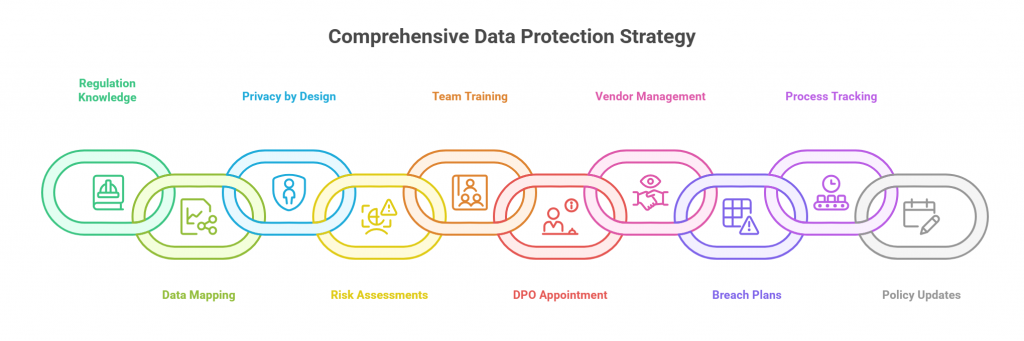
Keep Your Privacy Policies Updated
Privacy rules are often imposed with new updates, and you must abide by the current changes. The conditions you list out must contain a valid reason for collecting data, what you collect, how long you keep it, and the rights people have over their data.
This rules list should be comprehensible and easy to refer to. With these rules, follow up with regular reviews and updates to keep your systems complying with the respective legal standards.
The UAE business environment is growing complex with so much to handle, like governance, breach factors, and compliance. When you are observing measures to build your business successfully, you need to follow data privacy practices that seamlessly integrate with GRC. Implementing these effectively undeniably requires expert assistance.
The UAE business environment is growing complex with so much to handle, like governance, breach factors, and compliance. When you are observing measures to build your business successfully, you need to follow data privacy practices that seamlessly integrate with GRC. Implementing these effectively undeniably requires expert assistance.
At Wattlecorp, we handle every process from integrating GRC solutions to upgrading privacy frameworks and preparing your business for a cyberresilient future. Our expert cybersecurity professionals in the UAE are dedicated to offer the data privacy consulting service you need to ensure data protection and meet compliance requirements. Combining these with continued governance, risk, and compliance-aided efforts are what we can bring to your table to make your business accountable.
So, are you ready to go that extra mile? Connect with us to stay compliant through enhanced security.
GRC DATA PRIVACY FAQs
1.Is data privacy part of GRC?
Yes, data privacy is an important element of GRC. It falls under compliance and risk management, helping businesses protect personal data and meet legal requirements.
2.What is the data privacy act in the UAE?
The UAE’s main data privacy law is the Federal Decree-Law No. 45 of 2021 on the Protection of Personal Data (PDPL). It sets rules for collecting, processing, and storing personal data.

 Mobile Application Penetration Testing for Qatar Government Digital Services: NCSA- Aligned Security Assurance
Key Takeaways: Mobile Application Penetration Testing Qatar must cover the app, device storage, APIs, authentication and third-party components. Qatar’s NCSA assurance environment combines the National Information Assurance (NIA) Standard, the National Information Security Compliance Framework (NISCF) and accredited security assessment services. OWASP MASVS defines mobile security controls, while MASTG supplies practical test methods for Android […]
 Qatar Data Protection Law: Implementing PDPPL Data Subject Rights Processes for Businesses
Key Takeaways: The Qatar Data Protection Law (Law No. 13 of 2016) for Personal Data Privacy Protection, grants individuals specific rights such as right to access, correct, erase, object, withdraw consent, and right to be notified of processing or inaccurate disclosure. Beyond having a privacy policy, businesses or controllers, under Article 11 of Personal Data […]
 AI Governance for Indian Enterprises: Building Internal Controls Before Key DPDP Obligations Take Effect
Key Takeaways: The DPDP Act does not contain AI-specific provisions. Its requirements, however, apply in situations when an AI system processes digital personal data within its territorial and material scope. India is working on building a broader governance framework around safety, accountability, transparency and trust via programs like the IndiaAI Mission. Indian organizations should inventory […]
 Cloud Security Audit for UAE Government Cloud Migration: NCAP and Security Requirements
Key Takeaways: A cloud security audit UAE helps government entities identify security, governance, configuration, access, data-protection and resilience gaps, before and after shifting critical workloads to the cloud. UAE National Cloud Security Policy has defined cloud governance, data security, data sovereignty, IAM, incident management, resilience, portability and cloud operations requirements. The National Cyber Accreditation Program […]
 Data Privacy Consulting UAE – Building a PDPL-Compliant Data Governance Program
Key Takeaways: PDPL compliance requires ongoing operational governance that goes beyond policies to demonstrate how personal data is collected, used, protected, transferred, retained, and deleted. Data mapping helps businesses move from reactive compliance to proactive risk management by establishing a comprehensive inventory of the data ecosystem, helping build a mature data privacy and governance program. […]
 Saudi Arabia’s Critical Systems Controls: What CSP-Linked Enterprises Must Comply With in 2026
Key Takeaways: The Critical Systems Cybersecurity Controls (CSCC) are more applicable to critical systems than to all IT assets owned or operated by an organization. To be in full compliance or to remain in full compliance with CSCC, organizations must maintain continuous adherence to NCA ECC. CSCC has 32 core controls and 73 sub-controls across […]