
Key Takeaways:
- Sectors that fall under energy, finance, telecom, and government sectors are the highest-risk targets in Saudi Arabia.
- Zero-trust architecture enforces continuous verification of users, devices, and access requests, reducing the risk of unauthorised lateral movement and credential-based attacks.
- To meet with the legal cybersecurity standards Saudi enterprises must comply with ECC 2-2024, SAMA, and PDPL frameworks.
- Regular VAPT practices must be followed to find and fix security gaps before attackers intrude.
Table of Contents
ToggleIs Saudi Among the Top Target for Nation-State Cyber Threats
Based on the insights surveyed during the timeline of July 2022 to June 2023, Statista reports that Saudi Arabia accounts for 9% of all nation-state cyber attacks in the MENA region.
Moreover, The National News also reports that post the war beginning, Saudi Arabia is one prime target with risk factors aiming especially on government and high-profile websites. The threats include ransomware and wiper malware, highlighting the urgent need for Saudi enterprise cyber resilience to keep their businesses defensive from threats.
Why Saudi Enterprise Cybersecurity Is Under Nation-State Threat Now
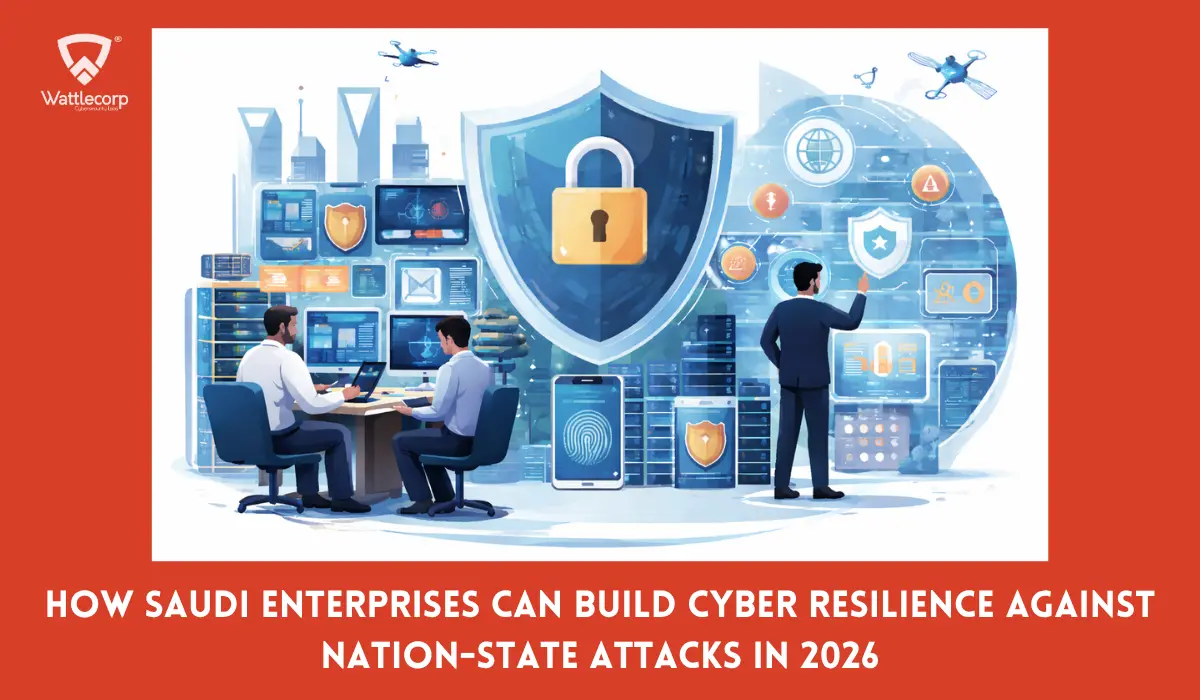
Nation-state attacks are not solely aimed at the government sector, whereas attackers see private sectors as a major target, including energy, finance, telecom, and healthcare. The reason is that the attackers see a huge amount of sensitive data and critical infrastructure, where the economy resides.
Also Read : Key Cybersecurity Threats Addressed By VAPT In 2025
Several threat groups outside the KSA deploy backdoor malware and espionage-driven attacks to gain access to critical data, making Saudi enterprise cyber resilience a growing priority. The consequences are more than a data breach and go beyond to disrupt critical business operations. Besides this, these attacks expose and leak critical data, leading to serious regulatory penalties, including tampered trust from the consumer end.
Which Saudi Sectors Should Build Nation-State Resilience First
Some sectors that operate with and handle critical and large amounts of data are at higher risks. Below are four specific areas with major threat exposure where Saudi enterprise cyber resilience must be at top priority.
Not all sectors carry the same level of nation-state cyber risk. Saudi enterprises in these four areas face the highest exposure and should treat cyber resilience as an immediate priority:
Energy and Oil & Gas
ARAMCO and related energy supplying entities have historically been prime targets of cyber threats. Malicious actors often engage in threat activities targeting ICS resulting in disrupted operations, and causing reputational damage.
Financial Services
Banking firms and entities that are related to financing are one of the prime targets as it is connected with a huge amount of monetary data. Owing to the need of this sector, the SAMA Cybersecurity Framework is mandated across this sector, and the non-compliant ones will be imposed with heavy penalties.
Government and Defense Contractors
Government organizations and defense contractors are also common targets. Attackers, especially from other countries, try to secretly collect important military, economic, or strategic information. In high times like during a war period, such data can be a big lead for threat actors.
Telecommunications and Technology
As 5G deployment and cloud adoption continue to grow, telecom infrastructure is increasingly becoming a target for disrupting communications at the national level.
Step-by-Step: How Saudi Businesses Should Build Cyber Resilience
Know What You Are Protecting
Saudi enterprises’ resilience efforts must start with a full inventory of critical assets, including systems, data, cloud environments, third-party connections, and vendor access. The initial step is to map what is to be protected. For most businesses, their primary asset would be data, and it must be classified based on its sensitivity. It is also essential to identify and prioritize which systems, if disrupted, would cause the most operational damage.
While determining the core assets that need a cyber-resilient infrastructure, enterprises must also take efforts to perform a business impact analysis to understand the real-world consequences if key systems are compromised.
Adopt a Zero-Trust Architecture
Traditionsl perimeter-based security relied on implicit trust within internal networks, meanwhile Zero-Trust approach mandates verification at every access point. This involves verifying every user, device, and connection, so basically, it does not follow trust by default.
In this approach, businesses follow multi-factor authentication across all access points, network segmentation to contain breaches, and strict identity and access management policies. NCA’s ECC 2-2024 framework has zero trust principles aligned within, which includes identity management, access control, and network segmentation making this step both a best practice and a compliance obligation.
Align With ECC 2-2024 and Saudi Regulatory Frameworks
Saudi Arabia’s National Cybersecurity Authority (NCA) has put forth an updated framework, ECC 2-2024. This applies to all government organizations, operators of critical national infrastructure, and companies in regulated industries in the private sector. The new framework addresses four major areas: Governance, Defense, Resilience, and Third-Party/Cloud Security, and has 108 streamlined controls to cover the current threats, such as AI vulnerabilities, supply chain risks, and cloud security gaps.
ECC 2-2024 also strengthens Saudi enterprise cyber resilience by urging entities to occupy cybersecurity roles by qualified Saudi experts. In addition to aligning with the ECC 2 standards, financial businesses must also strictly adhere to the SAMA Cybersecurity Framework.
Run Regular VAPT to Find Gaps Before Attackers Do
Vulnerability Assessment and Penetration Testing (VAPT) is the way Saudi enterprises can put their defenses to the test as to their ability to withstand real-world attack environments.
Also Read : Virtual CISO + VAPT: A Winning Formula for Cyber Resilience
VAPT involves a multi-stage analysis for simulating real-world attack scenarios. The first step in it is vulnerability assessment, which involves identifying all potential vulnerabilities in systems, applications, and network infrastructure, and the second step is penetration testing process, during which certified ethical hackers imitate real attacks to determine how far they can go.
For Saudi enterprises, resilience-focused VAPT has now become a mandatory compliance practice required by NCA ECC, SAMA, and the Personal Data Protection Law (PDPL). It is also a practical way to verify that security controls actually work.
Build a practical Incident Response Plan
Most Saudi businesses have incident response plans, but they rarely practice or are often outdated. Nation-state attackers often exploit vulnerabilities and can leave a serious impact if identified and targeted. So, businesses must remain ready by conducting regular tabletop exercises and red-team practices that simulate real-life attacks and insider threats.
Business Continuity and Disaster Recovery plans must also consider the possibility that major systems will also be targeted with threats, facing interruption in processes. This implies backups, articulated recovery procedures, and well-established escalation channels are essential. These fundamentals determine whether organisations recover quickly, support timely VAPT remediation and help maintain Saudi enterprise resilience.
Build a Cyber-Aware Culture Across the Organisation
Phishing, social engineering, and human error are common entry points for nation-state actors into an organization’s networks. Saudi enterprises focusing on resilience must have a security culture, where the employees at all levels should be aware of their role in defending.
Adapted gamified security awareness training modules, simulated phishing, and clear reporting channels significantly reduce the human attack surface. Creating this culture should start at the leadership level and be reinforced regularly rather than verified only annually.
How the Right Cybersecurity Partner Helps Saudi Businesses Build Resilience
Finding the appropriate cybersecurity partner is as important as the appropriate strategy. In the case of Saudi companies working on cyber resilience, the partner should be aware of the threats to cybersecurity in the region and compliance regulations like NCA, SAMA, and PDPL.
Professional providers such as Wattlecorp with a regional understanding of the risk patterns unique to KSA can assist organisations to be more pragmatic and informed.
They must also possess good experience in the application of ECC 2-2024 and provision of compliance services in Saudi Arabia. The fact that the partner has recognised certifications (e.g. CREST to VAPT) and does not conduct a one-time assessment but continuous monitoring is an added benefit.
An effective partner can assist companies to move past compliance and develop genuine Saudi enterprise cyber resilience. This involves matching security controls with actual risk, conducting realistic attack simulations, producing clear incident response playbooks, and safeguarding critical operations.
Saudi Enterprise Cyber Resilience FAQs
1.What is cyber resilience for Saudi enterprises?
Saudi enterprise cyber resilience is the capacity of the business to plan, absorb, recover, and adjust to cyberattacks with continuity on critical business operations without huge operational disruption. It goes further than cybersecurity, where businesses are in a position to continue operating and recover promptly even after an attack has been successful.
2.How does ECC 2-2024 help Saudi organizations improve resilience?
The ECC 2-2024 released by the National Cybersecurity Authority of Saudi Arabia gives a systematic list of a total of 108 controls. The controls primarily cover governance, defense, resilience, and third-party security. It requires zero-trust access, ongoing monitoring, controls over cloud security, and preparedness to respond to an incident.
3.Which Saudi sectors should prioritize resilience against advanced attacks first?
Energy and oil and gas, financial services, government and defense contractors, and telecommunications are some critical sectors facing serious cyber threat risks and enterprises under these sectors must immediately prioritize cyber resilience approach to avoid operational failures.
4.Where do VAPT services fit into a Saudi cyber resilience program?
VAPT is a major component of a cyber resilience program. It assists in uncovering actual security gaps before attackers do and verifies whether your security controls are functioning in the actual scenarios. It also assists in the adherence of NCA ECC, SAMA and PDPL. VAPT practices should be performed at regular intervals and it particularly depends on system criticality, after upgrades or third-party integrations. Moreover, high-risk environments require continuous security testing.