

The Business Impact of Compliance Failures in SaaS
Do you want to avoid massive fines, mountains of paperwork, months of litigation, and severe loss of face and reputation? Well, then, you need to make sure that you avoid compliance failures in SaaS. The consequences can be heavy, long-term, and far-reaching. But before we discuss the impact of compliance failures in SAAS, let’s understand SAAS compliance. It refers to a set of rules and best practices that companies must adhere to so that SaaS apps can run safely, legally, and ethically. Being compliant with regulations demonstrates your commitment to creating trust and being reliable. While they can be cumbersome, compliance activities are essential.
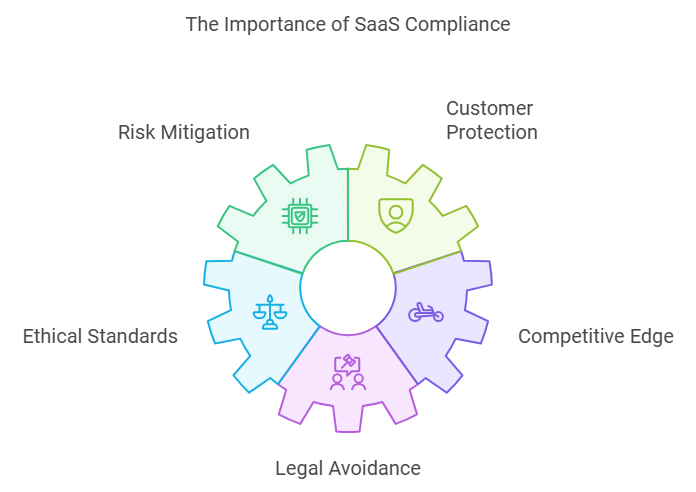
Why implement SaaS compliance?
- Helps mitigate risk of fraud and breaches
- Protects customers and employees
- Ensures safety of data and privacy of individuals
- Promotes ethical standards
- Gives a competitive edge
- Supports certification of diverse industry standards
- It is mandatory to avoid legal action
Types of SaaS Compliance
While compliance requirements are mandated across several areas, SaaS compliance is of the following types:
- Data Privacy – GDPR, CCPA, HIPAA, PDPL, PDPS
- Cybersecurity – CIS, SOC 2, ISO/IEC 27001
- Financial – SOX, PCI DSS, ASC 606
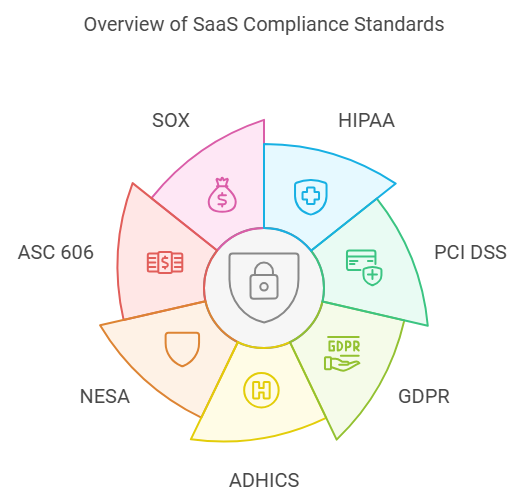
HIPAA and PCI-DSS are Some of these are industry-specific SaaS compliances, while some are specific to certain regions.
- HIPAA- established in the US, it deals with data privacy and security in the healthcare services industry.
- PCI DSS is designed for the financial servicesindustry, specifically, card payments, to ensure security of card and payer information.
- GDPR – deals with data privacy and security of EU citizens; any company, regardless of their own location, must comply with GDPR if they transact with EU citizens and collect their information.
- ADHICS – This is a set of standards developed by the Health Authority of Abu Dhabi to ensure that the health information in Abu Dhabi maintains integrity and is confidential and accessible when required.
- NESA – This standard is mandatory in the UAE and aims to protect IT infrastructure and critical information assets, increase cyber resilience, and develop a culture of cybersecurity.
- ASC 606
- SOX – Companies in the US that are traded publicly must implement robust financial reporting standards like logging electronic records for auditing, protecting data, monitoring attempted breaches, and proving their compliance.
SaaS Compliance
Software as a Service, or SaaS, compliance management is concerned with SaaS compliance frameworks and industry security frameworks as well.
Most of the companies using SaaS products collect and store volumes of sensitive data, increasing the SaaS legal risks and making compliance to data security essential. Depending on the nature of their business, companies may need to be compliant with multiple regulations.
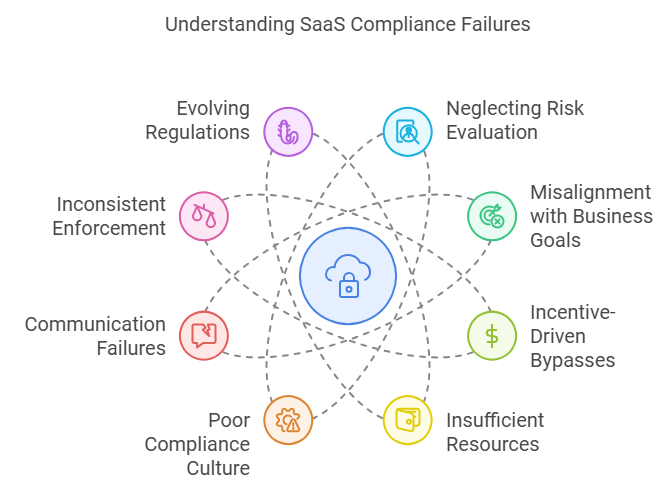
Now that we have understood that, let us see what the main reasons are for compliance failures in SaaS:
1. Neglecting Risk Evaluation Protocols
Businesses sometimes jump into new markets or implement innovative business models without a proper assessment of compliance requirements, and this can pose significant legal and financial risk.
2. Clash of Business Goals and Compliance Requirements
If compliance activities are not integrated with business goals, the misalignment can hamper business performance and adherence to compliance. Entering risky markets without compliance integration can have severe repercussions.
3. Bypassing Compliance to Bag Incentives
Employees may be tempted to bypass compliance requirements in order to grab incentives offered by the company and meet targets set by their bosses.
Also Read : Why Your SaaS Business Needs an Annual Security Program
4. Insufficient Resources
Formulating compliance policies, educating the workforce, and implementing them can be very expensive. Often, organizations don’t have the finances and other resources to see this through, and this is one of the biggest reasons for compliance failures in SaaS.
5. Poor Compliance Culture
Some organizations look at compliance as a hindrance to business and as a wasteful activity. They may willfully ignore compliance requirements and focus only on business growth.
6. Communication Failure
Not providing the proper training and awareness to employees can also lead to compliance failure. Communication is extremely important.
7. Inconsistency in Enforcement
In order to maintain credibility and effectiveness, it is necessary to apply the compliance policies uniformly and consistently; without that, it will most likely fail.
8. Evolving Regulations
Compliance requirements often change quickly, and it may be difficult for businesses to keep up.
The types of compliance failure in SaaS include not taking sufficient steps to protect data privacy, not implementing the proper security controls, and not reporting breaches.
Business Impact of Compliance Failures
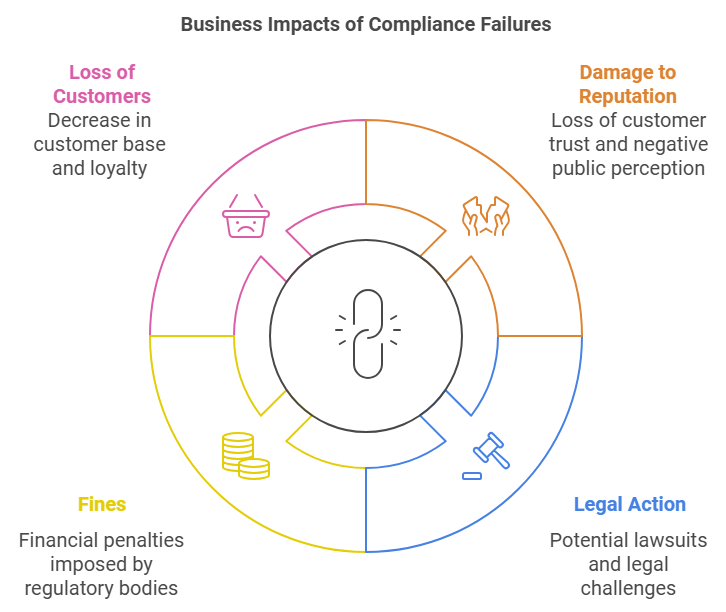
1. Damage to Reputation
If you lose sensitive customer information to a data breach, your reputation will suffer a setback. You will be seen as a company that doesn’t care for its customers and their privacy.
2. Legal Action
Many international compliance regulations are mandatory by law. Compliance failures in business can attract lawsuits which can further damage your reputation.
3. Fines
Most international compliance regulations have strict provisions, and punitive fines are imposed on businesses that don’t adhere to compliance. Often, the fines are very heavy and can create a dent in the finances of the business
Also Read : Future-Proofing SaaS Security: The Role of an Annual Security Program
4. Loss of Customers
Not only will you not be able to attract new customers, you may even lose your existing customers if you lose their data to security breaches.
To illustrate the severity of the impact, here are real-life examples of compliance failures in SaaS and the hefty fines they had to pay:
- eBay was fined 7.2 million USD for violating GDPR norms; hackers were able to access personal information of 145 million users
- Yahoo paid a total of 35 million USD for multi-regulation violations; they failed to disclose a data breach that happened some years ago.
- Anthem, one of America’s largest health insurance companies, was fined a whopping 115 million USD for HIPAA violations (data breach) – probably the biggest penalty from the compliance failure in SaaS examples.
- The five-star hotel chain Marriott International had to cough up 23.8 million USD as they failed to conduct due diligence before acquiring a hotel which had a data breach
What are you doing to Ensure Compliance?
You cannot take compliance lightly; as you can see from the above examples, consequences of noncompliance in SaaS can be far-reaching and extremely punitive.
The costs of dedicated resources to ensure compliance don’t seem very high now! Senior management in organizations has to be serious about compliance and monitor compliance implementation thoroughly.
Creating a Compliance Roadmap
Merely being committed to compliance adherence is not sufficient. It is essential to have a proper SaaS compliance strategy in place and best practices to ensure that it is followed through. Doing things at the last minute is risky and may cost you dearly.
A Viable Alternative
Wattlecorp offers the Annual Security Program, where we help SaaS companies to ensure that the risk of data breaches is mitigated and security is strengthened.
Our penetration testing team routinely tests your security, provides you with a SaaS compliance checklist, evaluates the impact of potential breaches and recommends patches to mitigate those risks.
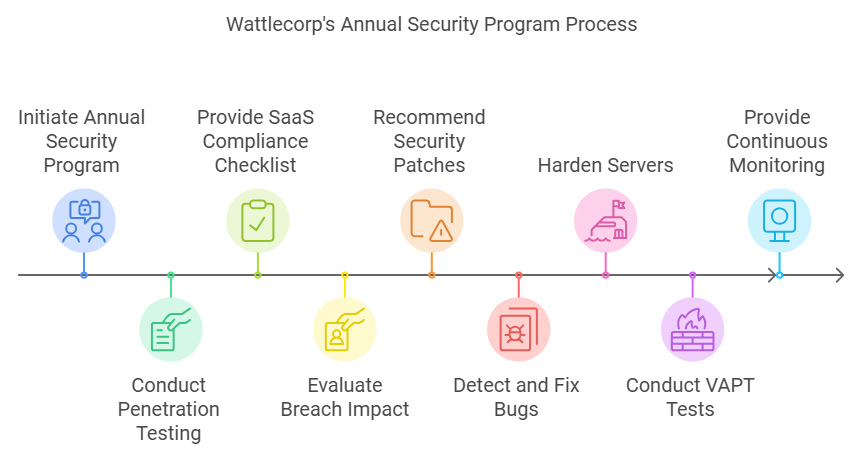
We detect and fix bugs, harden your servers, and conduct VAPT tests every quarter to ensure that your systems are protected from malicious entities. We provide a dedicated manager and offer competent and professional consultations to ensure continuous compliance monitoring and address your security concerns on a continuous basis. Wattlecorp’s ASP provides comprehensive protection for your organization and customers. Our Annual Security Program can help you avoid compliance penalties.
Are you worried about security and data privacy? Wattlecorp can help prevent it. Contact us now!
Frequently Asked Questions
1. What are the most common compliance challenges faced by SAAS companies?
The most common compliance concerns for SaaS companies are the expenses, frequent changes, and integrating compliance with business goals and operations. Companies are sometimes unable to find the resources to dedicate to compliance adherence and find it hard to keep up with frequent regulation change.
2. What are the risks of non-compliance for my SAAS business?
Organizations that fail to comply with regulations stand to face lawsuits, punitive fines, and loss of reputation. Data breaches can paint the company in a poor light, with customer trust falling and leading to loss of business in the end.
3. How often should my SAAS company conduct compliance audits?
Frequent ad-hoc compliance audits may cause disruptions; conducting them after long intervals can increase your security risk. The best option is to choose an annual maintenance program that can continuously evaluate your security without disrupting your operations. Wattlecorp’s annual security program provides comprehensive security testing services that help fortify your systems.

 Mobile Application Penetration Testing for Qatar Government Digital Services: NCSA- Aligned Security Assurance
Key Takeaways: Mobile Application Penetration Testing Qatar must cover the app, device storage, APIs, authentication and third-party components. Qatar’s NCSA assurance environment combines the National Information Assurance (NIA) Standard, the National Information Security Compliance Framework (NISCF) and accredited security assessment services. OWASP MASVS defines mobile security controls, while MASTG supplies practical test methods for Android […]
 Qatar Data Protection Law: Implementing PDPPL Data Subject Rights Processes for Businesses
Key Takeaways: The Qatar Data Protection Law (Law No. 13 of 2016) for Personal Data Privacy Protection, grants individuals specific rights such as right to access, correct, erase, object, withdraw consent, and right to be notified of processing or inaccurate disclosure. Beyond having a privacy policy, businesses or controllers, under Article 11 of Personal Data […]
 AI Governance for Indian Enterprises: Building Internal Controls Before Key DPDP Obligations Take Effect
Key Takeaways: The DPDP Act does not contain AI-specific provisions. Its requirements, however, apply in situations when an AI system processes digital personal data within its territorial and material scope. India is working on building a broader governance framework around safety, accountability, transparency and trust via programs like the IndiaAI Mission. Indian organizations should inventory […]
 Cloud Security Audit for UAE Government Cloud Migration: NCAP and Security Requirements
Key Takeaways: A cloud security audit UAE helps government entities identify security, governance, configuration, access, data-protection and resilience gaps, before and after shifting critical workloads to the cloud. UAE National Cloud Security Policy has defined cloud governance, data security, data sovereignty, IAM, incident management, resilience, portability and cloud operations requirements. The National Cyber Accreditation Program […]
 Data Privacy Consulting UAE – Building a PDPL-Compliant Data Governance Program
Key Takeaways: PDPL compliance requires ongoing operational governance that goes beyond policies to demonstrate how personal data is collected, used, protected, transferred, retained, and deleted. Data mapping helps businesses move from reactive compliance to proactive risk management by establishing a comprehensive inventory of the data ecosystem, helping build a mature data privacy and governance program. […]
 Saudi Arabia’s Critical Systems Controls: What CSP-Linked Enterprises Must Comply With in 2026
Key Takeaways: The Critical Systems Cybersecurity Controls (CSCC) are more applicable to critical systems than to all IT assets owned or operated by an organization. To be in full compliance or to remain in full compliance with CSCC, organizations must maintain continuous adherence to NCA ECC. CSCC has 32 core controls and 73 sub-controls across […]