

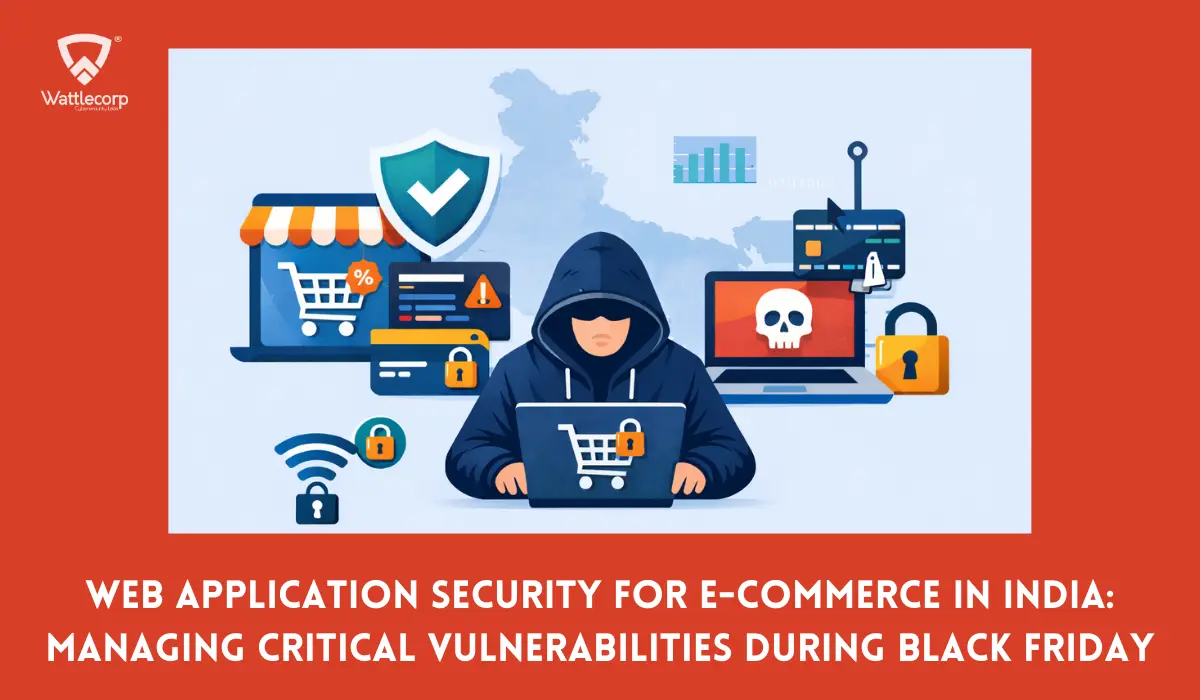
Web Application Security for E-commerce in India: Managing Critical Vulnerabilities During Black Friday
Key Takeaways:
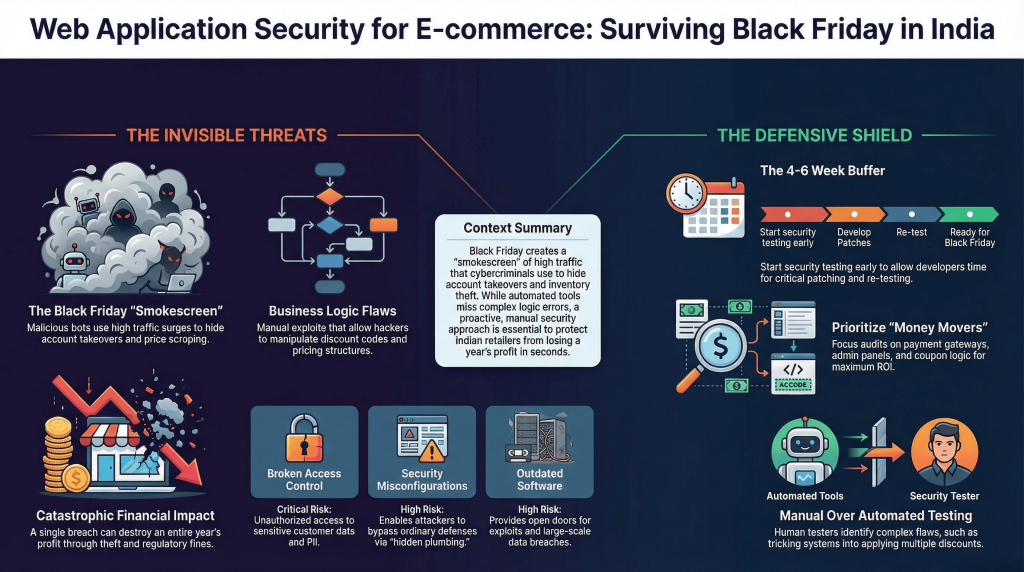
- Cybercriminals utilize the festive offers like Black Friday traffic as a strategic smokescreen to hide account takeovers and inventory theft right under your nose.
- Automated security scans are blind to the “Business Logic Flaws” that allow sophisticated hackers to manipulate your prices and discount codes manually.
- The real cost of a Black Friday breach isn’t just a lost sale; it’s the permanent loss of customer trust and a year’s worth of profit gone in seconds.
- Waiting until the week before a sale to test your defenses is like neglecting data security, as critical patches require a buffer that most brands ignore.
- For small D2C brands, focusing on money movers rather than a total audit is the difference between surviving the holiday rush and facing financial fraud.
Web Application Threats in E-Commerce: Navigating Black Friday’s Cyber Risks
Web Application Security for E-commerce is the frontline defense for Indian online retailers facing record traffic, real-time attacks, and strict data protection laws.
When millions of Indian shoppers hit “Add to Cart” at midnight, security logs often resemble a battlefield.
Web Application Security becomes incredibly difficult, especially during high-traffic events, because malicious traffic hides within legitimate user activity.
Such a large number of users creates an ideal smokescreen for “Grinch Bots” to scrape prices or buy out stock, causing genuine customers to experience delays and out-of-stock messages.
It’s not just about lost sales during downtime. For an e-commerce brand in India, a breach often means that PII (Personally Identifiable Information) ends up on the dark web.
The reputational impact can be catastrophic in the long term, as Indian customers are becoming increasingly sensitive to brands that fail to protect their personal and financial information.
A single Black Friday incident can destroy a year’s worth of profit through direct financial theft and significant regulatory fines.
With India’s data protection and digital governance frameworks overseen by MeitY, e-commerce platforms are expected to take reasonable security measures to protect customer PII and prevent preventable data breaches.
Understanding Critical Vulnerabilities in Modern E-commerce Platforms
Attackers do not always take the front door. To truly master Web Application Security for E-commerce, you have to look at the hidden plumbing of your site.
Many of these vulnerabilities align with real-world attack patterns, which are highlighted in advisories issued by CERT-In, India’s national cybersecurity agency, particularly during these high-traffic sale events.
Where Most Indian Sites Fail:
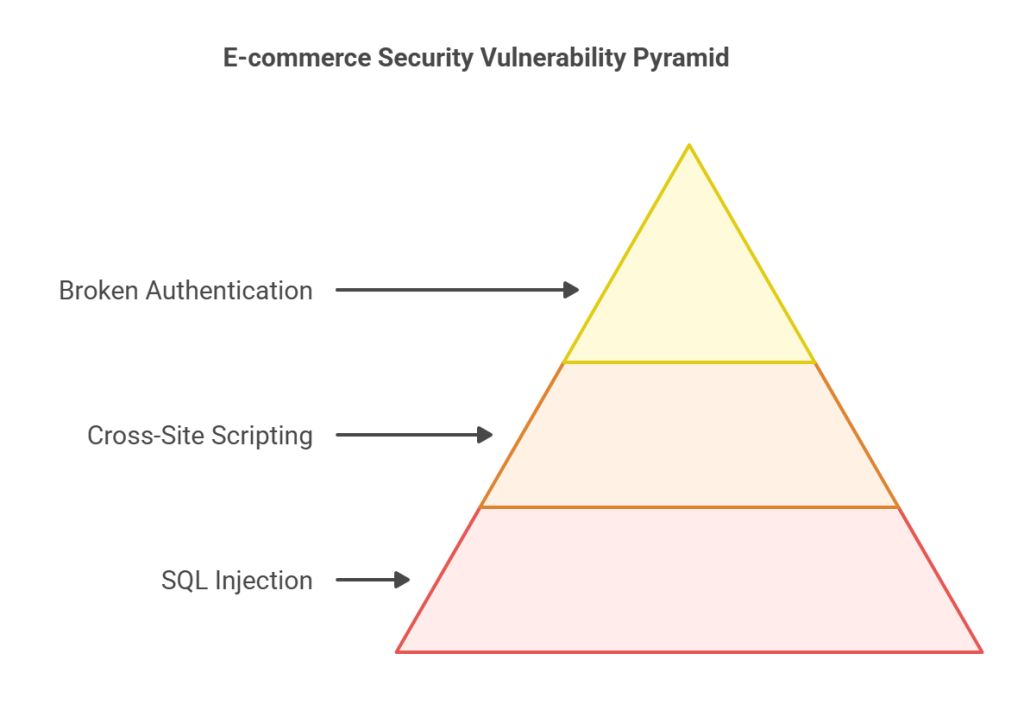
- SQL Injection (SQLi): This is a traditional method but still deadly. An attacker sends an unauthorized query through your search bar and suddenly has your entire database.
- Cross-Site Scripting (XSS): This happens when a threat actor injects a script into your site that steals your customers’ session cookies.
- Broken Authentication: If your session timeouts are too long or your passwords are weak, attackers can hijack real user accounts during the holiday rush.
In 2025, attackers are increasingly exploiting vulnerabilities that don’t require login access, making them easy targets for automated bots.
Recent statistics indicate that broken access control and security misconfigurations are the most common vulnerabilities that are identified during professional penetration tests.
These concealed plumbing malfunctions normally enable the attackers to bypass the ordinary defenses and have unauthorized access to the sensitive e-commerce data.
Addressing common Penetration Testing Vulnerabilities and outdated software is no longer optional, as these remain the most frequent entry points for large-scale data breaches.
The Importance of Security for E-commerce Sites Before Black Friday
Why target Black Friday? Because that’s when your team is most distracted. In India, we see a massive spike in “Account Takeover” attacks right before the big sale.
Attackers know that with thousands of transactions happening every minute, a few fraudulent ones might slip through.
Reserve Bank of India (RBI) influences payment security architecture (tokenization, storage restrictions), while PCI DSS compliance is mandated by card schemes and acquiring banks.
If you’re taking payments in India, PCI DSS isn’t a suggestion, it’s a requirement. Beyond that, the surge in digital payments means your “attack surface” is huge.
One bad integration with a third-party coupon app could lead to a catastrophic data leak.
Also Read : Top 10 E-commerce Security Threats In 2024
E-commerce sites are a gold mine for attackers because they house everything from home addresses to credit card details.
After looking at a wide range of security tests, we’ve pinpointed the most dangerous threats that are currently putting online stores and their customers at risk.
E-commerce sites are a gold mine for hackers because they house everything from home addresses to credit card details.
While most brands focus on the front-end shopping experience, these common web application vulnerabilities are the silent killers lurking in your site’s code, waiting for the holiday traffic spike to turn a small oversight into a full-scale business collapse.
After looking at a wide range of security tests, we’ve pinpointed the most dangerous threats that are currently putting online stores and their customers at risk.
How Penetration Testing Identifies and Fixes Vulnerabilities
Vulnerabilities are also invisible, and until they are provoked deliberately; this requires an effective Web Application Security, which is an offensive security posture that goes beyond passive monitoring.
Penetration testing simulates targeted attack scenarios within defined scope, not full adversary emulation.
While many penetration testing companies in India rely on automated software, the best results come from manual testing.
Core Application Security Testing Areas
- Scans API traffic and parameter manipulation, as well as validation logic in the backend to identify trust between client and server.
- Performs testing on session lifecycle management like token generation, rotation, reuse and expiration with multiple users.
- Authorization enforcement is tested across roles and workflows to detect privilege escalation and access control weaknesses.
- Audit third-party integrations and webhook endpoints for insecure configurations, excessive permissions, and data exposure risks.
- Associates error responses with application logs to detect information leaks and accidental behavior in edge cases.
Also Read : Why Penetration Testing is Essential for Secure API Development
The right validations assist in ensuring that security controls are resilient when used under concurrent conditions, complex workflows and realistic attack conditions.
A human can spot a “Business Logic Flaw”, like a trick that lets a user apply a 90% discount code ten times in the same order. Automated tools usually miss these subtle errors which affect the Web Application Security for E-commerce during Black Friday offers.
Choosing the right security partner is about more than just filling out a compliance form. You need a team that won’t just run a quick scan, but will actually conduct in-depth manual testing to find the flaws a machine might miss.
Best Practices for Securing Your E-commerce Website
If you want to be secure and survive in the exciting 2026 holiday season while online purchase, here is your non-negotiable checklist for Web Application Security for E-commerce:
- Encryption and Secure Payment Gateways: Encryption protects confidentiality, but must be paired with access control, key management, and monitoring.
- Regular Security Audits: Static code is easy to attack. Ensure to run routine vulnerability assessments and deep-dive code reviews to identify and resolve the flaws before hackers do.
- Strong Authentication Mechanisms: Passwords alone are not enough anymore to secure our data. Implement Multi-Factor Authentication (MFA) for every user and admin to create a secondary wall against unauthorized access.

- Keeping Software Up-to-Date: Outdated software is an open door for exploits. Patch your vulnerabilities immediately and automate updates to stay one step ahead of emerging threats.
- User Awareness: Your security is only as strong as its human element. Guide your team and your customers how to spot scams and follow digital safety best practices.
These measures aren’t best practices anymore, they’re the minimum standard for protecting revenue, data, and customer trust for improving the Web Application Security for E-commerce.
Think of this as a penetration testing guide not as a technical manual, but as a survival map that helps you move beyond basic compliance and into a proactive mindset where you break your own systems before a stranger does it for you.
Making Web Application Security a Core E-commerce Business Priority
The security in e-commerce is not a technical challenge; it is a guarantee of security you give to all customers who entrust their information to you.
A secure storefront among Indian retailers is a competitive advantage that would turn one-time buyers into life long brand supporters.
With the mounting pressure of the holiday season, the most effective leaders are the ones who do not consider Web Application Security for E-commerce as an emergency cost, but rather a strategic investment in the sustainability of their brand.
At Wattlecorp, we feel that resilience is achieved by manual testing performed by humans, who can spot the complex business logic errors that automated tools cannot detect.
Don’t allow an otherwise successful sale to be tainted by an avoidable weakness. In choosing security nowadays, you are not only securing code but you are securing trust, loyalty and your business future.
Our specialized Web Application Penetration Testing service is designed to find the gaps in your defense before they cost you money.
Want to protect your e-commerce website before Black Friday? Book a Free Consultation with Wattlecorp’s experts.
Web Application Security for E-commerce FAQs
1. Should organizations using Shopify conduct regular VAPT for their e-commerce applications?
Not entirely. While Shopify secures the core infrastructure, you are responsible for the custom layers. In the Indian ecosystem, heavy reliance on third-party apps, custom themes, and local logistics APIs creates unique entry points. Regular VAPT, Vulnerability Assessment & Penetration Testing is essential to identify flaws in these specific integrations that standard platform security won’t catch.
2. What is the minimum security testing recommended for small D2C businesses with limited budgets?
Adopting a risk-first approach is the thing. If a full audit is not feasible, prioritize money movers like payment gateway integrations, admin panel access, and coupon logic. Because these are the prime targets for exploitation during sales. Testing your customer login flow and exposed APIs ensures you prevent the most damaging events, financial fraud and data leaks without overextending your budget.
3. What is the ideal timeline for Pre-Sale security testing?
Start at least 4–6 weeks before major events like Black Friday. Finding a vulnerability is only step one; your developers need a buffer to implement fixes, and security teams need time for a re-test. You don’t want to be patching a critical Zero-Day flaw 48 hours before your biggest traffic spike of the year.
4. Is our payment flow 100% secure if our gateway is PCI DSS compliant?
No. A secure gateway is only half of the equation; the bridge connecting your store to that gateway is your responsibility. We frequently see Indian stores with insecure redirects or exposed tokens. If the integration is flawed, attackers can intercept payments or manipulate checkout values, leaving your business liable for regulatory penalties despite the gateway’s compliance.
5. What’s the real difference between a vulnerability scan and penetration testing?
Both vulnerability scan and penetration testing know their unique signatures. Penetration Testing is the fire inspector who checks if the fire escapes are actually blocked. Automated tools excel at finding low-hanging fruit, but they miss complex business logic errors that only a manual human tester can uncover.

 Qatar Cybersecurity Boardroom Accountability: Why QCB and NCSA Now Expect Executive Ownership
Key Takeaways: Cybersecurity in Qatar is increasingly becoming an executive governance responsibility, with national cybersecurity initiatives and sector-specific requirements encouraging organizations to establish stronger leadership oversight. QCB and NCSA play important roles in strengthening cybersecurity governance in Qatar, with QCB focusing on financial sector requirements and NCSA supporting national-level cybersecurity coordination and guidance. Executives can’t […]
 Data Privacy Consulting for Saudi Enterprises: How to Operationalize PDPL Data Subject Rights in 2026
Key Takeaways: The Saudi data protection law may apply to organizations outside the Kingdom when they process personal data related to individuals in Saudi Arabia, meaning geographic location alone does not automatically exclude an organization from PDPL obligations. PDPL data subject rights span access, correction, deletion, and consent withdrawal, and enterprises are on the hook […]
 Third-Party Vendor Security Risk Assessment Under DPDP: A Guide for Indian Enterprises
Key Takeaways: Third-party vendor risk assessment with DPDP practices helps Indian enterprises to verify that external partners handle personal data with adequate safeguards. The Digital Personal Data Protection Act holds data fiduciaries accountable for vendor conduct, which makes due diligence a legal and operational necessity. A structured vendor security questionnaire, covering encryption, access control, and […]
 Virtual CISO Services for UAE Free Zone Startups: Affordable Security Leadership for Growing Companies
Key Takeaways: Most startups already hold sensitive data such as customer info, source code, financials, long before they feel big enough to take security seriously, and that’s exactly when the risk starts. A virtual CISO gets you someone who’s done this before, setting up strategy and guiding compliance, without the cost of putting a full-time […]
 SOC as a Service for Indian BFSI and FinTech Companies: 24/7 Monitoring for CERT-In Readiness
Key Takeaways: SOC as a Service for BFSI and FinTech India gives banks, NBFCs, insurers and digital lenders continuous security visibility without the cost and hiring effort of building an in-house operations centre. CERT-In directions require regulated entities to report qualifying cyber incidents within six hours of detection, and implementing SOC for BFSI and FinTech […]
 SOC as a Service in India: How It Works, Pricing, and Why Businesses Need It
Key Takeaways: SOC as a Service helps Indian businesses to get 24×7 security monitoring without huge cost and complexity of building a full in-house security operations center. A managed SOC check and analyse beyond basic log monitoring, which combining SIEM, threat intelligence, analyst-led alert triage, incident escalation, reporting, and security response support. SOC as a […]