


UAE PDPL 2025: Essential Compliance Insights for Organizations

What Is the UAE’s PDPL?
The UAE’s PDPL compliance is the abbreviation of the Personal Data Protection Law of the United Arab Emirates. In official terms, this is known as Federal Decree-Law No. 45 of 2021, and it came into effect on January 2, 2022.
The purpose behind this is to establish compliance among all UAE-based companies on how the personal data they process is handled, collected, processed, stored, and transferred within the nation. Also, any business having access to the UAE residents’ data is subject to following this rule.
The UAE Data Office announced that enforcement of full compliance will begin by December 2025. Moreover, based on the recent May 2025 compliance guidelines, non-compliant businesses will be charged penalties up to AED 1 million. This implies the necessity of PDPL, as neglecting it could cause reputational damage, resulting in loss of trust.
Who Must Comply with the UAE PDPL?
The UAE’s PDPL compliance applies to any organization that collects or processes personal data in the UAE region. This includes both data controllers and data processors that specifically have access to data subject of the UAE nationals/residents.
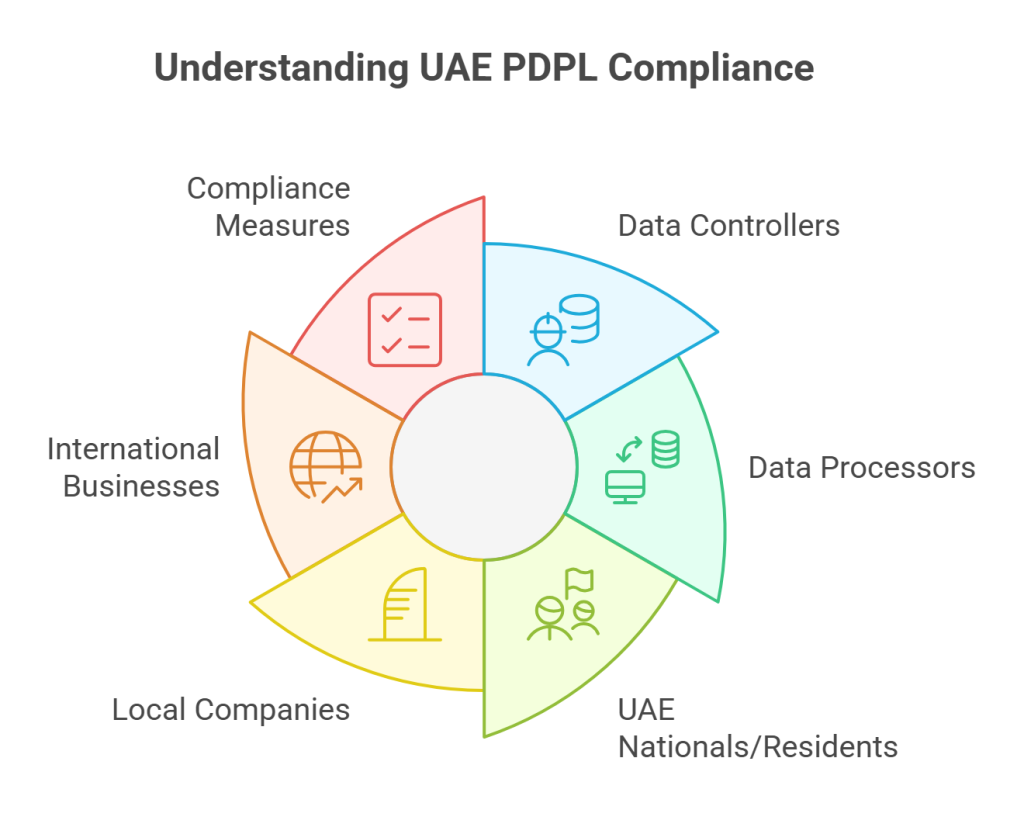
If your business is established in the UAE and you process the personal data of people in the UAE, then PDPL should be followed. It means local companies operating in the UAE must treat personal data securely and follow the compliance framework. Also, if any website, app or service targets UAE residents and have control over their data, even if your company is registered is another nation, you must comply with the UAE’s PDPL compliance.
All businesses that come under the scope of the UAE’s personal data protection law must strictly follow the compliance measures. The necessary steps include keeping track of processing activities, and aligning by the consents lawfully. Moreover, in crucial cases assigning a Data Protection Officer and performing Data Protection Impact Assessments is necessary.
Key Principles Involved in the UAE PDPL Compliance
Transparent processing (Lawfulness, Fairness, and Transparency)
All personal data must be processed in lawful terms, which implies that the data collected or used must align with the rightful purpose. While your businesses collect this data, you must be clear on the reason keep it transparent on why you collect it, how you use it, and who you share it with.
Purpose and retention limits
Data collected should only be used for the defined purpose, and it should not be processed for any other new reasons without prior notice. Also, your business must limit the data collection, which means you source only needful data to fulfill your purpose.
Also Read : The Role of Data Protection Officers (DPOs) Under the UAE PDPL
In addition, organizations must take essential steps to retain the data they acquired. Once the purpose is fulfilled and the data is no longer needed, it must be deleted or anonymized. Such retention schedules must be regulated responsibly.
Security and technical safeguards
Protecting the data you collect is essential, so you must take appropriate technical and organizational measures, including access controls, pseudonymization, breach detection, encryption, and logging. Stronger security measures should be enabled when it comes to accessing sensitive or large datasets.
Data subject rights
The data you collect can be controlled and deleted by the original owner. They can even correct, delete, or remove access from the business’s visibility. Such rights should be provided in simple ways, and those individuals’ requests should be resolved within short timelines.
Documenting the identified
To show the proof of the practical compliance framework, your business must maintain a clear record of the processes performed, decisions, and measures taken. Keep a clear data inventory, written policies, and documented procedures that clearly define what you do with personal data.
Data protection impact assessments
There are instances where handling sensitive datasets poses risks. In such cases, an impact assessment on the data must be done to identify and reduce the possible risks that may arise. You can also take advantage of the penetration testing service in the UAE and analyse the strength of your environment.
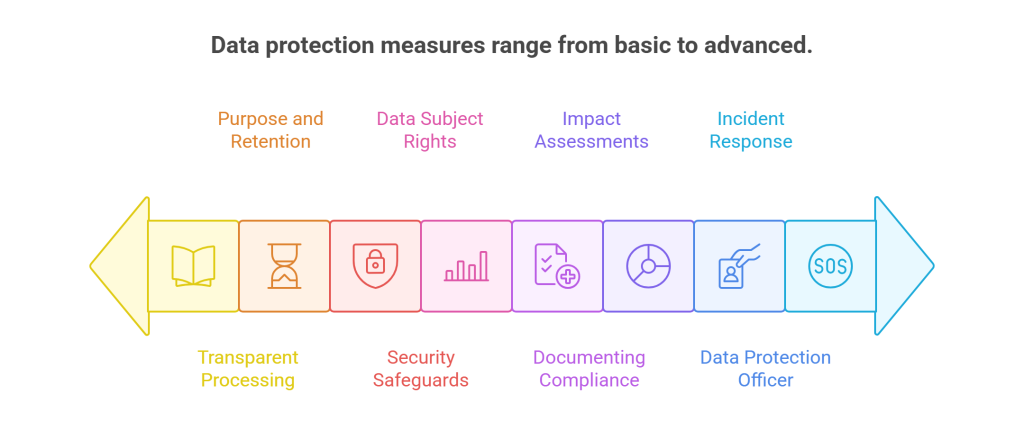
Assigning a Data Protection Officer (DPO)
Businesses involving large datasets are prone to risks, and having a responsible official to manage the data protection tasks is essential. Appointing a Data Protection Official will help secure data and reduce penalties resulting from non-compliance.
Incident response
During critical times such as data breaches, organizations must have an incident response plan and notify the regulator and affected individuals promptly. Quick threat detection, containment, and clear notification actions can limit the harm. Moreover, these measures prove the responsible handling of PDPL compliance.
Steps Businesses in the UAE must follow for PDPL Compliance in 2025
Conduct a PDPL gap analysis
Initiate a comparative study on your existing data practices with the PDPL requirement. This will help you spot the missing areas or gaps, and you can take efforts on new controls and policy updates. With the analyzed results, take effective measures, prioritizing to fix the high-risk first.
Map personal data
Make a simple inventory of all the personal data you collect. Have a history of where it is stored, who can access it, and why you hold it. Classify that data based on the sensitivity level so that you can project stronger protection on such datasets.
Update privacy notices and lawful bases
Rewrite privacy terms in simple language while acquiring consent from the people. Record the lawful basis for each processing activity, so that it will help you respond quickly to regulator queries and data-subject requests.
Also Read : Ensuring Data Privacy Compliance: Essential Steps For UAE Businesses
Strengthen contracts with vendors
Verify the contracts you have enabled with the processors and third parties and ensure that they abide by the PDPL security requirements. Businesses must define a strong vendor contract so as to allow lawful management of data and avoid legal risks. Also, keep the vendors and associated parties informed about contractual rules through clear instructions and liability clauses.
Implement technical security
Enable secure controls by limiting access and following encryption methods. Clear policy implementation, role-based and regular security checks are the ideal organizational measures that keep data safe.
Prepare for high-risk processing
Identify projects that involve large-scale or sensitive data processing and perform simple Data Protection Impact Assessments (DPIAs). If your organization does high-risk processing, you must consider appointing a Data Protection Officer.
Train staff
It’s essential to provide regular training for employees about basic data protection rules and to train them on spotting risks at an early stage. Keeping them informed about the potential risks and breach paths can help businesses restrict emerging threats.
Document and regularly monitor
Keep records of processing activities, DPIAs, data-subject requests, breach logs, and vendor assessments. Follow with simple monitoring and periodic reviews to recognize changes in processing or new risks.

The UAE’s Personal Data Protection Law is a crucial requirement imposed on any business that deals with UAE residents’ data. The law protects individuals’ privacy and builds customer trust, eventually keeping the business active. However, understanding and meeting every requirement can feel complex without the right guidance.
Such businesses need experts to deal with this situation, and Wattlecorp simplifies this process. Our team of data protection experts deeply screens your existing practices, identifies gaps, and helps you to achieve PDPL compliance. Through our PDPL audit services, we recheck your policies, cross-verify vendor agreements, and strengthen your security framework to keep your data protected and business aligned with the UAE’s regulatory standards.
PDPL Compliance FAQs
1.What are the main obligations for organizations under PDPL in the UAE?
Businesses must process data according to the law they proposed, and they must abide by the purpose transparently. They should also maintain records, respect data-subject rights, and appoint a DPO in case of managing highly sensitive datasets.
2.How frequently should security assessments or pentests be done under PDPL?
There is no definite timeline for penetration testing, but businesses must perform tests periodically. You must do testing at regular intervals, like annually or after system updates. This can help you detect gaps and take necessary measures.
3.What penalties or enforcement mechanisms are expected under PDPL in the UAE?
If your business in the UAE does not comply with the PDPL compliance, you can expect administrative fines, and corrective orders. Based on the recent update, the penalty can go up to AED 1 million.

 Mobile Application Penetration Testing for Qatar Government Digital Services: NCSA- Aligned Security Assurance
Key Takeaways: Mobile Application Penetration Testing Qatar must cover the app, device storage, APIs, authentication and third-party components. Qatar’s NCSA assurance environment combines the National Information Assurance (NIA) Standard, the National Information Security Compliance Framework (NISCF) and accredited security assessment services. OWASP MASVS defines mobile security controls, while MASTG supplies practical test methods for Android […]
 Qatar Data Protection Law: Implementing PDPPL Data Subject Rights Processes for Businesses
Key Takeaways: The Qatar Data Protection Law (Law No. 13 of 2016) for Personal Data Privacy Protection, grants individuals specific rights such as right to access, correct, erase, object, withdraw consent, and right to be notified of processing or inaccurate disclosure. Beyond having a privacy policy, businesses or controllers, under Article 11 of Personal Data […]
 AI Governance for Indian Enterprises: Building Internal Controls Before Key DPDP Obligations Take Effect
Key Takeaways: The DPDP Act does not contain AI-specific provisions. Its requirements, however, apply in situations when an AI system processes digital personal data within its territorial and material scope. India is working on building a broader governance framework around safety, accountability, transparency and trust via programs like the IndiaAI Mission. Indian organizations should inventory […]
 Cloud Security Audit for UAE Government Cloud Migration: NCAP and Security Requirements
Key Takeaways: A cloud security audit UAE helps government entities identify security, governance, configuration, access, data-protection and resilience gaps, before and after shifting critical workloads to the cloud. UAE National Cloud Security Policy has defined cloud governance, data security, data sovereignty, IAM, incident management, resilience, portability and cloud operations requirements. The National Cyber Accreditation Program […]
 Data Privacy Consulting UAE – Building a PDPL-Compliant Data Governance Program
Key Takeaways: PDPL compliance requires ongoing operational governance that goes beyond policies to demonstrate how personal data is collected, used, protected, transferred, retained, and deleted. Data mapping helps businesses move from reactive compliance to proactive risk management by establishing a comprehensive inventory of the data ecosystem, helping build a mature data privacy and governance program. […]
 Saudi Arabia’s Critical Systems Controls: What CSP-Linked Enterprises Must Comply With in 2026
Key Takeaways: The Critical Systems Cybersecurity Controls (CSCC) are more applicable to critical systems than to all IT assets owned or operated by an organization. To be in full compliance or to remain in full compliance with CSCC, organizations must maintain continuous adherence to NCA ECC. CSCC has 32 core controls and 73 sub-controls across […]