

Does a Compliance Certificate Guarantee SaaS Security? The Facts vs. the Myths
Having served SaaS organisations secure their SaaS platforms over the years, we’ve been faced with the one recurring question – whether a compliance certificate is enough to ensure security. Though compliance certifications, such as ISO 27001, GDPR, and SOC 2 are considered trusted standards for compliance, the fact that these cannot wholly ascertain robust SaaS security is a rough reality. In this blog, we share our perspective as cybersecurity experts, debunking myths around compliance certificates and explaining why they represent just one piece of the security puzzle. We will also outline how businesses can build a comprehensive security strategy that goes beyond compliance to effectively protect their SaaS platforms.
Does a Compliance Certificate Guarantee Full SaaS Security?
SaaS compliance certifications, such as ISO 27001, SOC 2, and GDPR are highly regarded for setting high security standards on data protection and privacy. However, SaaS platforms cannot thoroughly achieve security assurance despite undergoing rigorous audits and ultimately certification. This is where the confusion arises.
We as Wattlecorp cybersecurity professionals recognise the importance of ISO 27001, GDPR, and SOC 2 in ensuring SaaS security. We are also aware that these certifications are not synonymous with complete protection. At the same time, you need to be intuitive enough to discover and uphold to derive total security for your SaaS applications. You should also ensure the safety of the SaaS platforms and networks associated. So what does it take for SaaS to remain completely secured? Bear in mind that a compliance certificate can only denote adherence to specific compliance standards. Whereas, deriving true SaaS security demands undergoing constant vigilance and adopting proactive measures.
Understanding SaaS Security Beyond Compliance Certificates
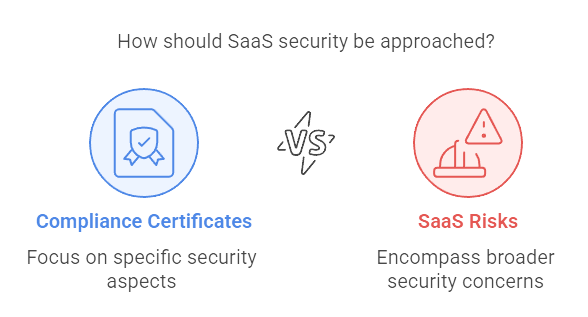
When it concerns SaaS security compliance, you need to understand that compliance certificates primarily focus on certain aspects of security, such as data access controls, encryption, and internal processes. However, compliance certificates vs. SaaS risks (bold keyword) show that there is much more to securing a SaaS platform than meeting regulatory standards.
1. Compliance Certification Does Not Cover Every Vulnerability
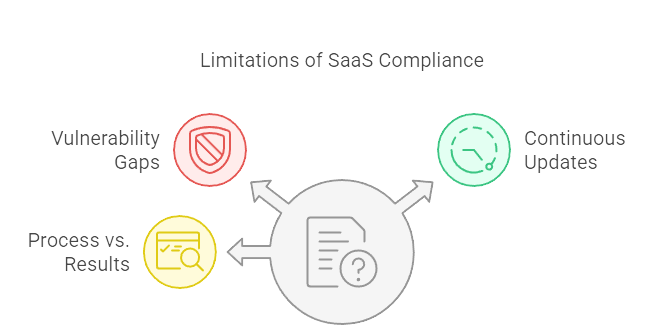
While certifications like SOC 2 and ISO 27001 do examine critical aspects of security, they may not cover all potential vulnerabilities in a SaaS platform. Take for example a single SaaS platform that meets GDPR compliance for data privacy, but leaves out more pertinent-cum-newer risks. These can include anything, such as zero-day vulnerabilities or sophisticated phishing attacks. If our compliance standards miss any of these parameters, chances are that they can directly or indirectly compromise user data.
2. Compliance May Not Be Continuously Updated
The cyber threat landscape is constantly evolving. Your SaaS application and platform can fall hard if you do not do the needful to help them stay ahead of upcoming threats. A SaaS platform that is certified today may not be prepared for the threats of tomorrow. This highlights the importance of ongoing security practices like regular penetration testing, continuous monitoring, and updating security protocols. Compliance guarantees for SaaS should not be confused with ongoing, proactive security measures. This gap underscores the need to conduct regular vulnerability assessments and proactive threat detection, which Wattlecorp provides as part of its SaaS security services.
3. Compliance Focuses on Processes, Not Results
A majority of the SaaS security compliance facts (keywords) center on how an organisation handles security. These typically focus on the incident response procedure, access control regimen, and auditing procedures. Amid these activities, what goes amiss is checking whether the real infrastructure or code of the SaaS platform is adequately secure or not. For example, a platform might be compliant with security regulations, but its API security buildup may not be adequate. At other times, it may be low on endpoint protection. Wattlecorp bridges this gap by strengthening both processes and outcomes for its clients.
Myths of SaaS Compliance Guarantees: What You Need to Know
There are several myths of SaaS compliance guarantees that businesses often fall for. These misconceptions can result in false confidence and expose them to avoidable risks. Below you’ll find the most common myths versus real implications surrounding SaaS compliance certificates:
Myth 1: A Compliance Certificate Means the SaaS Platform is 100% Secure
This is perhaps the biggest myth. While compliance certificate SaaS security can indicate that a platform adheres to basic security standards, it doesn’t mean that the platform is immune to cyberattacks. Cyber threats evolve daily, and no compliance certification can guarantee immunity against new forms of attacks, such as ransomware or advanced persistent threats (APT). Wattlecorp goes beyond certifications, implementing continuous monitoring and advanced threat detection.
Also Read : The Business Impact of Compliance Failures in SaaS
Myth 2: All SaaS Platforms with Compliance Certificates Are Equally Secure
Just because a SaaS platform has a compliance certificate doesn’t mean all certified platforms are equally secure. Some platforms may implement security best practices in their infrastructure, while others may only meet the minimum required standards. Businesses should assess a platform’s specific security measures beyond compliance, such as encryption, multi-factor authentication (MFA), and vulnerability patching.
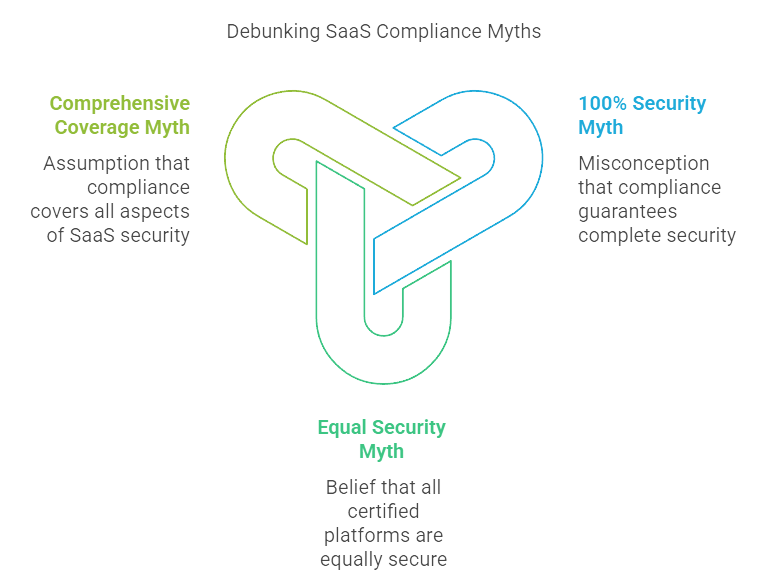
Myth 3: Compliance Certifies Security for All Aspects of SaaS
Compliance certification may focus on some areas, but it does not cover everything in a SaaS environment. For instance, while a certification may verify encryption at rest and in transit, it may not address risks at the endpoint. This can be the most vulnerable point in a SaaS system and can prove to be the most critical within the remote work environment.
Facts Regarding SaaS Security and Compliance Certification
The relationship between SaaS compliance and SaaS security is not as straightforward as it might appear. Let’s now break down the facts vs. myths of SaaS Security to clarify the true role of compliance certification for you.
Fact 1: Compliance Is a Foundation, Not the Whole Solution
Compliance certificates are the baseline for SaaS security, ensuring that the platform follows industry standards for data protection, access controls, and privacy. However, SaaS security compliance myths often obscure the reality: Compliance certificates vs SaaS risks show that organisations must implement additional security strategies for obtaining complete protection. We at Wattlecorp believe compliance to be the foundation for SaaS security. This allows us undertake a proactive approach to help ensure a secure and trustworthy SaaS environment for you. Additionally, understanding that security gaps can still exist, we can also facilitate you to stay adherent to industry standards. Note that being compliant doesn’t address real-time threat detection or patch management.
Fact 2: SaaS Security Is an Ongoing Effort
While compliance certification can be achieved through periodic audits, SaaS security is an ongoing process that requires continuous improvement. Certifications alone do not guarantee long-term security. Security controls should be routinely assessed, updated, and tested to address evolving threats. Our approach focuses on ongoing improvements through regular penetration testing, vulnerability assessments, and round-the-clock monitoring.
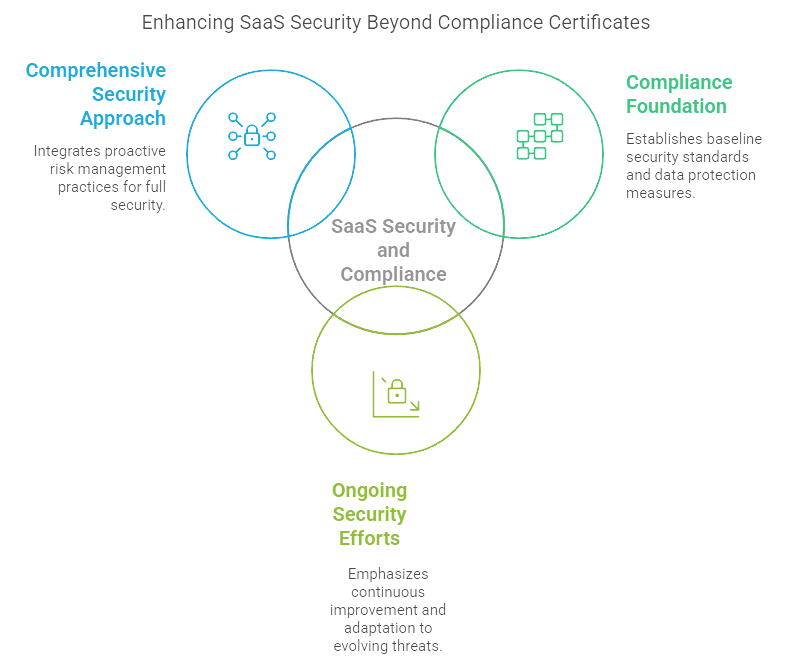
Fact 3: Understanding SaaS Security Beyond Compliance Certificates
One of the most important takeaways is that businesses need to adopt a more comprehensive approach to SaaS security compliance. Relying only on compliance certificates may leave gaps in your security posture. Consider integrating the following proactive risk management practices to ensure full security of your SaaS platform:
- Vulnerability assessments and penetration testing
- 24/7 security monitoring and incident response plans
- Endpoint protection for SaaS users
- Data encryption and secure access controls
Also Read : Understanding the Unique Vulnerabilities of SaaS Products: Insights from ASP
Common Misconceptions About SaaS Compliance Certificates
There are several misconceptions that organisations have regarding SaaS compliance certificates. These misunderstandings can lead to complacency, making businesses more vulnerable to cyber risks.
1. Compliance Means I’m Covered for All Types of Risks
Compliance certificates typically focus on specific risk areas and do not provide all-encompassing protection.While they may address security and privacy concerns, other vulnerabilities—such as those in SaaS apps, third-party integrations, or end-user devices—may be overlooked.
2. SaaS Compliance Certification Guarantees No Data Breaches
Data breaches can happen for many reasons, including human error, outdated software, and new attack vectors.Compliance does not offer a 100% guarantee against data breaches. It simply ensures that the platform meets established security standards.
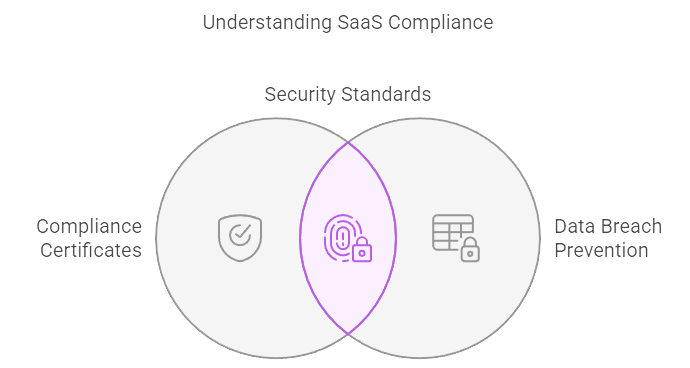
Achieving full SaaS security beyond compliance certificates is key to addressing and resolving potential security concerns for SaaS platforms. While SaaS compliance is essential to ensuring data security, it should not be seen as a catch-all solution. Understanding the facts about SaaS security compliance and debunking the myths of SaaS compliance guarantees will help businesses create a more holistic security strategy. Wattlecorp believes in a layered approach to help you achieve SaaS security compliance. This goes beyond meeting regulatory requirements and incorporates continuous monitoring, vulnerability management, and proactive security measures. To fully protect your SaaS infrastructure and data, we recommend investing in comprehensive security strategies that extend compliance certification.
Join Wattlecorp SaaS Security Program and derive explicit insights on the essentials of continuous SaaS Security. Because, with Wattlecorp, you’re not only compliance certified, you enjoy lasting security benefits! Want to know more about our ASP program? Visit our service page or directly book an appointment with us and we’ll provide you with the necessary details regarding the same. If you wish, we can also set up a tailored security program for your organisation.
Compliance Certificate FAQs
1. What are the limitations of SaaS compliance certifications?
Compliance certifications primarily address specific areas like encryption, access controls, and internal processes, but often miss modern threats such as zero-day vulnerabilities or phishing attacks. The fact that these standards are not updated enough to move according to the rapidly evolving threat landscape make them highly challenging in terms of compliance certification. This can significantly leave critical gaps in security – calling for a more proactive approach to address such emerging risks effectively.
2. How can businesses enhance SaaS security beyond compliance?
To enhance SaaS security beyond compliance, businesses should adopt a multi-layered approach that includes penetration testing, endpoint protection, 24/7 monitoring, and incident response to address vulnerabilities and detect threats. Robust access controls, multi-factor authentication, and data encryption further strengthen security, while proactive threat management with advanced tools and regular updates ensures resilience against evolving risks.
3. Are all certified SaaS platforms equally secure?
Not all certified SaaS platforms offer the same level of security. While compliance certifications set a baseline, some platforms go beyond by implementing advanced measures like multi-factor authentication, encryption, and real-time monitoring.
Others may meet only the minimum requirements to achieve certification, leaving potential vulnerabilities unaddressed. Businesses need to regularly assess the security practices of their SaaS providers rather than relying solely on ensuring compliance with relevant standards. Choosing platforms with robust, proactive security measures

 Mobile Application Penetration Testing for Qatar Government Digital Services: NCSA- Aligned Security Assurance
Key Takeaways: Mobile Application Penetration Testing Qatar must cover the app, device storage, APIs, authentication and third-party components. Qatar’s NCSA assurance environment combines the National Information Assurance (NIA) Standard, the National Information Security Compliance Framework (NISCF) and accredited security assessment services. OWASP MASVS defines mobile security controls, while MASTG supplies practical test methods for Android […]
 Qatar Data Protection Law: Implementing PDPPL Data Subject Rights Processes for Businesses
Key Takeaways: The Qatar Data Protection Law (Law No. 13 of 2016) for Personal Data Privacy Protection, grants individuals specific rights such as right to access, correct, erase, object, withdraw consent, and right to be notified of processing or inaccurate disclosure. Beyond having a privacy policy, businesses or controllers, under Article 11 of Personal Data […]
 AI Governance for Indian Enterprises: Building Internal Controls Before Key DPDP Obligations Take Effect
Key Takeaways: The DPDP Act does not contain AI-specific provisions. Its requirements, however, apply in situations when an AI system processes digital personal data within its territorial and material scope. India is working on building a broader governance framework around safety, accountability, transparency and trust via programs like the IndiaAI Mission. Indian organizations should inventory […]
 Cloud Security Audit for UAE Government Cloud Migration: NCAP and Security Requirements
Key Takeaways: A cloud security audit UAE helps government entities identify security, governance, configuration, access, data-protection and resilience gaps, before and after shifting critical workloads to the cloud. UAE National Cloud Security Policy has defined cloud governance, data security, data sovereignty, IAM, incident management, resilience, portability and cloud operations requirements. The National Cyber Accreditation Program […]
 Data Privacy Consulting UAE – Building a PDPL-Compliant Data Governance Program
Key Takeaways: PDPL compliance requires ongoing operational governance that goes beyond policies to demonstrate how personal data is collected, used, protected, transferred, retained, and deleted. Data mapping helps businesses move from reactive compliance to proactive risk management by establishing a comprehensive inventory of the data ecosystem, helping build a mature data privacy and governance program. […]
 Saudi Arabia’s Critical Systems Controls: What CSP-Linked Enterprises Must Comply With in 2026
Key Takeaways: The Critical Systems Cybersecurity Controls (CSCC) are more applicable to critical systems than to all IT assets owned or operated by an organization. To be in full compliance or to remain in full compliance with CSCC, organizations must maintain continuous adherence to NCA ECC. CSCC has 32 core controls and 73 sub-controls across […]