

From Code to Cloud: How VAPT Secures SaaS Platforms at Every Stage
Why VAPT Implementation is Essential For Securing SaaS Platforms for UAE Businesses?
There is no area of business that the SaaS platforms have left untouched – be that the bustling tech hubs of Dubai to Abu Dhabi’s government digitization initiatives. From fintech to healthcare solutions in the region undergoing rapid transformation, it’s all thanks to SaaS.
But the painful reality? Cybersecurity threats are evolving faster than ever. A recent report from the UAE Cybersecurity Council revealed a 32% increase in ransomware attacks in 2024, with a 18% increase in other forms of cyberattacks, such as phishing, scams, DOS (denial of service), etc. On top of it, Dubai-based companies experience a 40% increase in API attacks, most of these being sophisticated.
If you’re a CTO, CISO, or security architect managing SaaS platforms in the UAE, you’re probably asking yourself:
- How do I deploy fast without compromising security?
- How can PDPL compliance secure my code?
- How can I protect customer data while scaling across Emirates?
This is where Vulnerability Assessment and Penetration Testing (VAPT) comes to your aid.
This guide will show you exactly how UAE’s most successful and leading SaaS companies are implementing VAPT throughout their development lifecycle – from that first line of code in your Dubai or Abu Dhabi office to production deployment serving customers across the region.
What is VAPT?
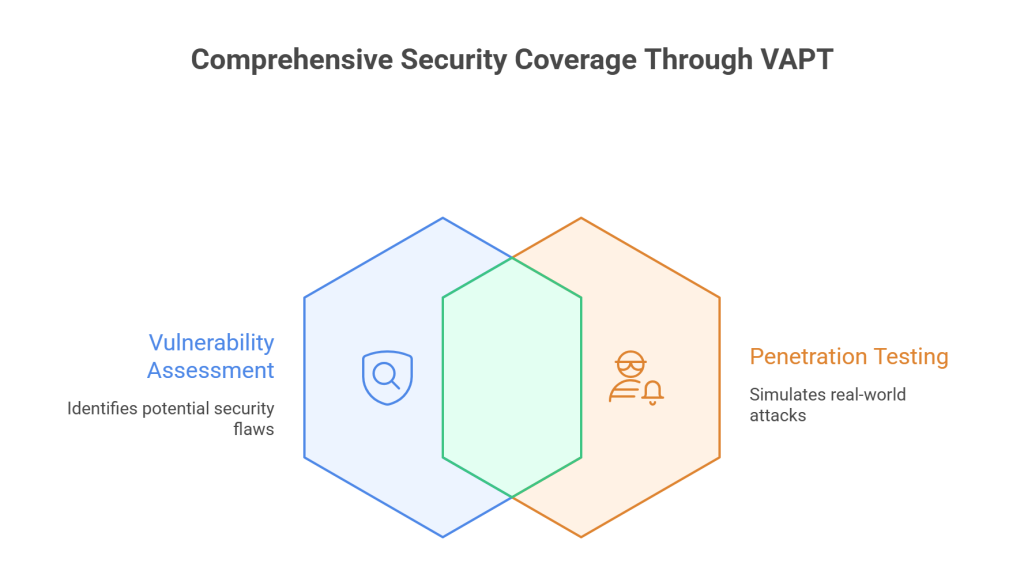
VAPT stands for Vulnerability Assessment and Penetration Testing. A combined security process that encompasses two power-packed approaches, namely Vulnerability Assessment (VA) and Penetration Testing (PT), VAPT offers a security coverage that no traditional security testing system can provide, be it for your systems, applications, or network.
- Vulnerability Assessment: Scans every aspect of your system, apps, and network to detect potential security flaws. This part of VAPT analysis may be considered as a comprehensive security health check, for it provides a more accurate picture of potentially exploitable risks.
- Penetration Testing: Ethical hackers or penetration testers simulate real-world attacks to ascertain the strength of your security posture by assessing your incident response capability. though in a controlled environment and by utilizing automated tools.
Why UAE SaaS Companies Can’t Afford to Skip VAPT
Ever thought why UAE SaaS platforms face unique challenges when undertaking security measures, especially when conducting code to cloud transfers? Here are the possible scenarios that make them complex:
- Multi-tenant Architecture Complexity: Data isolation is crucial when serving customers from Dubai’s financial district alongside Abu Dhabi’s government agencies. If you miss configuring a tenant boundary, you risk unauthorized access.
- API-First Development Reality: Since most UAE SaaS platforms today are built API-first, you may need to secure innumerable integration points. These are not only challenging, but overwhelming as well because each API endpoint is a potential entry point for attackers.
- Cloud Infrastructure Dependencies: Whether you’re running on AWS Dubai, Microsoft Azure UAE, or local cloud providers, you’re operating on a shared responsibility model. You need to know exactly what you’re responsible for securing.
- Rapid Deployment Pressure: UAE’s business environment moves fast. As a SaaS service, you are expected to deploy new features every now and then. Each deployment cycle can introduce new vulnerabilities.

Regional Security Considerations for Dubai and Abu Dhabi
Dubai’s Business District Requirements: If you’re serving Dubai’s financial sector, these mandate you to abide by additional regulations like the Dubai Financial Services Authority (DFSA). You should also strictly ensure protection of critical aspects like asset management, credit, and banking services.
Abu Dhabi Government Sector Compliance: Abu Dhabi’s government digitization initiatives come with specific security requirements. The Abu Dhabi Digital Authority (ADDA) has established frameworks that may impact your SaaS platform if you’re serving government clients.
A Step-by-Step Guide to a Complete and Successful VAPT Implementation for UAE SaaS Platforms
In this section, you’ll learn how to practically and effectively implement VAPT throughout your entire SaaS development lifecycle.
Phase 1: Development Stage (Stopping problems at their track)
What You’re Doing: Writing code, building features, creating APIs
VAPT Integration: Static Application Security Testing (SAST)
How to Implement This:
1.Set Up Automated Code Scanning
- Integrate tools like SonarQube or Checkmarx into your IDE
- Look for common vulnerabilities (SQL injection, XSS, and authentication flaws)
- Get real-time feedback as you code, also when you shift from code to cloud
2.Establish Secure Code Review Processes
- Every pull request includes security considerations
- Use security-focused checklists for code reviews
- Train your developers on common UAE-specific attack patterns

3.Implement Security-First Coding Standards
- Create coding guidelines that prioritize security
- Document approved libraries and frameworks
- Establish input validation standards for all user inputs
Why This Matters: Fixing security issues at the development stage costs 10x less than fixing them in production. Your developers learn secure coding practices from the ground up, and this is more valuable.
Phase 2: Building Your Security Safety Net (No Code Passes Through Without Getting a Green Signal)
What You Should Do: Code merging, running tests, preparing deployments
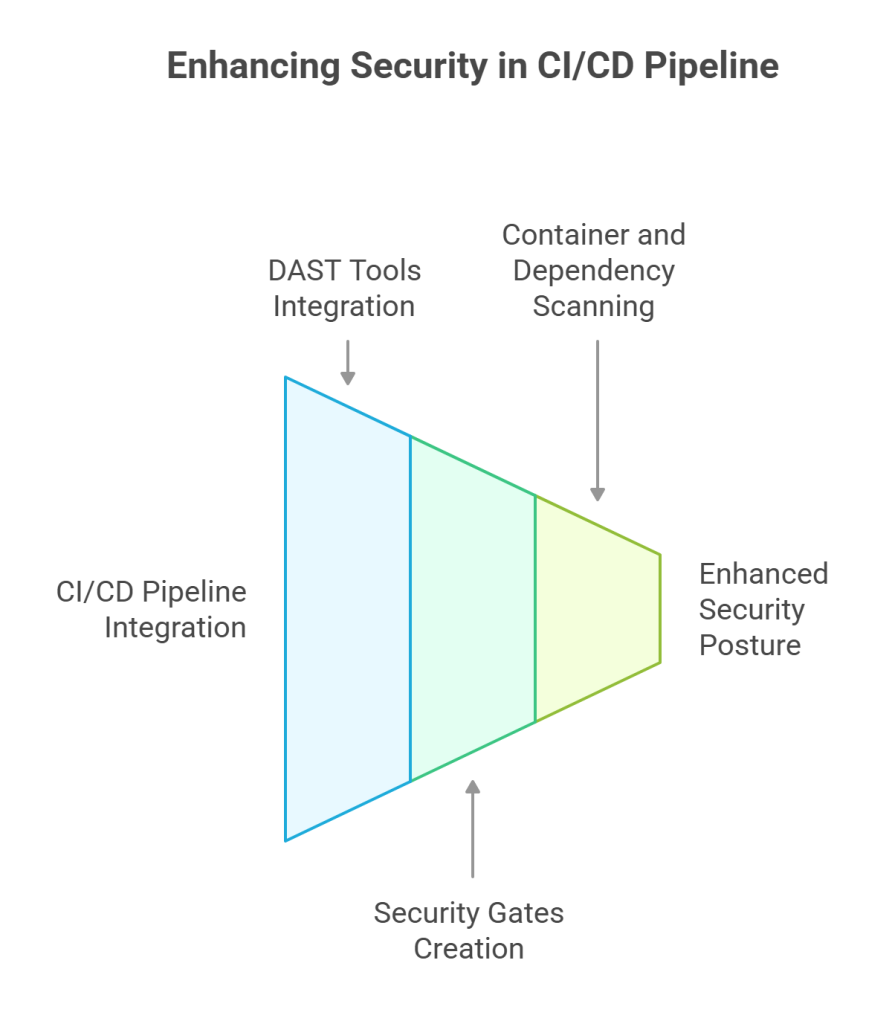
VAPT Integration: Dynamic Application Security Testing (DAST) and CI/CD Security
Your Implementation Checklist:
1.Integrate DAST Tools in Your Pipeline
- Use tools, such as OWASP ZAP for automated web app scanning
- Implement Burp Scanner for more comprehensive API testing
- Set up automated scans for every staging deployment
2.Create Security Gates in CI/CD
- Deployments automatically fail if critical vulnerabilities are found
- Implement graduated security thresholds (critical, high, medium)
- Generate automated security reports for every build
3.Container and Dependency Scanning
- Scan all Docker images for known vulnerabilities
- Monitor third-party dependencies for security updates
- Implement automated dependency updates for security patches
Dubai Business Hours Optimization: Schedule intensive security scans during off-peak hours (2 AM – 6 AM GST) to avoid impacting your development team’s productivity.
Phase 3: Pre-Production – Deep Security Validation
What you’re expected to perform: Final testing, production readiness testing, and user acceptance testing (UAT).
VAPT Integration: Comprehensive Manual Penetration Testing
Your Expert-Level Approach:
1.Professional Penetration Testing Service
- Appoint security firms familiar with UAE-specific local regulations
- Look for business logic flaws that automated tools overlook
- Consider social engineering assessments for Dubai and Abu Dhabi offices
2.Specialized API Security Testing
- Test every API endpoint for authentication bypass
- Implement automated load testing for rate limiting and abuse prevention validation
- Test API responses to look for data exposure
- Thoroughly test multi-tenant data isolation
3.Cloud Security Configuration Review
- Audit AWS/Azure configurations for UAE compliance
- Review access controls and permission boundaries
- Validate encryption at rest and in transit
- Test backup and disaster recovery procedures when moving from code to cloud with VAPT.
Recommended UAE Security Partners: Consider firms like Help AG or Wattlecorp Cybersecurity Labs that understand both technical requirements and UAE regulatory landscape when securing your SaaS platforms
Phase 4: Production – Continuous Security Monitoring
What You’ve to do: Serving customers, monitoring performance, scaling systems
VAPT Integration: Ongoing Security Validation and Monitoring
Your Continuous Security Strategy:
1.Quarterly Comprehensive Assessments
- Full-scope penetration testing every 3 months
- Include all critical systems and customer-facing applications
- Involve both internal and external attacker perspectives when doing penetration testing
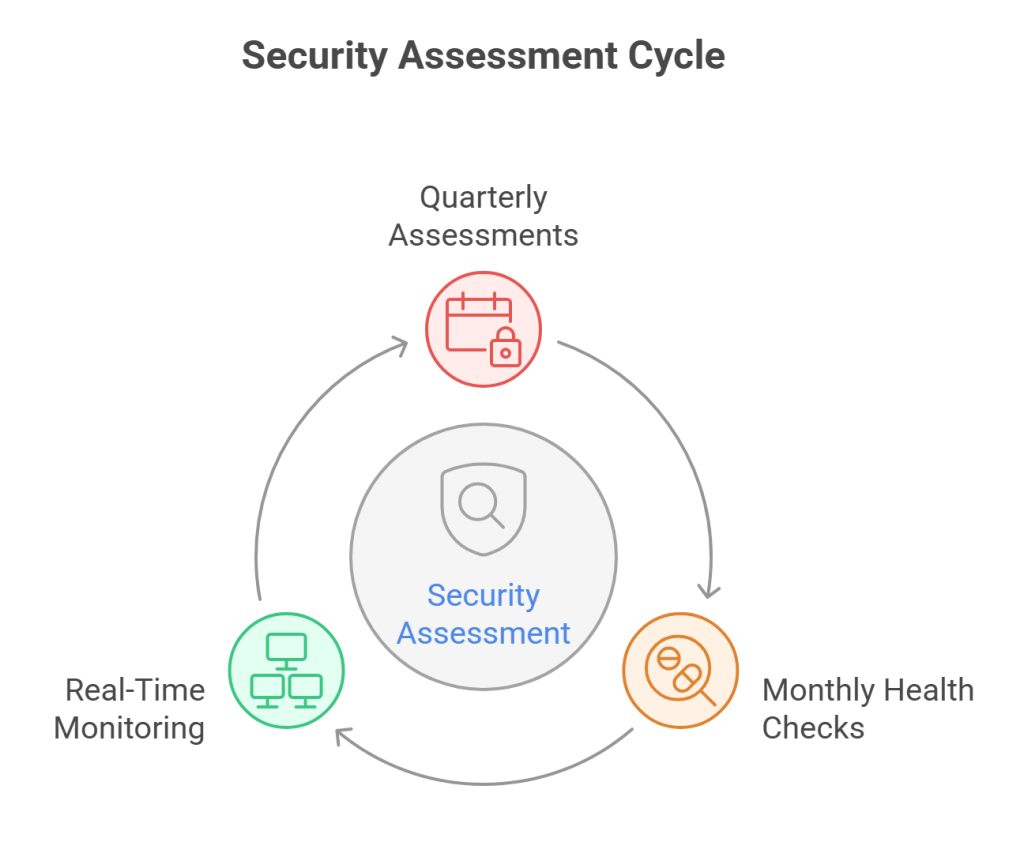
2.Monthly Security Health Checks
- Focus on new features and infrastructure changes
- Quick vulnerability scans after major deployments
- Review security logs and incident reports
3.Real-Time Security Monitoring
- Implement security information and event management (SIEM)
- Set up automated alerts for suspicious activities
- Monitor API usage patterns for abuse detection
UAE-Specific Implementation Strategies That Actually Work
Timing Your VAPT for Maximum Impact
The UAE Business Calendar Approach:
- Ramadan Considerations: Plan major security assessments, either before or after Ramadan to ensure full-team availability.
- Summer Schedule Adjustments: Take into account decreased operational hours in peak summer months.
- National Day Planning: Do not schedule critical security testing during UAE National Day celebrations.
Optimal Testing Schedule for UAE SaaS Companies:
Scroll below to know the exact timing for performing security testing on the UAE SaaS companies.
- Undertake a comprehensive annual security testing for Q1 (January to March).
- Thoroughly evaluate API security in Q2 (April to June).
- Infrastructure and cloud security review for Q3 (July to September).
- Compliance and regulatory alignment testing for the 4th quarter (October-December).
Choosing the Right Security Tools for UAE Operations
Automated Testing Tools That Work Well in UAE:
Open Source Options:
- OWASP ZAP: Free, comprehensive web application security scanner
- Nuclei: Fast vulnerability scanner perfect for CI/CD integration
- Semgrep: Static analysis tool for secure code reviews
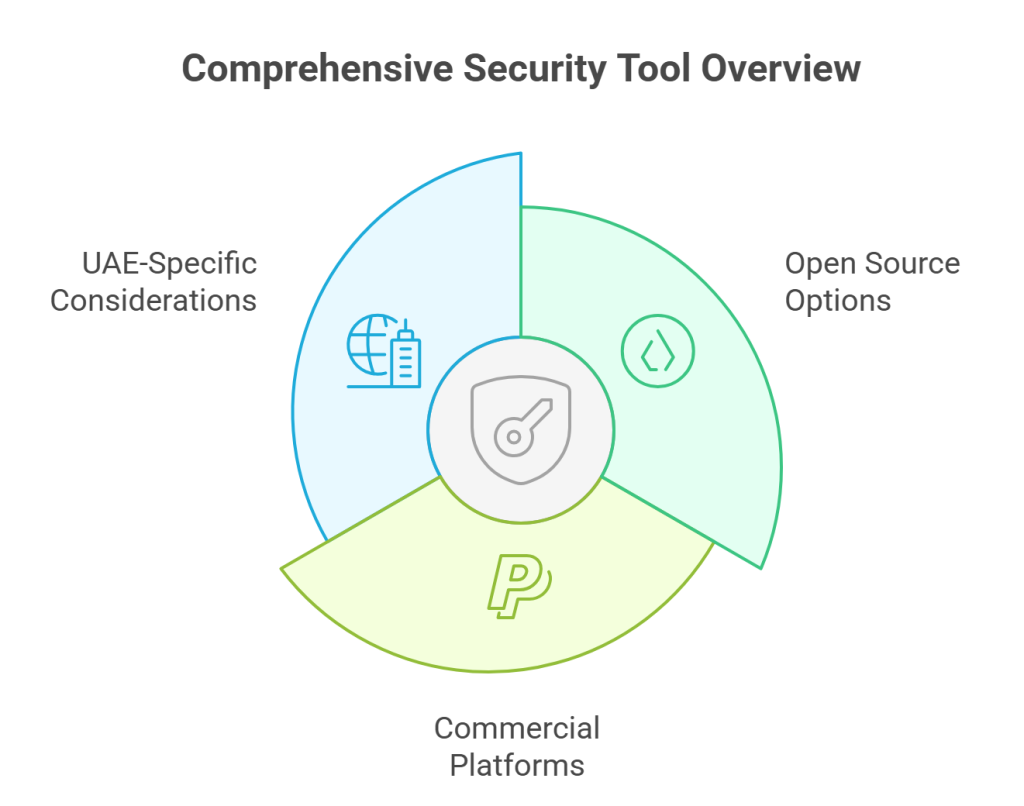
Commercial Platforms:
- Burp Suite Professional: Widely recognized Industry standard for web application testing
- Checkmarx: Comprehensive static application security testing
- Rapid7 InsightAppSec: Cloud-based DAST solution
UAE-Specific Considerations:
- Choose tools with Middle East data center options
- Ensure compliance with UAE data residency requirements
- Consider Arabic language support for reporting
Building Your Vulnerability Management Process
The UAE SaaS Company Risk Framework:
Immediate Action Required (Critical):
- Remote code execution vulnerabilities
- Authentication bypass issues
- Data exposure affecting UAE customer data
- PDPL compliance violations
48-Hour Response (High):
- Privilege escalation vulnerabilities
- Cross-site scripting (XSS) in customer-facing areas
- API authentication weaknesses
- Cloud infrastructure misconfigurations
1-Week Response (Medium):
- Information disclosure issues
- Session management weaknesses
- Third-party integration vulnerabilities
- Configuration hardening opportunities
Planned Response (Low):
- Security best practice improvements
- Documentation updates
- Training recommendations
- Process optimization suggestions
How can UAE Businesses Achieve SaaS Security Excellence?
For achieving proficiency in SaaS security, it would be worth it if you consider implementing an actionable roadmap:
Week 1: Security Assessment and Planning
1.Audit Your Current Security Posture
This stage requires you to document existing security tools and processes. You’re also expected to identify gaps in your existing VAPT implementation.
This is not all, for you’ll need to list every customer-facing APIs and applications.
2.Set Security Goals Aligned with Business Objectives
Before defining your security goals, you need to know what it means to be “secure” for the SaaS platform you’re utilizing.
This would prompt you to establish SMART (Specific, Measurable, Attainable, Relevant, and Time-bound) security metrics that align with business objectives when these concern your SaaS development processes, i.e., from code to cloud.
You may also create a security roadmap for the next 6 months.
Week 2-3: Tool Selection and Setup
1.Choose Your Security Testing Stack
Utilize automated tools that effectively integrate into existing workflows
Choose security service providers that deliver comprehensive cybersecurity solutions, can promptly and effectively handle your physical security needs, and also understand and adhere to the UAE’s National Cybersecurity Strategy.
Also Read : Why Your SaaS Business Needs an Annual Security Program
Obtain immediate wins by setting up basic vulnerability scanning, identifying potential security gaps in the process.
2.Team Training and Process Creation
Building a team culture with a security mindset is indeed a boon, for it directly leads your organization to the path of success that is guarded, byte by byte. This, however, requires you to:
- Train developers on secure coding practices
- Create security-focused code review processes
- Establish vulnerability response procedures
Month 2: Implementation and Testing
1.Deploy Automated Security Testing
- Integrate SAST tools into your development environment
- Set up DAST scanning in your CI/CD pipeline
- Configure automated security reporting
2.Conduct Your First Comprehensive Assessment
- Engage professional penetration testers
- Focus on your most critical customer-facing systems
- Document findings and create remediation plans
Month 3: Optimization and Compliance
1.Refine Your Security Processes
Once you’ve gained a strong foothold on your security processes, consider advancing your automated testing to achieve more coverage. Efforts like these will help you to:
- Optimize testing schedules based on initial results
- Improve automated testing coverage
- Streamline vulnerability management workflows
2.Prepare Compliance Documentation
- Organize security assessment reports
- Create PDPL compliance documentation
- Prepare for potential regulatory audits
Advantages of implementing VAPT for UAE SaaS Security, from secure code reviews to safe cloud deployments
When you start implementing comprehensive VAPT as a UAE-based SaaS service provider, you acquire security and compliance that outperforms your competitors in many ways. You also derive competitive-cum-strategic advantage that earns you value:
- High customer trust and retention (grossing to 73%) with enterprise sales cycles growing faster (45%) and customer acquisition costs dropping significantly to 60%
- Operational Excellence, where you note fewer security incidents (85%), faster incident responses (40%), and lower operational costs, say 30%.
- Business Growth, characterized by faster and easier expansion into regulated industries, international market entry, and higher company valuations during funding rounds.
Also Read : Aligning VAPT Practices with UAE’s Data Protection Regulations
Success Stories from UAE SaaS Leaders
- Dubai Fintech Case Study: A payment processing SaaS company, a Fintech based in Dubai, implemented comprehensive VAPT. The result was an eventual reduction in security incidents (by 90%). The company could also achieve SOC 2 compliance with a remarkable increase in customer retention.
- Abu Dhabi Healthtech Example: By proactively employing VAPT. a healthcare SaaS platform in Abu Dhabi could successfully avert a major security breach. The latter could’ve otherwise exposed 50,000+ sensitive patient records.

An Effective VAPT Implementation to Enhance Your SaaS Security
The UAE’s digital economy is booming, SaaS platforms being at the centerstage of this massive transformation. However, such a great opportunity also calls for great responsibilities. White mandating you to protect critical data, you also need to simultaneously comply with relevant regulatory standards and build trust in the digital ecosystem.
VAPT has a pivotal role to play in both these scenarios. While on the one hand, it helps boost your SaaS security posture, on the other, it aids you in complying with UAE’s existing and evolving cybersecurity regulations.
In the end what you achieve is sustainable competitive advantage.
Implementing comprehensive VAPT for SaaS platforms can remarkably position your company as a trusted leader in the UAE’s digital transformation. Know that VAPT is not confined to protecting your SaaS platform.
Hope you now understand what your next step should be:
- Start with automated security testing this week
- Plan your first comprehensive assessment this month
- Build security into every aspect of your development process
- Document everything for compliance and business purposes
The UAE’s most successful SaaS companies didn’t become leaders by accident. They invested in security, implemented VAPT systematically, and built customer trust through demonstrable security excellence.
If you’re willing to take the stride to secure your SaaS operations from now on, we would suggest you to start your VAPT journey today. What you’ll achieve in this pursuit is esteemed value from your customers and investors. What’s more, you won’t be plagued by your conscience anymore because you failed to adequately implement security controls, otherwise.
Want to learn more about implementing VAPT for your UAE SaaS platform? Connect with our security experts at Wattlecorp, for a deeper understanding of the technical, security, and compliance aspects of the UAE regulatory landscape.
Book a VAPT today and upgrade your SaaS security.
Code to cloud security with VAPT FAQs
1.How often should Dubai-based SaaS companies conduct VAPT assessments?
We suggest a “3-2-1 approach” for most Dubai and Abu Dhabi SaaS companies.
Conduct 3 comprehensive assessments per year (quarterly deep dives)
Engage in 2 focused assessments per month (targeting new features or changes)
Install 1 continuous monitoring system that runs 24/7.
Imagine you’re handling financial data or are serving government clients. In that case, you should consider undergoing monthly comprehensive assessments.
If you’re a high-growth startup that handles weekly deployments, consider a bi-weekly-focused security testing
2.How does VAPT support PDPL compliance for UAE SaaS businesses?
Every public and private organization operating in Saudi Arabia exclusively handling personal data should perform VAPT as per Saudi’s PDPL mandates. This helps ensure appropriate security measures are in place as well as ascertain personal data protection during cross-border transfers.VAPT directly addresses PDPL compliance requirements through:
● Proactive Vulnerability Management: Regular VAPT helps identify and fix security gaps, thus stopping malicious entries in their track.
● Compliance Documentation: Through detailed compliance reports, VAPT offers concrete evidence for audits from the UAE Data Office.
● Breach Prevention: Finding and mitigating vulnerabilities early in SaaS application development helps avoid data breaches that trigger PDPL’s strict notification requirements.
Pro Tip: Keeps your VAPT reports organized by quarter, also including a summary of how each assessment supports your PDPL compliance strategy.
3.What security issues do UAE SaaS companies typically discover through VAPT?
VAPT helps validate the following technical requirements under PDPL mandates:
● Access control systems: Help ensure that only authorized users can access personal data. VAPT validation for this purpose involves checking for weak credentials, reviewing RBAC (role-based access controls), and testing whether multifactorial authentication mechanisms are aptly implemented or not.
● Application and Network Security: Under PDPL, VAPT directly examines the overall security posture of an organization. These cover web application security, cloud security, and network security.
● Breach detection and incident response: As per the robust breach notification procedure mandates of the PDPL, VAPT helps validate systems supporting such a requirement through attack simulation and network segmentation evaluation.
● Encryption: This is required when personal data is transmitted across borders.
4.How can UAE development teams integrate VAPT without slowing down deployment?
The key to scaling UAE SaaS operations with VAPT integration lies in automation, not additional steps. Here’s how successful development teams in the UAE do it:
● Parallel Processing Approach: Runs automated scans alongside your existing functional tests without slowing down essential business processes. This is possible when you weave VAPT security checks into your existing quality gates.
● Smart Scheduling: Helps schedule comprehensive manual tests during planned maintenance windows, uses automated testing for daily deployments, and reserves manual penetration testing for major releases.
● Developer Empowerment: This is an effective training program, where you empower your developers to find and fix common security issues themselves. With everything in track, security flows easily, making the overall process move smoothly and faster. You can also have them prepare simple checklists when doing code reviews in the meantime. This is essential, not overwhelming or exhausting.
● Real UAE Example: One Dubai fintech company reduced their security testing time to 60% by implementing automated SAST/DAST in their CI/CD pipeline.
5.Is there any structured process that the UAE UAE SaaS startups should consider when beginning their security program?
SaaS startups in the UAE should follow a structured approach that involves a month-on-month planning. This besides ensuring a definitive outcome, also helps streamline the process. Note that this process is necessary to implement a robust security program.
Month 1-2: Foundation Building
Consider incorporating basic automated vulnerability scanning by starting with OWASP ZAP. Strictly follow the UAE Personal Data Protection Law (PDPL) aka Federal Decree-Law No. 45/2021- mandated requirements for accountability, security, and transparency.
Also consider setting up basic logging and monitoring features for improving incident response capabilities to meet regulatory standards.
Implement secure coding practices for the developing teams.
Month 3-4: Process Development
● Integrate penetration test as per internationally recognized security standards.
● Adequately handle vulnerabilities
● Create incident response procedures
Month 5-6: Compliance Preparation
● Prepare a detailed document for security activities related to PDPL compliance
● Implement data protection controls
● Prepare for potential investor security in due diligence
● Budget Reality Check: Expect to invest 5-10% of your development budget in security tools and testing.

 Data Privacy Consulting for Saudi Enterprises: How to Operationalize PDPL Data Subject Rights in 2026
Key Takeaways: The Saudi data protection law may apply to organizations outside the Kingdom when they process personal data related to individuals in Saudi Arabia, meaning geographic location alone does not automatically exclude an organization from PDPL obligations. PDPL data subject rights span access, correction, deletion, and consent withdrawal, and enterprises are on the hook […]
 Third-Party Vendor Security Risk Assessment Under DPDP: A Guide for Indian Enterprises
Key Takeaways: Third-party vendor risk assessment with DPDP practices helps Indian enterprises to verify that external partners handle personal data with adequate safeguards. The Digital Personal Data Protection Act holds data fiduciaries accountable for vendor conduct, which makes due diligence a legal and operational necessity. A structured vendor security questionnaire, covering encryption, access control, and […]
 Virtual CISO Services for UAE Free Zone Startups: Affordable Security Leadership for Growing Companies
Key Takeaways: Most startups already hold sensitive data such as customer info, source code, financials, long before they feel big enough to take security seriously, and that’s exactly when the risk starts. A virtual CISO gets you someone who’s done this before, setting up strategy and guiding compliance, without the cost of putting a full-time […]
 SOC as a Service for Indian BFSI and FinTech Companies: 24/7 Monitoring for CERT-In Readiness
Key Takeaways: SOC as a Service for BFSI and FinTech India gives banks, NBFCs, insurers and digital lenders continuous security visibility without the cost and hiring effort of building an in-house operations centre. CERT-In directions require regulated entities to report qualifying cyber incidents within six hours of detection, and implementing SOC for BFSI and FinTech […]
 SOC as a Service in India: How It Works, Pricing, and Why Businesses Need It
Key Takeaways: SOC as a Service helps Indian businesses to get 24×7 security monitoring without huge cost and complexity of building a full in-house security operations center. A managed SOC check and analyse beyond basic log monitoring, which combining SIEM, threat intelligence, analyst-led alert triage, incident escalation, reporting, and security response support. SOC as a […]
 Mobile App Security Testing for Indian Digital Lending Apps RBI, DPDP and API Risk Checklist
Key Takeaways: Mobile app security testing forms an important part of meeting RBI cybersecurity expectations, secure application development practices, and periodic security assessment requirements for digital lending platforms. APIs in lending apps are constantly under attack. Broken object-level authorization, data leaking where it shouldn’t, weak token validation, and missing rate limiting, these aren’t edge cases, […]