


Why UAE Enterprises Should Consider Infrastructure Penetration Testing To Secure Their IT Environment

How Can UAE Businesses Secure Their IT Infrastructure in 2025?
With the UAE businesses being placed in a high-stakes digital environment due to rising geopolitical tensions, AI misuse, and pertinent cybersecurity skill gaps, how can they protect their critical infrastructure?
While the UAE’s National Cybersecurity Strategy 2025-31 demands staying compliant with the updated rules, this means not only ticking the boxes, but also ensuring total security of the systems and IT infrastructure in the region.
Since these suggest adopting robust security measures, a proactive alignment with the strategy is not merely an option. Rather, it’s become highly imperative to thrive in the volatile cybersecurity landscape of 2025 and also beyond.
So, let’s secure your IT infrastructure, which simultaneously demands strengthening its cybersecurity posture as it strictly pertains to operating within UAE’s strict regulatory standards.
What is Infrastructure Penetration Testing?
- Understanding Infrastructure Penetration Testing in the UAE Context
Infrastructure penetration testing is a comprehensive security testing approach that helps simulate cyberattacks on a firm’s, whether it resides on-premise or in the cloud.
The process predominantly involves uncovering and exploiting potential vulnerabilities across servers, cloud workloads, connected devices, endpoints, firewalls, and networks from an ethical hacker’s perspective. Such a high-profile security testing modality leaves no room for the actual attackers to act upon.
If you’re a business entity operating specifically in the UAE, you know how strict and vigilant the cybersecurity laws and regulations there are. But will ensuring compliance alone help you stay secure? Especially in a region like the UAE, where threats are thriving, and cybersecurity laws and regulations are getting stringently enforced? Definitely, NOT!
You, as a business owner, are accountable for maintaining adherence to the rules and policies governing a country or region. This means you should adopt and implement security strategies that while protecting your cloud environment, also offer all-premise coverage to protect your IT infrastructure against sophisticated cyber threats in real-time.
Also Read : The Role of VAPT in Achieving Compliance in UAE
- Infrastructure Penetration Testing in the UAE
By mimicking real-world attacks, infrastructure penetration testing helps detect and address vulnerabilities based on their potential risks and impacts on your systems and network. With expert recommendations to undertake remedial actions, you derive improved and strengthened security posture for your IT infrastructure. And when you regularly conduct pentest, your clients start trusting and valuing you. Going forward,
Being proactive is the key to remain protected at all times. And making security a priority leads to achieving compliance with both existing and evolving regulations in the UAE.
As per the State of the UAE Cybersecurity 2025, over 223,800 assets in the country are exposed to cyber threats. With a majority of them being left unattended and unpatched for five years at a stretch, these do convey the fact that security isn’t a one-time obligation, but a continuous process.
A combination of different types of penetration tests is conducted to understand how well your server and database stand against a security threat. Both manual and automated testing are utilized to secure your IT infrastructure, and your entire operating system.
Why UAE Businesses Need Penetration Testing?
As we can see, the UAE Cybersecurity Law mandates every business entity to effectively manage and secure their sensitive data and critical systems. Infrastructure penetration testing makes it technically possible, especially for those functioning in high-risk sectors like finance, energy, healthcare, telecom, and government. Through securing their critical systems, infrastructure penetration testing helps ensure:
Regulatory Alignment: In meeting standards that are outlined in the UAE’s strategy and sector-specific frameworks, Infrastructure Penetration Testing exceeds checklist compliance requirements.
Reputation Protection: Effectively wins over clients, gains regulator confidence, and helps establish partnerships by demonstrating proactive risk mitigation.
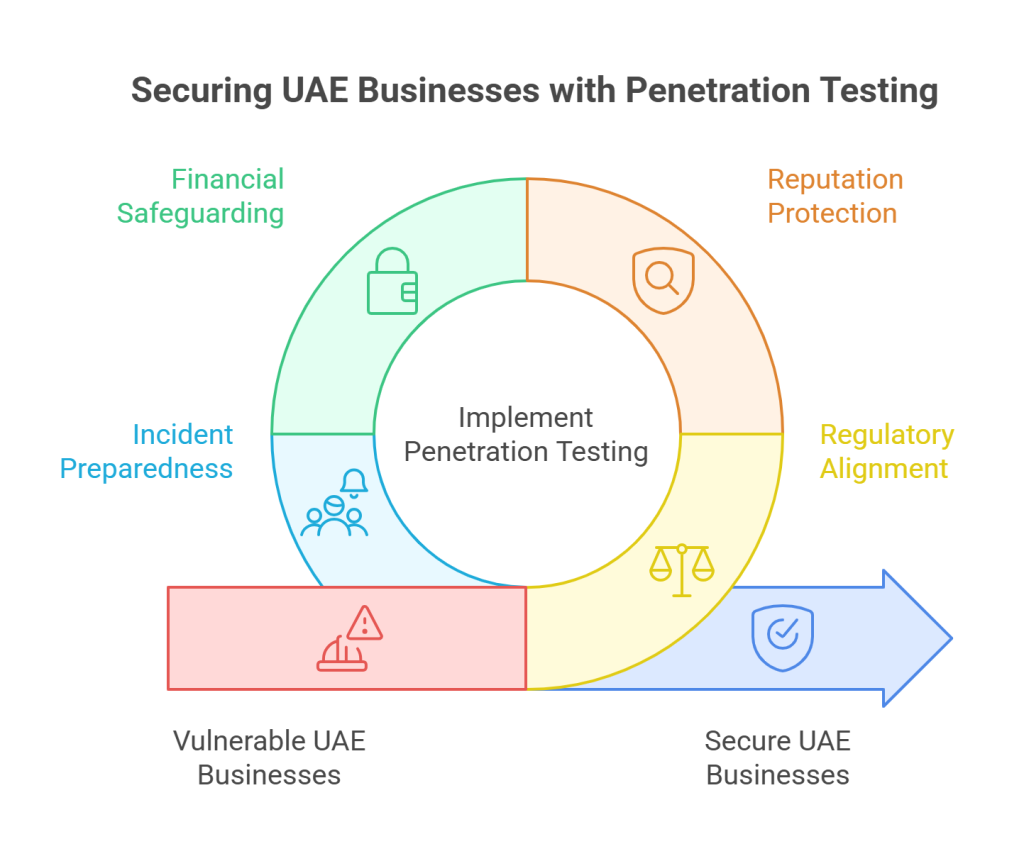
Financial Safeguarding: Since the Middle-East countries rank second in data breach costs from a global perspective, implementing Infrastructure Penetration Testing can significantly help prevent the impacts of such costly breaches.
Incident Preparedness: With the ethical hackers simulating real-world attacks for you, these lead you to achieving improved internal readiness through prompt detection, incident response, and recovery speed.
Who Should Consider Infrastructure Penetration Testing In The UAE?
Infrastructure penetration testing is essential for organizations or businesses that are required to keep their system ahead of cybersecurity threats. The necessity to ensure infrastructure security cuts across many industries, especially those handling sensitive data and relying on cloud and on-premises infrastructure.
As a security breach can significantly affect the brand image, penetration testing detects security weakness of devices in an IT infrastructure. This makes it easier for businesses to handle them before they snowball into a cyber threat. The result? You get to strengthen your cyber resilience, thus attaining an enhanced brand value.
What Are the Benefits of Infrastructure Security Testing?
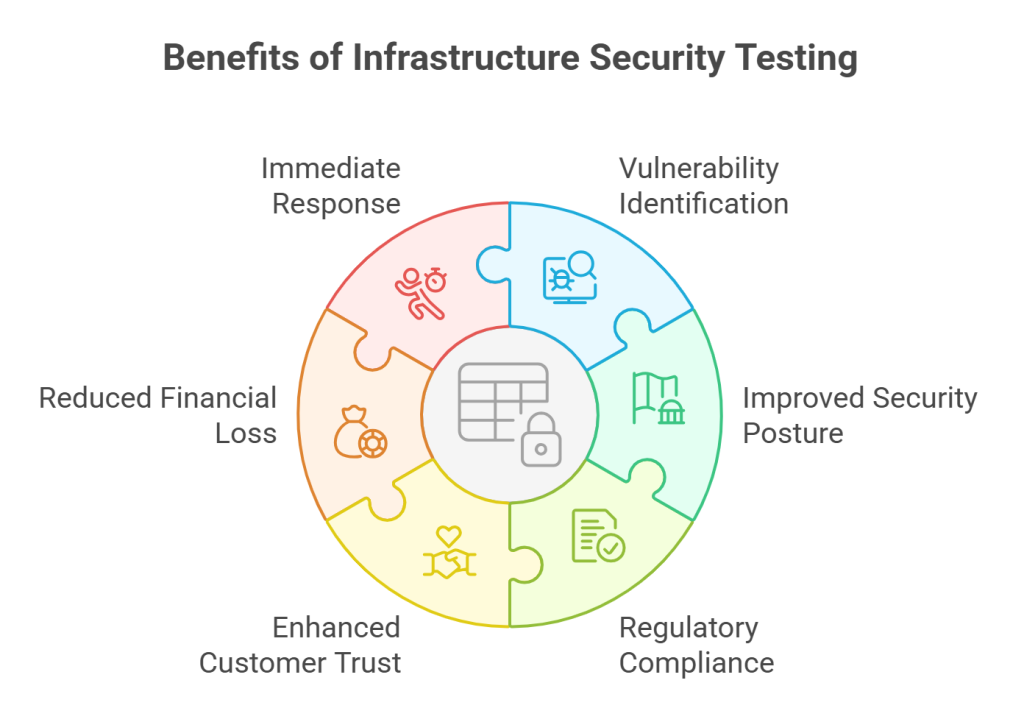
Infrastructure penetration testing is beneficial to organizations in many ways, such as:
- Identifying vulnerabilities: Infrastructure penetration testing primarily serves to detect security gaps and exploit those vulnerabilities before a potential hacker does.
- Improve security posture: Penetration testing helps discover security flaws (missing security updates, authentication issues) by simulating cyberattacks to strengthen security posture for organizations.
- Ensure compliance with regulations: The specific regulations and standards governing the UAE Industries, can be efficiently handled by infrastructure security testing through critical infrastructure security assessment.
- Enhance customer trust and confidence: By implementing high-profile security measures like penetration testing, you can safeguard customer information – building better customer confidence and brand image.
- Reduce financial loss: Infrastructure penetration testing enables you to stay ahead of emerging security threats – thus minimizing financial loss associated with security breaches for you.
- Improve immediate response and recovery: Infrastructure security testing as a trial run for a real-world attack helps improve your immediate response capabilities – enabling you to take prompt recovery measures.
The UAE Computer Emergency Response Team (aeCERT) being a national body oversees the UAE’s cybersecurity efforts on threat-sharing and incident coordination.
Types of Infrastructure Penetration Testing
To know how infrastructure penetration testing can enhance your security, you need to first learn how it works for the types it manifests. Different types of infrastructure penetration testing can benefit an organization by identifying and rectifying both known and unknown security weaknesses in your systems.
Read below to know the various kinds of infrastructure pentesting:
- External infrastructure penetration testing
Also called ‘black box’ testing, external infrastructure penetration testing is conducted from outside the concerned organization. Here, the pentester simulates a cyber attack with limited information about the organization’s system and network, except for the target system’s security infrastructure. External infrastructure penetration testing resembles predictions related to the real-world repercussions of an unknown attack.
- Network infrastructure penetration testing
Network infrastructure penetration testing assesses security for corporate networks. These include web servers, routers, USBs, firewalls, and wireless networks. This type of testing helps expose any vulnerabilities hidden within the internal and external networks – also helping analyze how an external network (eg, firewall) can withstand an attack.
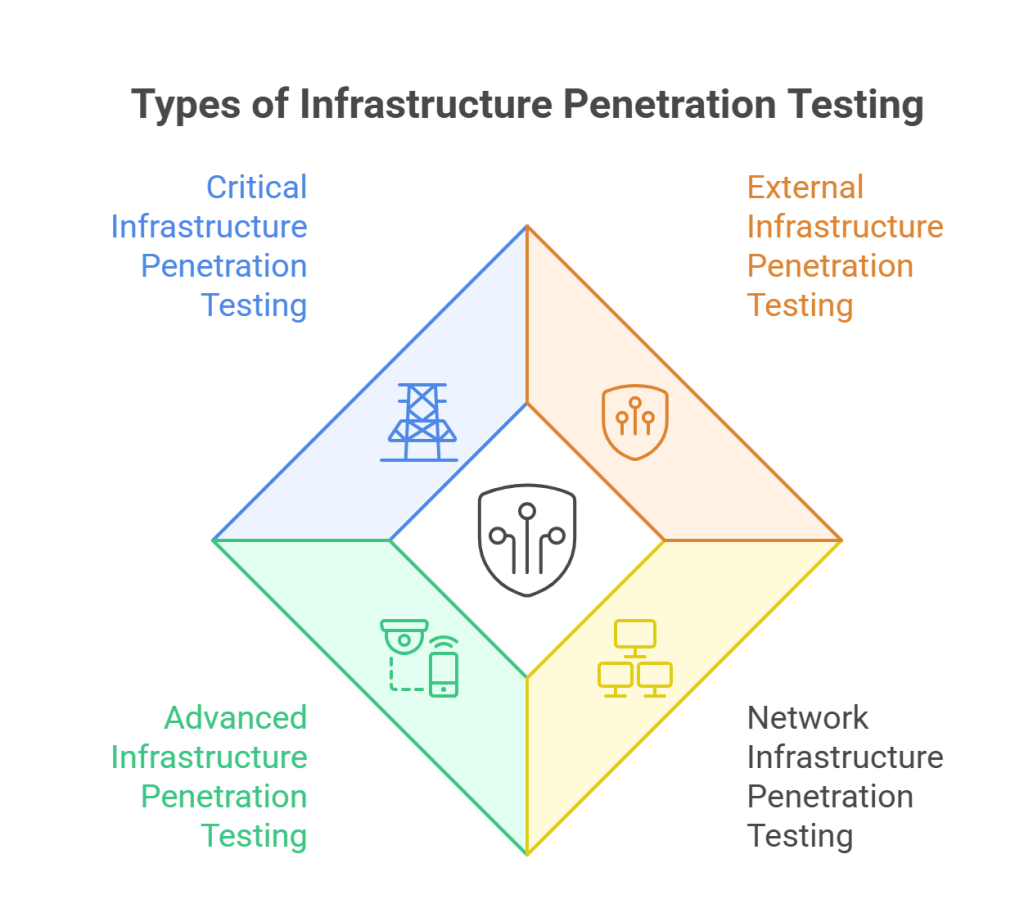
- Advanced infrastructure penetration testing
Advanced infrastructure penetration testing is a sophisticated ethical hacking process that exploits the vast infrastructure of a system – from database to routers and VPN to detect security flaws. Complex IT systems (IoT), network devices, and cloud environments are mostly targeted there. UAE officials during the recent GISEC Global 2025, emphasised collaboration to combat AI-powered cybercrime and ransomware.
- Critical infrastructure penetration testing
Critical infrastructure penetration testing involves a specialized cybersecurity testing of critical systems like the energy grid and hospital networks to safeguard sensitive information. It helps identify potential weak points and lets the organization update the system to prevent any data breach. It also ensures compliance by strengthening cybersecurity as part of the UAE’s strict compliance standards for industries. This approach is meant to avert penalties.
Why Choose Wattlecorp as Your Infrastructure Penetration Testing Provider
Wattlecorp is a trusted cybersecurity partner offering expert-led penetration testing services. We provide a comprehensive approach to infrastructure penetration testing, along with providing industry-specific solutions catering to your business. Our strategy for infrastructure penetration testing involves:
Also Read : 7 Key Benefits of Partnering with Wattlecorp for Penetration Testing in UAE
Initial Consultation & Information Gathering
This is the primary stage of understanding the scope, objective, and security concerns of your organization. Our team will gather detailed information about your organization’s infrastructure and potential threats.
Based on impact analysis, these threats are prioritized by leveraging threat modeling. This stage also evaluates the missing security updates, which can compromise an organization’s operation.
Through this stage, we attempt to raise cyber hygiene awareness in line with the UAE’s community programs like Cyber Pulse, Salim advisor, and the UAE Ambassadors for e-security.
Vulnerability Assessment
At Wattlecorp, we conduct extensive vulnerability assessments with cutting-edge manual assessment techniques and automated tools. With regular vulnerability testing, your security team can detect, analyze, classify, report, and remediate security threats in your infrastructure.
Our expert team will assess your infrastructure, including all servers, databases, and applications, to detect any vulnerabilities, security gaps, default misconfiguration, weak encryption, or access control issues.
Unauthorized access is a major concern as it is more likely to occur. Vulnerability assessment can easily detect weak passwords or other access control issues.
Penetration Testing
We provide deep penetration testing services where our professional ethical hackers will simulate a cyber attack to identify any weakness in your infrastructure. We provide Internal and external network VAPT, web application penetration testing, and API penetration testing that will exploit the security weakness in the system and assess its impact.
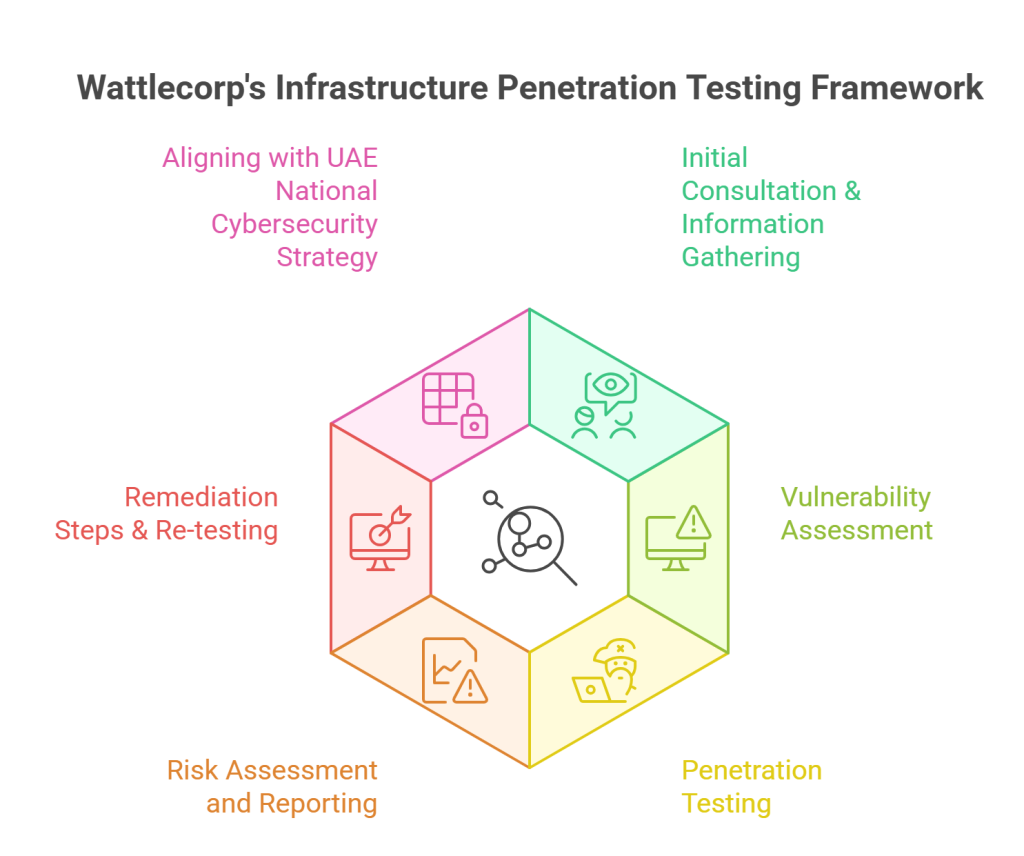
Risk Assessment and Reporting
After conducting the risk assessment and analyzing the detected vulnerabilities, our team will prepare a detailed report. Based on this, remediation measures are recommended and prioritized per the potential impact of the identified vulnerabilities.
Remediation Steps & Re-testing
We provide you with actionable recommendations to fix security flaws and conduct re-testing to ensure vulnerabilities have been addressed. As each of the detected vulnerabilities and security flaws require different levels of expertise, our professional group is well equipped to address them and improve the security posture of the organization.
Aligning with the UAE National Cybersecurity Strategy 2025–31
The UAE National Cybersecurity 2025-31 offers a comprehensive framework, strategically designed to strengthen the region’s overall cybersecurity posture and resilience. It’s structured around five pillars (governance, protection, innovation, development (cyber‑talent), and partnership (public‑private and international collaboration).
Also Read : Aligning VAPT Practices with UAE’s Data Protection Regulations
The proposed strategy, through ensuring cyber environment security, promoting cybersecurity awareness, and enhancing technical and legal capabilities, is dedicated to safeguarding the critical infrastructure of the nation.
Next, for the UAE to be declared as a top performer (Pioneering Model) based on the Global Cybersecurity Index 2024 shows its commitment and leadership in spearheading cybersecurity efforts in securing its industries, businesses, and people from cyber threats and incidents.
Conclusion: Protecting UAE’s IT Infrastructure From Impending Threats
With the UAE thriving amid evolving cyber threats, it’s now time to act! Especially when sophisticated attacks are targeting the region’s IT infrastructure.
For the number of cybersecurity service providers having emerged, the question is whom to trust when it concerns security testing reliably and professionally.
Wattlecorp being one of the most established, successful, and leading cybersecurity service providers has not simply got this reputation. Having conceptualized and founded in 2018, the number of clients we’ve served around the world is well enough to suggest the influence we could make in rendering top-notch cybersecurity services.
UAE businesses, are you ready to take the plunge to advanced cyberdefense strategies and protect your IT infrastructure? If so, feel free to contact us for further assistance.
Remember, it all lies in being a little intuitive when it concerns identifying and addressing security vulnerabilities, but a wholesome effort to restore and redefine cybersecurity when being struck. Which one would you choose?
Act Now to shield your IT Systems and Software from potential threats! Stay guarded with Wattlecorp!
Infrastructure Penetration Testing FAQs
1. What is infrastructure penetration testing?
Infrastructure penetration testing in the UAE involves simulating real-life cyber attacks to expose security flaws and vulnerabilities in an organization’s IT infrastructure. It uses both manual techniques and automated tools to detect and resolve system weaknesses.
2. Why is infrastructure security testing critical in the UAE?
For the UAE, maintaining IT infrastructure functionality in all its adequacy is critical, especially since various sectors rely on its smooth functions for effectively operating. Infrastructure security testing helps improve an organization’s security posture by assessing its security, as well as meet strict compliance requirements in this Middle East Land. When undertaking security assessments regularly, you tend to become proactive enough to promptly respond and combat cyber threats. In this way, you gain the trust and confidence from your stakeholders.
3. What are the 3 types of infrastructure security?
The 3 major categories of infrastructure security are:
• Physical security: This involves securing physical assets like hardware, data centres, and servers from any unauthorized access.
• Network/Cyber security: It aims at securing your digital assets and your internal and external networks from cyberattacks.
• Application security: Helps secure applications and software from any malicious actors or threats, such as SQL, XSS, etc.

 Mobile Application Penetration Testing for Qatar Government Digital Services: NCSA- Aligned Security Assurance
Key Takeaways: Mobile Application Penetration Testing Qatar must cover the app, device storage, APIs, authentication and third-party components. Qatar’s NCSA assurance environment combines the National Information Assurance (NIA) Standard, the National Information Security Compliance Framework (NISCF) and accredited security assessment services. OWASP MASVS defines mobile security controls, while MASTG supplies practical test methods for Android […]
 Qatar Data Protection Law: Implementing PDPPL Data Subject Rights Processes for Businesses
Key Takeaways: The Qatar Data Protection Law (Law No. 13 of 2016) for Personal Data Privacy Protection, grants individuals specific rights such as right to access, correct, erase, object, withdraw consent, and right to be notified of processing or inaccurate disclosure. Beyond having a privacy policy, businesses or controllers, under Article 11 of Personal Data […]
 AI Governance for Indian Enterprises: Building Internal Controls Before Key DPDP Obligations Take Effect
Key Takeaways: The DPDP Act does not contain AI-specific provisions. Its requirements, however, apply in situations when an AI system processes digital personal data within its territorial and material scope. India is working on building a broader governance framework around safety, accountability, transparency and trust via programs like the IndiaAI Mission. Indian organizations should inventory […]
 Cloud Security Audit for UAE Government Cloud Migration: NCAP and Security Requirements
Key Takeaways: A cloud security audit UAE helps government entities identify security, governance, configuration, access, data-protection and resilience gaps, before and after shifting critical workloads to the cloud. UAE National Cloud Security Policy has defined cloud governance, data security, data sovereignty, IAM, incident management, resilience, portability and cloud operations requirements. The National Cyber Accreditation Program […]
 Data Privacy Consulting UAE – Building a PDPL-Compliant Data Governance Program
Key Takeaways: PDPL compliance requires ongoing operational governance that goes beyond policies to demonstrate how personal data is collected, used, protected, transferred, retained, and deleted. Data mapping helps businesses move from reactive compliance to proactive risk management by establishing a comprehensive inventory of the data ecosystem, helping build a mature data privacy and governance program. […]
 Saudi Arabia’s Critical Systems Controls: What CSP-Linked Enterprises Must Comply With in 2026
Key Takeaways: The Critical Systems Cybersecurity Controls (CSCC) are more applicable to critical systems than to all IT assets owned or operated by an organization. To be in full compliance or to remain in full compliance with CSCC, organizations must maintain continuous adherence to NCA ECC. CSCC has 32 core controls and 73 sub-controls across […]