

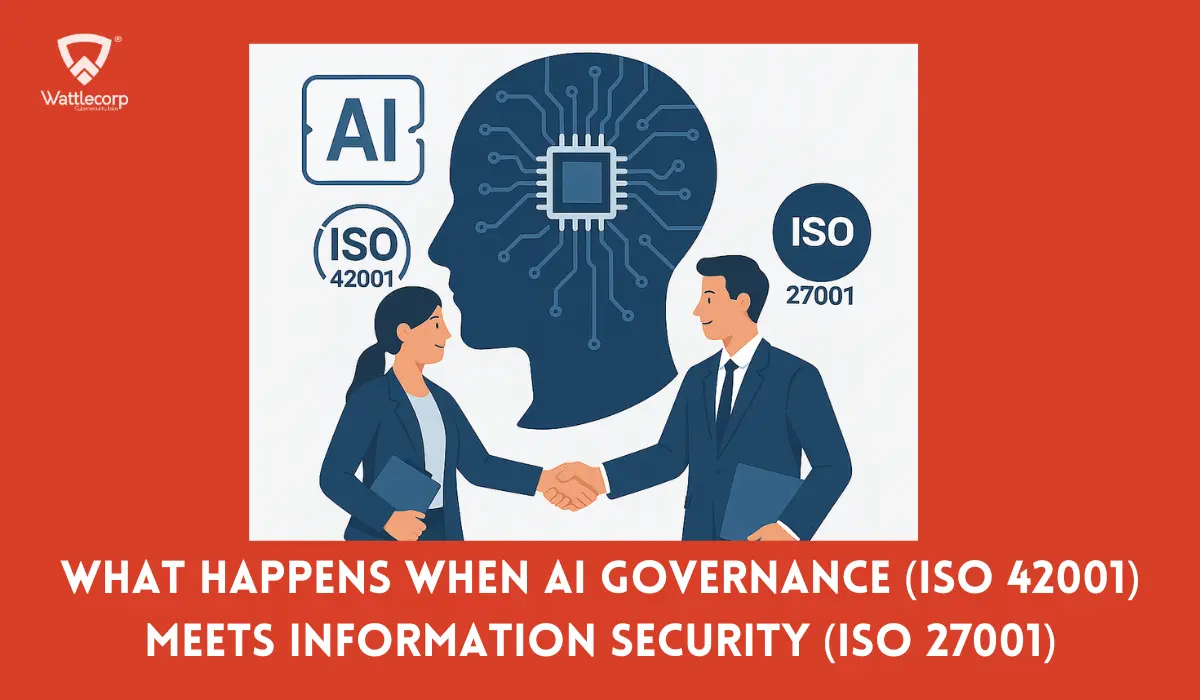
What happens when AI governance (ISO 42001) meets Information Security (ISO 27001)?
Differentiating the Standards ISO 42001 vs ISO 27001
ISO 42001
ISO 42001 is a newly introduced standard that businesses adapt to manage AI-related risks. This acts as a guide for your organisation to build, operate, and maintain AI technologies in an ethical, and transparent manner. With this, you can handle critical concerns like fairness in data, managing AI governance, and algorithmic accountability.
ISO 42001 certification is mainly to keep your AI systems trustworthy while it is functional. While Requirement 4 and Requirement 6 are essential sections of ISO 42001, the certification is based on overall compliance with all applicable controls for ethical and safe AI development.
ISO 27001
This globally accepted regulatory standard is developed to manage information security. ISO 27001 is a structured framework implemented in business’s flow to focus on Information Security Management System (ISMS). Here, in combination, people, processes, and technology work together to protect the data that businesses operate with.
ISO 27001 complements aspects of ISO 42001, particularly where AI systems interact with sensitive data or information infrastructure.
Why Do You Need ISO 42001 with ISO 27001 in Your UAE Business?
A Unified Approach to Risk and Governance
Combined integration of ISO 42001 with ISO 27001 is advantageous in two aspects: AI-specific risks and overall information security risks. Some organizations certified with ISO 27001 can improve their governance by adding ISO 42001’s AI-specific layers.
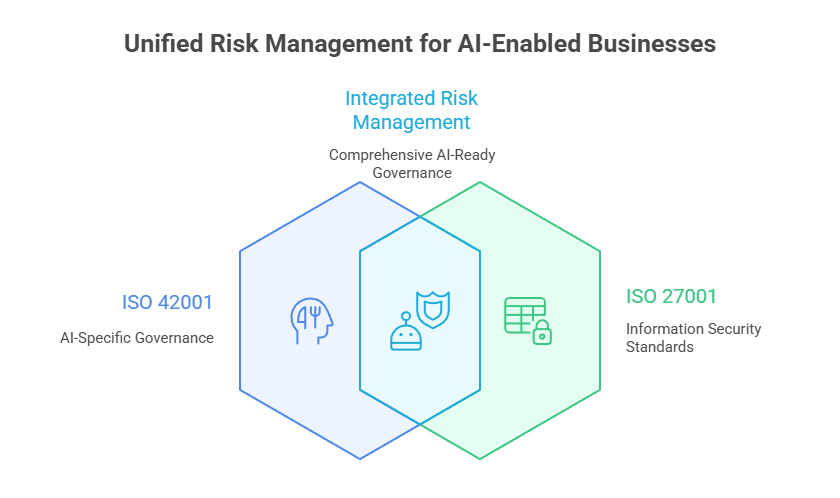
Giving an example, ISO 42001 introduces controls for AI-related transparency, fairness, and data quality in your AI-enabled operations. Those are the areas where the standard ISO 27001 can’t take control over. When implementing a fusion of both, companies can ensure that their security and governance frameworks are futuristic and capable of handling complex AI technologies.
Managing Complex Risks with More Precision
AI systems are evolving with unimaginable intelligence, and they come with unique risks. This can be biased decisions, a lack of explainability, or misuse. Standardizing with an ISO 42001 certificate addresses these challenges directly, providing a more focused risk management model (Requirement 6.1 and Annex A.5.4).
Also Read : What Are the ISO 27001 Requirements in 2025?
When specifying ISO 27001, it particularly deals with information security, and has no hold on AI-related risks. However, when making use of these two regulations, it provides a standardized approach covering both human and machine decision-making processes.
How Does Risk Management Differ in ISO 42001 vs ISO 27001?
These two standards are meant to manage risks, but both work in different ways.
ISO 27001 information security standard uses a general approach by identifying potential threats to information systems. This framework assesses the impact of threats and applies controls to mitigate them. This ISO 27001 governance focuses heavily on protecting data from breaches, insider threats, or cyberattacks.
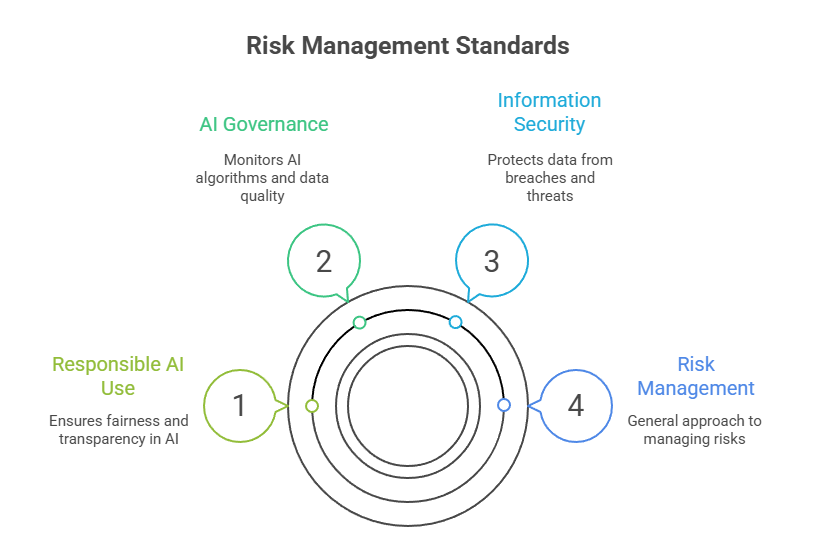
ISO 42001 is an AI governance standard that monitors the AI in your business. While enabling this standard, it monitors the algorithms to check for discriminatory activities. It also examines if the data used in training is fair and high-quality and whether the decisions made by AI systems can be explained.
ISO AI standard 42001 even aligns with the NIST AI Risk Management Framework, a leading framework in responsible AI use.
What Is The ISO 27001 and ISO 42001 Certification Process?
Both ISO 27001 and ISO 42001 follow structured certification processes in your UAE business.
The process begins with gap analysis to identify missing controls, followed by implementing the necessary policies and frameworks. Internal audits ensure that all requirements are met before facing an external audit for certification.
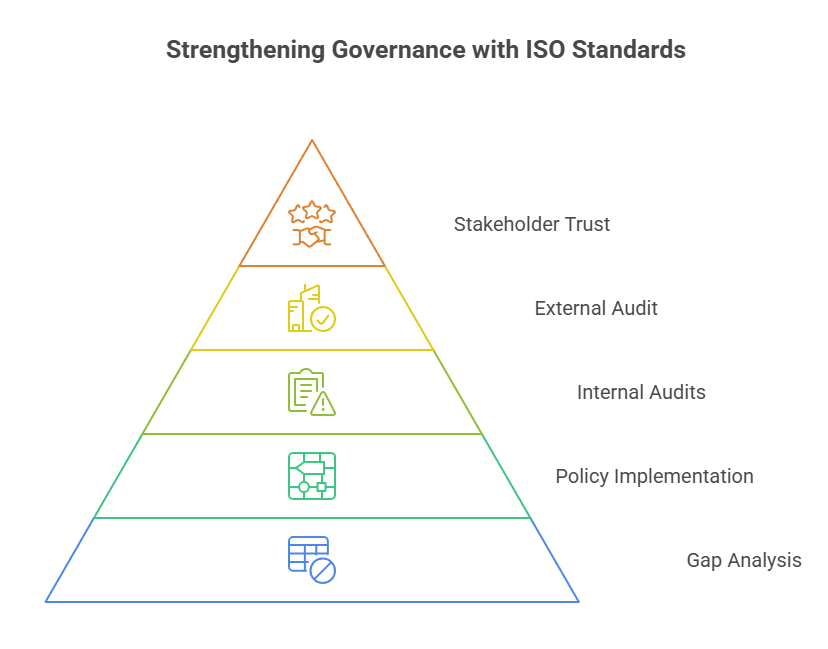
Earlier, it was only the informational security regulations and now with the addition of ISO 42001 to businesses, especially after its expected audibility in 2024, it builds your organisation’s governance stronger. It shows your business ethics towards AI transparency. For organizations, it is also becoming more relevant with regulations like the EU AI Act.
Certifying your organization with both regulations improves stakeholder trust. It also makes it clear that the organization takes efforts in handling data, AI responsibility, and ethical practices seriously.
How does ISO 42001 redefine team roles in an organization?
When your business in the UAE plans to adopt ISO 42001 governance, you must rethink internal roles and processes. You must define specific responsibilities, where they screen AI enabled operations. This includes assigning ownership for AI ethics, transparency, and risk assessments, as mentioned in Requirement 5.1 and A.3.2.
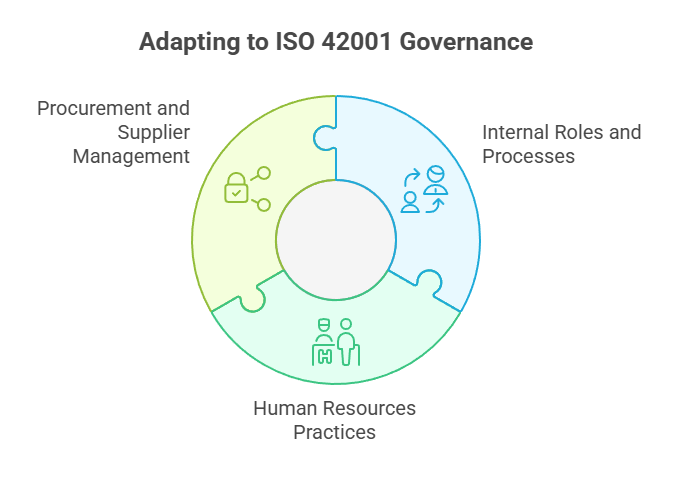
Human resources practices also need to adapt. Teams working on AI projects must be trained. This is not just in terms of tech but in ethical implications, privacy standards, and governance models.
Similarly, procurement and supplier management policies need to reflect AI-specific considerations. It is like verifying the ethical and security hold of an AI tool before it’s brought to your business. So, when you are planning ahead with this AI framework, restructuring roles and policies will help your company align better with modern AI advances.
What Makes ISO 42001 Suitable Across Different Industries in the UAE?
ISO 42001 AI framework’s wide applicability across industries is the biggest strength. Your business can be one among the industries that deal with AI-powered diagnostics in healthcare, fraud detection in finance, or autonomous systems in automotive. Whatever it is, this standard provides guidance that applies to all.
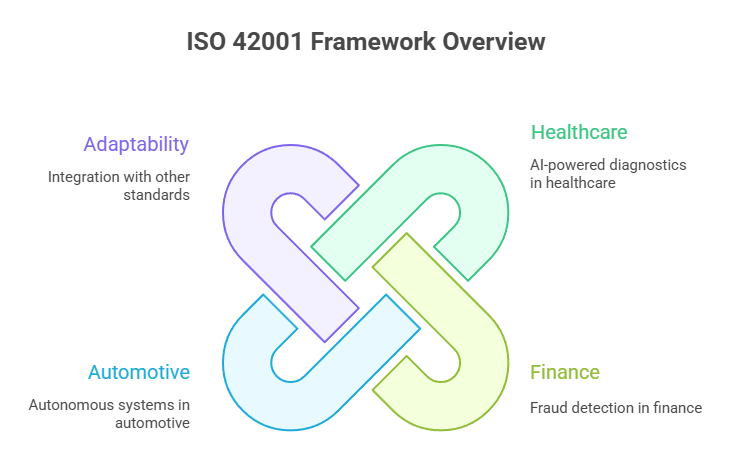
This standard performs duties like assessing how AI affects individuals, detecting possible algorithmic biases, and improving decision transparency. The adaptability of ISO 42001, discussed in Annex D.2, ensures it can be combined with sector-specific standards or broader ones like ISO 27001 for customized compliance.
Also Read : How Much Does ISO 27001 Certification Really Cost? A Guide for Business
As AI and data security become critical to business success, having the right frameworks is a necessity when you are progressing. While you know that ISO 27001 helps you protect sensitive information, and ISO 42001 ensures ethical AI operations in your UAE business, it is also time to implement these standards in your organization.
At Wattlecorp, our in-house team of ISO-certified consultants is here to support you every step of the way. Whether you are starting fresh or need AI governance experts to assist, Wattlecorp is ready to prepare you as a future-compliant business.
ISO 42001 vs ISO 27001 FAQs
1.How do you differentiate ISO 42001 and ISO 27001?
The two standards are built to mitigate risks. ISO 27001 is accountable only for information security management system. The new regulation ISO 42001 is majorly used for responsible AI usage in AI-enabled business operations.
2.Is ISO 42001 worth it for UAE businesses?
Yes, ISO 42001 is worth it for organizations using AI. Because it allows organizations to work risk-free with responsible AI use.
3.What is the purpose of ISO 27001 for business in the UAE?
The biggest gain with this regulation is it protects sensitive information through a structured Information Security Management System (ISMS). It reduces data breaches and builds customer trust.

 Third-Party Vendor Security Risk Assessment Under DPDP: A Guide for Indian Enterprises
Key Takeaways: Third-party vendor risk assessment with DPDP practices helps Indian enterprises to verify that external partners handle personal data with adequate safeguards. The Digital Personal Data Protection Act holds data fiduciaries accountable for vendor conduct, which makes due diligence a legal and operational necessity. A structured vendor security questionnaire, covering encryption, access control, and […]
 Virtual CISO Services for UAE Free Zone Startups: Affordable Security Leadership for Growing Companies
Key Takeaways: Most startups already hold sensitive data such as customer info, source code, financials, long before they feel big enough to take security seriously, and that’s exactly when the risk starts. A virtual CISO gets you someone who’s done this before, setting up strategy and guiding compliance, without the cost of putting a full-time […]
 SOC as a Service for Indian BFSI and FinTech Companies: 24/7 Monitoring for CERT-In Readiness
Key Takeaways: SOC as a Service for BFSI and FinTech India gives banks, NBFCs, insurers and digital lenders continuous security visibility without the cost and hiring effort of building an in-house operations centre. CERT-In directions require regulated entities to report qualifying cyber incidents within six hours of detection, and implementing SOC for BFSI and FinTech […]
 SOC as a Service in India: How It Works, Pricing, and Why Businesses Need It
Key Takeaways: SOC as a Service helps Indian businesses to get 24×7 security monitoring without huge cost and complexity of building a full in-house security operations center. A managed SOC check and analyse beyond basic log monitoring, which combining SIEM, threat intelligence, analyst-led alert triage, incident escalation, reporting, and security response support. SOC as a […]
 Mobile App Security Testing for Indian Digital Lending Apps RBI, DPDP and API Risk Checklist
Key Takeaways: Mobile app security testing forms an important part of meeting RBI cybersecurity expectations, secure application development practices, and periodic security assessment requirements for digital lending platforms. APIs in lending apps are constantly under attack. Broken object-level authorization, data leaking where it shouldn’t, weak token validation, and missing rate limiting, these aren’t edge cases, […]
 Cybersecurity Risk Assessment for Saudi Supply Chain Vendors Under Aramco and NCA Expectations
Key Takeaways: Cybersecurity risk assessment becomes a practical requirement for proving security maturity, with protecting vendor relationships, and moving forward in procurement processes with Aramco and critical infrastructure clients. Vendors will need to provide evidence of access review documentation, patch deployment, monitoring artifacts, technical assessment results and more that demonstrates the controls in place are […]