

Establishing Data Retention and Erasure Policies: Integrating GRC Frameworks for DPDPA Compliance

What to Know About GRC?
Governance, Risk, and Compliance (GRC) is a structured way to align business goals with regulatory needs and risk controls. These three elements are closely connected with data privacy. Governance means establishing policies and taking accountability for data usage and lifecycle.
Whereas risk management involves finding risks related to over-retention, unauthorized access, or poor practices in erasure. With compliance practices, your business stands with data privacy rules like India’s DPDPA and industry standards.
When integrating such practices into your business, you are taking efforts to monitor, enforce, and update necessary standards consistently.
According to the Kroll survey, nearly 70% of executives say that financial-based crime will magnify in 2025. However, 23% of them are confident that their compliance program is effective at stopping breaches and financial fraud. This report proves the need for compliance in every Indian business environment.
Why Data Retention and Erasure Policies Matter?
Most organizations that work on data dependence collect personal data. The personal data particulars differ by each industry’s standards and its needs. And it can be customer details, employee information, financial records, and more. But keeping all of this information indefinitely has increased risks, such as:
- Non-compliance with privacy laws like DPDPA.
- Retaining data should be treated for the business defined purpose. Else, it would be considered against the law.
- Exposure to cyberattacks if unused or outdated data is stored without a definite reason.
- Higher storage and operational costs.
- DPDPA explicitly allows data principals the right for erasure this means they can demand to erase the particulars once the purpose is fulfilled.
- Audit-readiness – clear retention policies simplify compliance checks by the Data Protection Board of India.
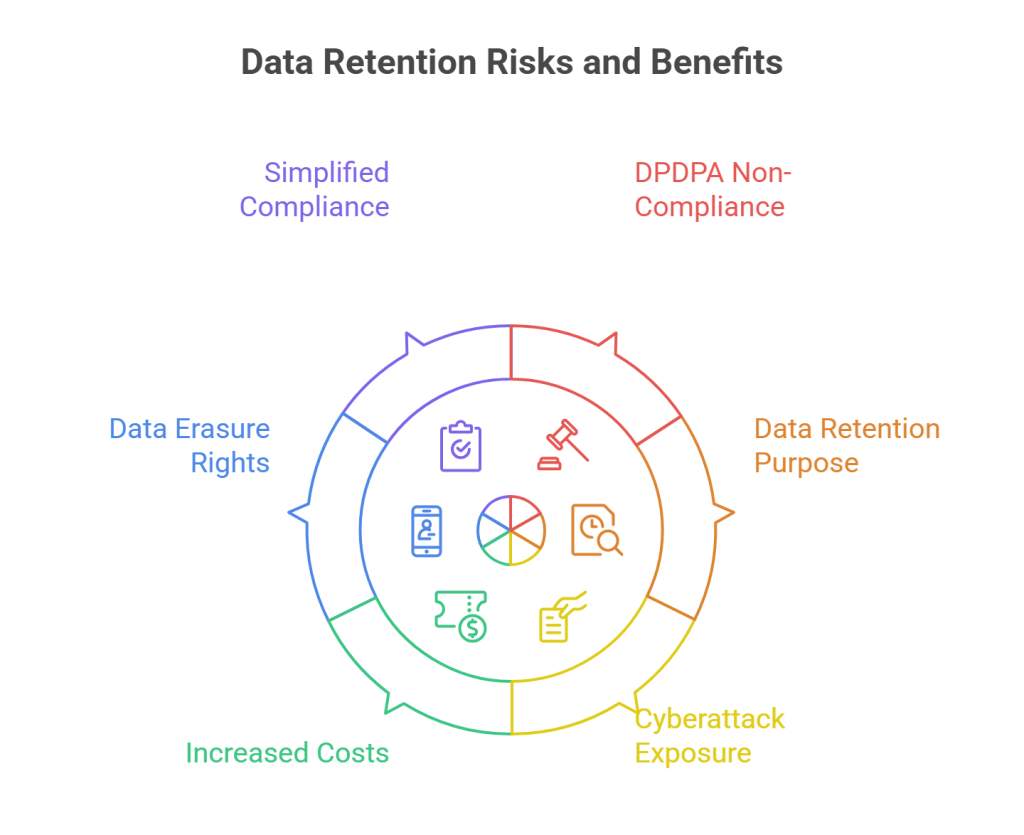
Considering such complex situations, the DPDPA, India’s Digital Personal Data Protection Act, requires businesses to store data for a specific period until it fulfills the purpose. Also, businesses must delete it once that purpose is complete. This is why data retention and erasure policies are essential for both compliance and risk management.
How Are GRC and Data Privacy Connected in Indian Businesses?
Establishing Clear Policy Governance
When handling personal information, companies can’t simply collect and store data. Every business in India is now expected to prove its strong privacy practices to retain and build a strong customer base.
This means your business must set clear policies on collecting, processing, storing, and sharing data. In addition, the policies must provide individuals more control through consent mechanisms, access rights, and deletion requests.
Businesses like yours can easily adhere to compliance by integrating privacy frameworks into a GRC tool. Thus, it helps track and monitor their practices in real time, and stay on par with changing regulations.
When you strictly practice the regulatory rules, you could protect your business from hefty penalties and secure the personal data involved in your business with consistent updates.
Linking Regulatory Practices to Risk Management
Data breaches are major risk factors to any growing organization, resulting in costly damages. With its effects as a financial impact, it also creates long-term effects on reputation and consumer trust.
A strong approach begins with understanding the personal data flow through the organization. It includes collecting, processing, and sharing it with third-party vendors. Once these data movements are mapped, experts easily spot weak points where unauthorized access, misuse, or privacy violations might occur.
Mitigation processes must be followed next. Methods like encryption, anonymization, and regular security audits can help in reducing emerging risks. Such procedures are practical ways to strengthen security and help comply with privacy expectations.
Also Read : What SaaS Providers Need to Know About India’s Digital Personal Data Protection Act 2023
Data privacy is not something that can be privately dealt with. It is a part of the regulatory rules business in India adapts to. And a well-structured GRC framework with it ensures these privacy-focused safeguards are perfectly integrated. It creates a proactive defense against both regulatory violations and security threats.
Driving Continuous Compliance and Accountability
To make governance effective, leadership must prioritize data privacy at the center of strategic decision-making. Data privacy should be considered as a key factor in risk management for long-term business resilience.
Clear monitoring measures are essential here. Many organizations appoint data protection officers (DPOs) or dedicated privacy officers who can act as the point of accountability and take credible efforts. Some businesses in India establish expert privacy committees to discuss concerns across departments of operations, marketing, and product development.
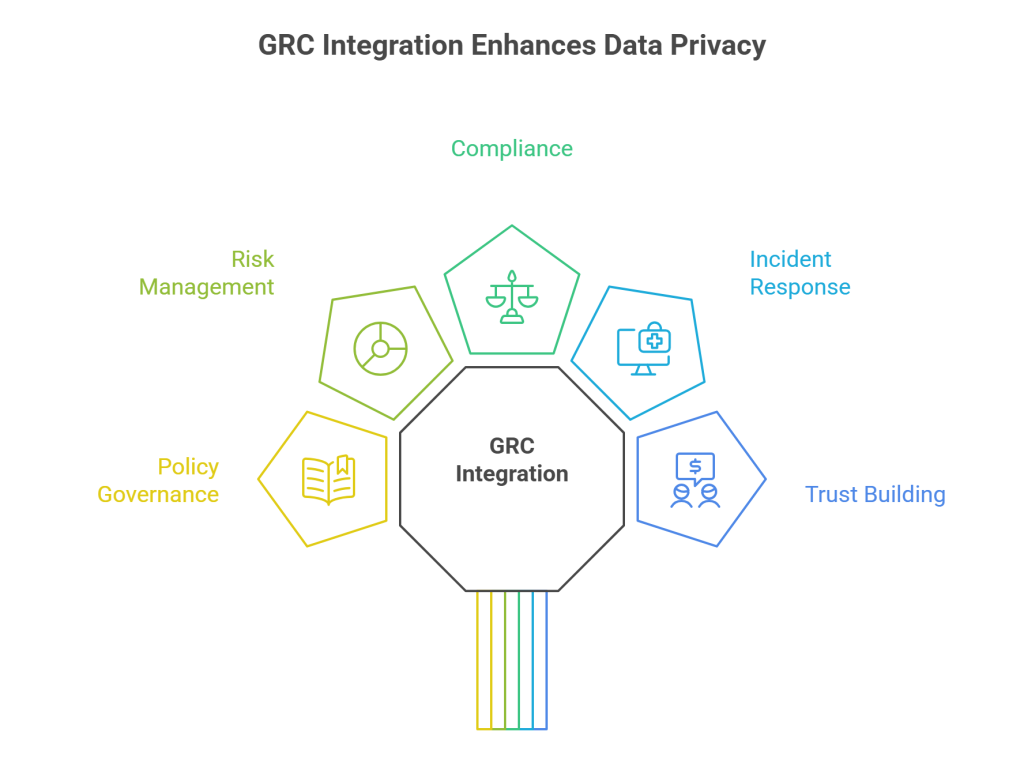
While compliances are strictly practiced, transparent reporting is also an important aspect. Integrating privacy metrics into governance reports allows experts to gain visibility into the organization’s privacy posture. When spotted, they can work on initiating remedies to address emerging risks.
Preparing Effective Response and Remediation Plans
When a data breach occurs, the way an organization responds can determine the scale of legal and reputational damage. You must proactively take quick action so that affected individuals and regulators are informed within the required timelines. Meanwhile, remedial steps should be taken to stop and mitigate the incident.
An effective GRC framework ensures this readiness through well-defined incident response plans. These typically include breach detection systems, clear communication strategies to manage reputational fallout, and post-breach audits to uncover root causes and strengthen defenses.
By enabling privacy incident management in GRC practices, organizations in India are aligning well with the regulatory obligations. This remedial action helps protect trust and reduce the long-term impact of a breach.
Building Trust Through Transparency
Businesses that aim to establish a strong foundation and a wealthy customer base must fulfil the promise to keep data secure. When privacy is one of your core objectives and your transparency towards the business subjects is treated as fundamental, then you are building a loyal customer base.
Best Practices to Design Retention and Erasure Policies Under DPDPA India
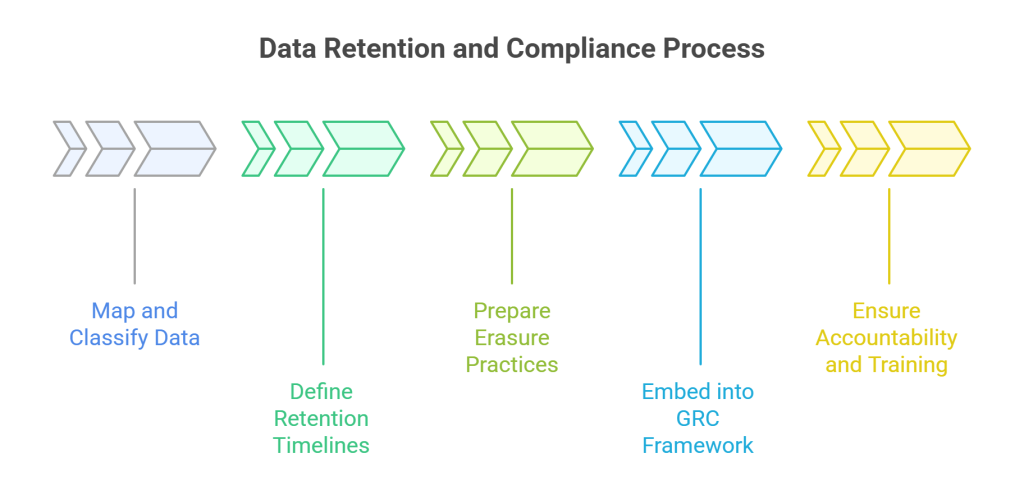
Map and Classify Data
First, you must have a chart of personal data you collect, where it resides, and the reason for collecting it. Distinguishing data based on each category, customer details, employee details, financial, and transactional status helps you define specific retention timelines.
Also Read : The Role of Data Protection Officers in SaaS Companies: A Mandate Under the DPDPA
Define Retention Timelines
Determine the usage and set clear rules for the duration of retaining different categories of data. Some type of customer data may be stored until service is provided. Financial records on the other side might be on hold for a longer period for tax compliance or audit purposes.
Prepare With Erasure Practices
DPDPA of India allows individuals to remove data from a service when they require. So, companies must create transparent processes to delete data securely when a request is made or its purpose is fulfilled.
Embed into GRC Framework
You must assign a well-trained data privacy committee to keep track of policies followed. Track compliance through periodic audits and automated GRC tools.
Ensure Accountability and Training
Policies are effective only if employees follow them. Preparing a skilled team with regular training and clear accountability structures to ensure that data is not retained unnecessarily or deleted incorrectly.
Aligning data retention and erasure requirements with GRC frameworks gives your India-based business multiple benefits, like winning stronger compliance with the DPDPA,
Risks of breaches and penalties are reduced, since unnecessary data is not stored beyond usage. Business operation also improves as GRC tools automate retention schedules and standardize erasure processes across departments.
Above all, there will be an increase in customer trust, as organizations demonstrate respect for individual privacy rights and transparency in data handling.Integrating GRC frameworks with DPDPA compliance strengthens the regulatory alignment of businesses in India. It also prepares organizations to adhere by the global standards including GDPR and other data privacy laws of different locations. When a business is ready to integrate regulatory framework in their processes it’s essential to take a data privacy consultation. You can hire experts from organization like Wattlecorp, so that you are prepared to meet the governance needs to build a future-oriented business.
DPDPA Compliance FAQs
1.Why are retention and erasure policies important under DPDPA India?
In every business, retention and erasure policies are enabled to store personal data only for a particular period as it is needed and delete it once the purpose is fulfilled. This helps organizations comply with DP regulations. It is also commonly known to reduce risks of breaches and avoids expenditure on unnecessary storage.
2.How is integrating GRC with data privacy benefiting business in India?
Implementing GRC in data privacy helps businesses automate compliance tracking, strengthen risk management, and maintain accountability. This integration greatly helps in reducing regulatory penalties resulting in building long-term customer trust.
3.What steps should companies follow to create effective retention and erasure policies?
Start the mapping of data. Then plan out retention timelines and set up secure erasure processes. These steps must be embedded into the GRC framework, and made effective by trained teams. Following these practices, run regular audits to check if your business complies with the regulatory norms.

 Virtual CISO Services for UAE Free Zone Startups: Affordable Security Leadership for Growing Companies
Key Takeaways: Most startups already hold sensitive data such as customer info, source code, financials, long before they feel big enough to take security seriously, and that’s exactly when the risk starts. A virtual CISO gets you someone who’s done this before, setting up strategy and guiding compliance, without the cost of putting a full-time […]
 SOC as a Service for Indian BFSI and FinTech Companies: 24/7 Monitoring for CERT-In Readiness
Key Takeaways: SOC as a Service for BFSI and FinTech India gives banks, NBFCs, insurers and digital lenders continuous security visibility without the cost and hiring effort of building an in-house operations centre. CERT-In directions require regulated entities to report qualifying cyber incidents within six hours of detection, and implementing SOC for BFSI and FinTech […]
 SOC as a Service in India: How It Works, Pricing, and Why Businesses Need It
Key Takeaways: SOC as a Service helps Indian businesses to get 24×7 security monitoring without huge cost and complexity of building a full in-house security operations center. A managed SOC check and analyse beyond basic log monitoring, which combining SIEM, threat intelligence, analyst-led alert triage, incident escalation, reporting, and security response support. SOC as a […]
 Mobile App Security Testing for Indian Digital Lending Apps RBI, DPDP and API Risk Checklist
Key Takeaways: Mobile app security testing forms an important part of meeting RBI cybersecurity expectations, secure application development practices, and periodic security assessment requirements for digital lending platforms. APIs in lending apps are constantly under attack. Broken object-level authorization, data leaking where it shouldn’t, weak token validation, and missing rate limiting, these aren’t edge cases, […]
 Cybersecurity Risk Assessment for Saudi Supply Chain Vendors Under Aramco and NCA Expectations
Key Takeaways: Cybersecurity risk assessment becomes a practical requirement for proving security maturity, with protecting vendor relationships, and moving forward in procurement processes with Aramco and critical infrastructure clients. Vendors will need to provide evidence of access review documentation, patch deployment, monitoring artifacts, technical assessment results and more that demonstrates the controls in place are […]
 Qatar Personal Data Privacy Compliance: Security Controls for Data Protection Readiness
Key Takeaways: Qatar’s Personal Data Privacy Protection Law applies to organizations that process personal data within its scope, including many businesses handling personal data of individuals in Qatar. Non-compliance isn’t just risky; it can result in hefty fines, operational chaos, and serious damage to your company’s reputation. Personal data privacy compliance Qatar isn’t just about […]