

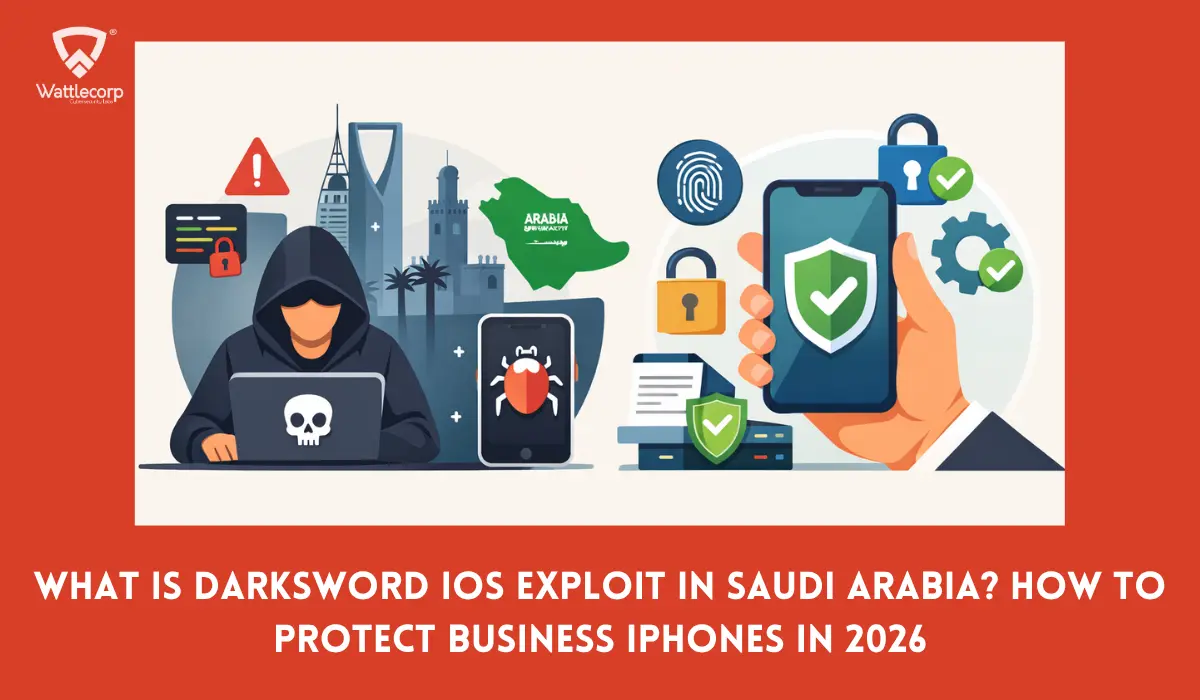
What is DarkSword iOS Exploit in Saudi Arabia? How to Protect Business iPhones in 2026
Key Takeaways:
- DarkSword is understood to be a browser-based iOS exploit chain that may be triggered when a user visits a compromised or attacker-controlled website.
- Advanced mobile exploitation has already affected users in the Gulf region, making Saudi Arabia a relevant threat environment.
- Even if Apple patches the underlying vulnerabilities, patching alone is not enough to secure enterprise mobile exposure.
- Saudi organisations should combine OS updates, MDM enforcement, Lockdown Mode, network controls, and mobile security testing.
- Mobile application VAPT helps validate what an attacker could access after a device compromise, including APIs, sessions, and business workflows.
Your Business iPhones Are Already a Target
Employees no longer need to click a phishing attachment for mobile compromise to become a serious business risk.
In modern attack scenarios, simply visiting a malicious or compromised website on Safari may be enough to trigger a browser-based exploit chain on an unpatched or weakly protected device.
If a corporate iPhone is compromised, the impact can extend far beyond the device itself. Attackers may attempt to access:
- Business email accounts
- SaaS sessions
- Financial workflows
- Corporate documents
- Mobile applications
- Authentication tokens and business data
For Saudi businesses, where iPhones are widely used by executives, finance teams, and decision-makers, this is no longer just a consumer-device issue. It is an enterprise attack surface problem.
What is the DarkSword iOS Exploit?
DarkSword is described in public threat reporting as a multi-stage iOS exploitation chain associated with advanced mobile attack activity in 2026. While exact campaign details may vary, the broader security concern is clear: attackers are increasingly targeting mobile devices through sophisticated browser, sandbox, and privilege-escalation techniques.
In practical terms, exploit chains like this are designed to move through multiple layers of device security in order to achieve deeper access.
A sophisticated iOS exploit chain may involve stages such as:
- Remote code execution through the browser or web content engine
- Escape from the browser sandbox into a more privileged execution context
- Privilege escalation to gain broader access to device functions or sensitive data
This is why advanced mobile threats are so dangerous: they are not limited to “malicious apps” alone. In some cases, web content itself can become the delivery mechanism.
Core Vulnerability Areas Commonly Seen in Advanced iOS Exploit Chains
While the exact vulnerabilities involved in a campaign should always be verified against trusted vendor advisories and threat intelligence, advanced iOS exploit chains commonly target areas such as:
- JavaScript or browser engine memory corruption
- JIT or web rendering weaknesses
- Sandbox escape mechanisms
- Security mitigation bypasses such as PAC-related techniques
- Kernel-level privilege escalation
For business leaders, the key takeaway is not memorising CVE numbers. It is understanding that a single browser session can become the starting point of a full enterprise security incident if controls are weak.
How the DarkSword Attack Works (Kill Chain)
Understanding the likely attack flow helps security teams reduce exposure more effectively.
DarkSword Kill Chain
A browser-based iOS exploit chain may typically work like this:
- User visits a compromised or attacker-controlled website
- Malicious content is loaded in the background
- The device is fingerprinted to identify iOS version, model, and attack suitability
- A browser exploit attempts code execution
- A sandbox escape is used to move into a more privileged context
- Privilege escalation or kernel-level exploitation is attempted to gain deeper control over the device
In successful cases, this process can happen very quickly, often before the user notices anything suspicious.
That is what makes advanced mobile exploitation especially dangerous for enterprise users.
Real DarkSword Attack Risk in Saudi Arabia
This is not a theoretical concern.
Public reporting has shown that advanced mobile exploitation activity has targeted users in the Gulf region using spoofed, compromised, or attacker-controlled websites designed to deliver malicious browser-based payloads. Saudi Arabia remains a particularly relevant target environment because of its strategic importance, enterprise digital adoption, and high-value executive user base.
That means Saudi organisations should treat advanced mobile compromise as a credible enterprise threat, especially where corporate iPhones are used to access:
- Email and internal messaging
- Financial platforms
- Government or regulated portals
- Cloud apps and dashboards
- Identity and SSO-protected business systems
The business risk is not only about the device. It is about everything that trusted device can reach.
Why Saudi Businesses Are High-Value Targets
1. High iPhone Usage in Enterprise Workflows
In many Saudi organisations, iPhones are used extensively by:
- Executives
- Finance teams
- Department heads
- Sales leadership
- Remote and travelling employees
These devices often hold or access sensitive business workflows, making them attractive to attackers.
2. PDPL and Data Protection Exposure
Under Saudi Arabia’s Personal Data Protection Law (PDPL), organisations are expected to protect personal data appropriately and respond responsibly to security incidents.
Also Read : Achieving PDPL Compliance in Saudi Arabia: Expert Tips for 2026
A compromised business iPhone can create downstream exposure involving:
- customer or employee personal data
- authentication sessions
- internal communications
- regulated business information
That means a mobile compromise can quickly evolve into a data protection and governance issue, not just a device issue.
3. Mobile Threats Are No Longer Limited to Nation-State Operators
One of the biggest risks with advanced exploit disclosure is that, over time, attack methods, reverse-engineered techniques, or exploit-chain components may become more widely understood across the threat landscape.
That does not mean every attacker suddenly gains full offensive capability overnight. But it does mean that enterprise mobile attack risk can spread beyond the most elite operators, especially after public disclosure or technical analysis emerges.
For Saudi businesses, that raises the urgency of hardening mobile devices before the next wave of attacks appears.
What Data Can Be Stolen?
If an attacker achieves high-privilege access on a business iPhone, the impact can be severe.
Depending on the level of access obtained, attackers may attempt to reach:
- Authentication tokens and session data
- Business email access
- Corporate documents and downloaded files
- Browser activity and web sessions
- Messaging or communication metadata
- Location-related information
- App data associated with business workflows
In enterprise environments, this kind of compromise is especially dangerous because the goal is often not just the phone itself, but access to the wider organisation through trusted mobile access.
Signs Your Business iPhone May Be Compromised
Advanced iOS compromise is often designed to be stealthy. In many cases, users may not notice anything obvious.
That said, organisations should investigate anomalies such as:
- Unusual or unexplained battery drain
- Unexpected background data activity
- Suspicious authentication events
- Unknown or unexplained browsing activity
- Unexpected device behaviour or overheating
- MDM compliance deviations or device posture anomalies
These are not definitive proof of compromise, but they are valid investigation triggers.
If compromise is suspected:
- Immediately isolate the device from business access
- Preserve forensic evidence where possible
- Avoid wiping the device before triage or analysis
- Review identity, SaaS, and email sessions linked to that device
The fastest mistake many teams make is wiping too early and losing the evidence needed to understand what happened.
How to Protect Business iPhones from DarkSword
1. Update to the Latest Apple Security Release Immediately
The first and most important step is to ensure all managed iPhones are running the latest Apple-supported security release.
This should not be left to users manually.
Saudi businesses should enforce patch compliance through MDM so that:
- outdated devices are identified quickly
- unsupported devices are blocked from sensitive apps
- patch gaps are visible to security teams
Patching is essential, but it should be enforced operationally, not assumed.
2. Enable Lockdown Mode for High-Risk Users
Apple’s Lockdown Mode is especially useful for users who may face elevated targeting risk, such as:
- Executives
- Finance leaders
- Privileged administrators
- Legal and compliance personnel
- High-visibility public-facing staff
Lockdown Mode helps reduce attack surface by restricting selected high-risk device capabilities and limiting exposure to sophisticated attack methods.
It is not necessary for every user, but for high-value business targets, it is a practical hardening control.
3. Deploy MDM With Strong Enforcement
A properly configured Mobile Device Management (MDM) program is one of the most important enterprise controls for iPhone security.
Saudi businesses should use MDM to enforce:
- minimum OS versions
- device compliance checks
- jailbreak detection where applicable
- application control policies
- corporate access restrictions for non-compliant devices
Without MDM, patching and policy enforcement often become inconsistent and difficult to scale.
4. Implement Network-Level Protection
Even though the exploit may begin on the device, network-layer controls still matter.
Recommended protections include:
- DNS filtering
- Secure web gateway or proxy enforcement
- Safe browsing policy controls
- Blocking access to known malicious domains
These controls do not eliminate advanced threats, but they can reduce exposure to attacker infrastructure and improve detection opportunities.
5. Reduce Unnecessary Application Exposure
The more software and permissions a device carries, the broader the attack surface becomes.
Saudi organisations should:
- remove unnecessary applications
- enforce approved app allow-listing where feasible
- review app permissions regularly
- restrict access to sensitive business data based on user role
This helps limit what an attacker can abuse if the device is compromised.
Why Patch Management Alone Is Not Enough
Patching the device is critical, but it does not answer the bigger business question:
What happens if the attacker gets in anyway?
A patched iPhone does not automatically validate:
- whether your mobile apps expose sensitive functions
- whether APIs can be abused using stolen sessions or tokens
- whether SaaS access can be hijacked
- whether business workflows can be manipulated post-compromise
- whether your identity and access controls can detect downstream abuse
In real-world incidents, attackers often try to move beyond the endpoint.
That is why Saudi organisations should not treat mobile security as just an OS update issue. It must be treated as part of the wider enterprise attack surface.
Why VAPT is Critical for Saudi Businesses
Vulnerability Assessment and Penetration Testing (VAPT) helps answer a far more useful question than “Is the device patched?”
It helps answer:
If a business iPhone is compromised, what else can the attacker reach?
A strong mobile-focused VAPT engagement can help test:
- Mobile app authentication and session security
- API exposure using stolen or replayed tokens
- Business logic abuse in mobile workflows
- Data exposure through app-to-API communication
- Weaknesses in access control and post-authenticated flows
- MDM and access enforcement effectiveness
Also Read : From Startups to Enterprises: Custom VAPT Strategies for Every Business In Saudi Arabia
This is especially important for Saudi organisations operating in:
- BFSI
- healthcare
- government-linked sectors
- eCommerce
- SaaS
- regulated enterprise environments
Because once mobile compromise becomes a gateway into business systems, the incident is no longer “just a phone problem.”
Saudi-Specific Compliance Alignment
For Saudi businesses, mobile security validation should also be mapped to broader governance and risk obligations.
This includes alignment with expectations and security maturity goals associated with:
- NCA ECC
- SAMA Cyber Security Framework
- PDPL-driven data protection responsibilities
These frameworks do not exist only for servers and laptops. Mobile endpoints must also be included in enterprise security and data protection thinking.
If corporate iPhones can access regulated or business-critical systems, they belong inside the organisation’s security assurance scope.
Cost vs Risk
The cost of mobile security validation is almost always lower than the cost of a serious mobile-led security incident.
A mobile security failure can trigger:
- credential theft
- internal access abuse
- business email compromise pathways
- data breach exposure
- compliance scrutiny
- reputational damage
- contract or client trust loss
The real comparison is not:
“How much does mobile testing cost?”
It is:
“How much could a compromised executive device cost the business?”
That is the more realistic risk conversation for Saudi enterprises in 2026.
Strengthen Your Mobile Security Posture with Wattlecorp
DarkSword is a reminder that mobile security can no longer be treated as a secondary control area.
The question is no longer:
Can a business iPhone be targeted?
It is:
If it is targeted, will your security controls hold up?
Wattlecorp helps Saudi businesses validate and strengthen mobile security through:
- Mobile application penetration testing
- API security testing
- MDM security assessments
- Mobile threat exposure validation
- Security testing aligned with Saudi enterprise and compliance expectations
If your organisation relies on iPhones for business access, financial workflows, executive communication, or regulated operations, mobile security should be tested as part of your wider enterprise security posture.
Book a consultation to assess your mobile security exposure before attackers do.
DarkSword iOS Exploit FAQs
1.What is the DarkSword iOS exploit in Saudi Arabia?
2.How can Saudi businesses protect iPhones from DarkSword?
3.Can DarkSword infect iPhones without downloading an app?
4.What are the risks of a DarkSword attack for Saudi companies?
5.Why is VAPT important after DarkSword disclosure?

 Qatar Cybersecurity Boardroom Accountability: Why QCB and NCSA Now Expect Executive Ownership
Key Takeaways: Cybersecurity in Qatar is increasingly becoming an executive governance responsibility, with national cybersecurity initiatives and sector-specific requirements encouraging organizations to establish stronger leadership oversight. QCB and NCSA play important roles in strengthening cybersecurity governance in Qatar, with QCB focusing on financial sector requirements and NCSA supporting national-level cybersecurity coordination and guidance. Executives can’t […]
 Data Privacy Consulting for Saudi Enterprises: How to Operationalize PDPL Data Subject Rights in 2026
Key Takeaways: The Saudi data protection law may apply to organizations outside the Kingdom when they process personal data related to individuals in Saudi Arabia, meaning geographic location alone does not automatically exclude an organization from PDPL obligations. PDPL data subject rights span access, correction, deletion, and consent withdrawal, and enterprises are on the hook […]
 Third-Party Vendor Security Risk Assessment Under DPDP: A Guide for Indian Enterprises
Key Takeaways: Third-party vendor risk assessment with DPDP practices helps Indian enterprises to verify that external partners handle personal data with adequate safeguards. The Digital Personal Data Protection Act holds data fiduciaries accountable for vendor conduct, which makes due diligence a legal and operational necessity. A structured vendor security questionnaire, covering encryption, access control, and […]
 Virtual CISO Services for UAE Free Zone Startups: Affordable Security Leadership for Growing Companies
Key Takeaways: Most startups already hold sensitive data such as customer info, source code, financials, long before they feel big enough to take security seriously, and that’s exactly when the risk starts. A virtual CISO gets you someone who’s done this before, setting up strategy and guiding compliance, without the cost of putting a full-time […]
 SOC as a Service for Indian BFSI and FinTech Companies: 24/7 Monitoring for CERT-In Readiness
Key Takeaways: SOC as a Service for BFSI and FinTech India gives banks, NBFCs, insurers and digital lenders continuous security visibility without the cost and hiring effort of building an in-house operations centre. CERT-In directions require regulated entities to report qualifying cyber incidents within six hours of detection, and implementing SOC for BFSI and FinTech […]
 SOC as a Service in India: How It Works, Pricing, and Why Businesses Need It
Key Takeaways: SOC as a Service helps Indian businesses to get 24×7 security monitoring without huge cost and complexity of building a full in-house security operations center. A managed SOC check and analyse beyond basic log monitoring, which combining SIEM, threat intelligence, analyst-led alert triage, incident escalation, reporting, and security response support. SOC as a […]