

Key Takeaways:
- Saudi businesses should maintain consistent adherence to PDPL policies for winning and retaining trust among relevant stakeholders, i.e, customers, investors, and strategic partners.
- Noncompliance with Saudi Arabia’s PDPL imposes harsh penalties, such as heavy fines, financial losses, and reputational damage.
- Appointing data controllers, data processors, and DPOs is pivotal to overseeing data processing activities.
- Adherence to data protection policies shifts the scene from PDPL compliance being a mandatory regulatory requirement to a long-term trust-building strategy.
- VAPT Integration helps organizations become audit-ready and improve overall resilience by identifying privacy-impacting vulnerabilities.
Why PDPL matters in Saudi Arabia?
Saudi Arabia, abundant with cybersecurity laws like NCA and SAMA has ultimately introduced Personal Data Protection Law (PDPL) to secure its citizen’s personal data.
Felt critically important to safeguard its citizens’ personal data, PDPL, however, adds another layer of rigidity to the already complex regulatory landscape in the Kingdom.
As stringent are PDPL’s compliance requirements, equally harsh are its penalties if businesses processing personal data fail to comply there.
Non-compliance committed knowingly or unknowingly attracts significant breaches and all the more, imposes penalties, amounting to SAR 5,000,000, quoted by credible sources in Saudi Arabia.
With all these in view, let’s find out how your data processing activities in Saudi Arabia can effectively align with it’s PDPL compliance requirements.
The Evolution of the Legal Framework and Implementation Timeline for Saudi’s PDPL
Having evolved from its actual issuance in 2021 by the Royal Decree M/19, PDPL in Saudi Arabia has evolved to the extent of becoming a fully enforceable legal framework on September 14, 2024.
The introduction of the PDPL reflects Saudi Arabia’s commitment to safeguarding personal data for its citizens in a responsible manner.
The first-ever regulatory standard with a global recognition, the PDPL is guided and supported by the SDAIA-issued implementation regulations.
The Saudi Data & AI Authority (SDAIA) is designated as the competent supervisory authority overseeing PDPL compliance and registration of controllers.
The SDAIA also entrusts PDPL with ascertaining whether or not the nationwide policy of protecting personal data aligns effectively with global data privacy standards like GDPR.

Specific to the PDPL mandates are:
- Cross-border data transfers
- Data breach notification
- Data subject rights
- Consent management
All these vital requirements come under Vision 2030’s broader legal framework tied to the country’s cybersecurity and data governance policies.
How PDPL Applies to Local and Foreign Businesses in Saudi Arabia
PDPL in Saudi Arabia applies to both local and foreign business entities collecting, processing, and storing its citizens and residents’ sensitive personal data.
Since PDPL holds a broad extraterritorial scope, every business processing Saudi citizens’ personal data outside the country should strictly comply with this law.
Needless to state that the Personal Data Protection Law largely applies to local businesses operating within the public and private sectors of the Kingdom.
Also Read : The Role of Data Protection Officers (DPOs) Under Saudi Arabia’s PDPL
Every individual residing in Saudi Arabia, including the expatriates and visitors, can now exercise their data subject rights under PDPL. This helps them ensure their personal data remains protected in all stages of the processing.
For local businesses handling Saudi citizens’ data, they should appoint an individual or unit that meticulously monitors these processes to ensure PDPL compliance.
Requirements for Foreign Entities Processing Saudi Arabia’s Personal Data
Foreign companies processing personal data should have a local representative looking over the key aspects of PDPL, Saudi Arabia obligations. Appointing one residing in Saudi is the prime requisite here.
As a business in Saudi Arabia and handling cross-border data transfers predisposes you to comply with SDAIA. However, you need not coordinate or seek approval from the latter for all types of data you overboard or upload, And though this entails you to go over a multi-step compliance process, you need to only contact SDAIA for specific requirements that involves:
- The nature of the data, critical or otherwise
- The destination country
- The safeguards employed during data transfer
There should also be proper risk assessments that support the aforementioned requirements.
What are the Core Principles and Lawful Bases of Processing Personal Data in Saudi Arabia?
PDPL in Saudi Arabia necessitates businesses to follow specific principles when processing personal data. This regulatory entity also considers applying relevant lawful bases in this regard.
Core Principles of Data Processing
- Transparency, Lawfulness, and Fairness: Every personal data processed should strictly abide by the existing and evolving laws of a region or country. Data subjects should also be informed why their data is collected, how these are processed, and where they are stored.
- Data Minimization: Collecting and processing personal data in minimal quantity, but that helps meet the purpose.
- Purpose Limitation: Data collected should be strictly for explicit, specific, and legitimate purposes mentioned. This means no personal intention should be entertained.
- Integrity and Confidentiality: Signifies implementing the proper technical and organizational measures for protecting data from unauthorized access or processing, destruction, etc.
- Accountability: Signifies responsibility in terms of demonstrating compliance with the applicable laws of data collection and processing, here Saudi-based PDPL.

Lawful Bases
- Consent: PDPL, Saudi Arabia makes it highly crucial to obtain consent from data subjects before processing their data. Standards for obtaining consent can be higher to explicit based on data sensitivity.
- Contractual Necessity: Processing personal data becomes crucial to fulfil a contractual agreement between two parties. Maintaining data limit to minimum is crucial in this regard.The objective is to avoid ‘just in case’ collection of unnecessary information as mentioned under the core principle of “data minimization’.
- Legal Obligation: When processing data becomes a legal necessity, data controllers should collect personal data without seeking user consent.
- Vital Interests: The PDPL mandate mentions the criticality of processing personal data to protect the vital interests, life, and/or health of a data subject’s or another natural person’s life. This does not require seeking explicit consent.
- Legitimate Interests: Under PDPL, Saudi Arabia considers legitimate interests as a valid legal basis to process personal data. Controllers should administer technical measures like anonymization or pseudonymization. This lawful basis shouldn’t interfere (overlap) with data subjects’ vital interests and should exempt sensitive personal data.
What are the Rights of Data Subjects under Saudi’s PDPL
Saudi’s PDPL grants specific rights to data subjects. Here’s a table that lists and explains what they mean and how organizations or data controllers should treat them:
| Data Subject Rights | Description | What Should Data Processors/Controllers Do |
| Data Processing | Should be duly informed about why and how their personal data is getting processed, and shared. | Provide clarity on privacy notices, disclose purpose and legal basis, offer information about data recipients, and inform data subjects when undertaking cross-border data transfers. |
| Data Correction and Deletion: | Users can correct or delete their data once they’ve been granted permission. | Maintain and uphold the required mechanisms to quickly verify and correct requested data; update systems and records accordingly. |
| Data Restriction | Can eventually withdraw their consent to process, collect, or store data. | Limit data processing to what has been consented. Should convey the legitimate purpose of data collection whatsoever. |
| Right To Access | Users can request access to their data and details related to processing of the same. | Organizations or data controllers handling personal data should provide that in a clear and readable format, responding to the request within the required time. In case of refusal of the request, should offer legal reasons. |
| Right to Withdraw Consent | Data subjects can revoke their consent at any time. | Should immediately stop processing data upon consent being revoked. Processors and controllers to ensure systems track and update (enforce) consent withdrawal. |
| Right to Compensation | Individuals can seek compensation in case of infringement of Saudi Arabia’s PDPL. | Ensure strict compliance to avoid penalties and undertake lawful processing of personal data, maintaining evidence of the latter. |
What are the Obligations of Controllers & Processors under PDPL, Saudi Arabia?
PDPL in Saudi Arabia mandates lawful and fair processing of personal data. Processing should also consider a valid legal basis when explicitly handling sensitive data.
Both data controllers and data processors have specific obligations to fulfil in this regard.
Obligations of Data Processors
- Data processors should only process data under explicit documented instructions from the data controller.
- Should be responsible enough to maintain strict confidentiality of personal data.
- When protecting data, should implement strong and effective security measures.
- Be thorough of and comply with the contractual clauses and the PDPL rules when undertaking data transfers outside Saudi Arabia.
- Should assist the data controllers in meeting the latter’s obligations. These may include cooperating with the data protection authorities, and more. importantly, responding to the rights requests of the data subjects.
- Assist in notifying the concerned authorities and the data subjects when a breach incident occurs.
- Should have a written agreement from the data controller outlining a data processor’s respective responsibilities. This will also cover the right to audit for the data processor.

Obligations of Data Controllers
- Collect and process data in all fairness, transparency and lawfulness.
- Gather only minimum data as required for a specific purpose.
- Utilize data for legitimate reasons only while obtaining consent for them from the users.
- Enable data subjects to use their rights, specifically, right to access, correction, and data erasure.
- Appoint Data Protection Officers (DPOs) if need be for overseeing procedures related to data processing and for point-in-time contact.
- Implement the right technical and organizational measures for safeguarding users’ data from unauthorized access and potential breaches.
- Undertake DPIAs (Data Protection Impact Assessments) for data processing activities that are considered highly risky.
- Maintain a well-written record of the processing activities (ROPA) for a specific period.
8. Cross-Border Transfer Rules Under PDPL, Saudi Arabia
PDPL in Saudi Arabia enforces stringent cross-border transfer rules. These are restricted to the recipient countries that possess adequate data protection standards.
Refer below for the specific cross-border data transfer clauses for processing Saudi citizens’ data.
- Implement approved safeguards like Standard Contractual Clauses (SCCs) and Binding
- Corporate Rules (BCRs)
- Undergo Transfer Risk Assessment (TRA) to ensure no harm to the Kingdom’s national security and vital interests.

Once again, it is the SDAIA that oversees these regulations.
Key Requirements for Cross-Border Data Transfers
- Data transfers should align with a permitted purpose and limit to processing minimum data.
- Critical sectors like BFSI should carry a ‘no-objection letter’ issued by the Saudi Central Bank.
- Foreign businesses should keep themselves updated of the guidelines and approved jurisdictions of SDAIA.
Exceptional Cases For Cross-Border Data Transfers
- For protecting the life or health of the data subjects or heeding to the public interest.
- To perform obligations based on international agreement.
- Transfers for scientific research to be allowed under SCC usage or through an approval certificate.
Breach Notification & Penalties Under PDPL, Saudi Arabia
Breach Notification
Under Saudi’s PDPL, reportable breaches should be notified to the SDAIA within 72 hours. Data controllers hold prime responsibilities in this regard.
Also Read : Navigating Saudi Arabia’s Personal Data Protection Law (PDPL ): Key Compliance Requirements for Businesses
Individuals (data subjects affected should also be duly informed with no undue delay.
Non-Compliance Penalties
These are classified as criminal penalties, administrative fines, and increased penalties.
- Criminal Penalties: Includes unauthorized disclosure of sensitive data. Penalties range from two years imprisonment with a fine up to SAR 3 million. Cross-border transfers conducted illegally impose imprisonment for 1 year and a fine of SAR 1 million.
- Administrative Fines: General data violations can invite penalties up to SAR 5 million.
- Increased Penalties: Fines can go up twice the amount for repeated offences despite warnings.

What are the Technical and Organizational Measures under PDPL in Saudi Arabia?
As a comprehensive data protection law, the PDPL in Saudi Arabia requires businesses to implement robust technical and organizational measures to protect personal data all through its lifecycle.
Key Technical Measures
- Implement strong access control measures
- Encrypt data, during rest and in transit
- Conduct ongoing security assessments
- Develop a comprehensive breach response plan
Essential Organizational Measures
- Acquire informed and explicit consent from data subjects, maintaining transparency by offering clear privacy notices.
- Collect and process data in only the minimal amount necessary for the purpose mentioned.
- Establish clear procedures to handle the explicit rights of individuals (access, correction, and deletion).
- Appoint DPOs to oversee data processing activities by undertaking DPIAs.
How VAPT Services Help Achieve PDPL Compliance for Saudi Businesses?
VAPT’s (Vulnerability Assessment and Penetration Testing) services have emerged as ground-breaking techniques to both achieve and maintain compliance with PDPL in Saudi Arabia.
- Vulnerability Identification and Fixation: A proactive vulnerability assessment and penetration testing helps identify and address security vulnerabilities before hackers get there and exploit.
- Meet Specific PDPL Requirements: Meet Specific PDPL Requirements: Helps meet critical PDPL expectations, such as data security and upholding data subject rights by notifying breach incidents.
- Reducing Risks and Disruption: Helps organizations prevent data breaches, system downtime, and financial losses through proactive threat identification and mitigation.
- Data Security: A systematic combo of vulnerability assessment and penetration testing through attack simulation helps identify and remediate security weaknesses. This is followed by implementing necessary controls to secure sensitive data.
- Risk Management: Clearly presents an organization’s security risks by prioritizing remediation effort based on the severity of the vulnerabilities identified.
- Breach Detection: Regular attack simulations through VAPT helps organizations reduce their time to detect and contain riskier breaches. This is per the Saudi’s PDPL mandates to report them within 72 hours to the SDAIA and affected individuals.
- Third-Party Vendor Management: VAPT helps evaluate, test, and confirm whether the security systems and infrastructure of the third-party vendors are robust when undertaking data processing tasks.
- Cross-Border Data Transfer Security: Helps test and validate that the data transfer mechanisms’ and the receiving environment’s security posture are adequate enough. VAPT-assigned security controls for the receiving organizations in the foreign land should, however, comply with the laws and specific security requirements there.
- Documentation and Accountability: Provides documented evidence for commitment to conducting robust security testing and resolution of potential security vulnerabilities. This is duly presented to the regulatory bodies for auditing purposes.
- Continuous Assessment and improvement: VAPT assessments offer ongoing assessment for facilitating continuous improvement in security and infrastructure by regularly updating data privacy policies. This also includes offering ongoing training on best practices to employees.

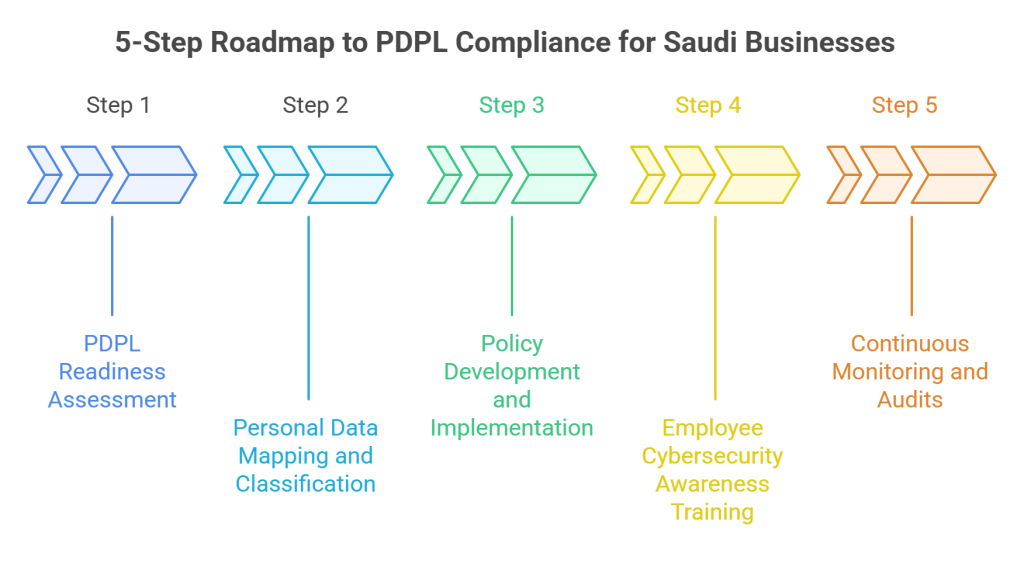
A 5-Step Roadmap to Achieving PDPL Compliance for Saudi Businesses
For Saudi businesses to achieve compliance, this necessitates following a step-by-step process.
Stage 1: PDPL Readiness Assessment
Meeting and maintaining PDPL compliance in Saudi Arabia involves understanding and identifying gaps in current data protection practices against those set by the law.
These issues are usually found within consent management, data processing, third-party sharing, etc.
Step 2: Personal Data Mapping and Classification
Contains knowledge of where data stays, where it’s transferred to, and who can access it.
Involves creating a data inventory to provide a detailed view of the data collected, stored, and processed.
This stage also carries information on:
- The purpose for which and to whom personal data is shared
- Categorical description of data subjects, i.e., employees, customers, business clients, etc
- Expected data retention period
Step 3: Developing and Implementing Data Protection Policies
PDPL, Saudi Arabia requires planning, developing, and drafting clear policies, enforcing them through training and regular updates.
Should consider core legal components like consent management, breach notification, data subject rights, and cross-border data transfers.
Also Read : Recent Amendments to Saudi Arabia’s PDPL: What Businesses Need to Know
These policies should be well documented for audit purposes as well.
Necessary procedures include:
- Conducting a data inventory and risk assessment
- Identifying applicable laws
- Defining the scope and objective of the policy
- Implementing technical and security controls
- Data breach response plan
Step 4: Educate Employee on Cybersecurity Awareness
The road to achieving compliance starts with the employees. This rule applies to every data protection law and policies, including PDPL in Saudi Arabia.
To foster cybersecurity awareness in staff, follow the steps below:
- Conduct regular training on phishing
- Educate on maintaining adequate password hygiene
- Conduct focused sessions on PDPL, Saudi Arabia
Team members should obtain a clear picture of their respective roles in meeting compliance requirements with the concerned law.
Regular training sessions should instill the need to ensure strict data protection and meeting privacy obligations in your staff in a responsible manner.
Step 5: Perform Continuous Monitoring and Audits
Your efforts to achieve compliance with PDPL, Saudi Arabia do not end with drafting and implementing the concerned policies.
Regularly undertaking security audits is critical to ensure continuous compliance.
Keeping abreast of updated privacy policies and accordingly conducting security assessments equally matter.
The intent is to enhance cyberdefence and resilience for your organization against evolving regulatory expectations and emerging threats.
Saudi Arabia’s rapidly digitalizing environment needs more than understanding and aligning with the PDPL compliance requirement.
When it concerns the Kingdom’s Vision 2030 objectives, PDPL compliance measures should be treated as a strategic step towards building trust and strengthening cybersecurity posture for its businesses.
With data breaches increasing in sophistication, these demand organizations to adopt a more proactive, yet continuous approach to safeguarding Saudi citizens’ personal data.
This calls for implementing strong technical and organizational safeguards to attain and maintain a robust cybersecurity posture while staying updated on Saudi’s PDPL compliance policies.
Here’s where a Saudi Arabian business entity like you should consider integrating VAPT.
An advanced cybersecurity approach, VAPT not only protects your sensitive systems, infrastructure, and data, but also performs simulations to ensure you stay guarded against cyber threats on a real-time basis.
This is where Wattlecorp’s VAPT expertise stands out. But when asked why you should trust us, it is our expert-led VAPT methodology that helps you feel confident and audit-ready. You strengthen your security posture by ensuring stronger governance.
All these don’t end here. While assessing privacy-impacting risks for your systems, network, and infrastructure, we make sure our remediation strategies align with the PDPL compliance requirements in the Kingdom.
You ultimately get to earn the trust from your stakeholders, clients, and partners and this helps you achieve sustainable competitive advantage.
Willing to strengthen your PDPL compliance posture? Visit our Personal Data Protection Law in Saudi Arabia service page for more information.
Maintaining ongoing security through VAPT is the first step to achieving sustainable compliance.
Strengthen your cyberdefence. Book a PDPL compliance assessment today!
PDPL Saudi Arabia FAQs
1.What is the scope of the PDPL in Saudi Arabia?
Under PDPL, Saudi Arabia enlists every public and private sector business processing its citizens’ personal data to comply with the law. PDPL in Saudi Arabia also applies to foreign businesses that process personal data for individuals residing in the Kingdom.
All commercial, non-commercial, and government entities are also meant to comply with the law.
The PDPL exempts personal data processing for personal usage, but applies to the data of deceased persons for identification purposes.
2.What are the lawful bases for processing personal data under PDPL?
PDPL in the Kingdom considers the following as its lawful bases:
● Contractual necessity: Fulfilling contractual obligations.
● Explicit consent: For processing personal data.
● Legal necessity: Data processed on legal grounds.
● Public interest: Data processing felt necessary by public entities.
● Vital interests: Protecting life or health of individuals.
● Legitimate interests: Under genuine interests and necessity of the third party or controller.
3.What are the obligations for cross-border data transfers under PDPL?
PDPL in Saudi Arabia enforces specific cross-border data transfer obligations, such as:
● Obtaining regulatory approval from the SDAIA (Saudi Data and Artificial Intelligence Authority).
● Determining that the recipient country has adequate data protection regulations.
● Implementation of SCCs (Standard Contractual Clauses) or BCRs (Binding Corporate Roles).
● Mandatory risk assessments felt necessary for large-scale continuous data transfers.
4.What penalties and enforcement powers does SDAIA hold under PDPL?
Failing to comply with PDPL (intentionally or unintentionally) carries high risks for harsh penalties. These can range from imprisonment and fines up to SAR 5 million. Reputational damage and financial losses are some of the other worst penalties that an organization in Saudi can incur.
SDAIA exercises enforce powers that include:
● Corrective actions: Issuing orders to stop processing activities for non-compliance.
● Inspection and audits: Monitoring compliance through audits and inspecting data processing activities.
● Information requests: Requesting necessary information and documents to ensure PDPL compliance.
● Processing complaints: Taking action against violation of data subjects’ rights.
● Tools specification: Assigning appropriate tools and mechanisms to monitor compliance.
5.How can organizations prepare for PDPL compliance (steps, best practices)?
PDPL in Saudi Arabia specifies essential steps to meet its compliance requirements.
● data auditing and mapping
● Establishing legal basis to process and manage consent
● Developing and implementing clear policies and procedures
● Administering robust technical and organizational measures
● Appointing DPOs (Data Protection Officer)